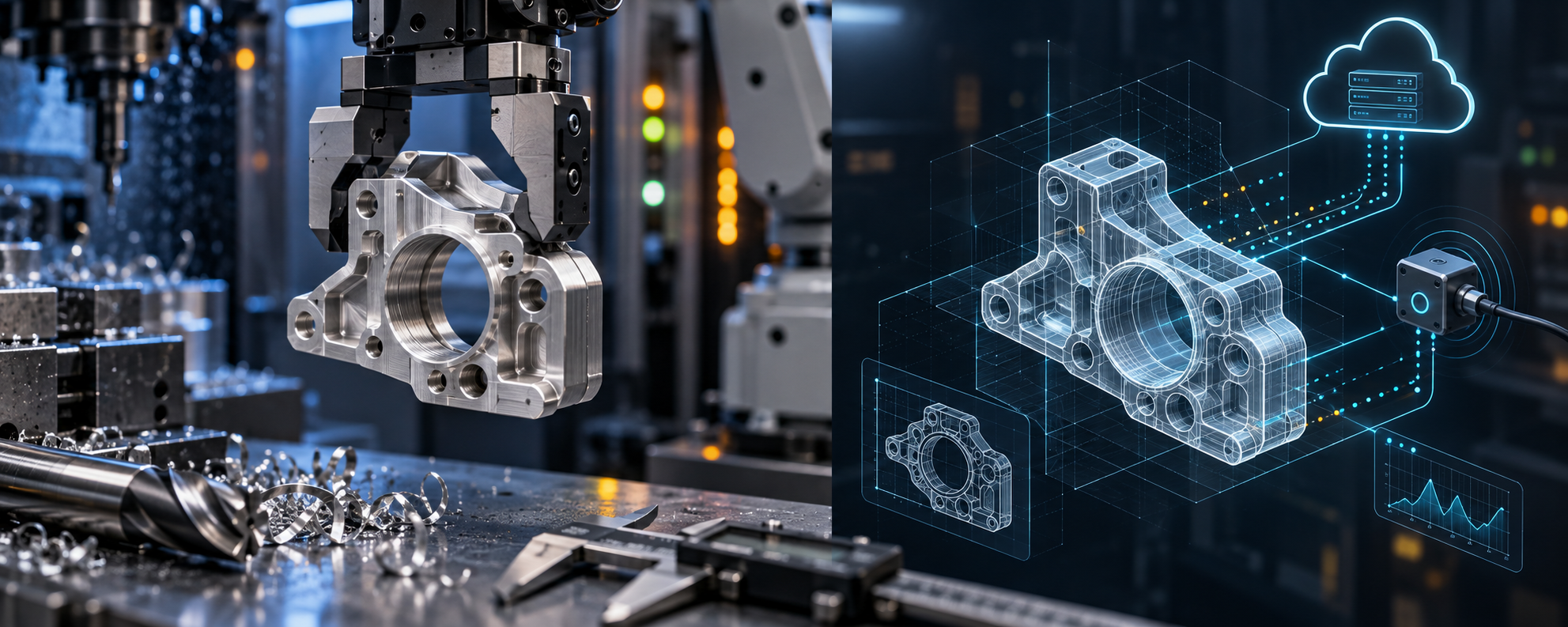
Surging Demand and Supply Bottlenecks: The Core Contradiction in Automated Precision Component Manufacturing in 2026
Let's look at two sets of numbers first, which almost define all the tension in automated precision component manufacturing in 2026. One set comes from market size: the global precision machining market will be approximately 124.4 billion USD in 2026 and is expected to approach 244.6 billion USD by 2035, with a compound annual growth rate of approximately 7.8%, of which the Asia-Pacific region accounts for approximately 49% of global demand. The other set comes from the supply side: for key transmission components such as planetary roller screws, Japanese and European companies together hold approximately 70% of the global share.
Put the two sets of numbers together, and the contradiction emerges. Demand is expanding rapidly in Asia-Pacific, in robots, in semiconductor equipment, and in low-altitude aircraft; yet the production capacity capable of stably delivering high-precision core components remains concentrated in the hands of a few regions and a few suppliers. The pace of capacity expansion among humanoid robot body manufacturers is clearly faster than the yield ramp-up speed for precision reducers, screws, and sensors. The result is lengthened delivery cycles and persistently high costs, and procurement must begin considering at the drawing stage whether "this part can be obtained in 2026."
This mismatch is not a short-term fluctuation, but the starting point for automated precision component manufacturing entering its next stage. It forces the manufacturing side to answer four questions: Can the production line be more automated and rely less on the eyes of veteran workers? Can the process be fully validated before going onto the machine tool? Can key components have a second and third source? Can order taking and production scheduling be coordinated across factories? These four questions correspond to the four major trends most worthy of attention in 2026.
Why "Yield Rate" Is More of a Bottleneck Than "Production Capacity"
Expanding capacity by buying equipment is relatively fast, but pushing yield from 70% to 95% is very slow. The yield rate of precision components is jointly affected by material batches, heat treatment deformation, grinding burns, clamping repeat positioning, and gauge measurement uncertainty. If any link is not locked down, the resulting parts will waver at the edge of the tolerance band. What downstream body manufacturers want is batch-to-batch consistency, not single-piece compliance. Therefore, competition in 2026 appears on the surface to be about production capacity, but at the underlying level it is about process stability—and this is precisely the problem domain that the four major trends below aim to solve.
The next four sections will break down in turn: how AI-driven automation shifts from "optional" to "mandatory," how digital twins and virtual validation become standard, how supply chain regionalization and domestic substitution accelerate, and how platform-based and intelligent ecosystems take shape. Each section first defines the trend, then provides data, and finally returns to the specific impact on precision component manufacturing—precision, lead times, and cost structure.
Trend One: AI-Driven Automation Shifts from "Optional" to "Mandatory"
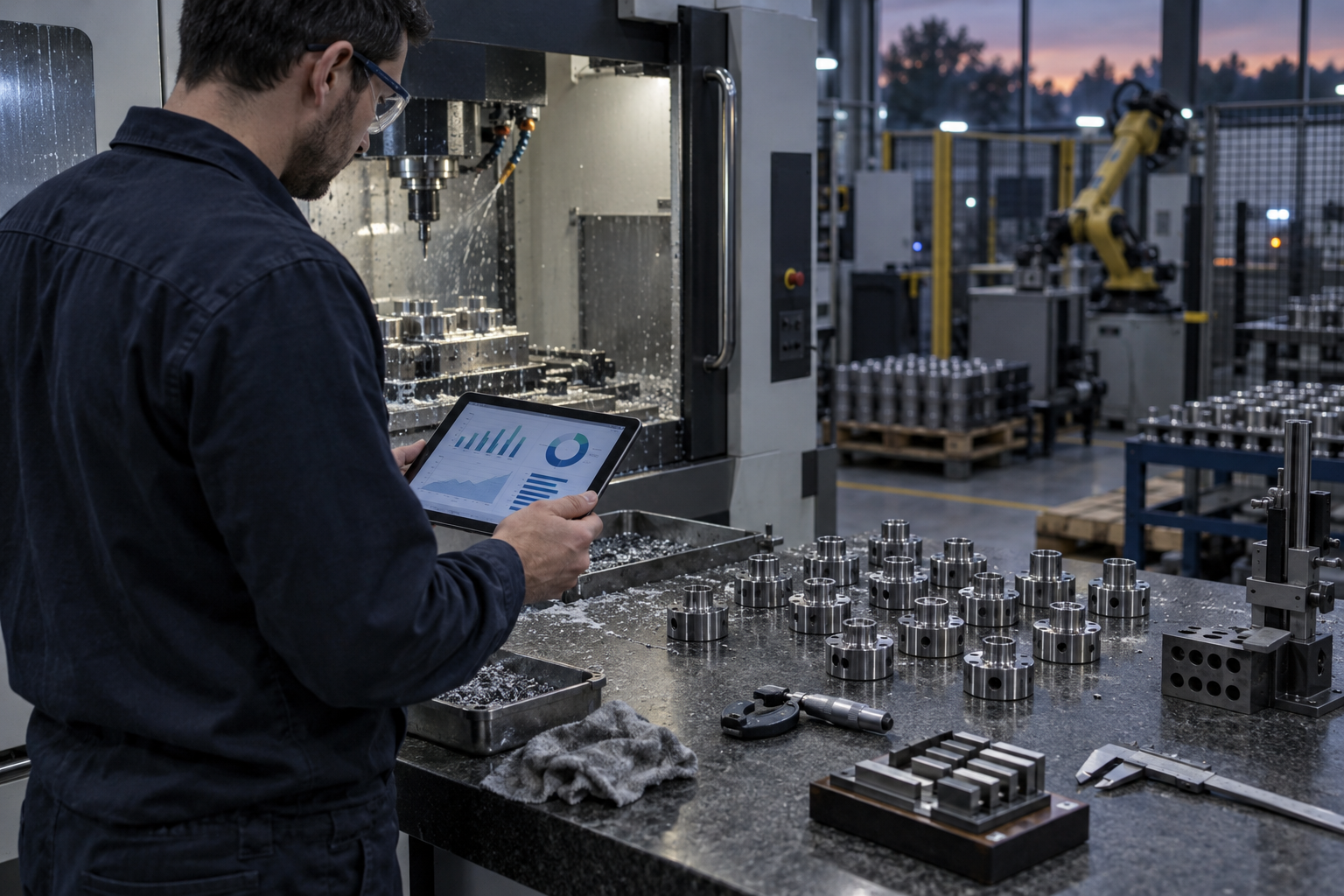
If AI adoption in machining shops before 2024 was a "trial sample," then the reality in 2026 is this: it has already entered production schedules, tool ledgers, and shift handover records. Industry surveys put the figure at roughly 69% of machining facilities having integrated AI-driven automation (Source: Business Research Insights precision machining market report); just two years ago, that share was only a handful of early adopters running experiments. The trend read is straightforward—the competitive threshold for automated precision component manufacturing is shifting from "do you have five-axis" to "can your data loop actually run."
"AI-driven" here does not mean swapping in robots. It is more about three specific actions: predictive maintenance, AI-assisted programming, and adaptive machining parameters. Industry materials show that predictive maintenance can reduce unplanned downtime by up to about 25%, and AI-assisted programming can cut the cycle from drawing to G-code for some parts by up to about 50% (Source: TiRapid CNC industry guide; these are typical industry magnitudes, and actual gains vary with part complexity). For precision components, a 4-hour stoppage is not just lost capacity—re-stabilizing spindle thermal state, re-inspecting the first article, and re-touching off tools often cost more than the downtime itself.
Closed-loop control pushes precision from "by feel" to "by feedback"
When precision component manufacturing talks about precision, it cannot avoid tolerance bands and repeatability. Closed-loop CNC machines commonly seen in the industry have repeatability on the order of ±2–5 microns (TiRapid); once on-machine measurement and tool wear compensation are layered on, operators shift from "leaving stock by experience" to "changing tool offsets based on feedback." This is not mysticism—it turns the three old problems of thermal deformation, tool wear, and micro-displacement during clamping into observable variables. To judge whether a factory has truly entered the AI automation stage, one detail is enough: are its tool offset records handwritten by people, or automatically issued by the system based on the number of parts machined?
Equipment utilization: where does the gap between 40–50% and 85–90% come from?
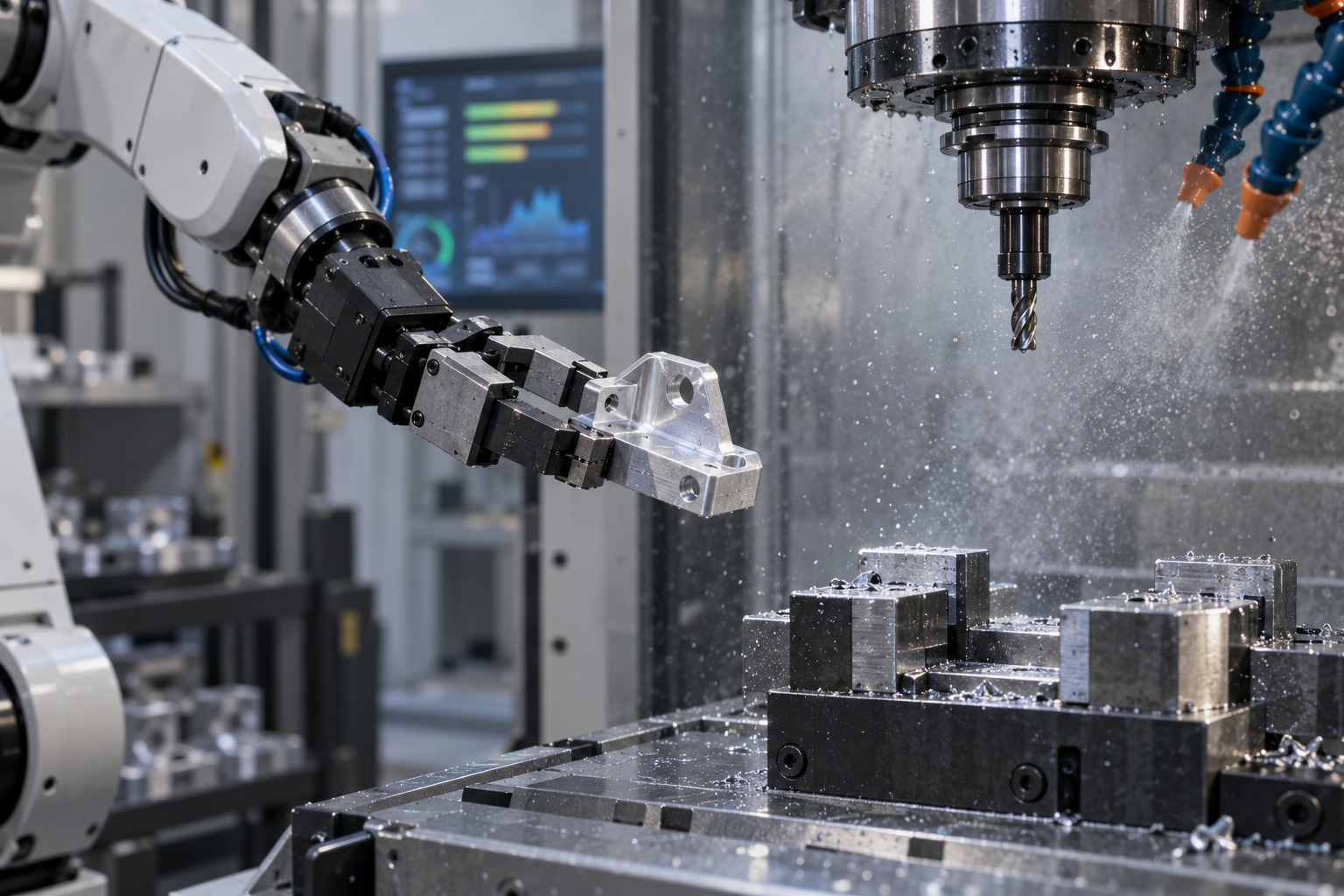
One frequently cited comparison is this: equipment utilization with manual loading/unloading and manual scheduling often sits at 40–50%; fully automated robotic cells can raise it to above 85–90% (TiRapid). The gap is not just "the machine never stops," but three things being handled in parallel—robotic loading/unloading shortens clamping gaps, AI scheduling batches orders with similar processes, and tool life prediction avoids mid-run tool-change stoppages.
But we should also pour a bucket of cold water. There is a physical ceiling to utilization gains: cutting time itself does not get shorter because of automation. Roughing allowance, material removal rate, and the linear speed a tool can withstand are limited by the match between tool and material; AI cannot change that. So for precision components, the first benefit of AI automation is not "faster machining," but more stable yield, faster changeovers, and less dependence on labor. Consistency across a batch often determines delivery reputation more than the extreme precision of a single part.
When it comes down to procurement and engineering decisions in 2026, one verifiable action is this: take stock of which of your existing parts are the high-mix, low-volume, tight-tolerance type. These parts are best suited to starting with AI scheduling and tool life management, because they suffer the greatest changeover losses and rely most heavily on experience. As for whether to go all the way to a fully automated cell in one step, that comes back to return on investment—whether the marginal gains from higher equipment utilization can cover the investment in robots, on-machine measurement, and data systems. There is no universal answer to this question; it needs to be calculated on a specific product line.
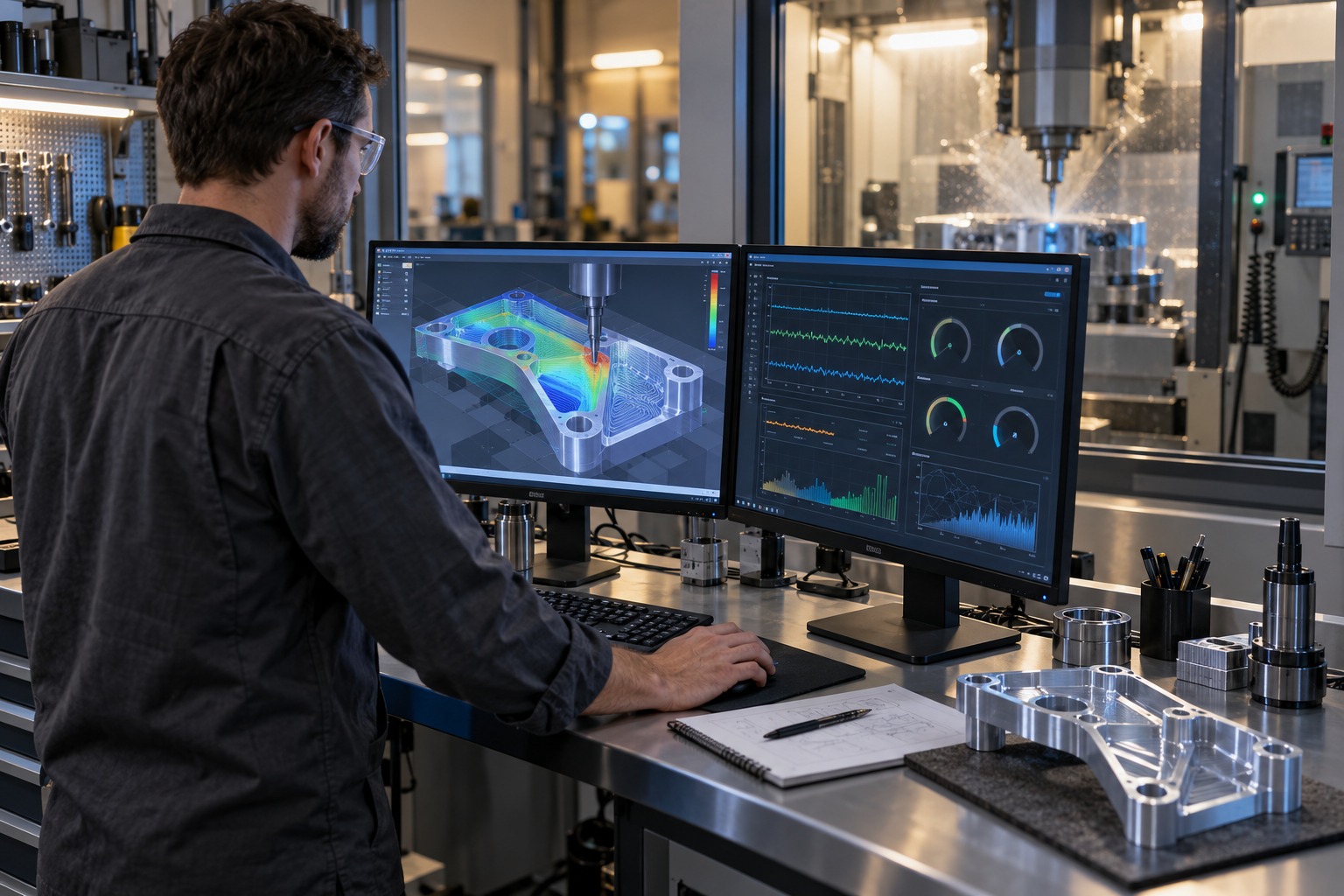
Trend 2: Digital twins and virtual validation become standard in precision manufacturing
Why thin-wall and deep-cavity parts benefit first
The payoff: first-article pass rate, debugging cost, and DFM feedback speed
Trend 3: Accelerating supply chain regionalization and domestic substitution
Setting the first two trends aside, let's look at a set of numbers first. The Asia-Pacific region accounts for about 49% of global precision machining demand, but in the global market for core transmission components such as planetary roller screws, Japanese and European companies together hold about 70% of the share. The center of demand is in East Asia, while the high end of supply is in Japan and Europe—this is the underlying driving force behind the acceleration of regionalization and domestic substitution in the precision component supply chain in 2026. It is not driven by policy slogans, but by the combined effect of policy, cost, and lead time pressures acting simultaneously.
Let's start with lead time pressure. In 2026, downstream humanoid robot OEMs are expanding production capacity faster than upstream core components such as precision reducers, screws, and sensors can improve yield. Once imported parts encounter tight production scheduling, the uncertainty in lead times will directly transmit to the OEM's production planning. For automated precision component manufacturing, lead time is not just a date table; it determines whether the OEM dares to expand production according to orders. The shift of second sourcing from "alternative" to "mandatory" is the most direct engineering signal of this round of supply chain restructuring.
Domestic substitution is not about changing suppliers, it is about changing a process validation system
Many procurement professionals, when first encountering domestic substitution, understand it as a commercial issue: find a factory that can do it, send over the drawings, compare prices and lead times. But what truly holds back substitution progress has never been "whether there is a factory that can do it," but "whether the batch consistency of what is produced can be validated." Take planetary roller screws as an example. Their precision life depends on material purity, heat treatment curves, grinding wheel dressing strategies for thread grinding, and the measurement uncertainty of gauges—if any one of these four things is not properly established, a single sample may pass, but batch delivery will fail.
Therefore, the real path for domestic substitution is usually: first benchmark materials and heat treatment, then close the loop on grinding process parameters, and finally establish gauges and acceptance standards equivalent to imported parts. A common industry practice is to first conduct small-batch installation validation at a non-critical station, run enough hours, and then expand the scope of substitution. This cycle cannot be compressed into a few weeks. Anyone who promises "rapid substitution" is skipping the validation step.
Which components will be domestically substituted first, and which still have to wait
The difficulty of substitution is not uniform. For parts such as sensor housings, structural brackets, connectors, and some linear guides, which rely less on materials and heat treatment and have medium-level precision thresholds, regional supply already has realistic conditions in 2026. The capacity and precision capabilities of CNC machining and sheet metal fabrication in these categories are not scarce in China.
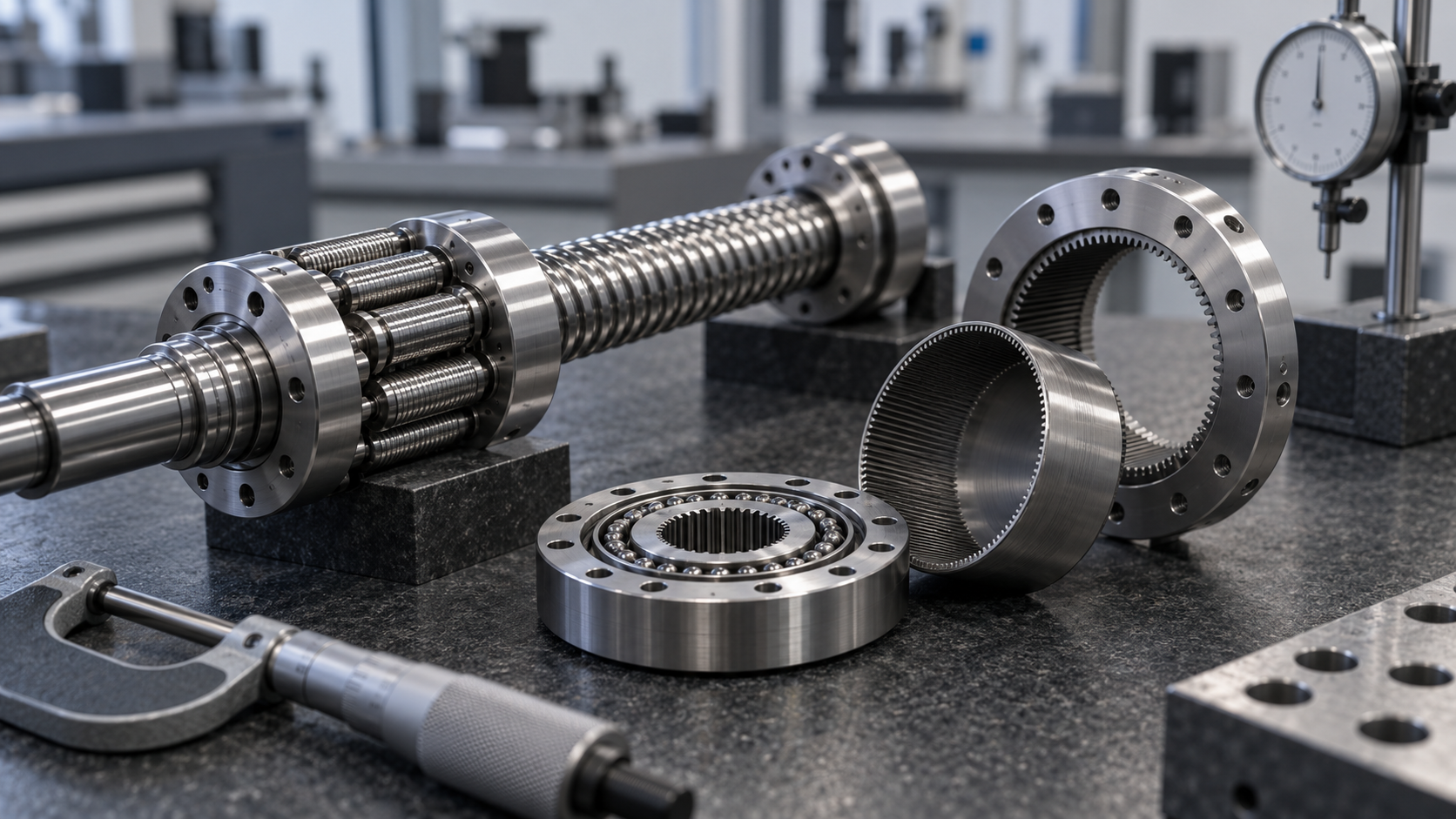
What truly still needs time are those parts where "precision is written into the material": high-precision reducer flexsplines, planetary roller screws, high-load bearings, and precision harmonic gears. Their bottleneck is not the machine tool itself, but the long-term accumulation of data on material batch stability, heat treatment deformation control, and grinding processes. In other words, the progress bar of substitution depends on the speed at which process knowledge accumulates, not the speed of equipment procurement.
The specific impact of regional layout on precision component manufacturing
First, second sourcing is shifting from an emergency plan to a standard configuration. OEMs will tend to deploy at least two interchangeable precision component suppliers within the same region, using the same set of drawings and the same set of gauge standards for acceptance, to reduce the risk of supply interruption from a single source.
Second, incoming material inspection standards will become stricter. When suppliers switch from imports to regional supply, OEMs will use more intensive sampling inspections and longer installation validation cycles to hedge against uncertainty. For precision component manufacturers, this means: gauge capability, batch traceability, and completeness of material certificates are changing from bonus points to entry tickets.
Third, regional capacity layout will be closer to OEMs. Variables that were previously ignored, such as transportation time, customs clearance cycles, and communication costs, are rising in weight for lead-time-sensitive high-end automation components. Manufacturing nodes within a region that can simultaneously cover CNC machining, sheet metal, rapid prototyping, and handboard duplication will have more obvious advantages in the transition stage from prototyping to small-batch production.
It should be noted that a common misjudgment often appears in discussions of domestic substitution: equating "can machine" with "can substitute." Being able to machine is only entry. Stable substitution requires a sufficiently wide process window, sufficiently strong inspection methods, and sufficiently long batch data. For readers, to judge whether a certain part is suitable for initiating regional substitution, you can first ask three questions: Is the precision written in the drawing tolerance band, or in the material and heat treatment? Are there ready-made gauges that can measure key dimensions and geometric tolerances? How many hours can small-batch installation validation run? The answers to these three questions explain the realistic pace of substitution better than any market forecast.
Trend 4: The formation of a platform-based, agile, and intelligent ecosystem
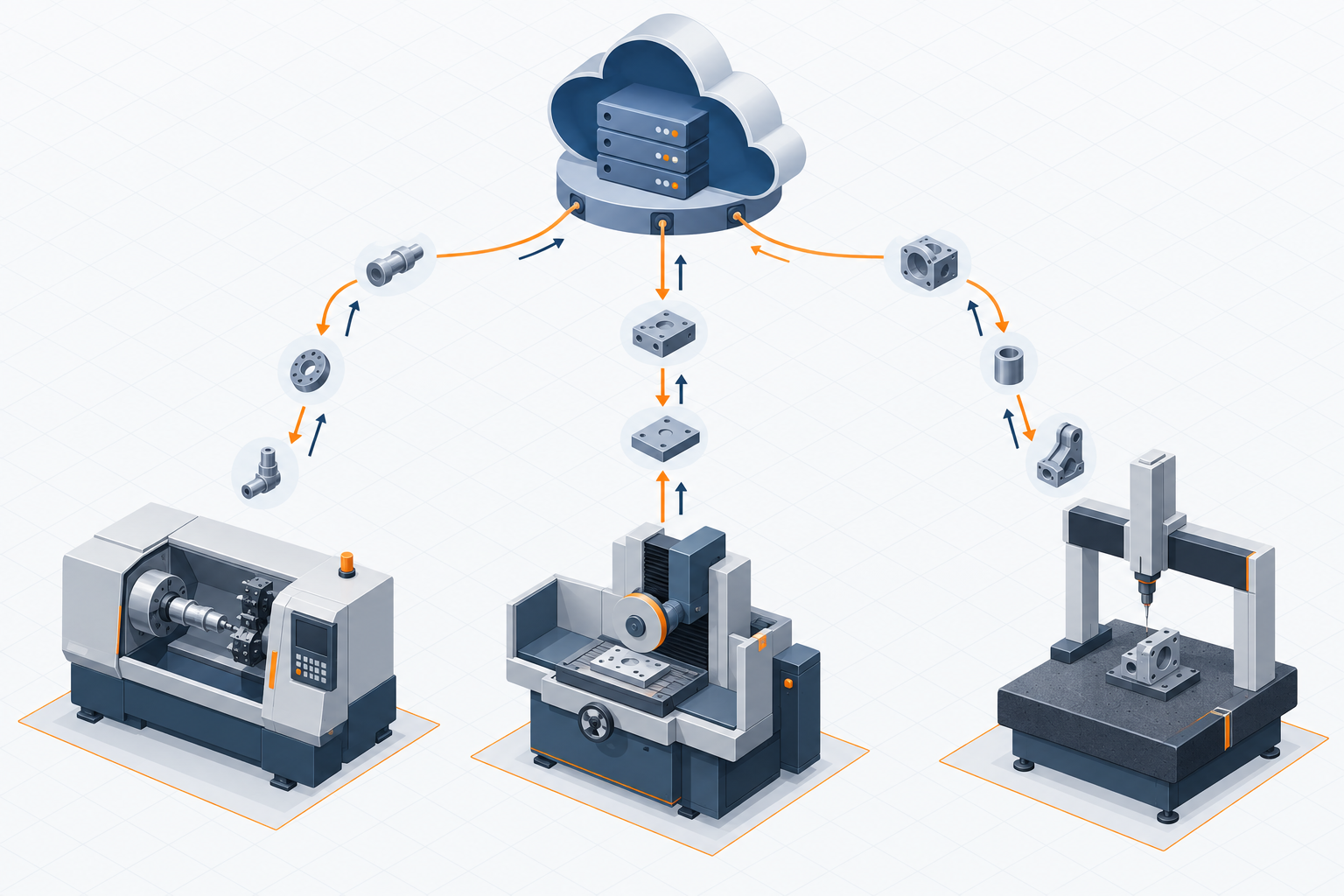
The first three trends discussed single-factory capabilities: AI makes machines better at judgment, digital twins let processes run once in virtual space first, and regionalization shortens the supply radius. The fourth trend changes scale—it does not change the precision of a certain machine tool, but changes how orders come in, how capacity is scheduled, and who owns process knowledge. In McKinsey's "Fusing Ecosystems, Embracing Intelligence: 2030 China Smart Manufacturing and Automation Industry Outlook," this line is broken down into three words: platform-based, agile, and intelligent. In the context of automated precision component manufacturing in 2026, these three words correspond to three specific questions: how to schedule capacity across factories, how to quickly change lines for small batches and multiple varieties, and how process parameters converge on their own.
Platformization: Capacity Scheduling and Process Knowledge Reuse
A single factory's capacity has a physical ceiling. A five-axis machine tool only has so many spindle hours in a day, and once it's fully booked, it can't take on more. The first thing platformization solves is breaking demand down into schedulable process tasks and then distributing them to different nodes: some factories are good at turning slender shafts, some are more stable at grinding flatness, and some only do surface treatment. The value of the industrial internet platform here is not a "connected dashboard," but rather structuring process capabilities—materials, achievable tolerance bands, maximum workpiece dimensions, available heat treatment and inspection methods—into searchable, matchable fields. When a customer submits a drawing, the platform matches nodes by field, rather than relying on sales to call one by one asking about scheduling.
The second thing is more subtle: process knowledge reuse. For the same thin-walled aluminum part, Factory A went through three rounds of fixturing to suppress deformation. When Factory B receives a similar part, can it directly obtain the set of experience covering "fixturing method + cutting parameters + support structure"? Before platformization, this kind of knowledge was locked in the personal experience of veteran masters, and when they left, it was lost. Platformization turns it into searchable process card templates, so new orders first match historically similar parts and then fine-tune. This is also why virtualized PLCs and industrial large models are repeatedly mentioned—they make historical data callable, rather than just sitting on a server.
Agility: The Line-Change Logic of Small Batches and High Variety
The order structure of precision component manufacturing is changing. The iteration pace of downstream robotics, semiconductor equipment, and medical instruments is accelerating, and single-batch quantities have dropped from several thousand pieces to several dozen or even just a few, but tolerance bands have not been relaxed. What agility must answer is: can line-change time be compressed to a magnitude that matches the batch size. A common industry approach is modular fixtures and zero-point positioning systems, compressing "re-alignment" from hours to minutes; tool presetting is completed offline to reduce spindle downtime; programs are templated, so new parts only require changing geometric parameters without changing the process skeleton. Individually, none of these methods is new; only when combined do they count as agility.
Agility also has an easily overlooked prerequisite: quoting and process review must be fast. If it takes two days to do a DFM assessment before accepting an order, agility breaks down at the door. This is also why cloud platform order intake and AI-assisted quoting have been pushed to the forefront—moving manufacturability judgment forward into the inquiry stage, so engineers only handle parts that are truly ambiguous.
Intelligence: Self-Optimization of Process Parameters and Quality Prediction
Platformization and agility solve "can it be taken on and can it be changed quickly," while intelligence solves "can it be produced stably." In automated precision component manufacturing, the landing points of intelligence are very specific: signals such as cutting force, vibration, spindle current, and temperature are collected in real time, and the model determines whether the current parameters have deviated from the stable range; if so, it fine-tunes the feed or speed. Quality prediction is the other side—detecting early signs of dimensional drift from machining signals in advance, rather than only learning about out-of-tolerance after the CMM measurement report comes out.
The boundary needs to be made clear: the effectiveness of intelligence depends on data quality. If the signal sampling frequency is insufficient, labels are inaccurate, and operating conditions are not fully covered, then the "predictions" given by the model are not credible. Therefore, the more realistic form in 2026 is human-machine collaboration—the model gives suggestions, engineers confirm, the system executes, and the results flow back for retraining. Expecting fully automatic, unattended handling of precision parts is still not viable for most materials and structures.
Three Specific Impacts on Precision Component Manufacturing
- Order intake model: from the serial process of "sales quoting—engineer review—production scheduling" to the platform first performing capability matching and preliminary quoting, with engineers focusing on abnormal parts. Orders with small batches and high variety are easier to take on.
- Pricing logic: the cost structure shifts from labor-intensive to equipment- and data-intensive. Early-stage investment in platforms, fixture modularization, and data collection is high, while marginal costs are low, so unit prices are more sensitive to batch size and more friendly to small batches.
- Engineer role: repetitive parameter trial cutting and scheduling communication are absorbed by the system, and engineers spend more time on process solution design, fixturing concepts, and inspection gauge and measurement strategies. People who can write process cards become more valuable instead.
To put it plainly: this trend is not "factories becoming software companies," but rather using data to connect dispersed capacity, experience, and judgment. For buyers, it means getting manufacturability feedback earlier; for processors, it means no longer relying on a single workshop to fill orders. To determine which parts in your product line will benefit first, you can start with three signals: "is the batch size declining, is line changing frequent, and is the tolerance band tightening." If you want to first see which process path your parts fall into, you can compare against the manufacturing capabilities overview, or go directly to AI conversational quoting for an initial manufacturability assessment.
The Specific Impact of the Four Major Trends on Precision, Lead Time, and Cost Structure
Precision: shifting from "relying on experience" to "relying on data," but measurement uncertainty remains the ceiling
Lead time: what gets shortened is scheduling and logistics, not cutting time
Cost structure: shifting from labor-intensive to equipment- and data-intensive
Frequently asked questions: follow-up questions about 2026 trends in automated precision component manufacturing
The following questions are the ones readers ask most often after the trend analysis in the previous four sections. The answers are kept as close as possible to engineering boundaries, without promising lead times or prices.
After AI-driven automation becomes widespread, will precision component manufacturing still need so many process engineers?
The demand structure will change, but the total volume may not decrease. AI-assisted programming, tool life prediction, and scheduling optimization replace repetitive calculations and empirical trial and error, but fixturing scheme design, tolerance band allocation, gauge definition, and root-cause analysis of anomalies still depend on people. The roughly 69% of facilities integrating AI automation mentioned in the article refers to tool penetration, not the disappearance of jobs. The more realistic change is this: engineers shift from "calculating parameters" to "setting rules, reviewing anomalies, and managing data quality."
Is digital twin realistic for small and medium-sized precision machining shops?
It depends on the level. Line-level digital twins require large investment, and for small and medium-sized shops it is usually more realistic to start with single-process simulation: first run tool paths, cutting parameters, and thin-wall part deformation through a virtual environment, then put them on the machine. The roughly 46% adoption rate mentioned in the article is an overall industry figure and does not mean every company has achieved the same depth. The criterion is simple—whether virtual verification can reliably reduce trial cuts and improve first-article pass rates. If it can, it is worth doing.
What is the biggest engineering obstacle to domestic substitution?
It is not "whether it can be made," but batch consistency. Take planetary roller screws as an example: Japanese and European companies together hold about 70% share, and the barrier lies in long-term accumulation in materials, heat treatment, grinding processes, and gauges. Meeting spec for a single piece is relatively easy; staying stably within the tolerance band across consecutive batches is difficult. The substitution path usually requires supporting incoming material inspection standards, second-source verification, and small-batch trial production. The cycle is measured in quarters, and success or failure should not be judged by a single prototype run.
Which component categories will these four trends change first?
The first to be affected are categories with medium batch sizes, high precision requirements, and heavy reliance on manual labor: robot joint reducers and lead screws, sensor structural parts, precision structural parts for semiconductor equipment, and new energy electric drive housings and connectors. These categories simultaneously have two characteristics: high automation returns and strong demand for domestic substitution. Conversely, single-piece, oversized, or extreme-material parts will still be dominated by process experience in the short term.
Once the trends take hold, how will the quoting logic for precision components change?
It will gradually shift from "estimating by labor hours" to "estimating by data": once equipment utilization, yield, changeover frequency, and inspection costs are quantified, quotes will be closer to the real cost structure. The fully automated cell utilization mentioned in the article rising from 40–50% to 85–90% is precisely the basis for this logic. But for a specific part, you still have to go back to the drawing, material, tolerance band, and gauges to calculate. Any price given by a platform is only a starting point, not a commitment.
Conclusion: The trends are not predictions, but engineering choices that have already happened
Key takeaways
- The core contradiction in precision component manufacturing in 2026 is the mismatch between surging demand and supply bottlenecks: downstream robot body production capacity is expanding rapidly, while yield rates and production capacity for core components such as precision reducers, screws, and sensors are constrained.
- AI-driven automation has shifted from optional to mandatory, with approximately 69% of machining facilities in the industry having integrated AI automation; predictive maintenance can reduce downtime by up to approximately 25%, but data collection and process knowledge accumulation must be addressed first.
- Digital twins and virtual validation have become standard in precision manufacturing, with approximately 46% adoption in the industry; simulation can reduce trial cutting time by approximately 40% and increase tool utilization by more than 20%, provided that model calibration is accurate.
- Supply chain regionalization and domestic substitution are accelerating: Asia-Pacific accounts for approximately 49% of global precision machining demand, but high-end components such as planetary roller screws are still dominated by Japanese and European companies with approximately 70% share.
- Platform-based, agile, and intelligent ecosystems are taking shape: leading enterprises are using cloud platforms, virtualized PLCs, and industrial large models to bring highly AI-empowered production environments into specific processes.