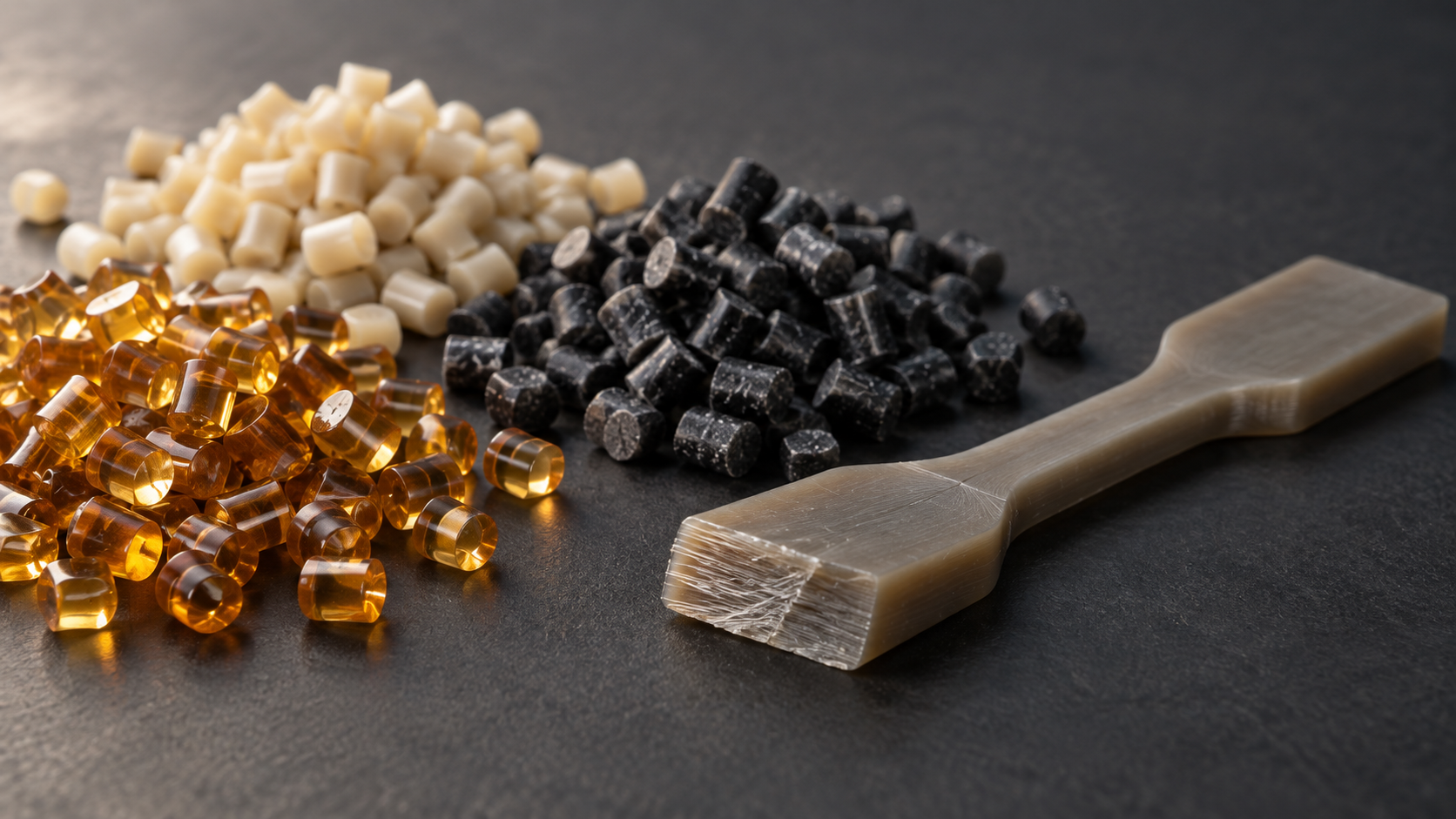
Don't Rush to Rank: Material Price Is Only a Small Slice of Cost
The most common action in procurement is to turn the "world's most expensive injection molding plastics" into a ranked list: PEEK, PEI, PPSU, PPS, LCP, PFA in order, then pick the one with the lowest unit price to negotiate. This approach works fine for most conventional parts, but it has a failure boundary — when the part is thin-walled, has a long flow path, high filler content, or must withstand long-term high temperature and chemical exposure, the lowest unit price option often ends up with the highest total cost.
The reason is no mystery. Material price is only one segment of cost; the rest hides elsewhere: the higher the melt temperature, the greater the energy consumption of the mold temperature controller and barrel; hygroscopic materials require hours of drying, and inadequate drying causes silver streaks; abrasive and corrosive materials eat away screws and check rings; once the scrap rate climbs from single digits to double digits, the material savings are wiped out in a few days; shortened mold life means amortization is brought forward; and high-cost materials usually require denser inspection, where gauges and labor hours also cost money. If any one of these items goes out of control, the ranking table becomes invalid.
A Rough Weighting Illustration (for judgment only, not a quotation)
The table below is only meant to help you prioritize in your head; it is not a quotation basis for any supplier. Actual proportions vary drastically with batch size, part weight, structure, and grade, and must be confirmed item by item with engineering and suppliers when not specified on the drawing.
| Cost Item | Typical Share Perception for Conventional Parts | How It Changes for High-Cost Material Parts |
|---|---|---|
| Raw Material Unit Price | Medium to High | Rises significantly, but often not the largest item |
| Usage Volume and Runner Regrind | Controllable | If runner material cannot be reused, losses amplify directly |
| Drying and Mold Temperature Energy Consumption | Low | Rises noticeably; drying time is often measured in hours |
| Scrap Rate and Setup Losses | Low to Medium | Very prone to climbing; this is the true hidden major cost |
| Mold and Screw Wear | Stable amortization | Corrosive and abrasive materials shorten life and force early replacement |
| Inspection and Acceptance | Mainly sampling | Often requires tightening; birefringence, heat resistance, and chemical resistance may all need testing |
Looking at this table together with the ranking table changes the conclusion: whether it is expensive does not depend on the material price column, but on which link in the chain of "material price × usage volume + energy consumption + scrap + mold amortization + inspection" breaks first. The rest of this article follows this line of thinking; the focus is not on ranking the top ten, but on identifying the boundaries where the ranking logic directly fails, and how to choose when it does.
The Real Barrier for High-Cost Materials: Not Price, but Equipment and Mold Compatibility
Listing materials like PEEK, PEI, PPSU, LCP, and PFA in a price table lets procurement rank them, but the shop floor still can't schedule production. The reason is straightforward: the unit price of these materials is just the ticket in. What really determines whether they can be processed and whether the parts come out qualified are four thresholds—melt temperature and mold temperature, drying and moisture absorption, screw/runner wear and corrosion, mold steel and venting. If any one of these doesn't match, the scrap rate will eat up the material price difference first. Below we break it down by "conventional rules—failure boundaries—detection signals—safer choices." The values are common industry references; the specific grade TDS and on-site mold trials shall prevail.
Threshold one: melt temperature and mold temperature—it's not "as long as it melts"
Conventional rules: set barrel temperature to the median in the TDS, and push mold temperature toward the upper limit. Failure boundaries appear when thin-wall, long-flow-path parts and high mold temperature requirements exist at the same time—PEEK-type materials commonly have a melt temperature in the 360–400 °C range, and mold temperature often needs to be 150–200 °C to fill and control crystallinity; if the mold temperature controller capacity is insufficient, the melt front freezes prematurely, and short shots and insufficient weld line strength appear simultaneously. Detection signals: short shot positions are fixed, a dull sound when tapping at weld lines, and dimensions drifting with batches. Safer choice: first confirm whether the mold temperature controller specifications and mold cooling channel layout support this window; otherwise switch to a grade with better flow or change the gate position, rather than forcing up the melt temperature.
Threshold two: drying and moisture absorption—silver streaks are the cheapest alarm
Conventional rules: follow the TDS drying curve. Failure boundaries are most obvious on moisture-sensitive materials such as PA, PES, and PEI: insufficient drying causes melt hydrolysis, resulting in silver streaks, bubbles, and reduced mechanical properties; over-drying or hopper moisture regain causes the same problems. Detection signals: visible silver streaks in transparent parts; in non-transparent parts, surface haze spots and low impact strength. Safer choice: use a hopper dryer with dew point monitoring, and perform a moisture check before startup; for small-batch trial production, it's better to dry one extra round than to judge by "it looks dry."
Threshold three: screw and runner—wear and corrosion are hidden costs
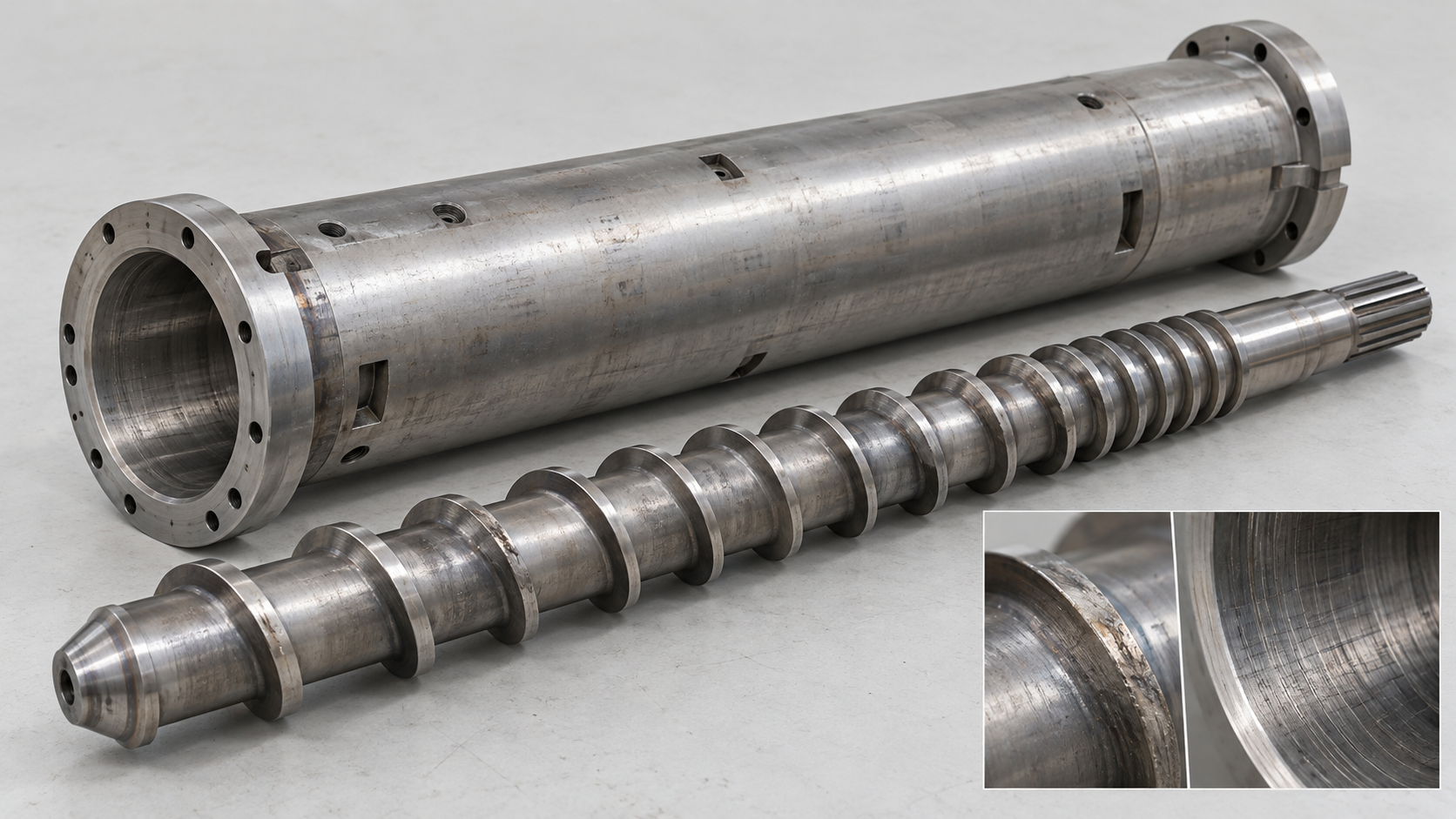
Conventional rules: a standard screw can be used universally. Failure boundaries are on glass fiber/carbon fiber reinforced PPS, PAI, and LCP: fibers abrade the screw and non-return ring, and fluorine-containing materials such as PFA and PVDF release corrosive gases at high temperatures, significantly shortening the life of ordinary nitrided steel screws. Detection signals: black spots, burnt material, unstable metering, and part weight fluctuation. Safer choice: confirm whether the injection molding machine screw is a wear-resistant/corrosion-resistant configuration and whether the runner and hot nozzle materials match; if it's only small-batch trial production, evaluate whether using a dedicated machine or switching to CNC/3D printing is more cost-effective.
Threshold four: mold steel and venting—poor venting is more common than steel grade
Conventional rules: select mold steel according to batch size. Failure boundaries are on high-temperature materials: high mold surface temperature, and when vent groove design is insufficient, gas burns and yellowing at the end of fill occur; corrosive materials also attack ordinary mold steel. Detection signals: burning at fixed positions, material shortage at the end, and early corrosion on the mold surface. Safer choice: for high-temperature material molds, prioritize vent groove distribution and steel corrosion resistance, and use inserts when necessary to reduce replacement costs.
| Material category | Typical processing window (reference) | Common failures | Alternative criteria |
|---|---|---|---|
| PEEK / PEKK | Melt approx. 360–400 °C, mold temp approx. 150–200 °C | Short shots, weak weld lines, dimensional drift due to uneven crystallinity | When mold temperature controller and cooling channels don't support it, switch to a grade with better flow or change the gate |
| PEI / PES | Melt approx. 340–390 °C, requires sufficient drying | Silver streaks, bubbles, reduced impact strength | When drying and dew point are uncontrollable, solve drying first before discussing material changes |
| PPS (fiber reinforced) | Melt approx. 300–340 °C, mold temp approx. 130–150 °C | Black spots, warpage, insufficient weld line strength | When screw wear-resistant configuration is insufficient, evaluate changing the machine or modifying the structure |
| LCP | Melt approx. 280–340 °C, good flow but strong anisotropy | Extremely weak weld lines, orientation causing directional dimensional differences | For thin-wall long-flow-path parts, prioritize changing gate position rather than simply raising temperature |
| PFA / PVDF | Melt approx. 330–400 °C, corrosive gases | Mold surface corrosion, burnt material, shortened screw life | When mold steel and screw corrosion resistance don't match, change the process or change the material |
The common point of the four thresholds is: none of them can be bypassed by spending more money. If any link—equipment, mold, drying, or venting—doesn't match, high-priced materials will only amplify the scrap rate. Conversely, if all these conditions are met, the temperature resistance, chemical resistance, and dimensional stability brought by high-priced materials truly pay off. The recommended order of judgment is: first confirm the equipment and mold window, then discuss the material grade, and only compare unit prices last.
Boundary condition table: in which situations does price ranking directly fail
Earlier we ranked materials along a line by "unit price per kilogram," which looks clear, but this line only holds under one condition: medium part size, uniform wall thickness, sufficient batch size to amortize mold and trial costs, and no strong regulatory constraints. As long as any one item falls outside this range, the ranking becomes distorted—expensive materials don't necessarily have high total costs, and cheap materials don't necessarily save money. The table below lays out common failure boundaries, with each row expanded by "conventional rules → failure boundaries → detection signals → safer choices." The values are common industry references; the specific grade TDS and drawings shall prevail.
| Scenario | Conventional rules | Failure boundary | Detection signal | A more reliable choice |
|---|---|---|---|---|
| Extremely small quantities (within a few dozen parts) | Low unit price = low total cost | Mold and trial-run costs account for more than the material price itself; high-priced materials can instead use a standard mold base with minor modifications | In the quote, the mold cost is far greater than the material cost; number of trial runs > 2 | First confirm whether CNC/3D printing can be used for small batches, or share a mold base and modify inserts |
| Very large parts (large projected area, long flow path) | Choosing a high-flow grade is enough | An excessive flow ratio causes short shots at the end; high-flow grades often have lower strength, forcing thicker walls | Short shots concentrated at the far end; obvious weld lines; dimensional out-of-tolerance at the end of the flow path | Prioritize changing gate position and number, then consider the grade; if necessary, accept a slightly higher material price to balance flow and strength |
| Thin wall, long flow path | Thin walls save material and money | Thin walls require high pressure and high speed, increasing clamping force and wear; high-fill material at thin walls causes fiber orientation and warpage | Warpage direction aligns with the gate; local whitening; mold pressure on the high side | Confirm minimum wall thickness and flow ratio; if necessary, locally thicken or change the structure; avoid relying purely on high pressure to force it |
| High fill (glass fiber/carbon fiber >30%) | Filling increases strength, worth paying more for | Wear and corrosion accelerate screw/check ring/gate wear; fiber orientation causes anisotropy, with dimensions varying by direction | Screw life decreases; shrinkage differs by direction within the same batch of parts; surface floating fibers | Evaluate mold steel and gate wear-resistant treatment; specify tolerances separately for critical dimensions according to orientation |
| Transparent parts | It is normal for transparent material to be a bit more expensive | Any shear, degradation, or moisture will leave marks; high mold temperature and slow cooling are necessary conditions, and cycle time becomes longer | Silver streaks, black spots, increased haze; visible weld lines | Confirm drying and barrel cleanliness; if necessary, accept a higher material price for a stable optical grade rather than repeatedly testing with cheaper material |
| Food/medical contact | Just choose material by performance | Compliant grades and traceable batch numbers limit the range of choices; changing material requires revalidation | The customer or regulations require a specific grade; changing material requires redoing migration/biocompatibility testing | Prioritize compliance and validation costs over unit price; once the grade is locked in, do not change material to save on material price |
| Long-term high temperature (>150°C continuous) | The higher the heat resistance, the more expensive; choose as needed | Heat-resistant grades often come with high mold temperature, high drying requirements, and a narrower processing window; when equipment does not match, the scrap rate eats up the material price difference | Dimensions drift with temperature; degradation odor; color change | First confirm whether the equipment can meet mold temperature and drying requirements, then discuss the grade; otherwise drop one heat-resistance level and change the structure for heat dissipation |
| Requires recycling/closed loop | Recycled material reduces cost | High-filled and high-performance materials degrade quickly after recycling; repeated reuse affects dimensions and strength. | Batch-to-batch shrinkage variation; increased dispersion in strength testing. | Define a clear upper limit for regrind ratio and write it into the purchase order; no regrind for critical parts. |
The most easily overlooked aspect of this table is the pairing of the third and fourth columns: the failure boundary is the condition, and the inspection signal is the evidence. Many disputes are not about "choosing the wrong material," but about failing to identify the boundary in advance and only turning back to fix things after seeing warpage or short shots. The experienced approach is: before quoting, run through this table once, mark the rows that fall on failure boundaries, get engineering and procurement to agree on the same boundary, and then discuss unit price. Otherwise, price ranking is just a table that looks neat but is disconnected from actual cost.
Two boundaries that are easy to get backwards: very large parts and very small volumes.
Very large parts and very small volumes appear to be two extremes, but their failure logic is exactly opposite. The common misjudgment for very large parts is that "using high-flow material will fill it," but in reality, when the flow-length ratio is too large, even higher flow cannot save the far end from short shots; the real lever is gate location and number. The common misjudgment for very small volumes is that "small batches have a lower unit price," but in reality the fixed investment in tooling and trial molding cannot be spread out, and in this case CNC or 3D printing is actually more cost-effective. The judgment signal is simple: if the mold cost in the quote is clearly greater than the material cost, you should ask again whether this batch size is really suitable for injection molding, rather than continuing to compare material prices.
A realistic scenario: what happened after switching PEEK to PPS.
On a piece of industrial equipment there was a load-bearing slider, and the original drawing specified PEEK with 30% glass fiber. The per-part usage was small, and the material cost share looked glaring, so procurement proposed a cost-reduction plan: switch to PPS with 40% glass fiber, with the same temperature resistance and the same flame retardancy, at a noticeably lower unit price. After engineering evaluation, the material change was approved, the mold was unchanged, and only the injection molding parameters were modified. The first batch of parts came out with no appearance defects, and most dimensions in the dimensional report were within tolerance, so they were released.
The problem only emerged on the assembly line. After the slider was press-fitted into the guide rail, it began to feel rough after two hours of operation. When removed and measured, its length was about 0.15 mm shorter than before installation; looking at flatness, the middle was arched upward. This is not that "PPS is no good," but that when changing material only the material price was compared, and three things were not calculated clearly: anisotropic shrinkage caused by glass fiber orientation, the weld line location falling in the load-bearing area, and PPS's moisture-absorption dimensional drift being more sensitive than PEEK's.
How to read failure signals.
- Warpage concentrated in the middle section of the long edge: this is typically because the gate location causes glass fibers to align along the flow direction, amplifying the shrinkage difference in the perpendicular direction. After the material change, the shrinkage rate changed, so the original gate scheme was no longer suitable.
- The weld line breaks in the load-bearing area: the strength loss at the weld line of PPS with high glass fiber content is more obvious than in unfilled material, and the step on the slider happens to be where two melt fronts meet.
- Dimensions drift with the environment: the dimensional change of PPS after moisture absorption is more obvious in high-humidity workshops, so assembly clearance calculated based on the dry state will be too tight.
The solution is not complicated, but it must be done in order. Step one, move the area of the slider under the greatest load away from the weld line location—change the gate so that the weld line falls on the non-load-bearing side. Step two, add a reinforcing rib along the long edge to compensate for the difference in material modulus with geometric stiffness, rather than simply increasing wall thickness (increasing wall thickness will worsen sink marks and warpage). Step three, write the acceptance criteria clearly: base it on the operating state after assembly, and note the test humidity and resting time, rather than only measuring dimensions 24 hours after demolding. After changing these three things, with the same mold and the same machine, the problem disappeared.
Inspection and acceptance: half the money for high-priced materials is spent proving they are qualified.
A commonly overlooked cost fact: for materials such as PEEK and PPSU, the material price is only part of it; another part is spent on "proving they are qualified." Ordinary PP parts are released after sampling inspection of a few dimensions; high-temperature material parts often require multiple verifications for dimensions, warpage, weld lines, internal stress, fiber orientation, and temperature and chemical resistance. If inspection is done too little, the risk remains on the assembly line; if done too much, the cost is pressed into the unit price. If the inspection criteria are not clearly written, quotes can differ by a large margin.
Common inspection items and acceptance criteria for high-priced materials.
| Inspection item | Purpose | Common method | Key points of acceptance criteria |
|---|---|---|---|
| Critical dimensions | Assembly and function | CMM / vision measuring machine | Mark the datum and tolerance zone; unspecified tolerances follow the drawing's general requirements |
| Warpage / flatness | Thin-wall and long-flow parts are prone to deformation | Surface plate and feeler gauge / scan comparison | Clarify the measurement state (free state / clamped state) |
| Weld line strength | Near multiple gates or inserts | Appearance + destructive sampling inspection | Weld line locations must be marked on the drawing in allowed areas |
| Internal stress | Transparent parts, optical parts | Polarized light / solvent immersion | Acceptance criteria must be agreed with the supplier to avoid disputes |
| Fiber orientation | Glass fiber/carbon fiber reinforced parts | Cross-section microscopy / mechanical sampling | Orientation causes anisotropy; acceptance must be direction-specific |
| Temperature and chemical resistance | High-temperature or media-contact applications | Immersion / heat deflection per standard | Test conditions (temperature, time, medium) must be written into the purchase order |
Regarding the acceptance criteria in the table, many disputes arise from the "measurement state" and "datum." A warped part measures out of tolerance in the free state but passes when clamped, and both sides stick to their own account. The safe approach: specify the measurement state and datum on the drawing, and state the sampling plan (AQL or full inspection) and dispute arbitration method on the purchase order. More inspection items is not better; each item must have a clear pass/fail criterion.
Five questions that must be clarified before quoting
- Does the drawing specify a grade and manufacturer brand? If not, what grade is the supplier quoting? Is re-qualification required when the material is changed?
- Are the measurement state and datum for critical dimensions clearly stated? Or are only tolerance values given?
- Are the sampling plan and acceptance criteria (AQL, full inspection, arbitration method) defined?
- Are there acceptance requirements for appearance/performance items such as weld lines, internal stress, and fiber orientation?
- Are inspection costs included in the unit price or billed separately? Are inspection reports shipped with the goods or issued per batch?
If these five questions are not clarified, quote differences are often not due to material price differences but to differences in inspection scope and risk bearing. For the same drawing, one supplier quotes based on "dimensional sampling inspection" and another based on "dimensions + internal stress + temperature resistance, all items," so the unit prices naturally differ—but the latter is not necessarily more expensive; it exposes risks upfront and avoids batch scrapping. The injection molding capabilities and materials library pages can first be used to check whether the process and material type match, then proceed to classic quoting to submit complete drawings and acceptance requirements.
When this set of judgments does not apply
The criteria in the previous sections are all based on three premises: "cost is calculable, material is selectable, and the validation cycle is controllable." As long as one premise collapses, price ranking is no longer the optimal solution—and may even be a harmful one. In the following situations, do not use the material price table to make decisions first.
- Extremely large volumes with a single grade locked in. When annual usage reaches the tens of millions of parts, mold amortization and material price discounts will again dominate cost, but at this point the validation cost of changing material (redoing mold flow, redoing life testing, redoing customer approval) is often higher than the material price difference saved. A common approach is to first calculate the "material change payback point." If the payback point falls beyond the mold life, the material should not be changed.
- Heavily regulated industries: medical, aerospace, automotive safety parts. Once a material enters a registration or certification list, price ranking immediately becomes invalid. Changing material means redoing biocompatibility, flame retardancy, aging resistance, or fatigue validation, and the cost is often counted by validation item rather than by material price. Such projects should prioritize compliance and validation, with cost optimization after validation is passed.
- Historical grade lock-in. The customer's drawing specifies the grade or even the batch number, or the production line has already tuned mold temperature, drying, and regrind ratio for that material. At this point, changing material means changing the entire process window, and the inspection criteria must change accordingly. Unless there is a clear quality complaint or supply interruption risk, maintaining the status quo is the more stable choice.
- Customer-specified material or supplier. Procurement has no authority to substitute; price ranking is only an internal reference. What should be done is to write the processing boundaries of the specified material into the process card, not to look for alternatives.
- Extremely short validation window. If the project is only a few weeks from delivery and the alternative material requires redoing dimensional and reliability validation, then "saving material" may very likely become "delay." Delay costs are usually higher than material price differences, and this account must be calculated in advance.
- Very small-batch prototyping. At the stage of dozens or hundreds of parts, mold and startup costs account for far more than material price. Using a high-priced material for small-batch validation can instead expose the process risks of subsequent mass production in advance; this kind of "expensive" is worthwhile.
The most direct signals for determining whether the above boundaries apply are three: first, the words "specified grade/specified supplier/certification requirement" appear on the drawing or purchase order; second, the project milestones are driven by external audit or registration rather than internal cost; third, the alternative material requires redoing life, temperature resistance, or biocompatibility validation. If any one appears, decision-making authority should be moved from procurement back to engineering or quality, and price ranking should be downgraded to reference information.
There is another easily overlooked boundary: regrind ratio. Some high-priced engineering plastics allow a certain proportion of regrind to reduce cost, but after blending, melt viscosity, color difference, and mechanical data will drift. If the product has appearance or strength acceptance criteria, the regrind ratio must be written into the process document and first-article confirmation must be performed; it cannot be agreed only verbally on the shop floor. If the drawing does not specify it, confirm the acceptable range with engineering rather than assuming "it can be blended."
In other words, the ranking logic in this article applies to general industrial parts where material is selectable, the validation cycle is controllable, and cost is mainly driven by process and usage. Beyond this scope, the priority order should be compliance and validation, supply stability, process reproducibility, and only then material price. Draw this boundary clearly first so that the previous criteria are not applied in the wrong place.
Frequently asked questions
The following questions are the ones most often asked during the quotation stage for high-priced materials. The answers all come with conditions—it is basically impossible to answer "whether expensive material is worth it" without discussing usage, wall thickness, and acceptance criteria.
Is the most expensive injection molding material always the best?
No. A high material price usually corresponds to a higher continuous service temperature, stronger chemical resistance, or higher mechanical retention, but these properties are only valuable when your operating conditions actually use them. If the part is long-term below 80 °C, free of strong solvents, and under stable load, using PEEK or PEI often just shifts cost from material price to mold temperature, drying, and scrap rate. The judgment order should be: first define the operating conditions (temperature, medium, load, life), then define the performance thresholds that must be met, and only then compare prices among materials that meet the thresholds.
Can high-priced materials be blended with regrind to reduce cost?
It depends. Most engineering materials and high-temperature materials are sensitive to regrind ratio; regrind brings molecular weight reduction, color drift, and batch fluctuation, and usually requires revalidation of dimensions and mechanics. If the part is a non-load-bearing appearance part and the customer has not prohibited regrind, blending can be trial-tested during prototyping with comparative inspection; if it is a load-bearing part, sealing part, medical part, or food-contact part, blending regrind is generally not recommended unless supported by clear validation data. If the drawing or purchase order does not specify the regrind policy, confirm with engineering first; do not assume it can be blended.
Should high-priced materials be used for small batches?
In small batches, material price usually accounts for a lower proportion of total cost, while mold and debugging costs account for more, so "using expensive material to save trouble" is sometimes actually more cost-effective—provided the expensive material can reduce post-processing, reduce scrap, and shorten validation rounds. Conversely, if the expensive material requires a dedicated screw, higher mold temperature, and longer drying time, the per-piece cost spread over a small batch may actually be higher. The safe approach is: for small batches, first select material according to functional thresholds, and do not move up to the most expensive grade in advance for the sake of "possible future upgrades."
Same grade, why do different suppliers quote very different prices?
There are several common reasons: first, the grade designation is written incompletely, and suppliers quote based on different grades or different modified versions; second, the mold plans differ (number of cavities, steel, hot runner), causing large differences in mold amortization; third, the inspection scope differs—some include a full-dimensional report, while others only do a first article; fourth, process assumptions differ, such as drying, mold temperature, and regrind ratio. When quotes vary widely, first align on "full grade name + acceptance items + mold plan + batch size," then compare prices; otherwise you are comparing different things.
The drawing does not specify a particular grade, only the material category. What should be done?
Do not default to a certain grade on your own. First confirm three things: the service temperature and medium, whether flame retardancy or food/medical compliance is required, and the acceptance criteria for dimensions and appearance. Once these three are set, the grade range can basically be narrowed down. If the drawing only says "PPS" or "PA66," it is recommended to add the full grade name, color, regrind policy, and key acceptance items in the purchase order or technical agreement to avoid later disputes caused by batch differences. Whether it can specifically meet the requirements must be confirmed according to the TDS of the selected grade and actual sampling.
Key takeaways
- Unit price ranking only holds approximately when "usage volume is small, single-cavity, and no regrind"; once volume increases, the weight of tooling and yield will outweigh material price.
- The first barrier for high-cost materials is not price but equipment compatibility: mold temperature, drying, screw wear, and mold steel — if any one of these does not match, costs will double.
- When the drawing does not specify, first confirm the resin grade, filler ratio, and allowable regrind ratio — the impact of these three items on cost often exceeds "which supplier's material to choose."
- When using high-cost materials, first conduct small-batch validation (CNC/3D printed prototypes or short-run molds) to confirm warpage, weld lines, and dimensional stability before cutting the mold.
- Before quoting, write the inspection criteria clearly: which dimensions to measure, which gauges to use, and the sampling ratio; otherwise the inspection cost of high-cost materials will be underestimated.