What Exactly Are New Energy Vehicles: First Distinguish the Five Major Technology Paths
If you have been looking at cars recently, you must have been confused by terms such as "pure electric, plug-in hybrid, range-extended, and hybrid." They all actually belong to the broad category of "new energy vehicles," but their technology paths differ greatly. In the industry, vehicles that do not use combustion in a traditional fossil-fuel heat engine as the direct source of kinetic energy are generally referred to as new energy vehicles (NEVs), and they are then divided into five categories according to energy source and drive method.
This definition has two key points: first, "direct source," so range-extended vehicles whose engines only generate electricity and do not directly drive the wheels count as new energy vehicles, while ordinary fuel vehicles do not; second, "broad category," so both pure electric and plug-in hybrid count, and new energy vehicles cannot be equated with pure electric vehicles.
Energy Sources, Drive Methods, and Refueling/Recharging Methods of the Five Paths
| Type | Energy Source | Drive Method | Refueling/Recharging Method |
|---|---|---|---|
| BEV Pure Electric | Power Battery | Motor direct drive | Charging |
| HEV Hybrid Electric Vehicle | Gasoline + small battery | Engine/motor work together, battery cannot be externally charged | Refueling |
| PHEV Plug-in Hybrid Electric Vehicle | Gasoline + externally chargeable battery | Both engine and motor can drive directly | Refueling + charging |
| REEV Range Extender Electric Vehicle | Gasoline power generation + externally chargeable battery | Engine only generates power, motor drives directly | Refueling + charging |
| FCEV Fuel Cell Electric Vehicle | Onboard hydrogen storage + fuel cell stack | Motor direct drive | Hydrogen refueling |
Once you understand this table, you won't be misled by sales talk when choosing a car later: the energy replenishment method determines the convenience of your daily driving, and the drive method determines power response and high-speed energy consumption performance. For example, HEV can only be refueled, suitable for people who have no charging conditions but want to save fuel; REEV and PHEV can be charged and refueled, suitable for people who want to use electricity but occasionally drive long distances.

In addition, there are more niche forms on the market such as solar electric vehicles (SEV), but in the passenger car segment, the mainstream models that are actually on sale and can be registered are the five categories above. Solar cars currently remain mostly in demonstration and racing scenarios, and are not a choice for ordinary consumers.
BEV, PHEV, REEV, HEV: Technical Differences and Applicable Scenarios
If you break down the term "new energy," what truly determines the vehicle experience is not battery size, but where the energy comes from, how the wheels are driven, and how the vehicle is recharged. Because these three points differ, BEV, PHEV, REEV, and HEV split into four routes. Below, the differences are explained one by one, then compared against typical scenarios to judge which route you should lean toward.
BEV: Only a battery and a motor, recharged via charging piles
A battery electric vehicle (BEV) has no engine, is driven entirely by a motor, and gets all its energy from the power battery. Structurally, it lacks a gearbox and exhaust system, the front compartment space is more flexible, and routine maintenance items are fewer. The constraints are also direct: range depends on battery capacity and vehicle energy consumption, while recharging depends on charging conditions.
In the industry, common BEV range under CLTC conditions is about 400–700 km, lower for small cars and higher for mid-size and large cars, depending on the model and battery capacity. It suits commuting scenarios with a fixed parking space and home charging, with a daily radius within 50 km; without home charging, when frequently traveling between cities and charging pile availability along the route is uncertain, route planning is needed in advance.
PHEV: The battery can be charged externally, and the engine can drive the wheels directly
A plug-in hybrid (PHEV) has two power sources: a battery that can be charged externally with a motor, plus an engine that can directly drive the wheels. Use electricity for short trips and fuel for long trips; when the battery is depleted, the engine can still drive the wheels directly, and efficiency at high speeds is usually more stable than in a range-extended EV.
In the industry, common pure electric range is 100–200 km, and combined range can exceed 1,000 km. It suits users who do not have home charging but can charge at work or at shopping malls, and who occasionally take long trips. The coexistence of two systems takes up space and increases curb weight; when choosing a car, it is worth paying attention to fuel consumption when the battery is depleted, rather than only looking at full-charge acceleration.
REEV: The engine only generates electricity and does not directly drive the wheels
A range-extended electric vehicle (REEV) is often mistaken for a PHEV; the difference lies in the engine's role: the range extender's output only passes through a generator to supply the battery or motor, and is not mechanically connected to the wheels, so the driving feel is always electric. Structurally, it eliminates the transmission path for direct engine drive, making layout more flexible.
In the industry, common pure electric range is 150–250 km, and combined range can exceed 1,000 km. It is used more often in mid-size and large SUVs because the battery and range extender can be arranged separately. The cost is that during sustained high-speed driving, energy must undergo two conversions—"fuel to electricity to mechanical"—so efficiency is usually lower than direct engine drive, making fuel consumption when the battery is depleted a point of concern.
HEV: The battery cannot be charged externally
A hybrid electric vehicle (HEV) has a small battery capacity and cannot be charged externally; it relies on the engine and regenerative braking to replenish electricity, and the motor only assists during starting, low speed, and acceleration. It does not change refueling habits and does not require a charging pile. Fuel consumption is lower than that of a fuel vehicle of the same class, but pure electric driving range is usually only a few kilometers.
It suits users who have no charging conditions but want to reduce fuel consumption. It is often included in the broad category of new energy vehicles, but in most regions of China it does not enjoy new energy license plates and subsidy policies. Before buying a car, you need to confirm according to local regulations, and do not assume it will be treated the same as a pure electric vehicle.

The difference among the four routes can be summed up in one sentence: the energy source determines the recharging method, the drive method determines the driving feel, and the recharging method determines whether it suits your residence and travel radius. BEV, PHEV, REEV, and HEV have no absolute advantages or disadvantages, only whether the conditions match.
FCEV: Another recharging logic
Putting FCEVs and pure EVs together in one discussion is the easiest way to create confusion. Both drive the wheels with electric motors and neither has an engine driving the wheels directly; the difference lies in where the electricity comes from: a pure EV draws electricity from the power battery, while an FCEV draws electricity from an onboard fuel cell stack, and the stack's fuel is hydrogen from the storage tank. The refueling methods are therefore completely different—pure EVs look for charging piles, FCEVs look for hydrogen refueling stations.
Among the five major technology routes, the FCEV has the longest engineering chain: hydrogen storage system, stack, air compressor, thermal management, and power battery buffering—each link affects the vehicle's efficiency and cost. This is also why its scale in the passenger car segment has remained limited, rather than any single technology failing to break through.
The FCEV's working chain: from hydrogen storage tank to drive motor
A high-pressure hydrogen storage tank (commonly 70 MPa class in the passenger car industry, while commercial vehicles mostly use 35 MPa) delivers hydrogen to the stack's anode, air enters the cathode, and hydrogen and oxygen react on both sides of the proton exchange membrane to generate electricity, with the products being mainly water and heat. The stack outputs direct current, which after DC/DC conversion supplies power to the drive motor or charges the buffer battery. The entire process involves no combustion, so there are no exhaust emissions in the traditional sense.
It sounds clean, but there are several hard engineering constraints. The hydrogen storage tank must withstand high pressure, be lightweight, and pass crash and permeation tests, so the barriers in materials and winding processes are high; the stack's platinum catalyst loading, membrane life, and low-temperature startup performance are all key to cost and reliability. Hydrogen itself is also classified as "gray hydrogen, blue hydrogen, green hydrogen"—if the hydrogen comes from fossil fuel reforming, the full-chain emission reduction effect is discounted. This point must be clarified when evaluating the environmental attributes of FCEVs.

Why FCEVs are rare in passenger cars yet appear in commercial vehicle demonstrations
Hydrogen refueling station density is the first threshold. The civil engineering, hydrogen storage, compression, and safety investment to build one hydrogen refueling station is usually higher than that of a charging station with equivalent service capacity, and passenger car users are the most sensitive to refueling convenience, so it is hard to form a usage loop without a dense network. The second threshold is the cost of hydrogen delivered to the station, with transportation and dispensing accounting for a significant proportion.
Commercial vehicle scenarios are actually a better fit: fixed routes, centralized return to depots, and on-site self-built hydrogen refueling facilities, while heavy trucks' requirements for refueling time and range are also closer to the FCEV's strengths. That is why FCEVs appear more frequently than passenger cars in demonstration scenarios such as heavy trucks, buses, and port tractors. What is said here is a common industry observation; the implementation of specific projects depends on local hydrogen sources and hydrogen refueling station planning and cannot be generalized.
For selection, you can first ask three things: is there a hydrogen refueling station near the routes you regularly drive, is the hydrogen source stable, and is the vehicle's average daily mileage long enough to amortize the high cost of the hydrogen storage system. Only if all three answers are positive does the FCEV deserve to enter the candidate list; otherwise, a pure EV or plug-in hybrid is more realistic.
From wind and solar to onboard batteries: the macro background and micro implementation of new energy
When talking about new energy vehicles, it is easy to focus only on the vehicle itself. But vehicle electrification is just the last link in the entire energy chain—where the electricity comes from and how clean it is directly determines how much carbon a pure EV actually reduces while running on the road. Pull the perspective back a bit, and then look at onboard batteries and electric drive systems, and many technical trade-offs become easier to understand.
Wind power, photovoltaics, tides: what is happening on the supply side
Wind energy and solar energy are generally regarded as inexhaustible energy sources, and this judgment has a physical basis: the total amount of solar radiation and atmospheric circulation far exceeds the scale of human energy consumption today. China has already made considerable progress in fields such as wind power generation, ocean tidal power generation, and solar energy utilization, with installed capacity and power generation continuing to grow. However, "inexhaustible" refers to the total amount, not the power available at any time—when the wind does not blow and the sky is not clear, output drops, which is also why energy storage and grid regulation must keep pace simultaneously.
The key directions of the Renewable Energy Law include solar thermal utilization, wind power generation, efficient biomass energy utilization, and geothermal energy utilization. Note that "solar thermal" and "photovoltaic" are separated here: solar thermal concentrates heat to drive steam turbine power generation or directly supply heat, while photovoltaic uses semiconductors to convert light directly into electricity—the engineering forms of these two technology routes are completely different. Biomass energy and geothermal energy rely more on local resource conditions and are suitable for distributed or district heating, but not necessarily for large-scale grid-connected power generation.
Down to the vehicle: grid cleanliness determines the actual emission reduction of pure EVs
A pure EV has zero emissions while driving, but if the electricity charged into it mainly comes from coal power, the full-lifecycle emission reduction will be discounted. A common industry judgment method is to look at the carbon emission factor of the regional power grid: in regions with a high share of hydropower, wind power, and photovoltaics, the carbon advantage of pure EVs is more obvious; in regions dominated by thermal power, the advantage narrows but is still usually better than that of fuel vehicles of the same class. This conclusion depends on the specific grid structure and cannot be generalized.
For ordinary users, this point is more of background for understanding rather than a hard indicator for choosing a car. What truly affects the daily experience is still charging conditions, usage radius, and the refueling network. The macro energy structure determines how far the pure EV route can go in the long term, while the micro-level battery, electric drive, and thermal management determine whether the car in your hands is easy to use. The two layers should be viewed separately and not discussed together.
So when we discuss the technology routes for new energy vehicles, pure electric is not the only answer, nor is it optimal under all energy structures. Hybrids, range extenders, and fuel cells each have their applicable ranges, backed by both engineering constraints and the practical conditions of energy supply and infrastructure. Understanding this chain from wind to electricity and from electricity to vehicles is the basis for judging the long-term value of each route.
800V platforms, range extenders, in-house batteries: the current engineering hotspots in the market
Open any new energy vehicle spec sheet, and the keywords that have appeared most frequently over the past two years cluster in three areas: 800V high-voltage platforms, range extenders, and in-house batteries. They correspond respectively to charging speed, the trade-off in energy sources, and cost and supply chain control. The technology routes differ, but they serve the same object—suppressing users' anxiety about range and charging.
800V platforms: compressing charging time from the "half-hour level" to the "teens-of-minutes level"
800V refers to the nominal voltage level of the vehicle's high-voltage electrical system. Compared with the common 400V platform, at the same charging power the current can be halved, and the heat pressure on wire harness cross-sectional area, connectors, and power devices decreases accordingly. In terms of metrics users can perceive, the industry commonly sees a charging time of about 15–30 minutes in the 10%–80% SOC range, provided the charging pile can output sufficient power. If the pile end only has 120kW, an 800V model will not be much faster than a 400V one.
In other words, 800V is a card with a "higher ceiling"; the actual charging curve also depends on battery temperature, cell rate capability, and the pile's power allocation strategy. When looking at specs, it is advisable to confirm three numbers at the same time: peak charging power, 10%–80% charging time, and the maximum supported pile power. Marking only "800V" without giving the latter two is not very convincing.

Range extenders: why mid-to-large SUVs cluster around range extension
The engineering logic of range extension (REEV) is straightforward: the engine does not directly drive the wheels, but only drives the generator to supply power to the battery and motor. In this way, the engine can work in a high-efficiency speed range for a long time, making NVH and fuel consumption easier to control, while the vehicle still retains the driving feel of pure electric drive. Mid-to-large SUVs are heavy and have high wind resistance; to achieve more than 600 kilometers in pure electric mode, they often need to stack a very large battery pack, driving up both cost and weight. Using a 1.5T range extender plus dual motors, pure electric range covers daily commuting (commonly 100–200 kilometers in the industry), long trips rely on refueling for energy replenishment, and combined range can exceed 1000 kilometers.
The cost should also be made clear: under high-speed conditions, a range-extended vehicle's energy goes through two conversions of "oil—electricity—mechanical," and efficiency is usually not as good as a plug-in hybrid direct drive or a gasoline-electric hybrid at the same level. If high-speed driving accounts for a very high proportion of your use, this point is worth including in the comparison when choosing a car.
In-house batteries: cost, supply chain, and vehicle definition rights
In-house batteries do not mean making the cells yourself. At present, the industry more often develops battery pack structures in-house (CTP, CTC-type solutions), BMS control strategies, and thermal management, while cells are still purchased from leading suppliers. The benefits of doing this are threefold: first, the pack structure and vehicle layout can be designed together, improving space utilization; second, the BMS is more tightly coupled with the vehicle's thermal management strategy, making charging and low-temperature performance more controllable; third, bargaining power and supply rhythm are more proactive. For users, these differences ultimately show up in the authenticity of range ratings, the extent of winter degradation, and charging strategy, rather than in a parameter that can be directly compared.
These three hotspots are not mutually substitutive. 800V solves charging speed, range extension solves the flexibility of energy sources, and in-house batteries solve cost and supply chain; they can appear on the same car at the same time. To judge whether a car is "technically up to standard," a more practical approach is to see whether these three items land on verifiable parameters in a specific model, rather than looking at the number of terms on a promotional page.
How to judge when choosing a car: work backward from charging conditions and usage radius
First look at charging: do you have a fixed parking space and home charging
Next, look at your usage radius: is it mainly commuting or mainly intercity travel?
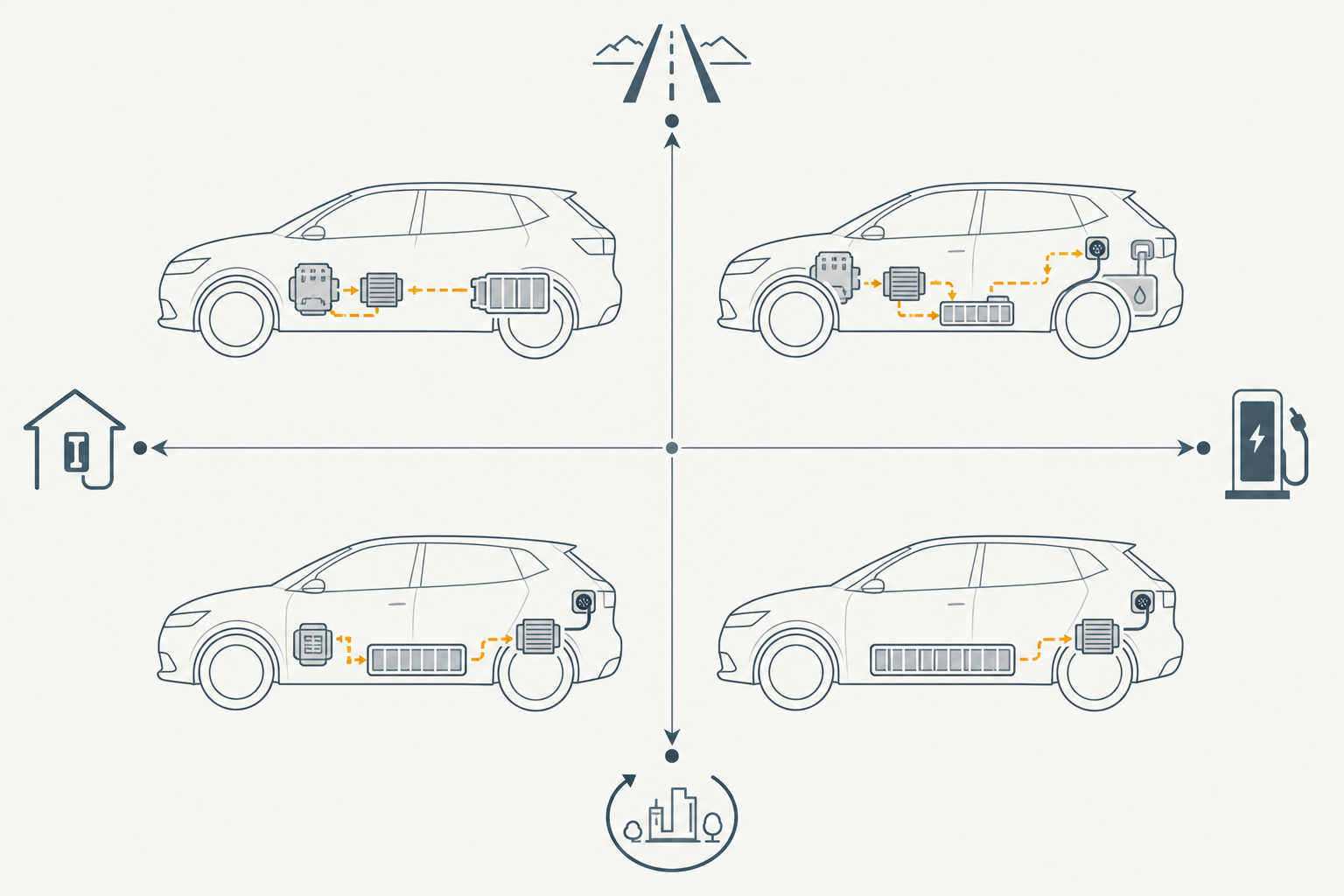
A decision checklist compared by scenario
- Fixed parking space + home charging + small daily commuting radius: Battery electric (BEV) is the most direct choice, with advantages in both charging cost and time.
- No home charging + want to use electricity + occasional long trips: Plug-in hybrid (PHEV) or range-extender (REEV), using electricity for short trips and fuel for long trips.
- Frequent intercity travel + uncertain charging network: Hybrid electric (HEV) requires no charging planning; just refuel.
- Fixed route + hydrogen refueling available (mostly commercial scenarios): Then consider fuel cell (FCEV).
- Only one car at home and long trips must also be covered: Prioritize overall range and energy replenishment method, not the pure electric range figure.
New energy and AI: different growth logic
This section focuses on "New energy and AI: different growth logic." Key points: use a comparative perspective to conclude industry observations. The growth of the new energy industry relies more on manufacturing scale, supply chains, and charging/hydrogen refueling infrastructure, and fluctuations in capital attention differ from algorithm-driven tracks. This is only an observation, not taking sides or predicting stock prices. About 400 words. When writing, please combine drawing functions, clamping accessibility, and inspection feasibility for judgment; when involving tolerances and delivery times, use qualified expressions such as "common in the industry/needs confirmation according to drawings," and do not write them as company commitments.
If the main text is too short, please supplement it on this basis with specific process judgments, risk characteristics, and executable inspection items, avoiding vague overviews.
Frequently asked questions
The following four questions basically cover the places where readers are most likely to get stuck after reading the previous text: classification boundaries, the difference between plug-in hybrids and range-extenders, the applicable conditions for 800V, and whether a pure EV can really be purchased without home charging.
Does a new energy vehicle mean a pure electric vehicle?
No. New energy vehicles are a broad category of vehicles that do not use traditional fossil fuel heat engine combustion as the direct source of kinetic energy, usually including five routes: battery electric (BEV), hybrid electric (HEV), plug-in hybrid (PHEV), range-extended (REEV), and fuel cell (FCEV). Pure electric is only one of them. The previous text distinguished them by energy source, drive method, and energy replenishment method. To judge which category a car belongs to, looking at whether it can be externally charged and whether the engine directly drives the wheels is more reliable than looking at the badge.
What exactly is the difference between a plug-in hybrid and a range-extender, and how do you distinguish them when choosing a car?
The core difference lies in the role of the engine. In a plug-in hybrid, the engine can both generate electricity and, under certain conditions, drive the wheels directly; at high-speed cruising, direct engine drive is often more efficient. In an extended-range vehicle, the engine only drives the generator, and the wheels are always driven by the electric motor, so the driving feel is closer to a pure EV. Both can be charged externally, and in the industry, pure electric range commonly falls in the 100–200 km range, while combined range can exceed 1,000 km, depending on the model and battery capacity. For daily commuting with a small radius and a desire to use electricity as much as possible, both are suitable; if you often drive on highways and care about high-speed energy consumption, the direct-drive mode of a plug-in hybrid usually has an advantage.
Is the 800V high-voltage platform suitable for all vehicles?
No. The value of an 800V platform is mainly reflected in charging speed—in the industry, charging from 10% to 80% commonly takes about 15–30 minutes—but actual performance depends heavily on the output power of the charging pile. If the pile cannot keep up, even a high vehicle-side voltage will not make charging fast. It is better suited to users who frequently use high-power DC fast charging and are sensitive to replenishment time; if you mainly rely on home slow charging, the daily difference brought by 800V is limited. In addition, a high-voltage platform places higher demands on electronic control, wiring harnesses, insulation, and thermal management, and whether it is equipped must be confirmed by specific model, not just by marketing claims.
Can I still buy a pure EV without home charging?
Yes, but you first need to calculate your charging conditions clearly. Without a fixed parking space and home charging, the daily experience of a pure EV depends on the density, power, and queuing situation of public charging piles near your home or company. If your commuting radius is not large and fast charging nearby is convenient, a pure EV is still feasible; if you often travel between cities and the charging network is uncertain, a plug-in hybrid, extended-range, or hybrid electric vehicle will be more reliable. The selection logic above works backward from charging conditions and usage radius, rather than ranking by how new the technology route is—no route works for all scenarios. First confirm your own charging conditions, then decide on the route.
Key takeaways
- New energy vehicles are a broad category that includes BEV, HEV, PHEV, REEV, and FCEV; pure electric is only one of these paths.
- The key to distinguishing technology paths lies in three things: where the energy comes from, what drives the wheels, and what the refueling/recharging method is.
- The pure electric range of PHEVs and EREVs is mostly in the 100–200 km range, and the combined range can exceed 1000 km, but actual performance depends on the usage scenario.
- 800V high-voltage platforms, range extenders, and in-house battery development are current engineering hot topics; in essence, they are trade-offs among charging speed, cost, and range.
- The growth of the new energy industry depends on manufacturing scale, supply chains, and infrastructure, and its pace differs from algorithm-driven sectors.