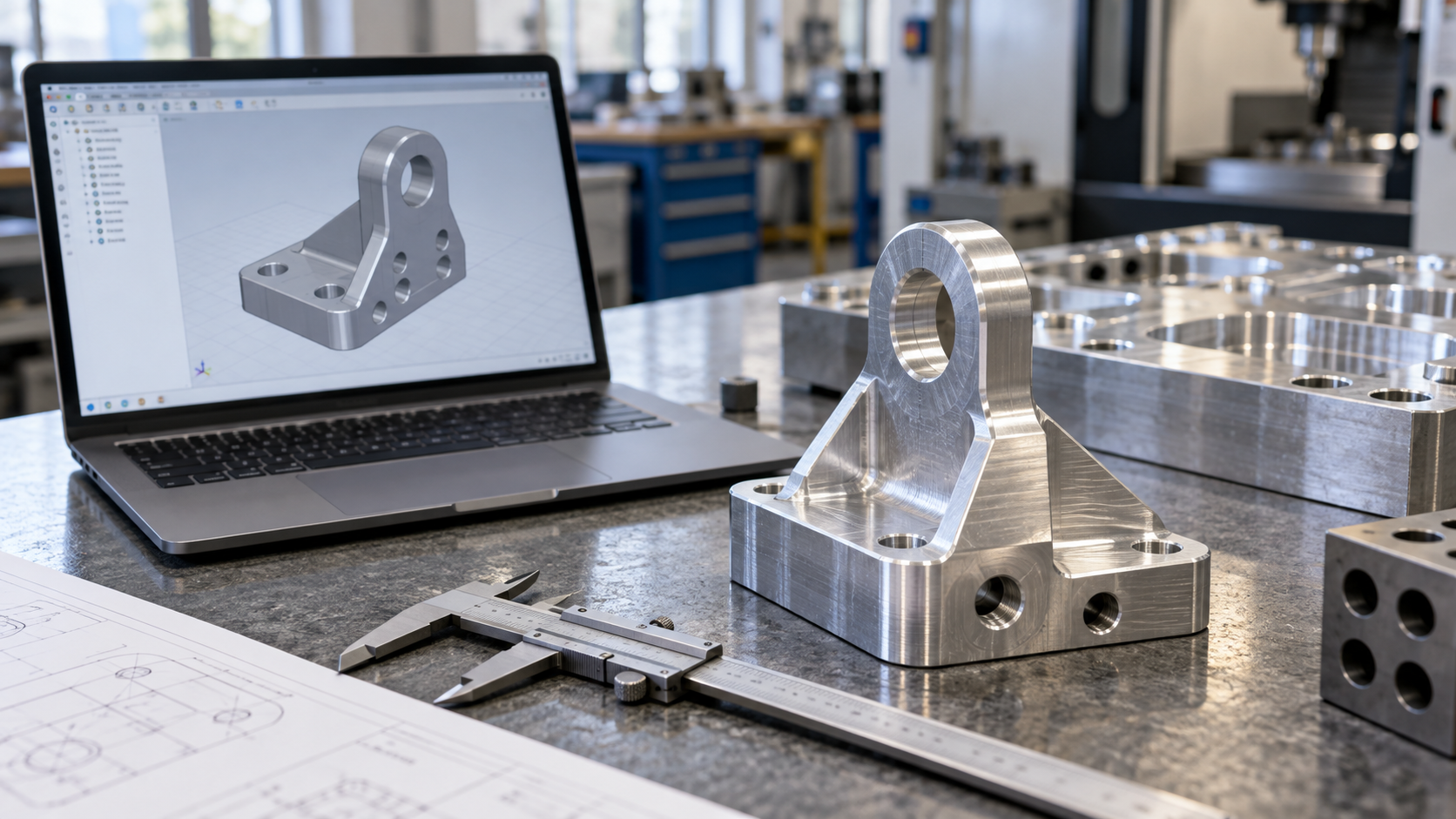
What On-Demand Manufacturing Is: A Digital Pathway from Design File to Part
On-demand manufacturing is an umbrella term for a set of manufacturing pathways: once a design file is uploaded, it triggers quoting, review, scheduling, machining, and shipping. The entire process is order-driven rather than based on forecasted stock. It isn't a specific process—CNC machining, 3D printing, sheet metal, urethane casting, and injection molding can all fit into this pathway.
Its core value is compressing the cycle from design to part. Traditional outsourcing involves requesting quotes, comparing prices, tooling or scheduling, and reconciliation, often taking weeks; on-demand manufacturing moves quoting and process feedback forward to the moment drawings are uploaded, letting design iterations close the loop faster. Being cheap is a byproduct, not the goal—revising the same drawing for two more rounds before ordering often saves more than the difference in unit price.
Why It's More Like a Pathway Than a Process
It's more accurate to understand on-demand manufacturing as a "digitally ordered pathway." The same batch of parts might first be 3D printed to validate assembly, then CNC machined for functional prototypes, and finally injection molded or urethane cast for low-volume production; they all share the same front end: upload, quote, DFM feedback, order, receive. The process is an option within the pathway, not the pathway itself. This also explains why on-demand manufacturing is often tied to "instant quoting"—quoting speed determines whether this pathway can truly run.
For engineering teams, the criterion is straightforward: when iteration frequency exceeds the speed of the procurement process, the value of on-demand manufacturing becomes apparent. It doesn't promise a specific lead time or price; instead, it shortens the feedback loop from idea to testable part, letting designs get manufacturability judgments at the CAD stage.
Below, we walk through this pathway in the actual order of placing an order: upload drawings → instant quote → DFM feedback → order and receive. Two decision points are inserted along the way: when to do it yourself and when to hand it to on-demand manufacturing; and which design factors directly affect quotes and lead times.
Step One: Upload Drawings—Get the Data Clear First
The first checkpoint in on-demand manufacturing isn't the machine tool—it's the data. Most delays, repeated quoting, and even rework happen before drawings enter the quoting system. Hand over the 3D model and machining requirements clearly in one go, and the next three steps have a stable foundation.
Solid Formats First: STEP and IGES Rather Than Pure STL Meshes
For models used in CNC machining and injection molding, the industry-standard practice is to submit boundary-representation solid formats such as STEP (.step/.stp) or IGES. These carry analytic surfaces, so the quoting system can directly read hole positions, fillets, and planar relationships, and the programming side can generate toolpaths accordingly. Pure STL is a triangular mesh—circles are broken into small facets, tolerance and surface accuracy are lost, and the features read by the quoting algorithm often don't match the design intent.
3D printing is more accepting of STL, but if the same part will later move to CNC or injection molding, it's advisable to keep a STEP version as well to avoid remodeling when switching processes. Sheet metal parts usually require a flat pattern or thickness and bend radius callouts; providing only a folded solid is often not enough.
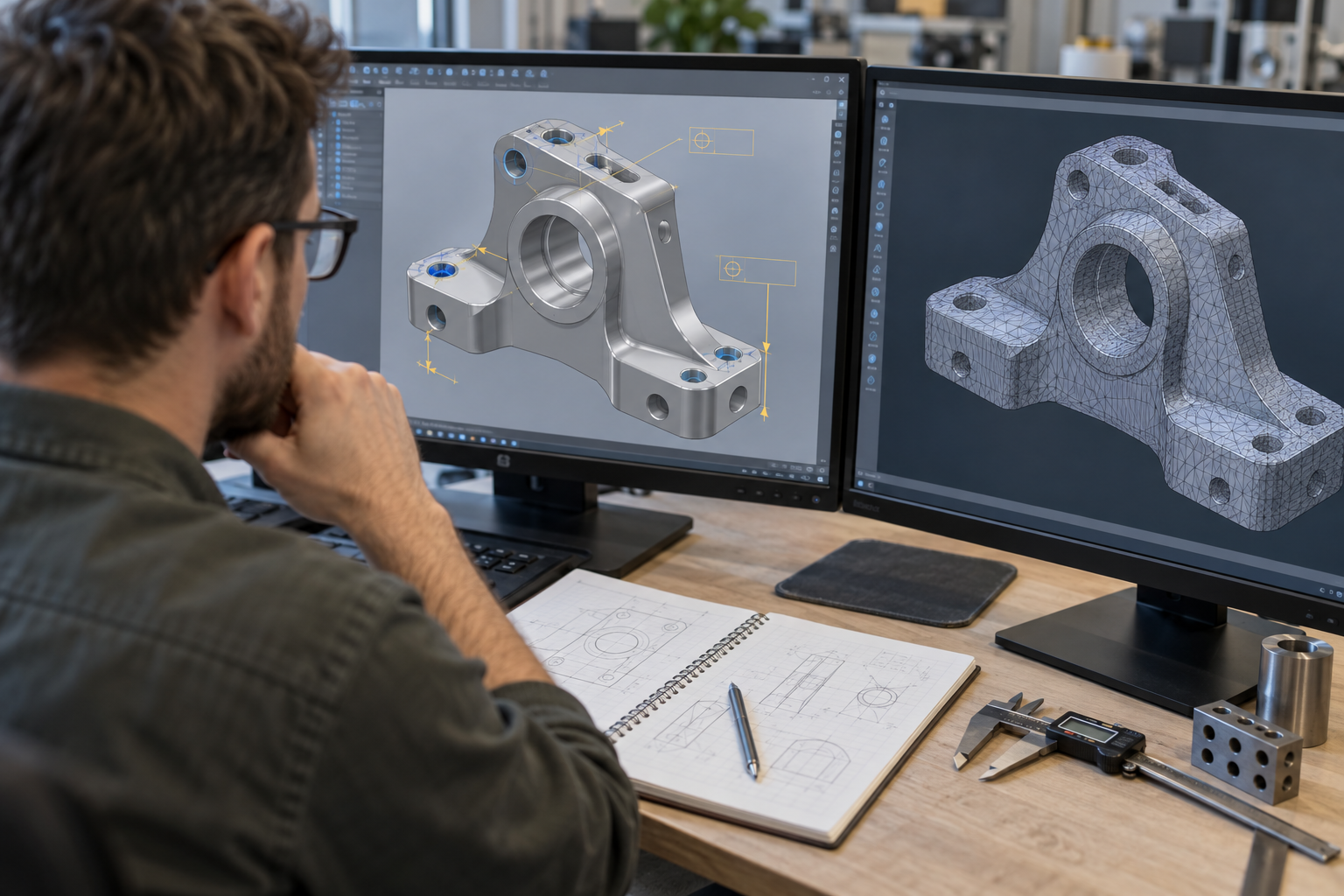
Five Types of Information to Provide Along with the Drawings
The model only shows shape, not intent. Submit complete data in one go, and the quote can go from a range to a definite value:
- Material grade and condition: write 6061-T6 rather than "aluminum," write POM-C rather than "plastic." Materials within the same family differ noticeably in machinability and price.
- Quantity and batch: prototyping a single piece and a 50-piece low-volume run follow different quoting logic. Whether nesting is allowed and whether fixturing can be shared depends directly on quantity.
- Critical tolerance bands: call out only the dimensions that truly affect assembly. A common industry tolerance band for CNC machining is about ±0.025–0.125 mm, subject to drawing callouts and factory confirmation; tightening everything by default across the drawing needlessly increases inspection and tooling costs.
- Surface treatment: anodizing, bead blasting, passivation, plating, or deburring only. The treatment affects process sequence and lead time.
- Datums and critical features: which faces are assembly datums and which holes are locating holes. If datums aren't marked, the fixturing plan can only be guessed.
The Cost of Incomplete Data
When material or tolerance callouts are missing, the quoting side usually has only two choices: give a wide range, or send it back for more information. A range quote looks fast, but in practice it gets renegotiated at order time, which actually lengthens the cycle. A more insidious problem is that DFM review has nothing to work with—without material, you can't judge whether wall thickness is reasonable; without tolerances, you can't judge whether grinding or wire EDM is needed. The ten minutes saved at the drawing stage often turn into several rounds of email later.
If you only have a physical part and no drawing, you can go through 3D scanning for reverse engineering, but the scanned mesh still needs to be cleaned up into a solid and have tolerance callouts added back before it can enter the subsequent quoting process. Get this step solid, and the instant quote in step two becomes meaningful.
Step Two: Instant Quoting—How the Price Is Calculated
Geometric Complexity: Whether the Tool Can Reach In Determines Most of the Cost
Tolerances and surface finishing: the tighter the band, the more operations
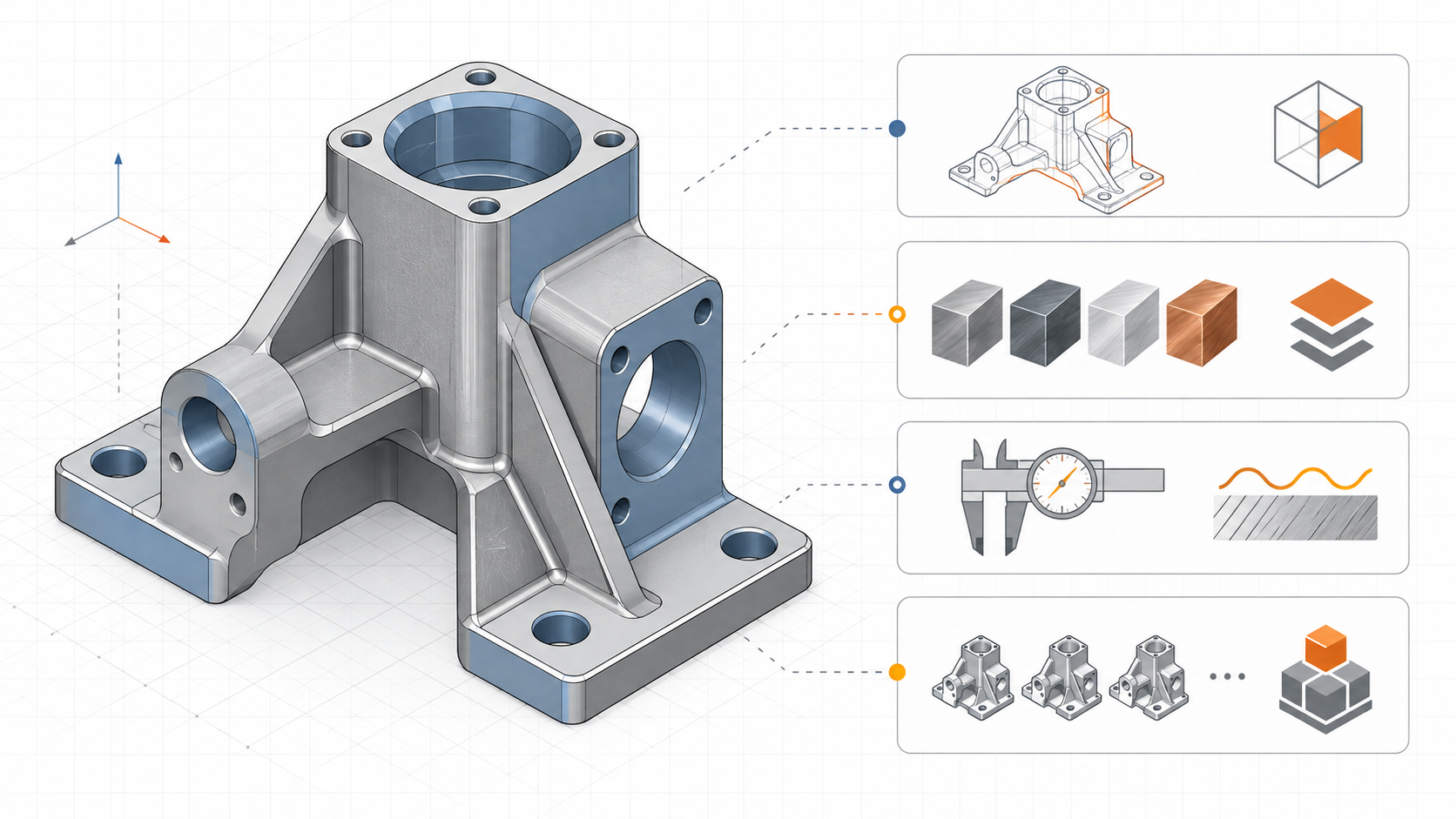
Material, batch size, and post-processing: three more price levers
Step three: DFM feedback—catching cost problems at the quoting stage
In an on-demand manufacturing workflow, DFM (design for manufacturing) feedback usually shouldn't appear only after scheduling. Most factories perform a manufacturability check during the quote review stage, because the bulk of a part's total cost is already locked in at the CAD stage—once geometry, tolerances, and material are finalized, there's limited room to compress later. Putting DFM feedback at the quoting step is the window where changes cost the least.
Why the quoting stage is the best time to fix cost problems
Once a drawing enters scheduling, changing a single tolerance often means regenerating the program, re-preparing tooling, and re-arranging fixturing. DFM feedback at the quoting stage is still just a line of annotation on a document, and the cost of change is nearly zero. Engineers at many factories in the industry perform a manufacturability review on every RFQ and flag issues in the quote—not to reject the order, but to let the customer know which tolerance or feature is driving up the price.
Four common types of DFM issues at the quoting stage
- Unnecessarily tight tolerances. Marking non-mating surfaces to ±0.01 mm when assembly doesn't actually need it. Tightening tolerances increases machining time and often requires special tooling or extra inspection gauges, so the price naturally goes up. A common industry practice is to mark critical mating dimensions separately and treat the rest as general tolerance bands.
- Cavities that are too deep. When internal cavity depth exceeds about 4 times the cavity width, tool overhang lengthens, and the risk of chatter and deflection rises, requiring reduced feed and stepped machining, which increases time cost.
- Walls that are too thin. For plastic parts and thin-wall metal parts, a common industry recommendation is a minimum wall thickness ≥0.5 mm; too thin and it easily warps and deforms, lowering yield.
- Fillets that require special tooling. If the internal fillet radius is too small, a standard end mill can't reach it, and you can only switch to a smaller-diameter tool or EDM, which jumps the process and cost up a notch.
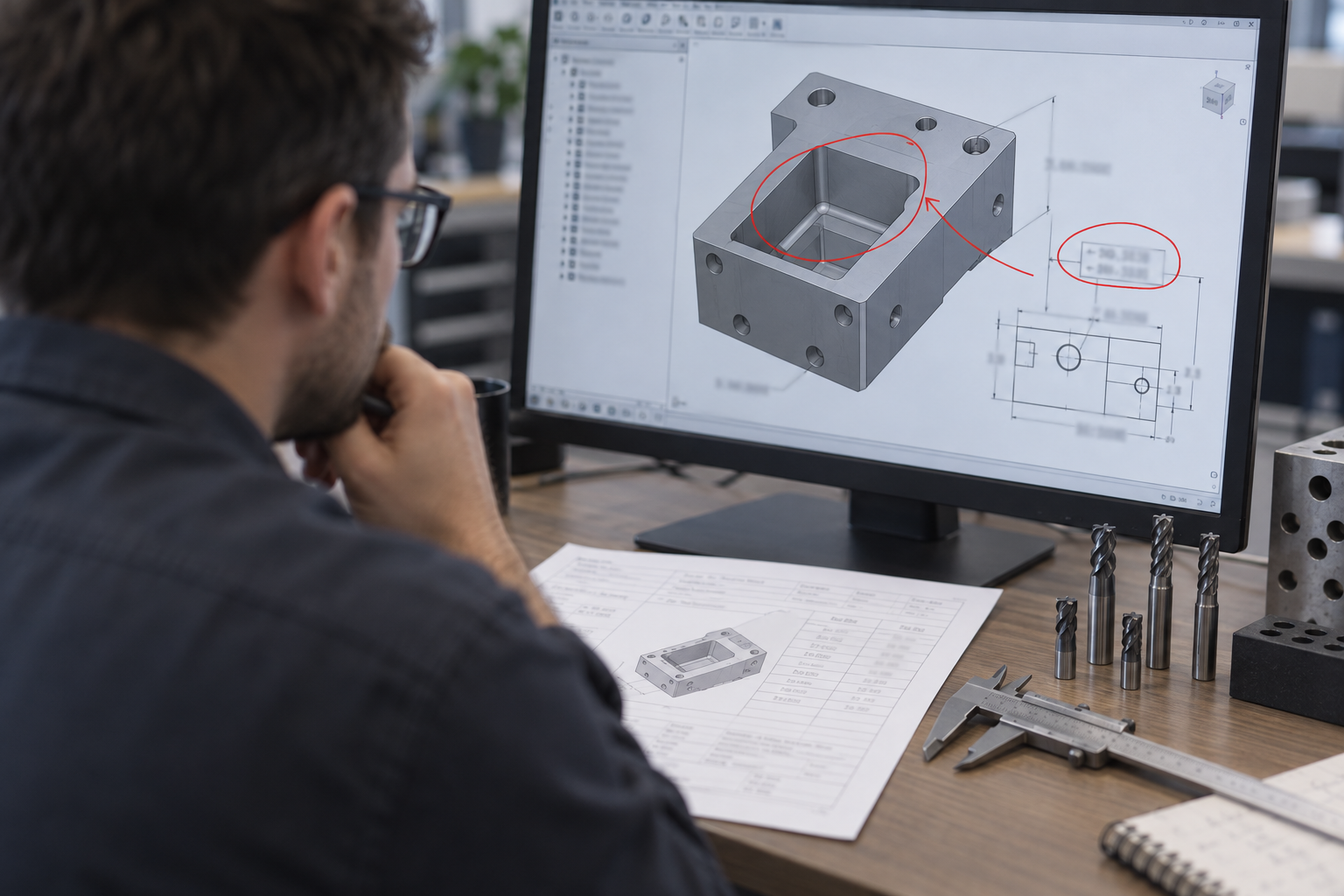
How to act on DFM feedback: the loop from quote sheet back to drawing
After receiving DFM annotations, a practical approach is to sort them into three categories: must change (can't be made, or yield would be too low, without changing), recommended change (can clearly reduce cost or shorten lead time), and can keep (functionally needed, and you're willing to bear the cost). Mark these three categories clearly and send them back, and the factory can give an accurate quote in one pass, rather than going back and forth revising drawings and re-checking prices.
The value of on-demand manufacturing shows up very directly here: digital quoting moves the DFM check forward to before the order is placed, so design problems surface at the file level rather than being discovered after parts are scrapped. The earlier the change, the more you save—not just machining cost, but also the lead time that would have been dragged out.
In-house manufacturing vs. outsourced on-demand manufacturing: when to choose which
On-demand manufacturing isn't only about outsourcing. For the same part, self-built capacity and an outsourcing platform often differ by an order of magnitude in their time and cost curves. To decide which to choose, first see one premise clearly: in-house manufacturing buys speed flexibility, while outsourced on-demand manufacturing buys process coverage. The two aren't substitutes but decisions aimed at different frequencies.
A commonly cited industry comparison illustrates the gap: a snow shovel prototype made in-house with 3D printing might take 8 hours and cost tens of dollars; the same part outsourced means waiting days and the cost rising to hundreds or even thousands of dollars. Such figures fluctuate with part size and material and aren't promised values, but they sketch the dividing line for the decision—how high is the iteration frequency.
What parts is in-house manufacturing better suited for
In-house manufacturing's advantages come down to three points. First, same-day validation: revise a structural part one version, print it the same day, and put it on the assembly bench the next day—the feedback loop is measured in hours. Second, small parts at high frequency: parts within the working range of a printer or small machine tool that need several versions a week are more time-efficient to make in-house than going through quote—scheduling—shipping each time. Third, confidential or trial-and-error-sensitive designs don't need intermediate versions sent out.
The trade-off is a capacity ceiling and equipment coverage. In-house usually has only one or two processes, so metal parts, heat treatment, or special surface finishing can't be done in-house. Once equipment is at full load, the iteration-speed advantage also disappears.
What parts is outsourced on-demand manufacturing better suited for
Outsourced on-demand manufacturing's strength is process combinations and material coverage. When a part needs CNC milling for its shape, sheet metal for its housing, and urethane casting for small-batch production, handing it to one on-demand platform is less hassle than coordinating three suppliers at once. Large parts, unconventional materials, and parts made only occasionally are even more typical scenarios—buying equipment for a part made twice a year doesn't pay back.
Its trade-off is waiting. A common industry lead-time difference is: in-house printing takes a few hours to a day per part, while outsourcing takes days at best and weeks at worst, depending on process, material, and scheduling. So outsourcing is better suited to designs where iteration has already converged, rather than the stage where drawings are still being revised daily.
If you've already decided to outsource, submit the drawings along with the material and quantity, and get a quote and DFM feedback before deciding—this saves more time than haggling back and forth over price. You can start with AI conversational quoting or classic quoting, look at the cost and manufacturability issues that come back, and then judge whether it's worth doing in-house.
A practical checklist for deciding
- Multiple revisions per week, small parts, only one process needed → prioritize in-house manufacturing.
- Only done once or twice a year, large dimensions, unconventional materials → prioritize outsourced on-demand manufacturing.
- Multiple processes need to be chained together (CNC + sheet metal + vacuum casting + injection molding) → outsourced on-demand manufacturing saves more coordination cost.
- Design is still diverging, tolerances and structure aren't finalized → iterate quickly in-house, don't rush to outsource.
- Design is frozen, only delivery remains → outsource to on-demand manufacturing and hand off capacity and material issues to the platform.
- Confidentiality-sensitive or intermediate versions inconvenient to send out → do it in-house, and consider outsourcing only in the later production stage.
- In-house equipment is already at full capacity → regardless of part size, outsourcing is the pressure relief valve.
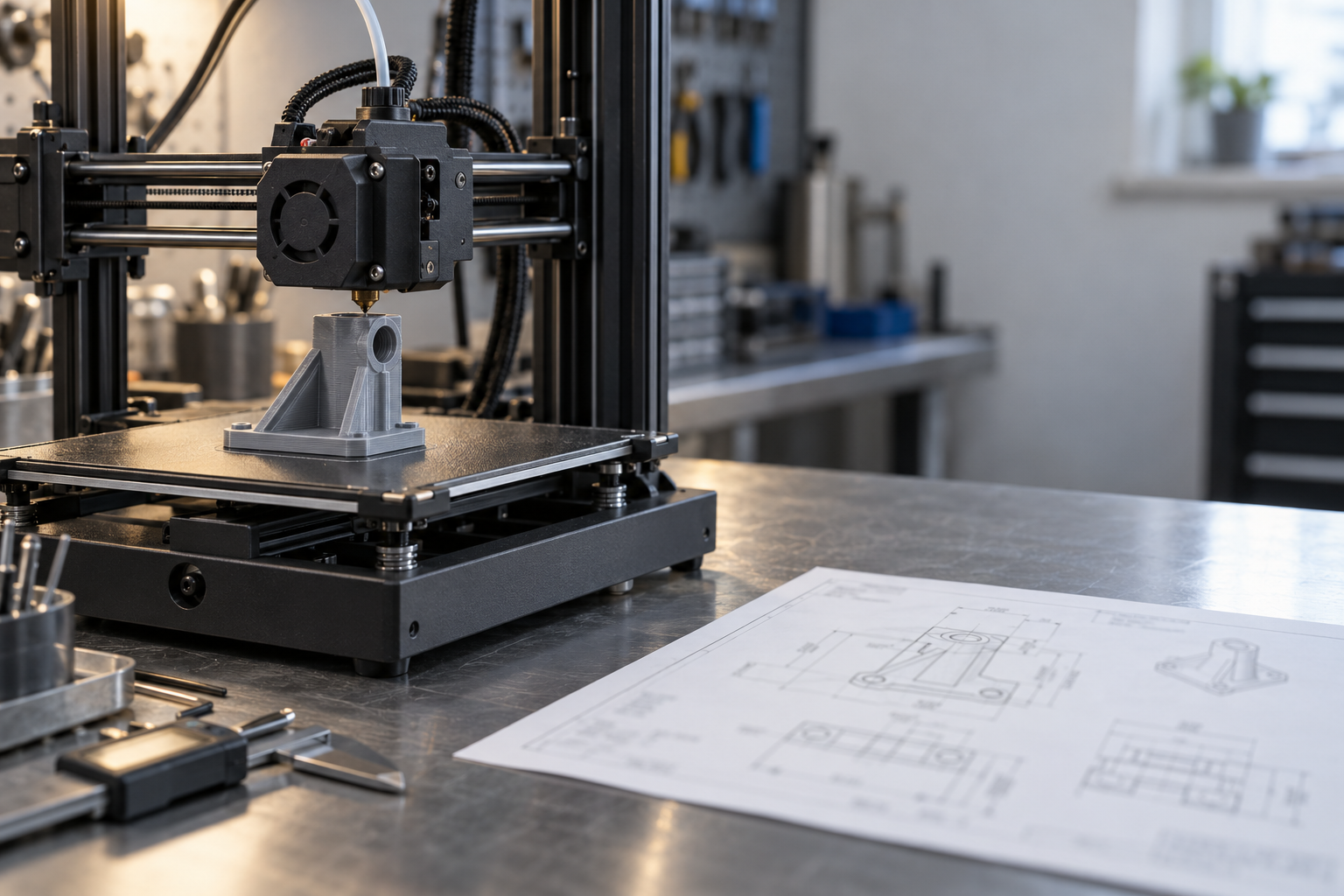
Design factors that affect on-demand manufacturing quotes and lead times
For on-demand manufacturing, the quote and lead time are mostly determined the moment the drawing is reviewed. On the same machine and with the same batch of material, changing one set of tolerance callouts or altering one cavity depth can shift the quote by several tens of percent—the difference comes from tooling, fixturing, inspection gauges, and cutting time, not from a "service fee." Below, we break it down along four dimensions: geometry, tolerances and surface finish, materials and inventory, and fixturing and workholding. For each item, we give a common industry reference value and then explain why it drives up cost. These values are judgment anchors; the final determination is subject to the drawing callouts and confirmation by the machine shop.
Geometry: aspect ratio and wall thickness determine whether the tool can get in
Cavity aspect ratio is one of the first items. A common industry practice is to keep internal cavity depth within 4 times the cavity width; beyond this ratio, the overhang of a standard end mill becomes longer, rigidity drops, the tool tip is prone to chatter, surface roughness worsens accordingly, and in severe cases you can only switch to a thinner tool and take multiple passes, multiplying machining time. The same applies to minimum wall thickness: a typical recommendation is ≥0.5 mm; thin-walled parts deform under clamping and cutting forces, so you don't dare clamp hard or cut fast, and lead time naturally stretches out.
- Cavity aspect ratio: recommended ≤4:1; deeper requires extended tools, reduced feed, or splitting into a built-up assembly
- Minimum wall thickness: typically ≥0.5 mm; thinner brings deformation, tool deflection, and secondary re-straightening
- Internal fillet: tool radius determines the minimum fillet; too small a fillet is equivalent to requiring custom tooling or EDM
- Sharp corners: internal right angles cannot be milled directly; the corner-clearing method must be specified, otherwise the quote will be estimated using the most conservative approach
Tolerances and surface finish: tighten one grade, and you add a layer of gauges and operations
For CNC machining, the conventional tolerance band commonly falls within ±0.025–0.125 mm. Within this range, standard tooling and conventional inspection gauges are basically sufficient. Once tightened to a smaller band, what the machining side must do is not just "go slower": it requires higher-precision machines, more frequent tool compensation, and sometimes a temperature-controlled environment, while the inspection side must upgrade from calipers to micrometers, CMMs, or dedicated gauges. The same goes for surface roughness: each step down in Ra value often requires an additional finishing or polishing operation, and lead time and unit price rise together.
The way to judge is simple: go through the tolerances and roughness on the drawing one by one and ask, "Is this item needed for fit, or is it just habitually called out?" Mating surfaces, sealing surfaces, and bearing seats should be tight where they need to be; for non-mating outer surfaces and cavity bottoms, relaxing by one or two grades usually doesn't affect assembly, yet can eliminate an entire set of gauges and one operation. Most cost isn't generated on the shop floor—it's already written into the callouts at the CAD stage.
Materials and inventory: the lead time gap between common grades and non-standard grades lies in material preparation
The impact of material on lead time is mainly in the material preparation stage. Aluminum alloys 6061 and 7075, stainless steels 304 and 316, and common engineering plastics such as POM, ABS, and nylon are usually kept in stock and can be cut quickly. Switch to a special grade, a special condition (such as a specific heat-treated or pre-hardened state), a large cross-section forging, or imported plate, and you have to wait for material; lead time goes from a few days to one or two weeks or even longer, and minimum order quantities drive up the per-piece allocated cost. When selecting materials, weighing "mechanical properties are sufficient" together with "available from stock" is more practical than focusing only on performance parameters.
| Cavity aspect ratio | Depth ≤ 4 times width | Long tool overhang, poor rigidity, requires reduced feed or a thinner tool, increasing machining time |
| Minimum wall thickness | Typically ≥0.5 mm | Thin walls deform under clamping and cutting forces, requiring light cutting and multiple setups |
| Conventional tolerance band | ±0.025–0.125 mm | Tighter requires high-precision machines, tool compensation, dedicated gauges, and temperature control |
| Surface roughness | Call out by functional grade | Each step down often requires an additional finishing or polishing operation |
| Material grade | Prioritize common stock grades | Non-standard grades require material waiting, and minimum order quantities and allocated costs rise |
| Clamping datum | Mark the clampable datum surfaces | Without a datum, a dedicated fixture is needed, increasing first-article lead time and cost |
Clamping and fixturing: if the datum is unclear, quotes can only be based on the most conservative estimate
Whether the drawing has a usable clamping datum directly determines whether a dedicated fixture is needed. With a flat datum surface, reasonable process bosses, or allowance for clamping margin on non-critical surfaces, the machining side can clamp it with standard vises or soft jaws. Conversely, irregular thin-walled parts, or parts requiring five-face machining without a datum, often require dedicated tooling, adding fixture design and fabrication time to the first-article lead time. Multi-face machining also introduces repeated positioning errors; each additional setup increases cumulative error and labor hours. If one or two process bosses or datum holes can be reserved at the design stage, the cost of clamping can usually be significantly reduced.
The role of on-demand manufacturing amid supply chain fluctuations
The moments when on-demand manufacturing is truly needed are often not ordinary times. In normal years, an outsourced mold, a production injection molding run, or a batch of CNC parts has a predictable lead time, and procurement can schedule production quarterly. Once upstream materials are cut off, a single supplier's capacity is squeezed, or a part suddenly needs a revision and rework, the traditional path of "waiting for this one to recover" quickly becomes a bottleneck. This is where the value of on-demand manufacturing shows: it is not a fixed production line, but an existing network of capacity—whoever has an opening, whoever has materials in place, whoever has a matching process, the order goes there.
This is two sides of the same thing as the four-step workflow described earlier. The reason uploading drawings, instant quoting, DFM feedback, and ordering to receipt can compress the cycle is that demand can be broken up and routed to different capacities, rather than being tied to a single factory's schedule. There have already been attempts in the industry to treat manufacturing capacity as a schedulable resource, such as the collaboration between Palantir and Divergent in defense manufacturing; the direction is to connect design, process, and capacity data so that parts can quickly land on available machines when needed—this is mentioned only as an industry trend and does not represent the specific capabilities of any on-demand manufacturing platform.
What is truly tested during volatile periods is switching cost, not unit price
When the supply chain is disrupted, the most expensive thing is often not the part itself rising in price, but the hidden costs of switching suppliers: redoing the DFM review, revalidating the first article, and going through gauges and process parameters again. The on-demand manufacturing model moves part of this work forward to the quoting and DFM stages; drawings and tolerance requirements are structured at the time of upload, so the migration cost when switching capacity is relatively low. This is also why, in a volatile environment, it is worth managing "whether the drawing data is complete and whether the tolerances are clearly marked" as a matter of supply chain resilience, not just as an internal matter for the design department.
Another reality is that a capacity network does not equal unlimited capacity. For unconventional materials, oversized parts, and processes requiring dedicated tooling, there are inherently few suppliers that can take them on; on-demand manufacturing only makes the matching process faster, rather than creating capacity out of thin air. So the more stable approach is: keep a validated backup path for critical parts, run small-batch trial orders in normal times, and only then can you switch quickly during fluctuations. Specific lead times and acceptable scope still need to be confirmed order by order based on the drawing and the capacity situation at the time; no platform will give a fixed promise detached from the drawing.
Common DFM errors and their cost impact
The previous sections covered "how to get through" the on-demand manufacturing workflow. This section takes a different angle: which design actions directly make the quote and lead time look bad. DFM errors are rarely "it can't be made"; more often they are "it's expensive to make, slow to make, and the yield is unstable." Below, they are broken down by error type, with typical consequences and optimization directions for each.
Overly tight tolerances: the most common hidden cost amplifier
Marking ±0.01 mm versus ±0.05 mm differs by only one number on the drawing, but in the workshop it means a difference in tools, number of setups, gauges, and machining time. The common CNC machining tolerance band in the industry is in the ±0.025–0.125 mm range; going beyond this range usually requires slower feed rates, more frequent measurement, and even switching to a more precise machine. The result is higher unit price and longer lead time, and if the assembly does not actually need to be that tight, the money is wasted.
Optimization direction: Tighten tolerances only on dimensions that truly affect assembly or function, and leave the rest at default tolerances. Mark datums and critical dimensions clearly on the drawing, rather than tightening the entire drawing uniformly.
Uneven wall thickness and overly deep cavities: hard on both tools and material
Sudden changes in wall thickness create stress concentrations during cooling or cutting; thin walls are prone to chatter and deformation, while thick walls may develop shrinkage voids. The common industry recommendation is a minimum wall thickness of no less than 0.5 mm, with transitions as uniform as possible. Overly deep cavities are similarly troublesome: when the depth-to-width ratio exceeds about 4:1, tool overhang increases, rigidity decreases, and both surface roughness and dimensional stability worsen, often requiring extended tools or segmented machining, with costs rising accordingly.
Optimization direction: Break deep cavities into machinable steps, or add process holes on non-functional surfaces; use fillet transitions for wall thickness to avoid abrupt right angles.
Failure to mark critical datums, ignoring draft, and choosing the wrong material
Without marked datums, there is no unified reference during inspection, and first articles and production parts may each be measured differently, which is where disputes and rework begin. Ignoring draft in injection-molded parts causes surface tearing during ejection, lowering yield and, in severe cases, requiring mold repair. Choosing the wrong material is even more insidious: selecting a hard-to-machine grade or a material requiring special heat treatment lengthens both machinability and post-processing cycles, and the quote naturally rises.
Optimization direction: Mark the main datums and critical dimensions on the drawing; for injection-molded parts, allow 1°–2° of draft along the ejection direction (subject to factory confirmation); for materials, prioritize conventional stock grades, and confirm machinability with the factory in advance for special performance requirements.
| Error | Typical consequence | Optimization direction |
|---|---|---|
| Overly tight tolerances | Higher unit price, longer lead time, increased gauge cost | Tighten only critical dimensions; leave the rest at default tolerance bands |
| Uneven wall thickness | Chatter, deformation, shrinkage voids, lower yield | Minimum wall thickness ≥0.5 mm, fillet transitions |
| Overly deep cavity | Large tool overhang, poor surface, segmented machining required | Keep depth-to-width ratio within about 4:1, or break into steps |
| Unmarked datums | Inspection disputes, rework, batch inconsistency | Specify primary datums and critical dimensions |
| Ignore draft | Demolding scratches, low yield, mold rework | Allow 1°–2° draft in the demolding direction |
| Wrong material selection | Poor machinability, long post-processing cycle, higher quote | Prioritize standard grades; confirm special requirements in advance |
The common thread among these mistakes: they all happen at the CAD stage, but only surface during quoting and scheduling. Moving DFM checks forward to the drawing stage is far less hassle than waiting for a quote to come back and then making changes.
Common questions
Below are common follow-up questions about the four-step on-demand manufacturing workflow, quoting, and DFM judgment. Answers are based on common industry practice; the specific drawing callouts and factory confirmation shall prevail.
What is the essential difference between on-demand manufacturing and traditional outsourced machining?
The difference is not in the process, but in the trigger method and data pathway. Traditional outsourcing usually involves inquiry, email back-and-forth, manual price verification, and scheduling confirmation; on-demand manufacturing puts drawing upload, quoting, DFM feedback, and ordering into the same digital chain, so manufacturability feedback is available at the quoting stage. What it compresses is the design-to-part cycle, not simply pushing the unit price down.
Can I upload only an STL mesh file when submitting drawings?
Not recommended. STL contains only triangular facets, with no solid features or tolerance semantics, making it hard for the quoting party to judge hole positions, datums, and mating surfaces. Subtractive or forming processes such as CNC, sheet metal, and injection molding usually require STEP, IGES, or native CAD solid formats, with material, quantity, tolerance band, and surface treatment all clearly annotated; otherwise the quote can only be given as a range or returned for supplementation.
Why is the price calculated by instant quoting sometimes inconsistent with the final transaction price?
Instant quoting estimates based on geometry, material, tolerances, batch size, and post-processing. When details require special tooling, extra fixturing, inspection gauges, or secondary processing, the price will be adjusted. A common industry practice is to attach a DFM feedback after quoting, listing the points that affect cost, and locking the price after confirming modifications. Annotating tolerances and surface treatment completely can reduce this deviation.
How do I quickly decide between in-house manufacturing and outsourced on-demand manufacturing?
Look at three variables: iteration frequency, part size, and whether the material is standard. For small parts with high-frequency iteration, in-house 3D printing can validate the same day, offering a clear speed advantage; for occasional small quantities, large parts, non-standard materials, or cases requiring a combination of multiple processes, outsourced on-demand manufacturing is more cost-effective. A common industry comparison is that printing one part in-house takes a few hours to a day, while outsourcing may take days to weeks, depending on the process and scheduling.
What issues does DFM feedback generally point out?
Common ones include: tolerances specified too tightly, cavity depth-to-width ratio exceeding 4:1, wall thickness below 0.5 mm, fillets requiring special tooling, critical datums not annotated, and draft ignored. Most of these issues determine cost already at the CAD stage, and changing them at the quoting stage costs far less than changing them after scheduling. After receiving feedback, first confirm the functional requirements, then decide which tolerances can be relaxed.
Key takeaways
- The core value of on-demand manufacturing is compressing the cycle from design to part; a quote is just one node in the process, not the endpoint.
- DFM feedback at the quoting stage often saves more money than rework later, because a significant portion of cost is already locked in at the CAD stage.
- In-house manufacturing suits small parts with high-frequency iteration, while on-demand manufacturing outsourcing suits occasional low-volume runs, large parts, or unconventional materials.
- Design factors like aspect ratio, minimum wall thickness, and tolerance bands directly affect quotes and lead times, and are usually visible at the quoting stage.