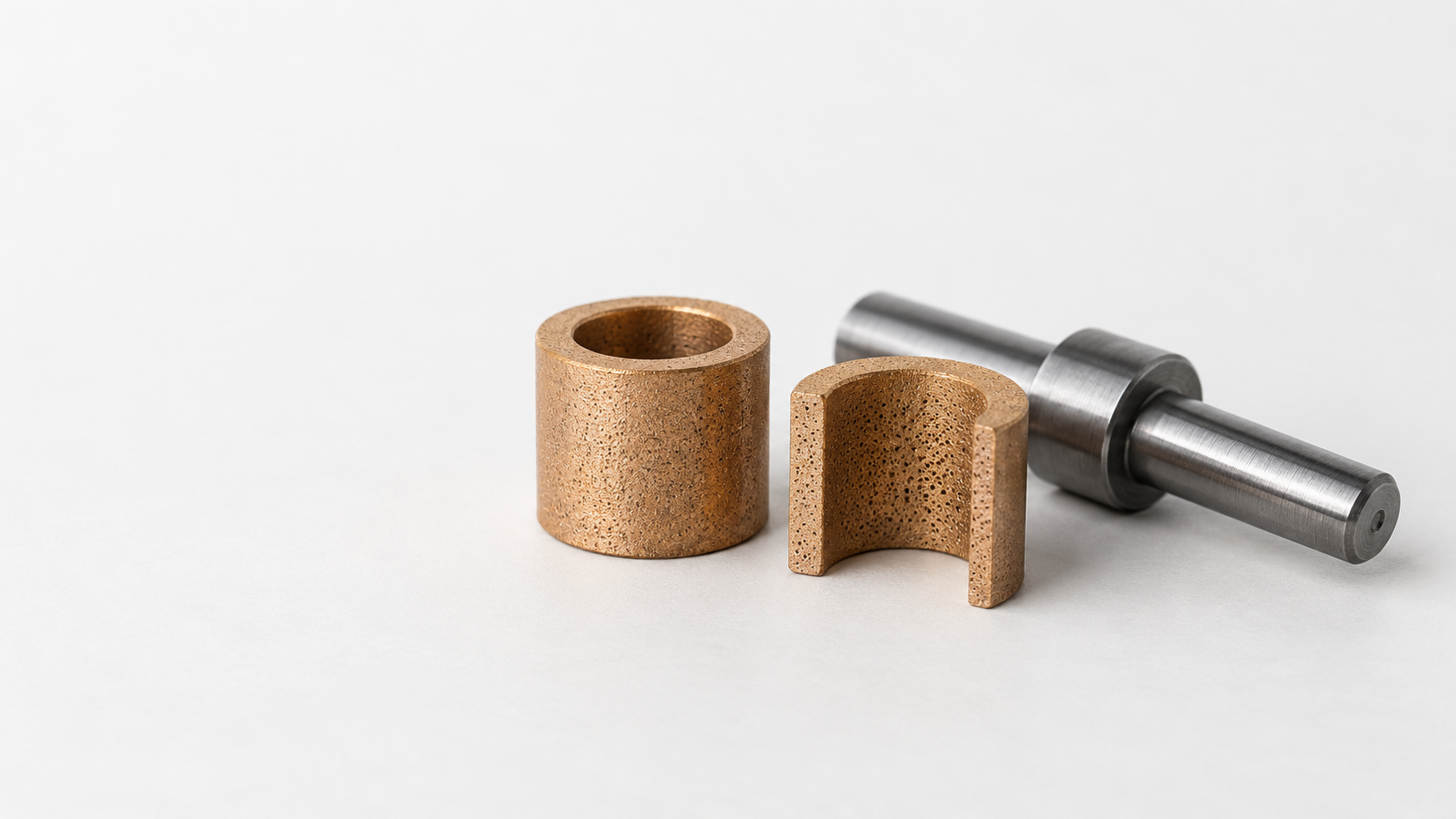
Why Powder Metallurgy Oil-Impregnated Bearings for Small Motors Can Be Mismatched to the Application
A common project conflict is that the bearing passes inner- and outer-diameter inspection, yet the assembled motor exhibits excessive starting resistance, increased operating noise, or significant variation in service life. In such cases, the problem may not originate from a single dimension, nor can it simply be attributed to “selecting the wrong material grade.” Powder metallurgy oil-impregnated bearings for small motors are not permanently maintenance-free once installed; their performance depends on the material system, connected porosity, oil impregnation method, the fit clearance between the shaft and bearing, and dimensional stability after sintering.
The operating condition of an oil-impregnated bearing results from the combined effects of multiple variables. Even among small motors, low-noise, high-speed fans, low-speed, high-load actuators, and equipment operating intermittently at high temperatures have different requirements for load capacity, friction, starting torque, and lubricant retention. Copper-based materials may be suitable for initially evaluating corrosion resistance and noise requirements, while iron-based or copper-iron-based systems may require closer verification of stiffness, load capacity, and impact performance. However, the material designation itself cannot replace sample validation.
The pore structure is likewise not a case of more being better. Connected porosity can store lubricant and provide a replenishment path to the shaft–bearing interface during operation; however, excessive porosity may reduce press-ring strength, wear resistance, or dimensional retention. Uneven sintering shrinkage, insufficient calibration, excessive deburring of the inner diameter, and deformation after press-fitting into the housing can also change the actual clearance and operating noise. Accordingly, the following sections examine materials, porosity, oil impregnation systems, and dimensional control one by one, linking each decision to the data and inspection methods that suppliers should provide.
How Oil-Impregnated Bearings for Small Motors Work: How Pores Store and Supply Lubricant
Powder metallurgy oil-impregnated bearings are not components that require no further attention forever once installed. Their performance depends on the connected porosity formed during pressing and sintering, the impregnated lubricant, the clearance between the shaft and bearing, and the actual speed, temperature, and load. Dimensional compliance only indicates that the geometric requirements have been met; it does not by itself prove that the starting torque, noise, or service life meets the motor requirements.
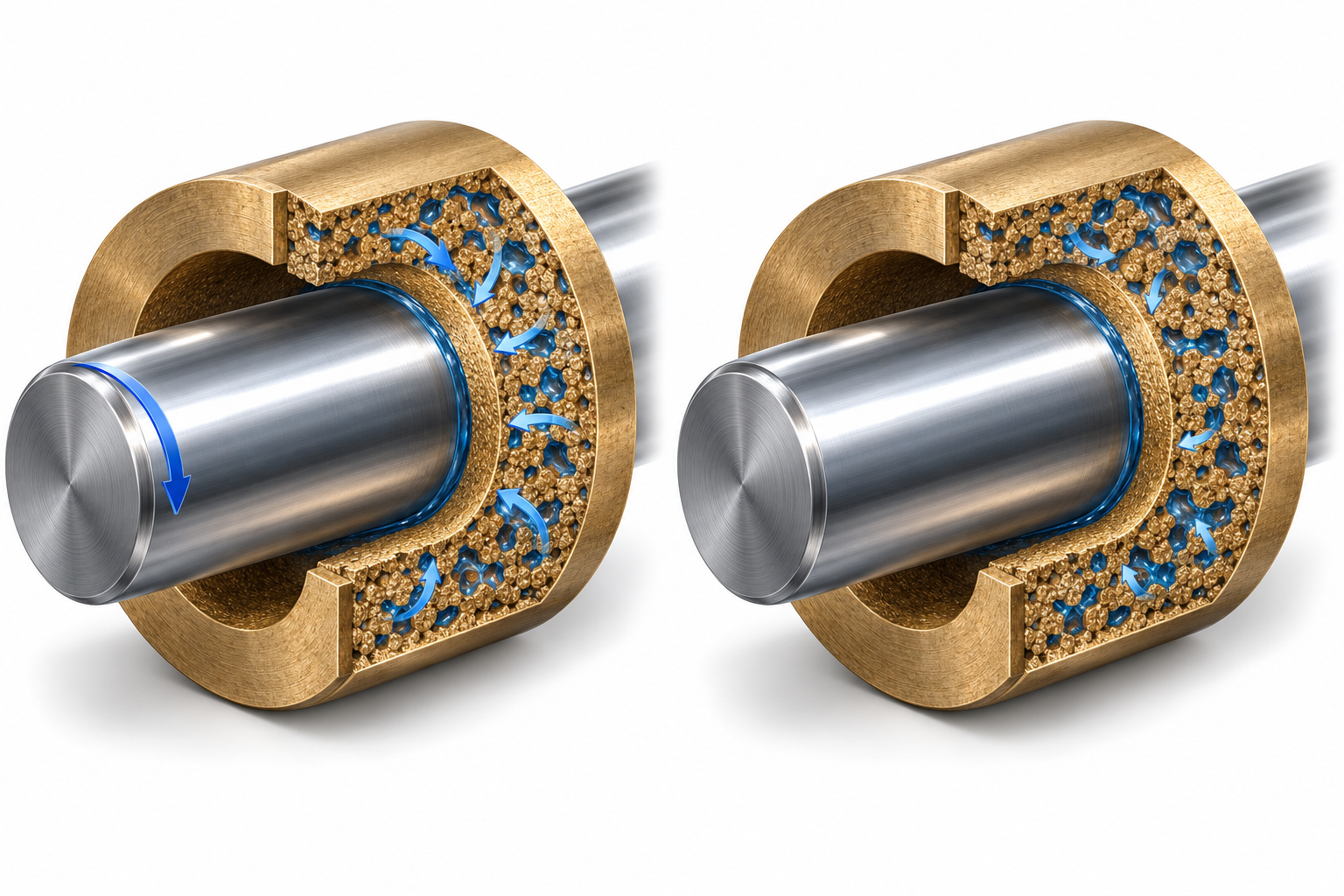
During operation: connected pores supply oil to the sliding interface
During manufacturing, metal powder is first compacted in a rigid die and then subjected to controlled sintering below the melting point of the matrix material. The particles do not become completely densified, thereby forming interconnected micropores. After oil impregnation, these pores serve as lubricant reservoirs. When the motor operates, relative motion occurs between the shaft and bearing, and interfacial temperature, pressure, and capillary action may promote the migration of some oil to the sliding surface, reducing direct metal-to-metal contact.
“Oil supply” does not mean that a complete and stable oil film will form under all operating conditions. Pore connectivity, pore-size distribution, oil viscosity, shaft surface condition, and fit clearance all affect the rate of oil migration. High-speed small motors may place greater emphasis on replenishment during starting and continuous operation, while low-speed or high-load mechanisms must also prevent excessive porosity from reducing load capacity and dimensional retention.
During shutdown: oil may return to the pores, but this cannot be used to promise maintenance-free operation
How to Select Materials: Operating-Condition Trade-Offs for Copper-Based, Iron-Based, and Copper-Iron Oil-Impregnated Bearings
Small-motor powder metallurgy oil-impregnated bearings should not be selected solely by material name. First determine the maximum and typical rotational speeds, radial and axial loads, startup frequency, continuous or intermittent operation, ambient temperature, moisture or corrosion exposure, and noise targets. Then confirm the material system in combination with the shaft material, shaft surface condition, mating clearance, and lubricating oil. Even among small motors, the material trade-offs for a low-noise, high-speed fan may be completely different from those for a low-speed, high-load actuator.
Copper-Based Oil-Impregnated Bearings: Prioritize Evaluation of Noise, Speed, and Environmental Adaptability
Copper-based systems are generally worth evaluating first for small, high-speed applications that are sensitive to operating noise or exposed to moisture and corrosion risks. Whether they are quieter still depends on the pore structure, shaft surface condition, clearance, oil viscosity, and assembly concentricity; “copper-based” should not be equated directly with low noise. When requesting quotations, ask suppliers to specify the material composition system, the definition of sintered density or porosity, recommended speed and load limits, and the verification methods for starting torque, noise, or service life under the same shaft material and mating conditions.
Iron-Based and Copper-Iron Oil-Impregnated Bearings: Verify Load Capacity, Stiffness, and Impact Conditions
Iron-based or copper-iron systems can be prioritized for applications with relatively high radial loads, requirements for greater support stiffness, or periodic impact. However, higher load-bearing potential does not mean they will be more durable in every motor; density distribution, effective interconnected porosity, hardness matching between the shaft and bearing, lubricant supply, and operating temperature all affect the result. Low-speed, high-load applications generally place greater emphasis on load capacity and dimensional stability, while high-speed, light-load applications must also be checked for frictional heating, oil replenishment capability, and starting resistance.
| Material System | Operating Conditions to Evaluate First | Issues Requiring Attention | Data the Supplier Should Provide |
|---|---|---|---|
| Copper-Based | High speed, small size, low noise, or humid environments | Noise and service life cannot be determined from the material name alone | Composition system, porosity definition, lubricant, speed, and noise verification conditions |
| Iron-Based | High radial load, stiffness, or impact requirements | Insufficient porosity, poor shaft surface condition, or inadequate lubrication may cause wear | Density, load boundary conditions, fit clearance, and life-test conditions |
| Copper-iron based | A compromise is needed among load-bearing capacity, friction, and cost | The differences among compositions and sintering conditions can be substantial | Specific composition, sintering condition, dimensional changes, and test data for sample parts |
Therefore, material evaluation should be conducted together with the shaft, housing, and lubricating oil, rather than specifying “copper-based” or “iron-based” first and then looking for operating conditions that can work with it. Drawings or RFQs should specify at least the rotational speed, load, temperature, shaft material and surface condition, fit method, and verification cycle, requiring suppliers to compare material options under the same boundary conditions.
Sintered bearing porosity is not necessarily better when higher: how to balance oil storage and strength
For powder metallurgy oil-impregnated bearings used in small motors, porosity affects oil storage, replenishment, load-bearing capacity, and dimensional stability at the same time. A greater amount of interconnected porosity facilitates oil impregnation and makes it easier to replenish oil at the shaft–bearing sliding interface during operation; however, increasing porosity indiscriminately may weaken press-fit strength, wear performance, and dimensional stability after sintering. The engineering objective is not “the higher the porosity, the better,” but rather to match the pore structure to the rotational speed, load, temperature, and service-life requirements.
Small-motor oil-impregnated bearings: distinguish porosity from oil content
When requesting quotations, do not treat total porosity, open porosity, interconnected porosity, pore-size distribution, sintered density, and oil content as the same indicator. Total porosity describes the proportion of voids inside the material, while interconnected porosity more closely indicates whether lubricating oil can migrate; oil content depends on pore volume, pore structure, and the oil-impregnation process. Materials may cite broad oil-content figures of approximately 10%–40%, while some sintered bronze product data give examples of interconnected porosity of approximately 18%–25%; these figures are affected by the material system and test definition and cannot be used directly as default specifications for small motors. Suppliers should also state the measurement method, specimen condition, and whether the result is expressed as a volume ratio or mass ratio.
Pore structure must follow rotational speed, load, and dimensional stability requirements
High-speed, light-load fan motors typically place greater emphasis on low noise, continuous oil supply, and starting characteristics; low-speed, heavy-load actuators or applications involving impact should first verify press-fit strength, deformation resistance, and wear life. The final target should be determined by the actual PV conditions, operating cycle, ambient temperature, and life testing, rather than by applying a fixed porosity value. Excessive porosity may also make the bearing more susceptible to deformation after being pressed into the housing, resulting in a reduced inner diameter, changed clearance, or fluctuating operating noise.
Some patents propose a zoned-density design: the outer load-bearing region uses higher density and lower porosity, while the inner friction region uses lower density and higher porosity to balance support and oil supply. This is a design concept that can be evaluated and does not mean that all standard powder metallurgy oil-impregnated bearings use this structure. During evaluation, suppliers should be required to provide the porosity distribution, sintered density, dimensions in the oil-impregnated condition, and the wear, temperature-rise, and starting-test conditions at the target rotational speed and load.
From compaction to oil impregnation: controlling the dimensional stability of powder metallurgy oil-impregnated bearings
The dimensional stability of a powder metallurgy oil-impregnated bearing is not determined solely by whether the finished inner diameter falls within the tolerance band. The density distribution during compaction, sintering shrinkage and deformation, roundness after calibration, and changes in inner diameter after oil impregnation and press-fitting into the housing may all alter the operating clearance of the motor shaft. Suppliers should provide data across the process chain rather than submitting only one final dimensional inspection report.
Compaction and sintering: control shrinkage consistency first
Compaction determines the powder density distribution within the die cavity. When density differences are substantial, shrinkage after sintering may be uneven, appearing as changes in the inner or outer diameter, end-face deformation, or roundness variation. When requesting quotations, confirm the compaction direction, the regions containing critical dimensions, and how the supplier monitors green-compact consistency. Sintering forms a structure with interconnected porosity in the compact while also causing material shrinkage. The specific amount of shrinkage cannot be predetermined independently of the material system, part dimensions, and sintering profile; it should be confirmed through sample parts or process data.
Calibration and deburring: obtain the inner diameter while preserving oil-supply paths
Dimensional calibration is generally used to correct the inner and outer diameters, roundness, or local deformation after sintering so that the bearing reaches the target fit dimensions. The calibration allowance, calibration direction, and dimensional changes after calibration must be confirmed; calibration should not be understood as simple cutting. Deburring or post-processing of the inner diameter also requires care: excessive processing may block or damage the open porosity of the bore, changing the path by which lubricating oil migrates to the sliding interface. If additional processing is necessary, the processing area, burr limits, and impact on oil supply should be included in the verification items.
Oil impregnation and assembly: remeasure dimensions in the oil-impregnated condition
After oil impregnation, the bearing should not use its dry-state dimensions as the sole basis for acceptance. The oil condition, cleaning residue, and measurement method may all affect the results; the inner diameter, outer diameter, roundness, and, where necessary, concentricity should be remeasured, with the measurement condition recorded. After installation in the motor housing, also confirm press-fit deformation, the tolerance of the bearing-seat bore, and the shaft–bearing clearance. For small motors, dimensional stability should ultimately be evaluated together with starting torque, noise, temperature rise, and life testing. Suppliers should at minimum specify the compaction–sintering–calibration–oil-impregnation process, critical gauges, and inspection conditions in the oil-impregnated state.
How to Confirm Lubricating Oil and Drawing Quotation Parameters for Oil-Impregnated Bearings in Small Motors
The lubricating oil for oil-impregnated bearings in small motors cannot be selected independently of the operating conditions. Before requesting a quotation, first compile the operating temperature, normal and maximum speeds, radial/axial loads, startup frequency, continuous or intermittent operating cycles, target service life, and low-temperature startup requirements. The oil's viscosity and low-temperature fluidity affect starting torque, while its evaporation and oxidation stability affect temperature rise, noise, and long-term oil supply. If the bearing is near plastic parts or elastomers, the oil's compatibility must also be confirmed.
Quotation Checklist for Oil-Impregnated Bearings in Small Motors
The drawing should not specify only the inner and outer diameters. It is recommended that suppliers respond to each of the following items:
- Material system or grade, along with the definitions and test methods for sintered density, total porosity, and interconnected porosity;
- Calibration process; inspection methods for inner and outer diameter tolerances, roundness, and concentricity; and whether measurements are taken in the dry or oil-impregnated state;
- Oil impregnation type, oil impregnation process, and dimensional changes in the oil-impregnated state; oil content must not be used as a substitute for specifying porosity;
- Fit method, shaft material, shaft surface roughness and hardness requirements, and whether the inner diameter must be remeasured after press-fitting into the housing;
- Cleanliness, packaging protection, and the speed, load, temperature, cycle, and acceptance criteria for sample service-life testing.
Lock Down Six Categories of Inputs Before Ordering
Engineering, quality, and procurement should lock down at least six categories of inputs in the same document: operating conditions, material system, porosity and oil impregnation definitions, shaft-to-bearing fit, dimensional and geometric inspection, and sample validation conditions. Dimensional stability should cover four states: after sintering, after calibration, after oil impregnation, and after press-fit assembly. If a supplier provides only “standard oil-impregnated bearing” or an undefined porosity value, complete the test methods and limits first, then decide whether to approve the drawing.
FAQ: Common Questions About Powder Metallurgy Oil-Impregnated Bearings for Small Motors
Evaluation of powder metallurgy oil-impregnated bearings for small motors cannot be based solely on the material name or a single dimensional tolerance. The following questions should be further confirmed during drawing reviews, sample validation, and supplier quotation inquiries.
Is the oil content equal to the porosity of a powder metallurgy oil-impregnated bearing?
No. Porosity describes the proportion of voids in the material, while oil content describes the amount of oil after impregnation. Total porosity, open porosity, interconnected porosity, and oil content are also affected by the test method, so the supplier should specify both the definitions and measurement conditions.
Are copper-based oil-impregnated bearings necessarily quieter than iron-based bearings?
Not necessarily. Noise is also affected by speed, load, shaft surface condition, fit clearance, pore structure, and lubricating oil. Copper-based bearings may be evaluated preferentially for low-noise or corrosion-resistant applications, but this should be confirmed through sample operating tests and supplier data.
Can the inner diameter of a powder metallurgy oil-impregnated bearing be machined afterward?
Supplementary machining or deburring may be possible, but it requires careful evaluation. Machining the inner diameter may damage open pores, alter the oil-supply path, or affect roundness. If machining is necessary, the machining allowance, tooling method, and cleaning requirements should be specified, and the dimensions and operating performance should be remeasured.
Is it necessary to remeasure the bearing dimensions after oil impregnation?
It is recommended to remeasure the critical dimensions. The oil-impregnated condition, cleaning treatment, temperature, and subsequent press-fitting into the housing may all affect the actual inner diameter, outer diameter, or fit relationship. The drawing or inspection plan should clearly specify the dimensional requirements and measurement conditions in the oil-impregnated condition.
The supplier has not provided a porosity testing method. Can the design be finalized directly?
It is not recommended to finalize the design based solely on a single percentage. Require clarification of the definitions of total porosity or interconnected porosity, sampling locations, testing method, sintered density, and oil-impregnated condition, and review these together with the rotational speed, load, temperature, and service-life test results.
Key takeaways
- Oil-impregnated bearings should first be evaluated based on operating conditions such as speed, load, temperature, starting frequency, and shaft material, followed by selection of a copper-based, iron-based, or copper-iron-based system.
- Higher porosity is not always better. Connected porosity, pore-size distribution, sintered density, and actual oil content should be confirmed together.
- Re-measurement after pressing, sintering, calibration, deburring, and oil impregnation can all affect the inner and outer diameters, roundness, clearance, and stability of press-fit assembly.
- Lubricating oil selection should not be based on viscosity alone. Low-temperature starting performance, evaporation and oxidation stability, and compatibility with motor plastic parts and elastomers must also be verified.
- Quotation documents should clearly specify the material system, critical tolerances, fit relationships, shaft surface condition, oil restrictions, inspection methods, and conditions for sample service-life testing.