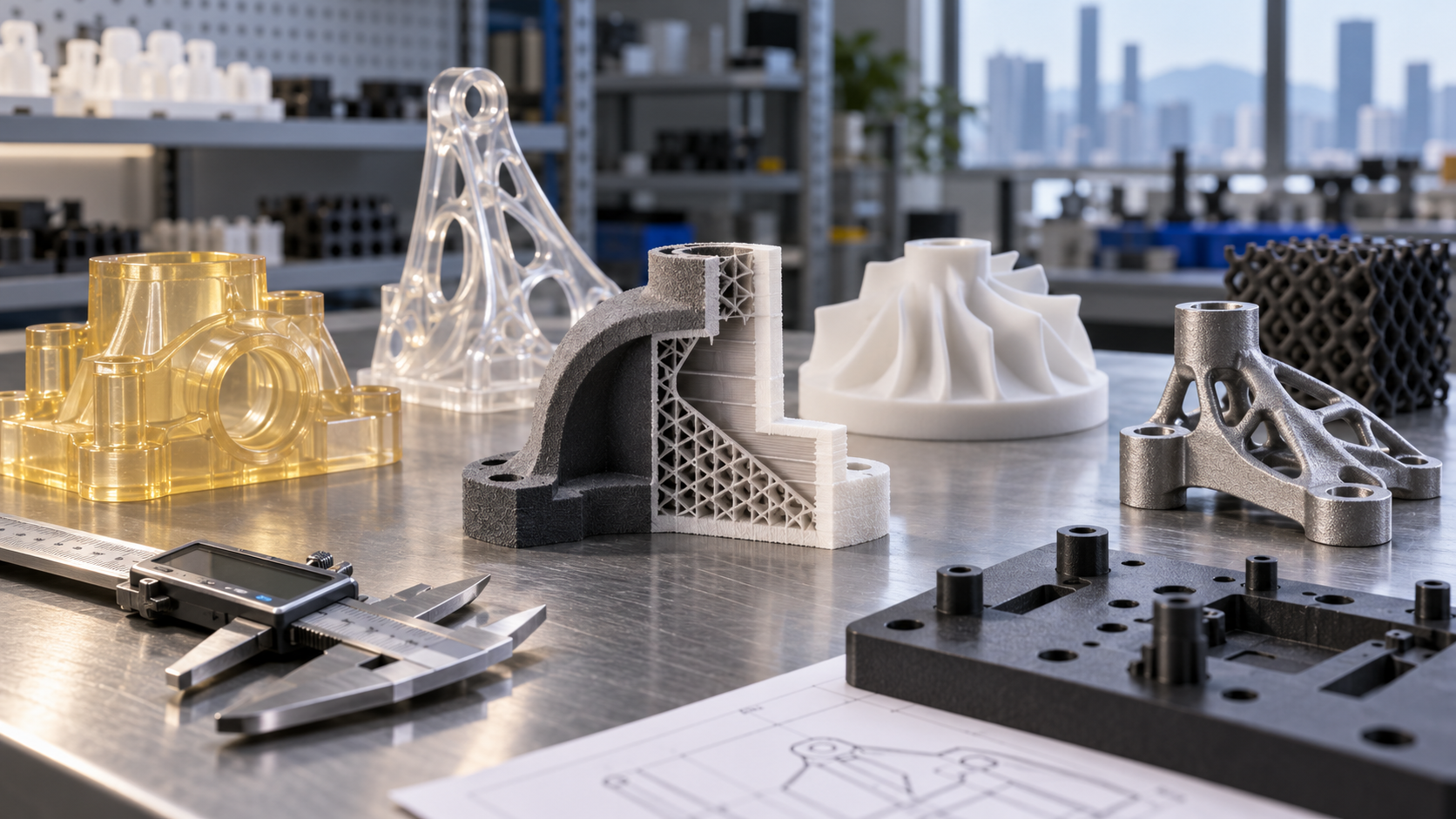
The On-Site Feel of Shenzhen 3D Printing: Why Prototyping Here Can Become Manufacturing
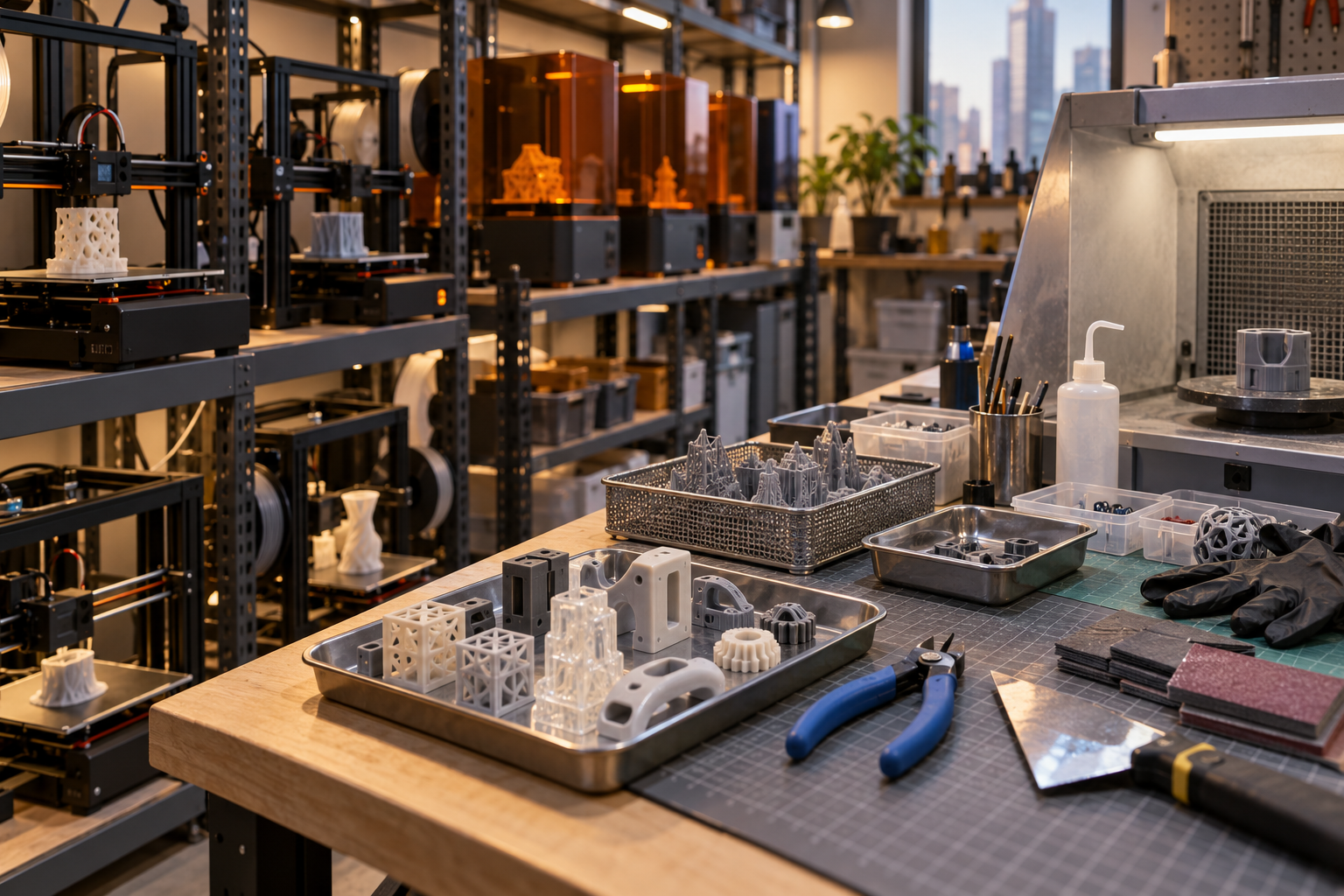
Choose Function Before Process: What FDM, SLA, SLS, MJF, and DMLS Each Solve
The easiest pitfall in Shenzhen 3D printing is not price, but using the wrong process to verify the wrong thing. Printing an enclosure part with FDM to check appearance—layer lines and support marks will mislead your judgment of surface quality; printing a load-bearing bracket with SLA resin and installing it—after a few weeks it creeps and cracks, wasting the entire assembly window. The first step in choosing a process is not asking "which machine," but asking "what is this version meant to verify."
Break the verification purpose into four categories, and the process is basically determined. Appearance verification looks at surface transitions, parting lines, and feel; SLA and MJF more easily produce surfaces close to injection-molded parts. Assembly verification looks at hole positions, snaps, and interference; dimensional stability matters more than surface. Function and heat resistance verification must withstand force, temperature, and repeated assembly; the material grade determines the upper limit. Metal load-bearing parts are where DMLS or direct CNC comes in. If the direction is wrong, no amount of fine post-processing can make up for it.
- FDM (Fused Deposition Modeling): Cheap material, can be made large, obvious strength directionality. Suitable for structural prototypes, jigs, and assembly verification of large enclosures. The surface has layer lines, and mating surfaces usually need allowance or post-machining.
- SLA/DLP (Stereolithography): Fine surface, minimum features can be achieved well, suitable for appearance parts, fine structures, transparent or rubber-like parts. But resin parts age and absorb moisture with long-term exposure, are not heat resistant, and are not suitable as final load-bearing parts.
- SLS (Selective Laser Sintering nylon): No supports, less anisotropy than FDM, good toughness, suitable for functional test parts, small-batch structural parts, snaps, and moving structures. The surface has a frosted feel, and larger parts risk warping.
- MJF (Multi Jet Fusion): A nylon part route similar to SLS, with better batch consistency, suitable for small-batch functional parts from dozens to hundreds of pieces. Details are slightly coarser than SLA, but durability is higher.
- DMLS (Direct Metal Laser Sintering): Metal parts such as stainless steel, aluminum alloy, and titanium alloy, suitable for topology-optimized structures, conformal cooling, and complex internal channels. Cost and post-processing (support removal, heat treatment, finishing of mating surfaces) account for a high proportion, and critical mating surfaces usually still need a CNC pass.
Orientation and Anisotropy: The Same Drawing, Two Results
Quotations for Shenzhen 3D printing rarely reflect one thing: for the same model, different orientations produce two different parts in strength and precision. FDM and SLA build layer by layer, and interlayer bonding strength is usually lower than in-layer strength. Industry-wide, Z-direction tensile strength is commonly only 60% to 70% of XY direction or even lower, depending on material and parameters, and must be confirmed against the material data at the time of order. So directions under tension or bending should not coincide with the build direction. Orientation also changes support contact surfaces, step mark positions, and warping tendency—large flat surfaces placed on the bottom tend to lift at the edges, while angled placement can alleviate this but sacrifices mating surface quality.
This also explains why critical mating surfaces are often required to be "left with allowance for post-machining." Producing the datum and outer shape at the printing stage and leaving holes, bearing seats, and sealing surfaces for CNC finishing is a common combination of Shenzhen 3D printing with CNC, and it is also a way to achieve both prototyping speed and assembly precision. When should you switch directly to CNC or sheet metal? The judgment is straightforward: if what this version needs to test is strength, fatigue, repeated thread disassembly, or strict dimensional chains, printing is only a transition, and going directly to CNC or sheet metal is easier; if you are only quickly confirming shape and assembly relationships, printing is clearly faster.

Tolerances and Fits in Shenzhen 3D Printing: What Can Be Printed, What Must Be Left with Allowance
Holes, Threads, and Thin Walls: The Three Most Underestimated Features in Shenzhen 3D Printing
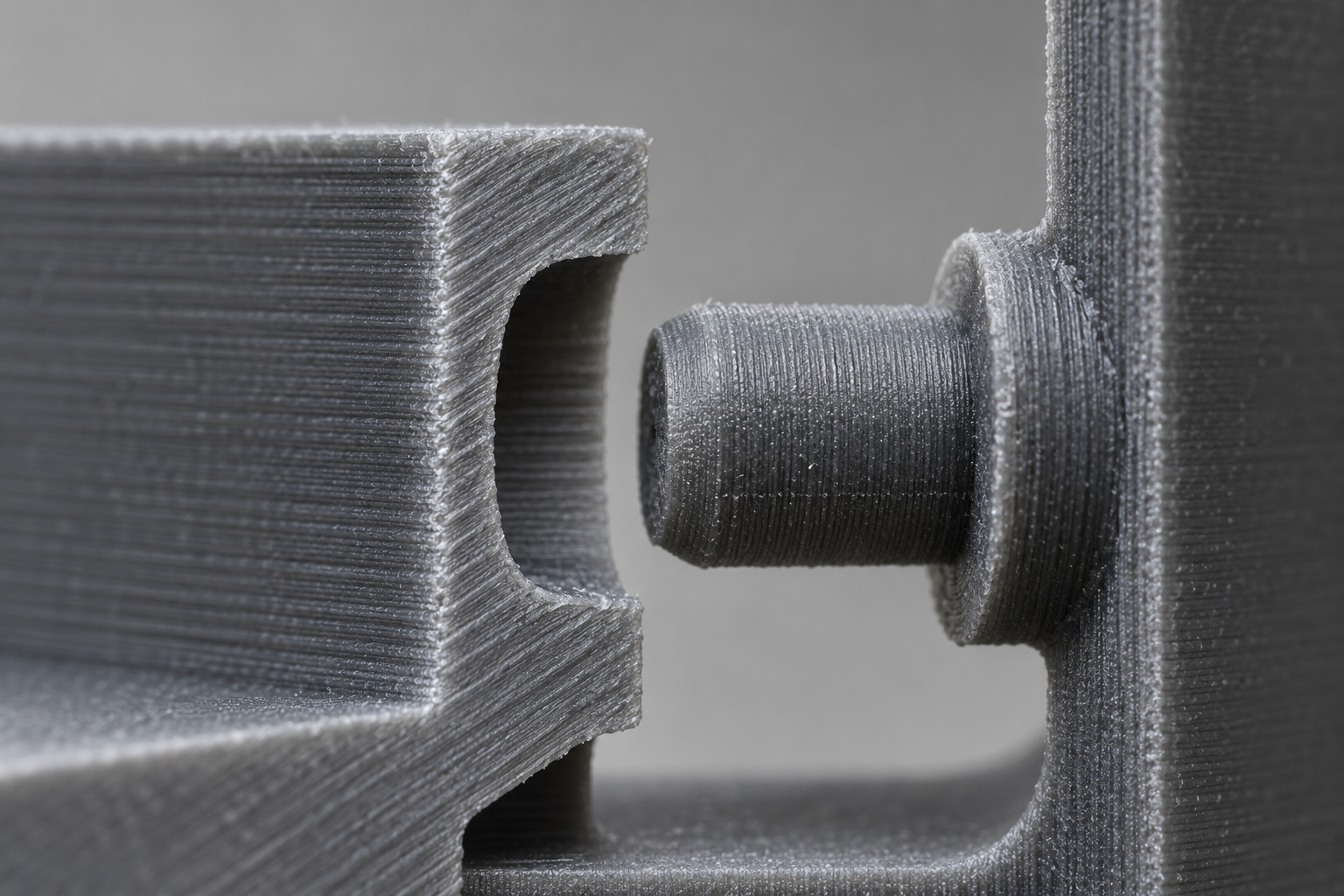
From STL to Finished Product: Files, Fixturing, and Post-Processing—The Three Most Underestimated Steps
Data preparation: mesh repair, wall thickness, and minimum features
Supports and orientation: print direction determines strength and surface

Post-processing: how support removal, sanding, dyeing, and plating change tolerances
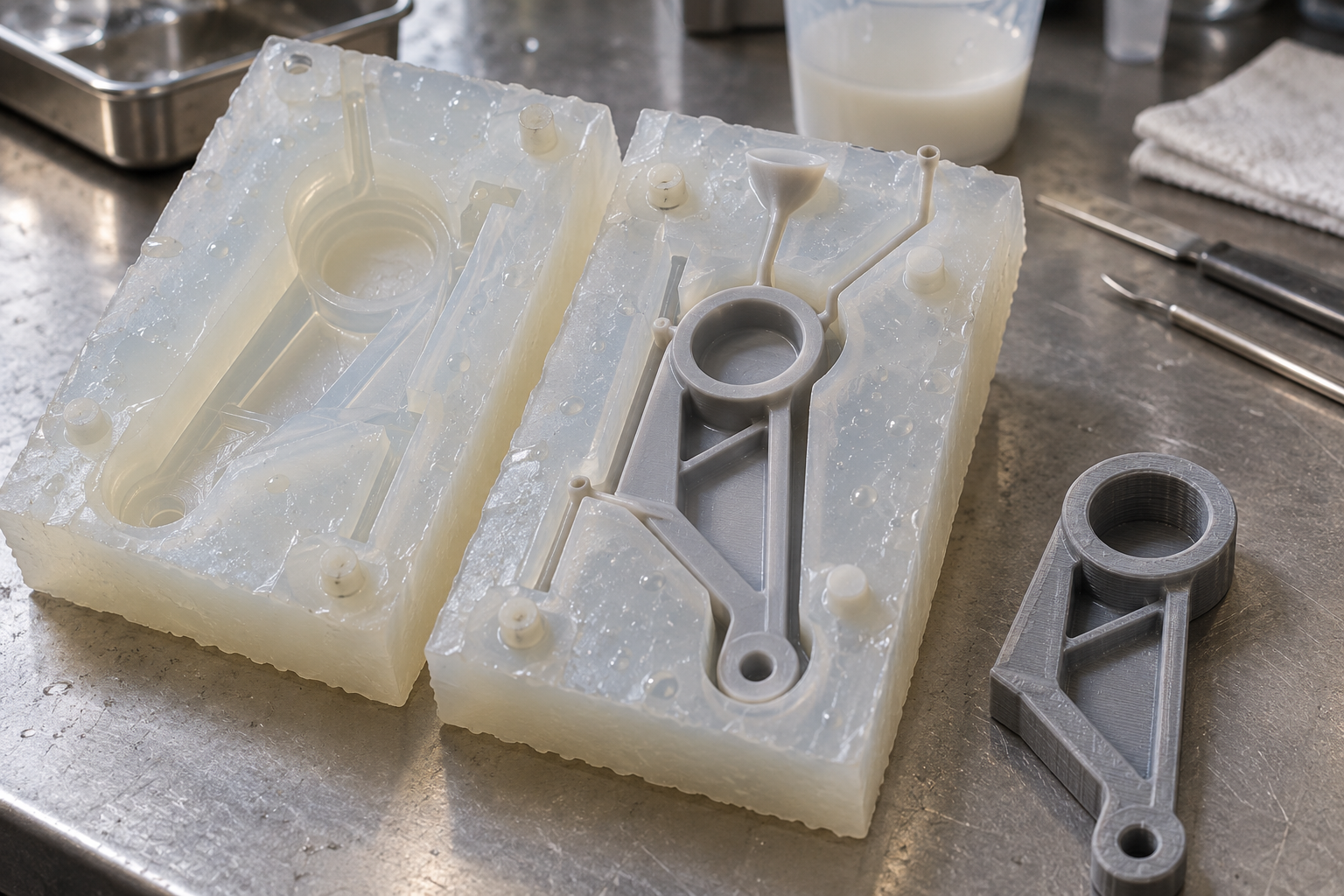
How to bridge small batches: the transition logic from vacuum casting duplication to simple molds
How many parts duplication can handle, and what materials can be cast
Features that must be frozen before cutting a mold
- Draft angle: injection-molded parts must have draft, otherwise demolding causes scratching and stress whitening; duplicated parts can be more relaxed, but draft must be restored before injection molding.
- Wall thickness: injection molding requires uniform wall thickness; thick areas will sink, and thin areas will short-shot. Duplication tolerates wall thickness better than injection molding, but that does not mean it can be ignored.
- Gate location and ejector pin positions: gate marks and ejector pin marks remain on the finished surface, so for cosmetic parts, which side they go on must be decided in advance.
- Cosmetic surfaces and parting lines: once the parting line position is set, the cosmetic acceptance standard is set with it.
- Critical mating dimensions: the tolerance bands for holes, shafts, and snap fits must be verified before mold cutting using physical parts or duplicated parts, not guessed from drawings.
Acceptance and inspection: how Shenzhen 3D printed parts are judged qualified
When a printed part comes off the machine, it can only be considered "formed," not "qualified." In Shenzhen 3D printing services, the step most prone to trouble is treating "it looks fine in the photo" as passing acceptance. Appearance photos can show layer lines and warping, but they cannot show that a hole position is off by 0.2 mm or that the assembly datum surface has been sanded at an angle. For a qualified judgment, the datum, gauges, and inspection items must be clearly written at the time of ordering.
Define the datum first, then talk about measurement
Just because geometric tolerances are marked on the drawing does not mean the processor knows which surface to use as the datum. Printed part surfaces have steps and support marks; if you casually pick a surface as the datum, the measured data will be scattered. A workable approach: specify A/B/C datums on the drawing, and leave a flat area on the model unaffected by supports as the point for dial indicator or scan alignment. Without this agreement, data from a CMM or 3D scan is only "a shape in some pose" and has no judgment significance.
Tier by critical dimensions, rather than applying one standard to everything
Dividing dimensions into three categories before deciding inspection methods is more realistic than "inspect everything to the drawing":
- Critical mating dimensions (hole diameters, shaft positions, mounting surface spacing): these are best measured with gauges or measuring tools; hole diameters commonly use plug gauges/pin gauges, and shaft positions use calipers paired with standard parts for fit checks. Printed part hole edges often have burrs and shrinkage, so caliper readings tend to be optimistic.
- Contour and shape: use 3D scanning to compare against the model; the scan report looks at the deviation cloud map and the maximum deviation area, not single-point numbers. A common industry practice is to overlay the scan result on the original STL/STEP, set the color bands as needed, and see which functional surface the out-of-tolerance points fall on.
- Cosmetic surfaces: clearly define which side is the A surface, how much grain is allowed, and whether support marks are allowed on cosmetic surfaces. This kind of judgment relies on comparison samples or photo standards, not on "it feels about right."

First article approval and sampling
Single-batch quantities for Shenzhen 3D printing are often not large, but "small" does not mean the first article can be skipped. First article approval should verify: whether the datum is usable, whether critical dimensions are within drawing requirements, and whether appearance and dimensions still meet standards after post-processing (support removal, sanding, dyeing, painting). Once the first article passes, subsequent batches are sampled for critical dimensions and appearance; sampling frequency is determined by your assembly risk and piece count. There is no universal number, so you can agree with the processor on a plan both sides can execute. Keep in mind: post-processing such as plating and spraying changes dimensions and surface condition, so the acceptance state must specify whether it is "before post-processing" or "after post-processing."
Inspection capability itself is also a factor in choosing a supplier. Services such as 3D scanning and reverse inspection are valuable because they turn the argument of "it doesn't fit" into a comparable deviation report. When the drawing and inspection requirements are provided together, the judgment has a basis, and you can also go directly to the 3D printing quote entry to clarify gauges, tolerances, and acceptance items together.
Common failures and DFM checklist: six real reasons printed parts do not fit
Shenzhen 3D printing prototyping moves fast, which easily obscures a fact: fast does not mean it fits. We reviewed a batch of printed parts returned by customers, and the problems almost all fell in the same few places—not insufficient equipment precision, but a misalignment between design intent and manufacturing constraints. The six failure causes below are ordered by frequency of occurrence on site, each with a directly actionable DFM step.
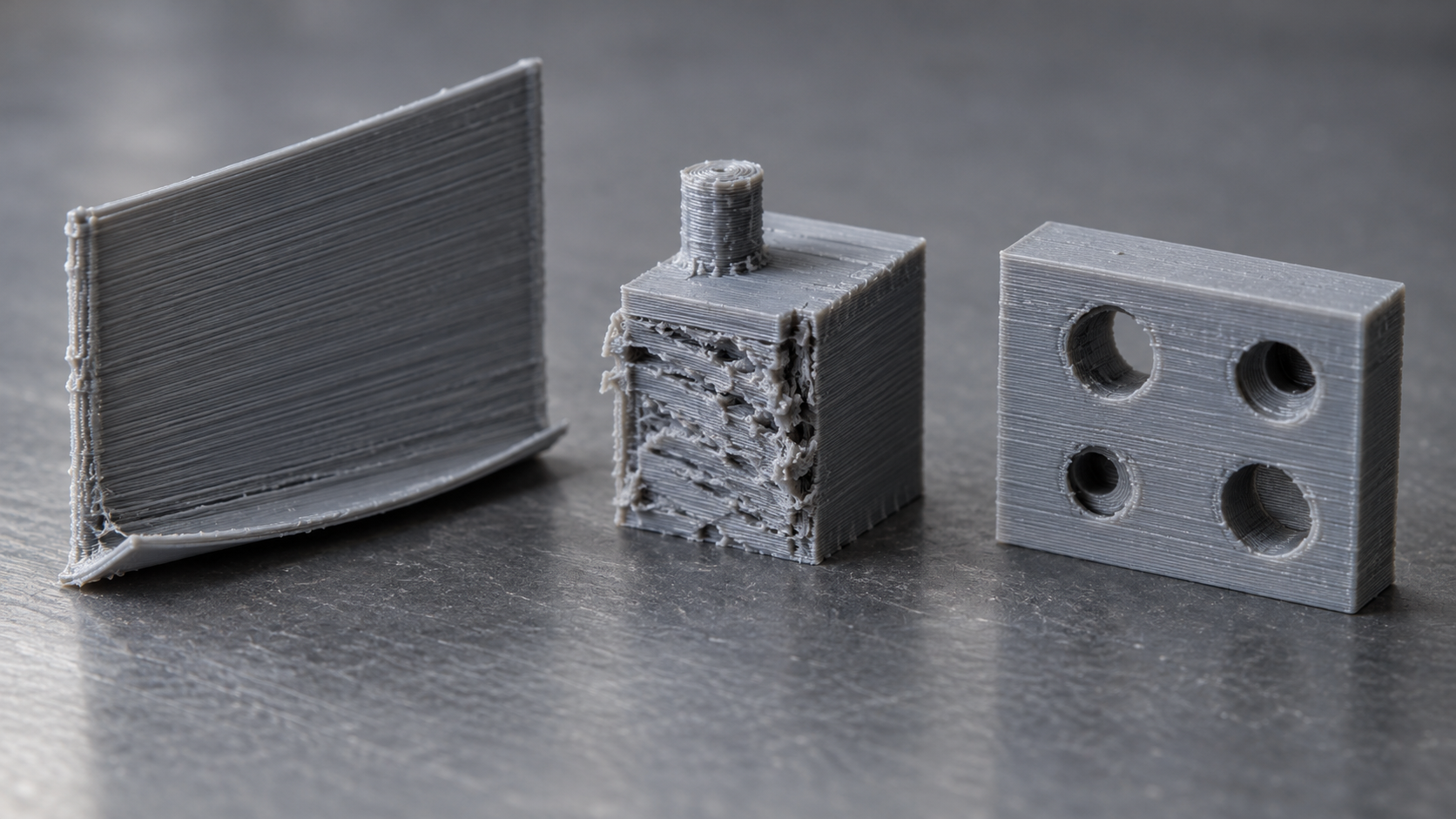
- Warping and shrinkage deformation. Most pronounced in large thin-wall parts, long strip-shaped parts, and crystalline materials, with the bottom edge lifting off the plate first. DFM actions: increase fillets, avoid large-area uniform-wall flat bottoms, add reinforcing ribs in the warping direction or change the orientation, and switch to a process with lower shrinkage if necessary.
- Hole position deviation. Holes are the most fragile feature of printed parts; shrinkage and layer-by-layer buildup commonly make the actual hole diameter 0.1–0.2mm undersized, which is a common phenomenon in the industry. DFM actions: leave allowance for assembly holes, change critical locating holes to post-machining (drilling/reaming), or mark them as "fit-matched during assembly."
- Support marks and rough contact surfaces. After support removal, bumps, steps, and rough surfaces remain, which is especially fatal for appearance parts. DFM actions: orient appearance surfaces upward, keep supports away from mating and sealing surfaces, and when needed specify the contact surface roughness and accept parts in that state.
- Insufficient interlayer strength. FDM and some resin parts have significantly lower strength in the Z direction than in the XY direction; if the tensile direction happens to cross layers, the part will crack along the layers during testing. DFM actions: identify the load direction, adjust orientation so layer lines avoid the main load path, or switch to CNC/injection molding for functional validation.
- Deformation introduced by post-processing. Sanding, dyeing, painting, and electroplating can all cause dimensions to drift by a few tenths of a millimeter, and heat-treatment-type post-processing is even more pronounced. DFM actions: include post-processing in the tolerance chain, and define the acceptance datum based on the finished state rather than the blank state.
- Assembly interference. When multiple parts mate with each other, individual parts may all pass but interfere when assembled, often due to inconsistent datums or tolerances stacking independently. DFM actions: establish a unified datum and fit chain, leave CNC machining allowance on critical mating surfaces, and perform first-article assembly validation first.
Five self-check questions before ordering
Condense the six points above into five questions you can ask directly; going through them before placing a Shenzhen 3D printing order can prevent most rework:
- What is this part validating? Form, assembly, or load-bearing—this determines the process and acceptance criteria; do not use appearance-part standards to validate functional parts.
- Which are the critical dimensions? Mark the mating surfaces and datums, relax the rest, and let manufacturing choose the most cost-effective path.
- Is the relationship between load direction and layer lines clear? If not, confirm the orientation plan first; do not start printing directly.
- Will post-processing affect the mating surfaces? If so, write post-processing into the tolerance chain and acceptance state.
- Who inspects, and in what state? Agree on gauges, scan comparison, or physical assembly; do not release based only on photos.
Among these six causes, usually only two or three truly require design changes; the rest can be solved through orientation, allowance, and acceptance criteria. When you cannot judge, provide the part's purpose, critical dimensions, and load direction together to Agile Intelligent Manufacturing Shenzhen Technology Co., Ltd.; we will first give process and DFM recommendations, then discuss quotation—far more cost-effective than discovering after printing that it cannot be assembled. To see capability boundaries first, check 3D printing capabilities and rapid prototyping.
Common questions about Shenzhen 3D printing
The following are common follow-up questions around this article's process judgment, tolerance fits, small-batch transition, and acceptance logic. The answers provide criteria you can check against, not promises; for specific values, refer to the drawings, material batch, and final finished state.
For the several Shenzhen 3D printing processes, in what order should they actually be selected?
First ask what the part needs to validate. If only form and feel are needed, SLA or MJF is sufficient; if you need to screw, snap-fit, or achieve interference fits, prioritize SLS/MJF or go directly to CNC; if heat resistance, load bearing, or functional testing is needed, then consider DMLS metal or switch to CNC. The order is function → assembly → appearance, not choosing a machine first. If the same part needs both appearance and assembly, a common approach is to print the appearance part and leave allowance on mating surfaces for CNC finishing.
What tolerances can 3D printing provide? How much allowance should be left for shaft-hole fits?
Printing tolerances are a range, not a single value, and are affected by layer thickness, orientation, material shrinkage, and post-processing. Common industry practice is: accept non-mating surfaces at the printing's original tolerance, leave 0.1–0.3 mm per side for shaft-hole fits depending on process and size, and leave 0.3–0.5 mm machining allowance on critical mating surfaces for CNC. These are judgment references, not company guarantees—please mark fit requirements on the drawing and let engineering confirm before deciding.
For small batches from dozens to hundreds of pieces, can Shenzhen 3D printing handle it directly?
Yes, but distinguish the stages. For dozens of pieces, use SLS/MJF or SLA direct printing to avoid tooling; for hundreds of pieces with materials close to the final plastic, silicone mold vacuum casting (prototype duplication) is usually more cost-effective; as quantities rise further and materials and surface requirements approach mass production, evaluate simple molds or formal injection molding. Before duplication, draft angles, wall thickness, and gate locations must be frozen, otherwise one structural change equals redoing an entire mold set.
Will post-processing change dimensions? Which state is used for acceptance?
Yes. Support removal, sanding, dyeing, painting, and electroplating all change surface roughness, and some processes also cause slight dimensional changes. Therefore acceptance criteria must be defined by the finished state, not the blank straight off the machine. It is recommended to specify the post-processing method and acceptance datum on the drawing or inspection sheet, and re-measure critical dimensions after post-processing to avoid passing appearance but failing assembly.
How are Shenzhen 3D-printed parts judged as qualified—can photos alone suffice?
No. Photos can only show appearance; assembly depends on dimensions. Conventional practice is: compare the first article with the digital model using CMM or 3D scanning to confirm critical dimensions and geometry; judge appearance parts by the agreed surface grade and color difference; re-inspect critical dimensions of batch parts according to a sampling plan. Datums, gauges, and judgment criteria are best written clearly before ordering to reduce back-and-forth rework.
Key takeaways
- The competitiveness of Shenzhen 3D printing lies not in the number of machines, but in the engineering judgment that aligns materials, tolerance bands, fixturing, and inspection all at once.
- Selection starts with function: appearance verification looks at surface and layer lines, assembly verification looks at tolerances and fits, and functional verification looks at anisotropy and heat resistance.
- Printing tolerance is not a single value; it is jointly affected by layer thickness, orientation, shrinkage, and post-processing. Critical mating surfaces should be left with machining allowance or switched to CNC.
- At the small-batch stage, vacuum casting duplication or simple molds can bridge the gap, enabling a smooth transition to injection molding without overturning the design.
- Acceptance must clearly specify datums, gauges, and sampling methods; otherwise, the same drawing will cause disputes when given to a different supplier.