CNC Machining
Five-Axis Machining: A Decision Checklist for Engineers and Buyers, from Fixturing Strategy to Acceptance
9/11/2026, 08:504 views
Five-axis machining is not a "more expensive CNC"—it is a process choice that uses a single setup to handle multiple faces, deep cavities, and complex curved surfaces. This article provides a judgment framework that engineers and buyers can directly apply, from part feature assessment, fixturing and tool accessibility, programming and in-machine inspection, to quoting and acceptance points.
First Determine Whether the Part Really Needs Five-Axis
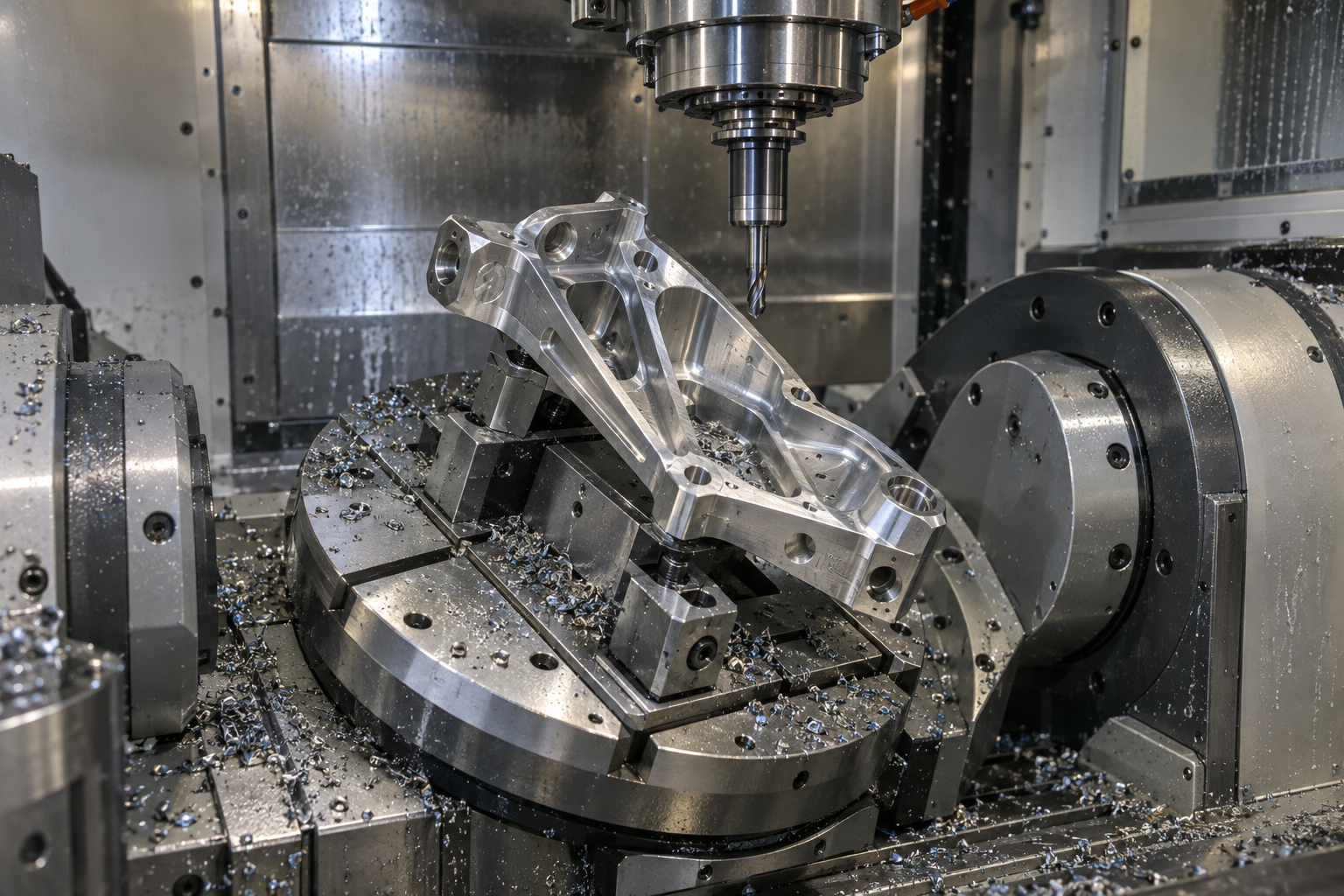
A common bracket in the shop: all four sides have mounting holes and mating faces, and their directions are not orthogonal to each other. With three-axis machining, every change of direction requires re-fixturing and re-alignment. After four setups, datum drift and accumulated error are often larger than the error of the tool itself. For this type of part, the value of five-axis truly shows—it compresses "multiple setups" into "one setup," while allowing the tool axis to avoid interference and reach into deep cavities and side walls.
But five-axis is not a synonym for "more advanced." Its core value comes down to just two things: reducing the number of setups, and solving tool accessibility. If the part itself is a body of revolution, or all features can be machined from one direction, forcing five-axis will only drive up cost. When judging, you can first ask yourself a few questions:
- Are there non-orthogonal machining faces that require flipping or special angle fixtures on three-axis?
- Are there deep cavities, undercuts, or side-wall features that a straight-shank tool cannot reach?
- Is it a complex curved surface that requires continuous tool-axis tilting to ensure surface quality?
- Is it thin-walled and prone to deformation, where the clamping force of multiple setups would introduce distortion?
- Are the assembly datums distributed across multiple directions, requiring a single setup to ensure positional relationships?
The more of these questions are hit, the more five-axis is worth considering. Conversely, if it is just "wanting to try five-axis," it is advisable to first go back and evaluate the three-axis plan. To determine whether a specific part is suitable, you can send the 3D model and key datums to the engineering team to judge together, then decide the process route.
Fixturing, Tool Accessibility, and Programming: The Three Keys to Implementing Five-Axis
The five-axis machine itself is only a tool. What truly determines whether a part can be made, how high the quote is, and how long the lead time will be are the three links of fixturing plan, tool accessibility, and programming simulation. Many projects get stuck not because of the equipment, but because of these process details.
Fixturing Plan: The Trade-Off Between One Setup and Multiple Setups
One of the core values of five-axis is completing machining in multiple directions with a single setup, reducing accumulated error from datum changes. But a single setup is not always optimal: when the part lacks rigidity, when the fixture and rotary table interfere, or when a large amount of material must be removed from both sides of the blank, sequential setups are actually more reliable. When evaluating, check whether the part has reliable clamping surfaces, whether the fixture will block the toolpath, and whether the workpiece and spindle might collide when the rotary table rotates. These factors directly affect the number of setups, and the number of setups is one of the main sources of quote differences.
Tool Accessibility: Ball-End Mills, Length-to-Diameter Ratio, and Vibration
Being able to tilt the tool axis on five-axis does not mean any corner can be reached. Deep cavities, narrow slots, and steep side walls often require slender tools, and the larger the length-to-diameter ratio, the higher the risk of tool deflection and vibration, and the harder it is to guarantee surface quality. Ball-end mills are suitable for finishing curved surfaces, but stepover and scallop height need to be weighed during programming. During the evaluation stage, engineers should confirm: whether the minimum tool diameter can reach the feature, whether the tool overhang exceeds the stable range, and whether special tool holders or extension bars are needed. These directly affect machining efficiency and tool cost.
Programming and Simulation: Tool-Axis Control, Collision Checking, and Post-Processing
Five-axis programming is not a simple overlay of three-axis toolpaths. The tool-axis control strategy determines surface quality and machining efficiency; collision checking must cover the full combination of tool, holder, fixture, and rotary table; and post-processing must match the specific machine's kinematic structure. Programs lacking simulation verification carry high risk when run on the machine. For buyers, this means the programming hours and verification cost for complex five-axis parts are usually higher than for three-axis parts, and quotes should reflect this workload rather than only comparing machine hourly rates.
Quoting and Acceptance: What Buyers Should Ask, What Engineers Should Provide
Differences in five-axis quotes often lie not in the machine itself, but in these three things: number of setups, tool wear, and inspection method. If buyers provide complete information before requesting a quote and engineers clearly explain the datums, both sides can avoid an extra round of rework.
Information to Prepare Before Requesting a Quote
- 3D model: Prefer neutral formats such as STEP, to avoid feature misunderstanding caused by providing only 2D drawings.
- Key dimensions and datums: Indicate which faces, holes, and contours are assembly datums, and which can be relaxed.
- Material and surface requirements: State the material grade, heat treatment condition, and surface treatment method together.
- Batch size and lead time expectations: One-off, small batch, or repeat order directly affects fixturing and programming strategy.
Where Quote Differences Come From
For the same drawing, two quotes may differ considerably. Common reasons are: a part that could be completed in one setup is split into multiple setups; deep cavities or thin walls require small depth of cut and slow feed, causing higher tool wear; requiring a full-dimensional CMM report versus only spot-checking key dimensions involves completely different inspection hours. Buyers can proactively ask: How many setups does this price correspond to, and which dimensions will have inspection reports?
Acceptance: Datum Consistency Takes Priority Over Number of Dimensions
During acceptance, first confirm that the inspection datum is consistent with the design datum; otherwise, even the most complete data may lead to misjudgment. Prioritize re-checking key features—assembly faces, locating holes, mating contours; for complex curved surfaces, you may require in-machine inspection or CMM verification. For specific inspection plans and acceptance criteria, it is recommended to confirm with engineering at the quoting stage rather than adding them after the part is finished.
Combining five-axis with other processes: when you don't need five-axis
The value of five-axis lies in reducing setups and avoiding tool interference, but it is not the default option for every part. Overusing five-axis often means higher quotes and longer preparation time. When judging, look at the part geometry first: if it is mainly a body of revolution with no non-orthogonal features, CNC turning is usually more direct; if it is a thin-walled enclosure dominated by bending and welding, sheet metal fabrication may be more economical than milling; if it is only a prototype stage to validate the structure, first use 3D printing to make a few versions, and after confirming the assembly relationships, switch to five-axis machining for functional parts, which can save considerable programming and setup costs.
The idea behind process combination is: let each process do what it does best. Use 3D printing for rapid iteration in the prototype stage, CNC machining for functional validation parts, and sheet metal or injection molding for production enclosures. Only parts that truly have multi-directional machining faces, deep cavities, or complex curved surfaces are worth five-axis. When requesting quotes, procurement might as well ask first: can this part be completed with three-axis plus one setup? If the answer is yes, five-axis is not a necessity.
- Mainly bodies of revolution with no side features: prioritize CNC turning
- Thin-walled enclosures dominated by bending and welding: prioritize sheet metal fabrication
- Structural validation in the prototype stage: use 3D printing first, then switch to CNC functional parts
- Multi-directional machining faces, deep cavities, complex curved surfaces: only then does five-axis offer clear advantages
Common Questions FAQ
The following are the questions engineers and procurement ask most often when evaluating five-axis machining. The answers are kept cautious; please confirm specific parameters with the engineering team.
Is five-axis always more accurate than three-axis?
Not necessarily. The value of five-axis lies in reducing the number of setups and improving tool accessibility, thereby lowering cumulative error and interference risk; but the final accuracy still depends on machine condition, setup rigidity, tooling, and process parameters. For parts with simple structures, three-axis with good fixtures can also achieve stable results.
What materials can five-axis machine?
Common metals and engineering plastics can usually be machined, depending on the tooling, cutting parameters, and machine configuration. It is recommended to provide the material grade and key requirements when requesting a quote so the engineering team can evaluate feasibility and the tooling plan.
Why is the quote more expensive than three-axis?
The difference mainly comes from setup plan design, tool wear, programming and simulation time, and inspection methods. Five-axis often requires dedicated fixtures or rotary table coordination, and programming and collision checking are more time-consuming. These steps often affect the quote more than the machine itself.
Is five-axis suitable for small batches?
When a part has non-orthogonal machining faces, deep cavities, or complex curved surfaces, and multiple setups would cause obvious cumulative error, five-axis is actually more cost-effective for small batches. If the structure is simple, three-axis or turning may be more economical.
How do you inspect complex curved surfaces?
It is recommended to first confirm that the datum is consistent with the drawing and prioritize inspection of key features; when necessary, use in-machine inspection or CMM verification. Acceptance criteria should be aligned with the engineering team before quoting to avoid later disputes.
Key takeaways
- The value of five-axis comes mainly from reducing the number of setups and tool interference, not simply from higher spindle speeds or feed rates.
- To judge whether five-axis is worthwhile, first check whether the part has multiple non-orthogonal machining faces, deep cavities, or complex curved surfaces.
- Quote differences often come from the fixturing plan, tool accessibility, and inspection requirements, not from the material unit price itself.
- Before acceptance, first confirm the datum, key features, and inspection method to avoid "dimensions pass but it won't assemble."
- For small batches and prototype stages, you can first validate with three-axis plus multiple setups, then decide whether to switch to five-axis.