Material
Material Selection: A Practical Approach from Part Function to Process Matching
9/13/2026, 10:200 views
Material selection is not about looking up a table and matching by number; it is about weighing force, environment, cost, and process constraints. This article outlines the selection logic for metals and plastics, as well as the material preferences and limitations of CNC, 3D printing, sheet metal, vacuum casting, and injection molding.
Start from functional requirements, not from material grades
Many projects go off track before the drawings are even finalized: someone opens with "should we use 6061 or 7075," while someone else directly asks "can we use PEEK." Grade names sound professional, but they cannot answer the most fundamental question—what is this part actually supposed to do? The first step in material selection is not flipping through a materials handbook, but clearly writing down the part's functional requirements: does it bear continuous load or impact? Does it operate at room temperature, high temperature, or under thermal cycling? Is it exposed long-term to moisture, chemicals, or outdoor UV? Is the service life requirement a few assemblies or years of service? Is the appearance a hidden structural part or a panel the user touches every day?
Once these conditions are listed, the material direction often emerges on its own. A bracket subjected to repeated bending needs toughness, not ultimate strength; an outdoor equipment enclosure makes weather resistance and UV aging resistance more critical than hardness; a threaded insert that is frequently disassembled and reassembled makes wear resistance and galling resistance the key points. Conversely, if you lock in a grade first, it is easy to fall into the trap of "the material can be bought, but the process cannot make it": you choose a high-strength aluminum alloy, only to find that a thin-wall structure deforms easily during CNC machining; you choose a high-rigidity plastic, only to find that it has poor flowability and cannot fill the ribs during injection molding. Material, structure, and process are bound together. Define function first, then determine the material direction, and finally use the process to validate it. If the order is reversed, rework costs will rise exponentially.
Metals and Plastics: Two Different Selection Logics
Many selection discussions get mixed up from the start: comparing the "lightness" of plastics with the "strength" of metals, or using the temperature resistance of metals to set requirements for plastics. In reality, the selection dimensions for metals and plastics are not in the same coordinate system. The core judgment for metal parts usually revolves around strength, hardness, corrosion resistance, and machinability; plastic parts focus more on stiffness, toughness, temperature window, and hygroscopicity. Separating these two logics makes selection much clearer.
Metals: Ask About Load and Environment First, Then Machining
Metal selection often starts with the stress state: is it a structural part bearing continuous load, or a part mainly used for support, heat conduction, or electrical conduction? Next is the environment—whether it is humid long-term, whether it contacts chemical media, and whether it is exposed outdoors to sunlight. These two points basically determine the broad material category. Only then does machinability come into play: CNC machining has good adaptability to most metals, but different metals differ significantly in cutting difficulty, deformation tendency, and surface quality; sheet metal relies more on the material's ductility, so materials that crack easily during bending and stamping are not suitable. The hardness and strength of metals are usually positively correlated, but the higher the hardness, the greater the machining difficulty and tool wear, which is a trade-off that must be accepted during selection.
Plastics: The Balance of Stiffness, Toughness, Temperature, and Moisture Absorption
Plastic selection is more like finding a balance point among several mutually constraining dimensions. Stiffness determines whether the part will deform noticeably under load; toughness determines whether it fractures or absorbs energy under impact. Many plastics become brittle at low temperatures and soften near their upper temperature limit, so the operating temperature window must be confirmed in advance. Hygroscopicity is often overlooked: some plastics absorb moisture and swell in humid environments, causing dimensional changes or performance degradation, which is especially critical for precision fitting parts. In addition, plastics vary greatly in chemical resistance and UV resistance, and outdoor parts and parts exposed to oil need separate evaluation.
| Selection Dimension | Metal | Plastic |
|---|---|---|
| Primary Focus | Strength, hardness, corrosion resistance | Stiffness, toughness, temperature window |
| Environment-Sensitive Factors | Rust, electrochemical corrosion | Moisture absorption, UV aging, chemical attack |
| Key Machinability Factors | Cutting difficulty, deformation tendency, ductility | Flowability, shrinkage rate, mold release |
| Common Misconception | Focusing only on strength and ignoring machining cost | Using metal thinking to require plastic stiffness |
A practical way to judge is: if the part needs to bear relatively large concentrated loads, long-term high temperatures, or frequent friction, metal is usually a more reliable starting point; if the part pursues lightweight, insulation, resistance to general chemical environments, or complex integrated molding, plastic is often more suitable. The two are not substitutes, but each solves different problems. What really needs to be guarded against is "using the wrong coordinate system"—for example, using plastic to replace a load-bearing part that should have been metal, or forcing metal into an application requiring insulation and then adding an insulation layer, both of which make subsequent processes and costs more complicated.
How Process Constraints in Turn Determine Material
Many selection discussions assume by default that material is the independent variable and process is the dependent variable: first determine the material, then find a process that can machine it. In actual projects, this order often has to be reversed. Processes have hard preferences for a material's forming method, flow behavior, and ductility. If the direction is wrong, no matter how beautiful the drawing is, it cannot be realized. Below is a breakdown by process.
CNC: Hardly Picky About Materials, but Picky About "Being Machinable and Stable to Cut"
CNC machining has the highest material tolerance, and can handle both metals and plastics. But it is not without constraints: materials that are too soft tend to cause chip welding and poor chip evacuation, while materials that are too hard or too tough affect tool life and surface quality. When selecting a material, ask one question: does this material brittle-fracture or weld to the tool during cutting? The former gives a smooth surface but is prone to edge chipping, while the latter requires a more conservative feed strategy. Thin-walled parts also need to account for the risk of deformation under cutting forces; when the material lacks sufficient rigidity, the structural design has to give way.
3D printing, sheet metal, vacuum casting, injection molding: each has its own "material threshold"
The constraints of 3D printing come from the forming principle: different processes correspond to different material forms, and the material must match that process's curing or melting mechanism and cannot be substituted arbitrarily. Sheet metal, on the other hand, requires the metal to have sufficient ductility—bend radius, springback, and cracking risk are all directly related to the material's plasticity, and highly brittle metals tend to fail at the bend. Prototype vacuum casting has requirements for the material's viscosity and flowability: too high a viscosity leads to incomplete filling and difficulty in evacuating bubbles, while too low a viscosity may affect wall thickness uniformity. Injection molding is most sensitive to flowability: whether the runner can be filled, weld line strength, shrinkage, and warpage all depend on the material's behavior in the molten state, not on the strength values in a room-temperature data sheet.
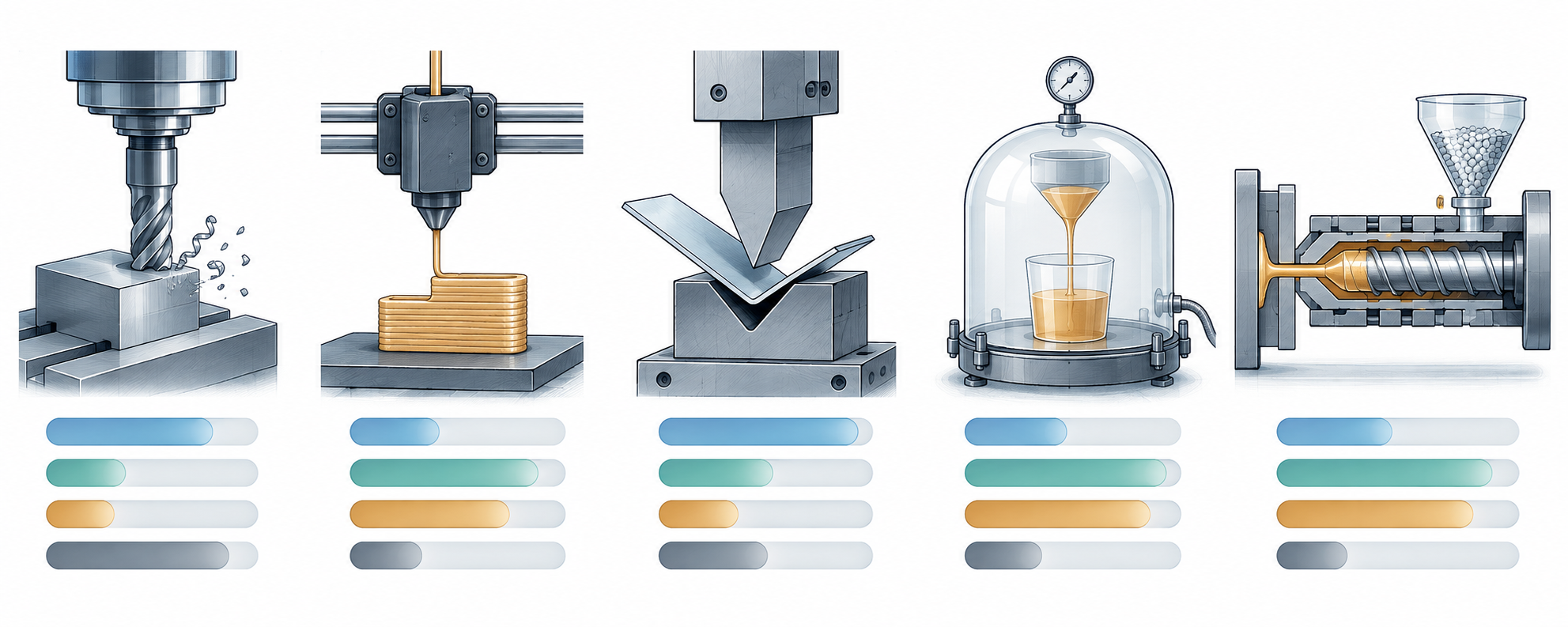
Putting these points together, the conclusion is clear: process and material are a two-way choice. First lock in the process route, then choose the material within the range allowed by that process that best fits the functional requirements; or first lock in the material, then confirm whether the process can achieve it stably. When the two conflict, prioritize adjusting the structure or process rather than forcing a grade that is "the best performing." For your specific part, you can compare the material compatibility range of each process in the manufacturing capabilities overview, and then decide on the direction.
Small batch and mass production: the watershed in material strategy
At the prototype stage, material selection is often very free: CNC can cut any sheet stock, 3D printing can switch filaments or resins, and prototype vacuum casting can adjust two-component resins. But once you move into small-batch or mass production, material is no longer a question of "can it make the shape," but of "can it stably make the same thing every time." The watershed usually appears at two points: first, the shift from vacuum casting to injection molding; second, the shift from 3D printing or CNC to mold-based forming.
Vacuum casting and injection molding: the materials are not the same thing
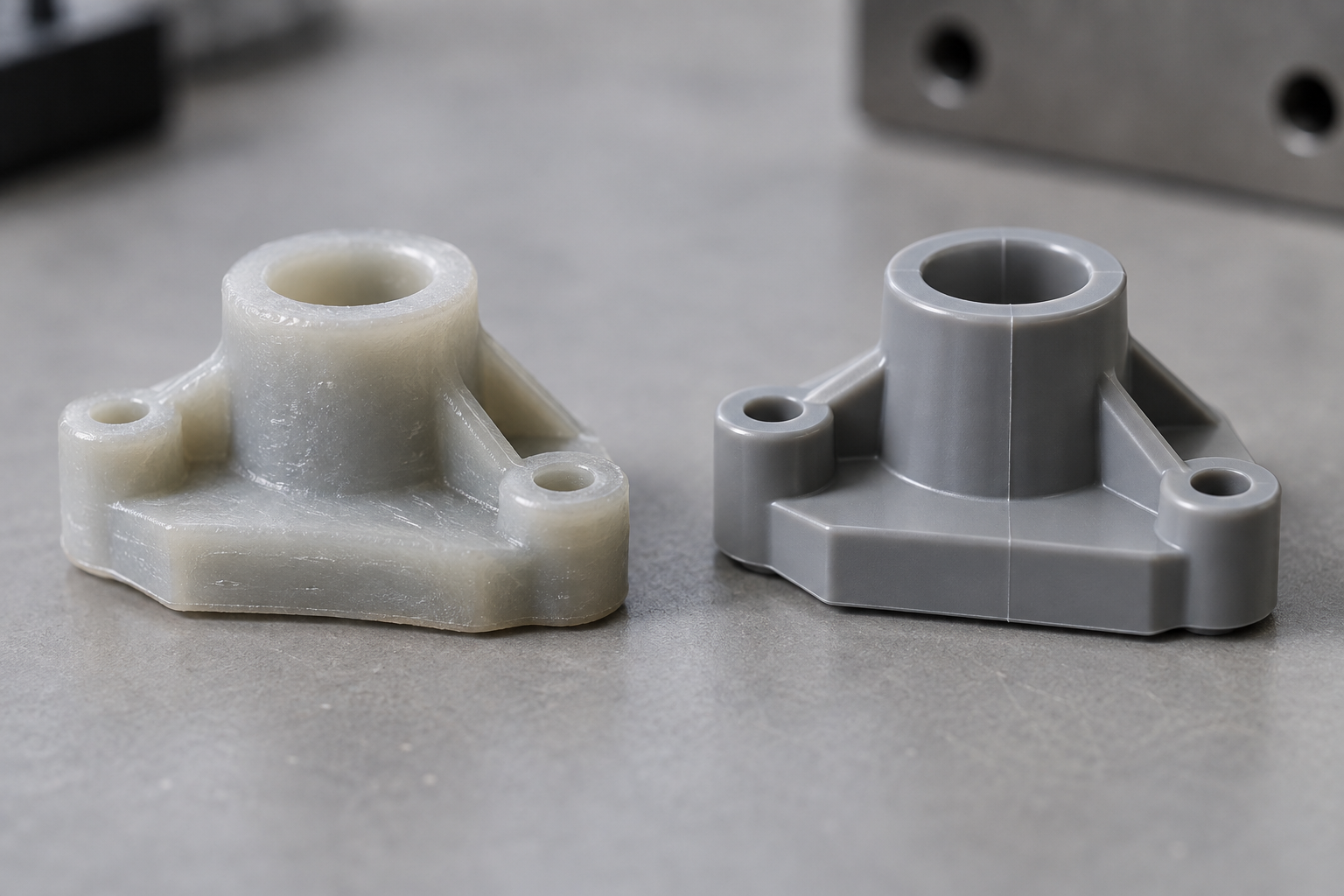
Prototype vacuum casting (vacuum pouring) commonly uses polyurethane resins, with the advantages of low mold cost and short lead time, suitable for small batches of dozens to hundreds of parts. But vacuum casting materials and the thermoplastics used in injection molding are not equivalent in molecular structure, flow behavior, or long-term performance. Vacuum-cast parts can achieve appearance and assembly verification, but they may not represent the toughness, heat resistance, or chemical resistance of injection-molded parts. If the product will ultimately go to injection molding, it is advisable to confirm the target production material with the engineering team already at the vacuum casting stage, to avoid "vacuum casting passes, injection molding fails."
Material equivalence between 3D printing and CNC
3D printing (FDM/SLA/SLS/MJF/DMLS) and CNC machining can both cover the range from prototype to small batch, but their material equivalence differs. CNC directly uses metal or plastic sheet/bar stock, so material properties are closer to the final part; 3D printing is affected by interlayer bonding, print orientation, and post-processing, with obvious anisotropy. If the part bears cyclic loads or has sealing requirements, be cautious when using 3D printing for functional verification, and if necessary use CNC to make comparison parts from the same material. When should you lock in the production material in advance? When the part involves safety, sealing, long-term weathering, or assembly fit, it is advisable to lock it in at the late prototype stage rather than waiting until just before mold opening to change materials.
Verification and confirmation: judgment beyond the data sheet
The data sheet gives the performance of a standard specimen under controlled conditions, while the actual part is the product of a specific structure, a specific process, and a specific assembly environment. The gap between the two is often the source of batch failures. Therefore material confirmation cannot stop at "the table says it passes," but must be grounded in physical samples.
Sample trial assembly: look at assembly first, then performance
Many material problems only surface at the assembly stage: plastic parts with insufficient stiffness cause snap fits to spring back inadequately, metal parts undergo slight deformation after assembly due to residual machining stress, and vacuum-cast parts cannot be interchanged with injection-molded parts due to dimensional inconsistency from shrinkage. It is advisable to use real mating parts for trial assembly and record interference, clearance, and feel, rather than only looking at single-part dimensional reports. If the part has motion or load-bearing conditions, apply the actual load in the trial-assembled state and observe whether there is abnormal noise, loosening, or permanent deformation.
Environmental testing and appearance comparison
Environmental testing does not need to go all the way to full certification in one step, but it should at least cover the extreme conditions the part will actually encounter: high-temperature storage, low-temperature brittleness, humidity or condensation, and contact media (oil, cleaning agents, sweat, etc.). In terms of appearance, the surface texture of the same material varies noticeably under different processes—CNC tool marks, 3D printing layer lines, and the mold-surface replication effect of vacuum casting all affect the customer's perception of "the same material." It is advisable to compare appearance samples with the final product under the same light source to confirm whether color difference, gloss, and texture are acceptable.
If you need to make a systematic comparison among multiple candidate materials, you can refer to the material library and the materials guide to first narrow the range, and then use samples to verify and finalize.
Frequently asked questions
At the end of material selection, it is often not a technical problem but a judgment problem. The following questions come from actual project communications, and the answers try to give the basis for judgment rather than just conclusions.
How do you determine whether a part should use metal or plastic?
First look at load and environment: parts that need to withstand large bending, impact, high temperature, or long-term wear usually prioritize metal; parts mainly for insulation, lightweight, chemical corrosion resistance, or appearance often make plastic more suitable. If both are feasible, then compare process cost and assembly method, rather than locking in the material first.
Can the material used for prototype vacuum casting be equated with the material for injection molding mass production?
They cannot be directly equated. Vacuum casting materials differ from injection molding materials in flowability, shrinkage, and mechanical performance. They are suitable for verifying appearance, assembly, and basic feel, but for conclusions involving long-term loading or environmental aging, it is advisable to confirm again with injection-molded samples or the actual production material.
Can 3D printed parts be used directly for functional testing?
It depends on the purpose of the test. Assembly verification, structural interference checks, and appearance reviews are usually fine; for tests involving fatigue, sealing, long-term load, or high-temperature conditions, the interlayer bonding and density of printed parts differ from production parts, so conclusions need to be treated cautiously, and if necessary retest with CNC or injection-molded parts.
Can the performance values on a material data sheet be used directly as the basis for selection?
The data sheet is a starting point, not the end point. Actual performance is affected by wall thickness, gate location, print orientation, post-processing, and more, and the same material differs noticeably under different processes. It is advisable to judge based on sample trial assembly and targeted testing, rather than only looking at table values.
Key takeaways
- Material selection should start from functional requirements (force, environment, service life), rather than locking in a grade first and then finding a process.
- The same material performs very differently under different processes, and process constraints often determine the solution earlier than the material itself.
- The selection logic for metals and plastics is different: metals focus on strength and environmental resistance, while plastics focus on stiffness, toughness, and temperature window.
- The material strategy for small batches and mass production is different, and the transition between vacuum casting and injection molding needs to be considered in advance.
- Material confirmation is best verified through samples or test pieces, rather than making the final decision based only on data sheets.