Manufacturing processes
Process scheduling: practical logic for sequencing multi-process orders
9/13/2026, 14:000 views
An order contains CNC, sheet metal, 3D printing, and cast replica parts at the same time—which comes first, where does it get stuck, and how do you insert a rush job? This article explains the dependencies in process scheduling, bottleneck identification, and the cost of inserting jobs, with a scheduling checklist.
When one order stalls the whole line, the problem is often not the machine
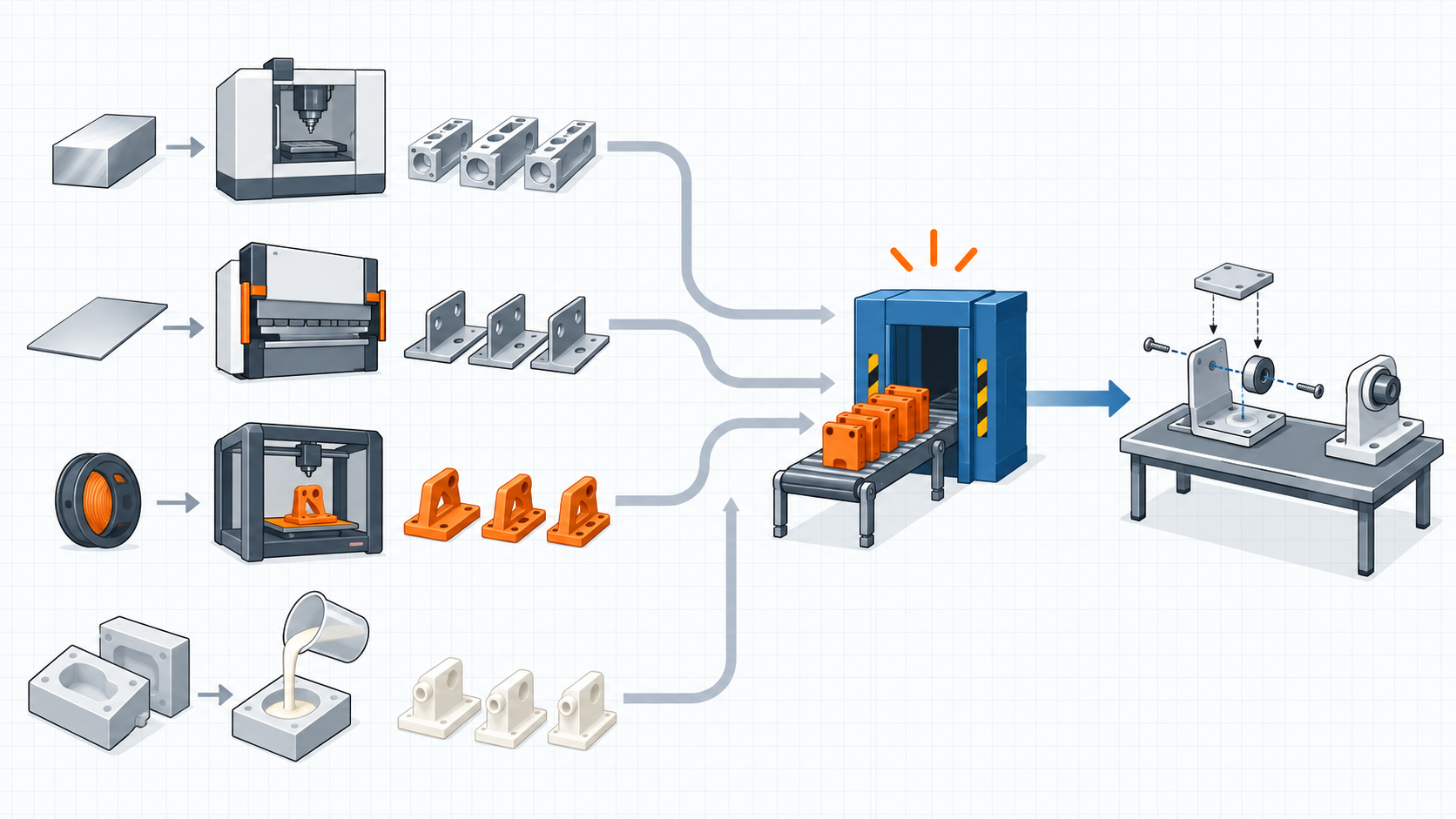
A common scene on the shop floor: one order includes CNC precision parts, sheet metal enclosures, 3D printed prototypes, and hand-made replica parts. The CNC parts were delayed by two days because the fixturing plan was adjusted at the last minute; the sheet metal enclosures were bent early and are stacked on the rack; the replica parts are waiting for the CNC parts to confirm the assembly dimensions, so the silicone mold cannot be started. As a result, the downstream assembly station waits idle, and although the whole line looks “very busy,” delivery keeps slipping.
This kind of problem is usually blamed on not enough machines or not enough manpower, but what really stalls the entire order is that the dependencies between operations have not been scheduled clearly. The essence of process scheduling is not filling every machine with tasks, but sequencing “who is waiting for whom.” Machines being idle does not mean the order is progressing; if the upstream step has not delivered, completing the downstream step early only creates work in progress.
First clarify dependencies: the three basic relationships in process scheduling
Scheduling is not about filling machines by time, but about sequencing dependencies. In multi-process orders, there are usually only three kinds of precedence constraints between parts.
| Relationship type | Typical scenario | Scheduling focus |
|---|---|---|
| Serial dependency | CNC parts must be machined before deburring and anodizing | The completion time of the upstream step is the earliest start time of the downstream step; buffer should be kept on the critical chain |
| Parallel and splittable | Sheet metal enclosures and 3D printed prototypes do not interfere with each other | They can be released at the same time and scheduled independently according to their own bottleneck operations, avoiding competing for the same machine |
| Converging dependency | All parts must be complete before assembly | Work backward to the assembly milestone from the part that finishes latest; kit completeness rate takes priority over individual part progress |
Draw the dependency diagram first, then schedule time. Any delay in a serial chain will push back the entire order; parallel parts must be prevented from competing for the same equipment; and at convergence points, it is necessary to confirm in advance which is “the slowest one.” Marking these three types of relationships on the order card provides the basis for subsequent bottleneck identification and rush-order decisions.
Find the bottleneck: the pace of the entire order is determined by the slowest operation
The pace of a multi-process order is not determined by the fastest equipment, but by the slowest operation. Identifying the bottleneck does not require a complex system: whichever operation has the largest pileup of work in progress in front of it and the longest waiting time is the bottleneck. A common situation is links with long per-piece time such as CNC finishing or replica curing, where a pile of parts waits in front and downstream assembly can only wait idle.
The key insight is: completing non-bottleneck operations early only increases work in progress and does not speed up the entire order. If sheet metal parts are bent three days early but the CNC parts are not yet in place, those enclosures are just occupying the transfer area. Scheduling should place buffer before the bottleneck so the bottleneck does not stop; non-bottlenecks should be fed at the pace of the bottleneck’s consumption rate, rather than each rushing ahead on its own.
Rush orders and changes: the cost is not in that one part
The most easily underestimated aspect of inserting a rush order is that it does not only consume the machining time of that one part. What is really consumed is three things: changeover preparation (tool changes, program changes, refixturing, first-article confirmation), rescheduling of subsequent operations (the originally scheduled sequence of bending, welding, and replica casting is disrupted), and batch rework risk—when rush-order parts and in-process parts share the same batch of fixtures or the same furnace run, parameter adjustments may require completed parts to be re-inspected.
To judge whether a rush order is worth inserting, you can ask three questions: Has the order being displaced already entered an irreversible operation (such as mold already opened or casting already poured)? Can the rush-order part be split into an independent small batch to be made first without interrupting the main line? Will this change actually push back the kit-completeness time of some convergence point (such as final assembly)? If the answer points to “it will push back kit completeness,” the benefit of inserting the rush order is usually offset.
A more reliable approach is to make changeover costs explicit: mark the changeover cost level of each operation on the schedule so that sales and engineering discuss in the same view, rather than only comparing the unit price of two parts. When it is necessary to evaluate the cost structure of a multi-process combination, you can first clarify the process route and quantity through AI chat quotation, and then decide the priority of the rush order.
Common questions
When scheduling discussions reach the end, they often come down to a few recurring questions. The following is organized by actual decision-making scenarios; the answers do not involve specific delivery commitments, and specific orders should be confirmed with engineering.
If an order contains CNC parts, sheet metal enclosures, and 3D printed prototypes at the same time, which should be scheduled first?
Schedule the one with the longest dependency chain first. Typically, CNC parts and sheet metal enclosures converge at assembly, while 3D printed samples are mostly used for validation and do not block assembly, so they can be scheduled later. The criterion is: whichever chain, once delayed, delays the entire order's delivery, should be started first.
How should buffer be reserved for outsourced processes (such as surface treatment, heat treatment)?
Outsourced processes are less controllable than internal operations, so buffer should be reserved after the outsourced work returns, rather than compressing the outsourced cycle itself. A common practice is to set up a separate waiting node for the outsourced process; after it returns, incoming material confirmation is done first before flowing to the next operation, avoiding rework parts going directly online and causing secondary waiting.
After a rush order is inserted, how should the original orders be handled?
First assess how much time the rush order occupies on the bottleneck operation, then decide whether the displaced orders should be postponed or split. If the downstream of the displaced order is parallel and splittable, only the affected parts can be postponed while the rest continue as normal, reducing the cost of postponing the entire order.
What information should a scheduling table at least contain?
It is recommended to include: part number and quantity, associated process, upstream/downstream dependencies, current status (pending scheduling/in production/pending outsourcing/pending inspection), and the occupancy of bottleneck operations. The information does not need to be extensive, but dependencies and bottleneck occupancy are two items that cannot be missing; otherwise, the scheduling table is just a task list.
For orders with small batches and many varieties, does the scheduling logic need to change?
Yes. When batches are small and changeovers are frequent, the bottleneck often shifts from a single machine to the setup and changeover stage. At this point, the focus of scheduling is to combine parts with the same process and same material into production runs to reduce the number of changeovers, rather than pursuing the shortest flow of individual pieces.
Key takeaways
- The core of scheduling is not scheduling machines, but scheduling dependencies: if the upstream step is not finished, scheduling the downstream step is just idle spinning.
- The bottleneck operation determines the pace of the entire order; completing non-bottleneck operations early only creates a pileup of work in progress.
- The real cost of inserting a job is changeover and rescheduling, not the machining time of that one part itself.
- Uncontrollable stages such as outsourcing and heat treatment need buffer time, rather than squeezing your own machining time.
- The schedule must be understandable to the shop floor: operation, dependency, responsible person, and status—none of these four elements can be missing.