Starting from a single silicone mold: the branching point of casting-type processes
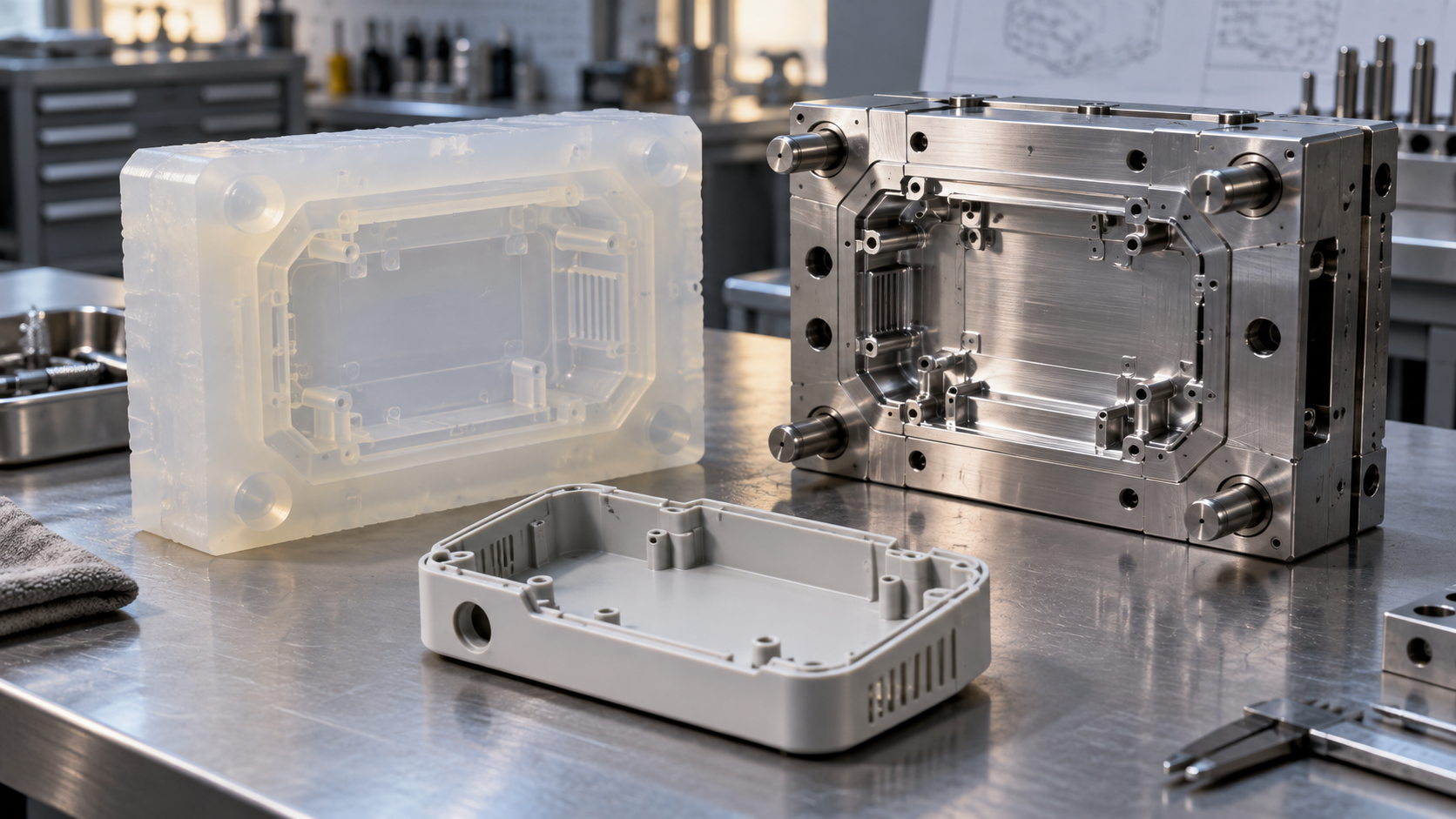
The most common arguments on the shop floor often start with a single enclosure. The product manager holds a polished prototype part and asks: can we make fifty sets of this enclosure? The structural engineer says, open a steel mold for injection molding, the per-part cost is low; the process engineer shakes his head, opening a steel mold for fifty sets isn't worth it, use silicone mold vacuum casting first. Both are actually right—they are talking about two different routes within casting-type processes, and the branching point is not the part itself, but the mold type.
The word casting is easily mistaken for a single process, but in fact it is an umbrella term for a family of processes. What determines which route to take is what material the mold is made of, how many times it can be replicated, and how the per-part cost changes with batch size. Silicone molds are soft, cheap, and have limited life, suitable for the scale of dozens of parts; steel molds are hard, expensive, and long-lasting, suitable for spreading mold cost across thousands or tens of thousands of parts. In between there is another often-overlooked route: using CNC or 3D printing to directly produce parts without going through a mold, suitable for validation of single-digit to a dozen or so parts.
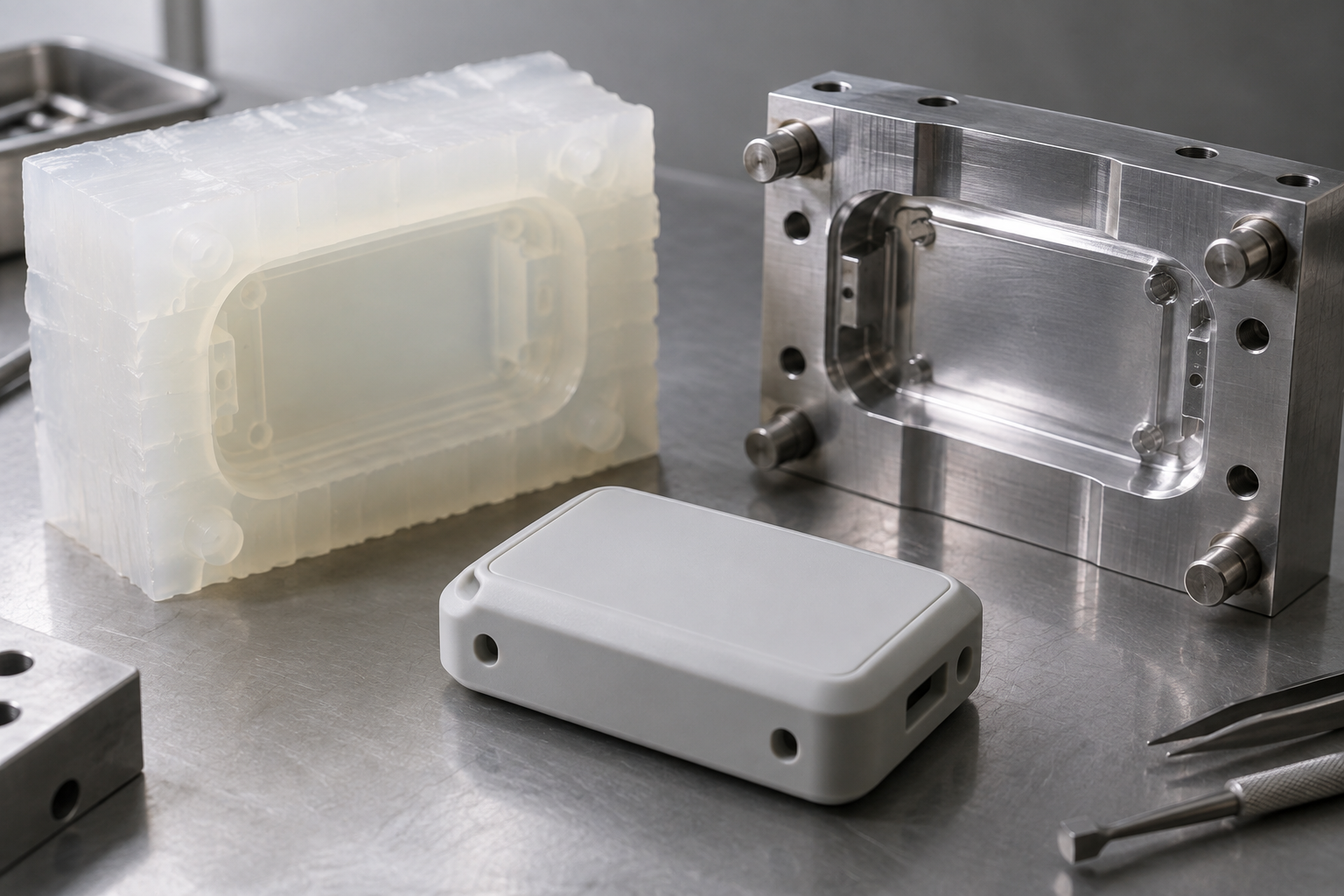
The scope of this article focuses on the two casting routes of prototype duplication (vacuum casting) and injection molding, while also explaining how they integrate with CNC machining and 3D printing. The reason for discussing these two together is that they share the same underlying logic: first there is a mold, then there is a part; the way the mold is invested determines batch size, cost, and modification flexibility. Once you understand this branching line, process selection is no longer based on feeling.
Vacuum casting (prototype duplication): the small-batch logic inside silicone molds
The starting point of vacuum casting (prototype duplication) is not a mold, but a prototype part whose appearance and assembly have already been confirmed. This prototype part usually comes from CNC machining or 3D printing, with its surface sanded, painted, or electroplated to reach a state suitable for mold duplication. The process chain can be summarized as: prototype part → make silicone mold → cast resin under vacuum → cure and demold → post-processing and assembly.
Silicone mold life and duplication cost
A silicone mold is a soft mold, and its life determines the trend of per-part cost. With each duplication, the silicone is affected by the exothermic heat of resin curing and the pulling force of demolding, and the mold cavity surface gradually loses detail. Therefore, the number of parts that can be duplicated from the same silicone mold is usually limited; beyond a certain number of times, flash, dimensional drift, and surface roughness will noticeably worsen. For procurement, this means the "mold fee" on a quotation is not a one-time sunk cost, but a variable that needs to be amortized according to the expected batch size. The larger the batch, the lower the per-part amortization; but if the batch approaches the life limit of the silicone mold, a second mold must be prepared, and the cost curve will show a step.
The role of the vacuum environment in suppressing bubbles
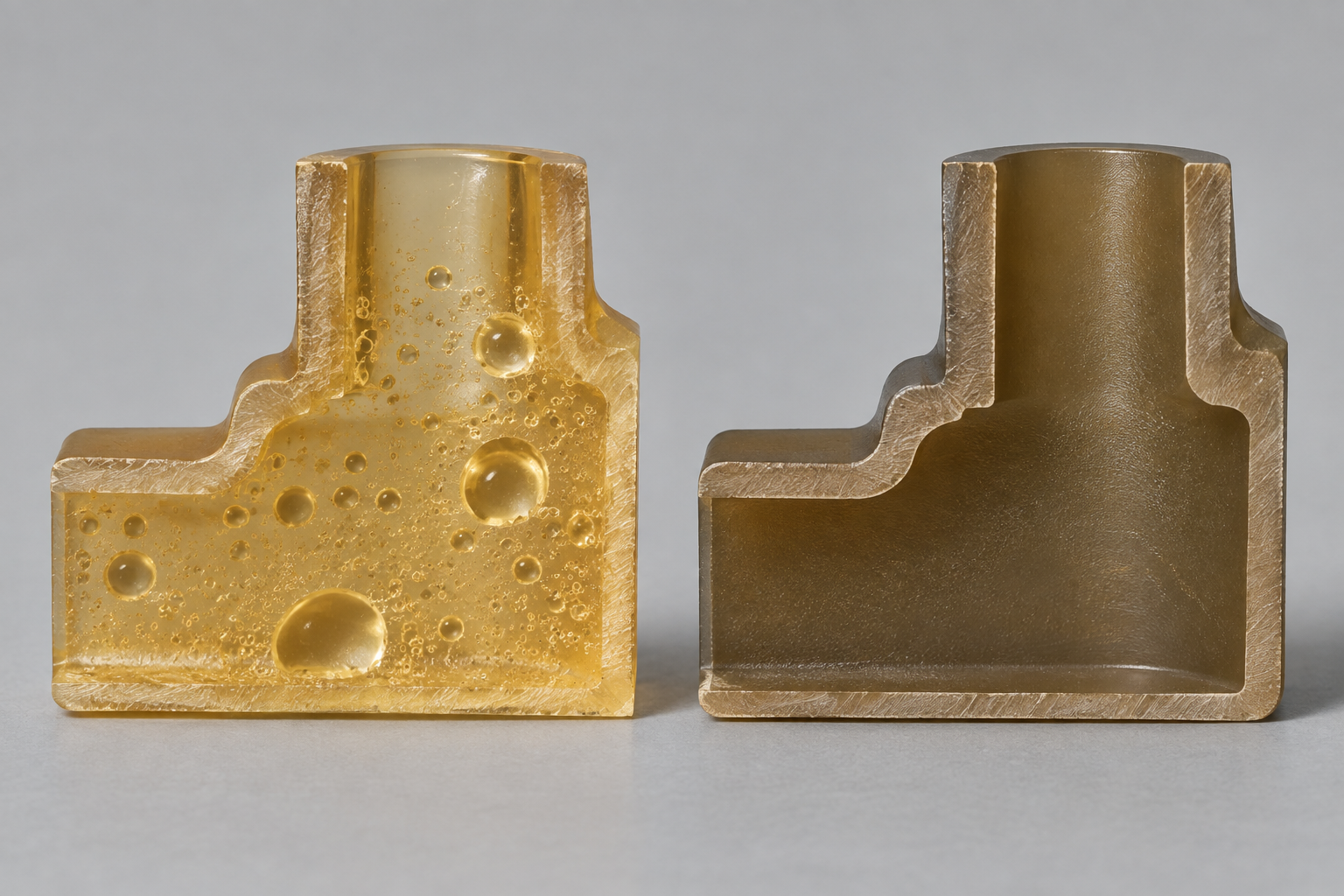
The core value of vacuum casting lies in bubble control. Resin entraps air during mixing and pouring into the mold cavity; if poured directly at normal pressure, this air tends to remain in corners, thin walls, and deep cavities, forming visible pores or internal voids. The vacuum environment draws gas out of the mold cavity and the resin, allowing the resin to fill details under negative pressure and significantly reducing the probability of bubble defects. For appearance parts and transparent parts, this step is almost essential; for structural validation parts, it can also reduce local strength fluctuations caused by pores.
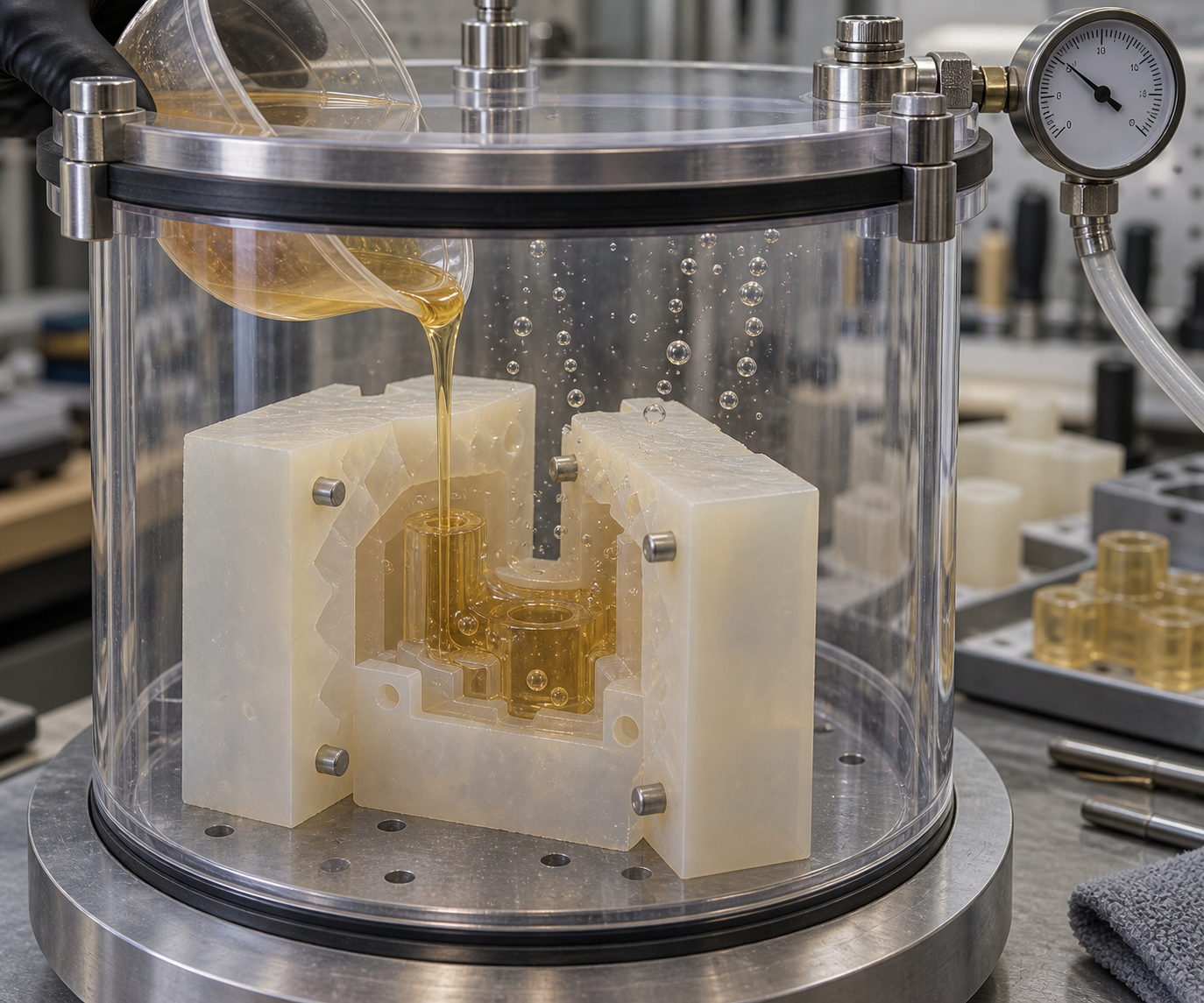
The scenarios suitable for vacuum casting are very clear: small-batch trial production, appearance validation, assembly validation, and stages where an appearance close to injection-molded parts is needed but a steel mold is not yet justified. It does not pursue the long-term consistency of injection molding, nor is it suitable for structural parts bearing high loads. Positioning it as "trading a soft mold for speed and appearance" is more realistic than treating it as a mass-production process.
Injection molding: once batch size amortizes mold cost
The silicone mold of vacuum casting can be understood as a "soft mold," while injection molding uses steel or aluminum molds, which are "hard molds." Hard molds have long processing cycles and high upfront investment, but in return they provide a stable cycle rhythm and repeatable dimensional performance. The economics of injection molding do not come from the per-part processing itself, but from spreading the mold cost across a sufficient number of parts: the larger the batch, the lower the mold cost amortized per part, and the per-part cost curve declines with batch size and gradually flattens. Conversely, if the batch is very small, the mold fee cannot be spread out, and the per-part cost will be noticeably higher than vacuum casting or CNC.
Mold structure determines the design boundaries of injection-molded parts
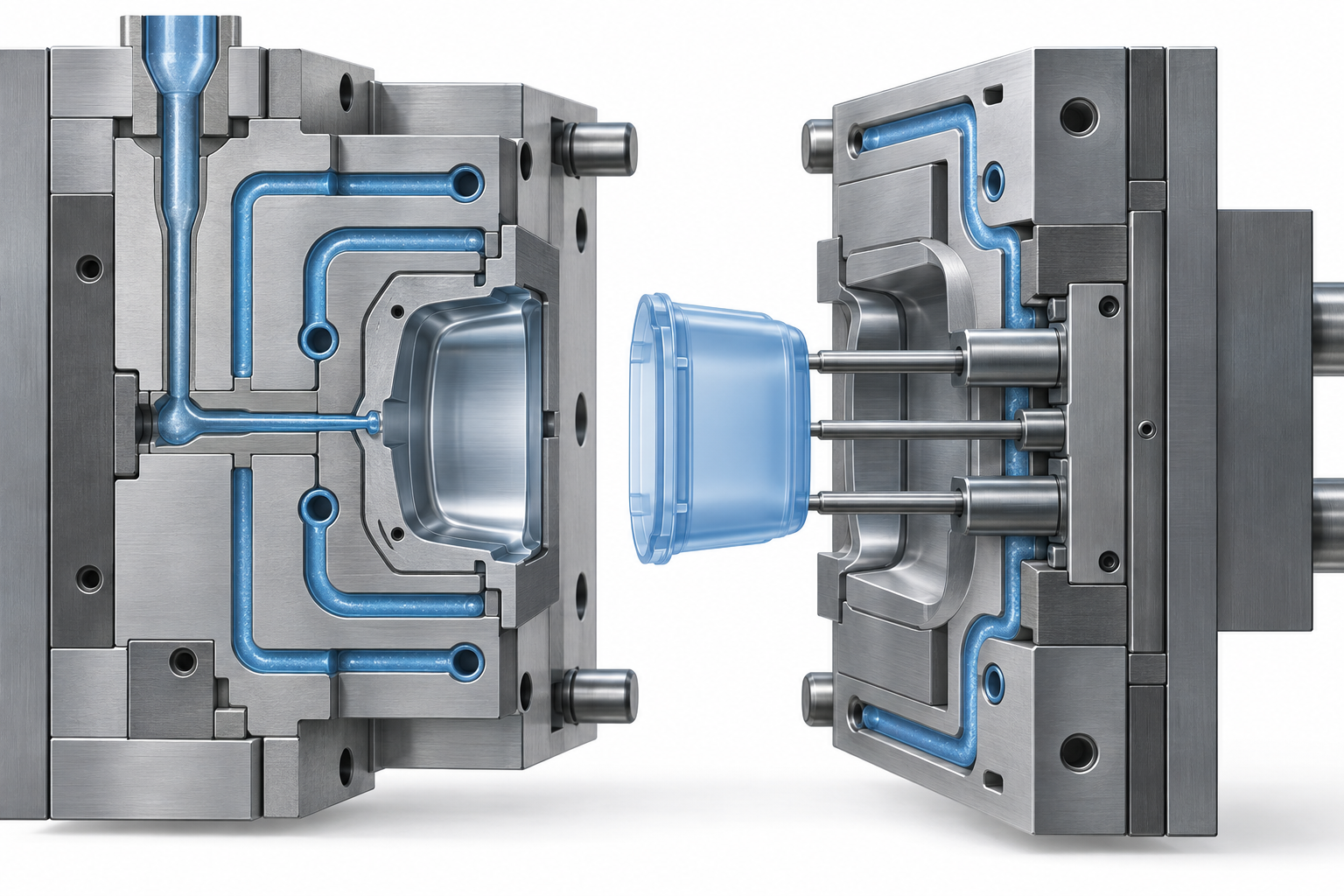
The DFM points of injection-molded parts essentially revolve around "how plastic flows into the cavity, how it cools, and how it is ejected." Common check items include:
- Draft angle: without a draft angle, the part will be "bitten" by the cavity, causing scoring or deformation during ejection; textured surfaces usually require a larger draft angle.
- Uniform wall thickness: abrupt thickness changes tend to produce sink marks and internal voids, and thick-wall areas also extend cooling time and slow down the cycle.
- Gate and runner: gate location affects weld line position and filling pressure, while runner design affects material utilization and color-change difficulty.
- Cooling and ejection: cooling channels determine the molding cycle and warping tendency; ejector pin locations must avoid appearance surfaces and thin-wall areas.
Once these designs are fixed into the mold, later modifications often mean mold repair, insert replacement, or even re-opening the mold, with costs far higher than at the drawing-change stage. Therefore, before injection molding it is usually recommended to first use CNC or 3D printing to validate structure and assembly, running through features prone to problems such as appearance surfaces, snaps, and bosses, and then freeze the mold design. This is also why injection molding is more suitable for already-validated plastic parts with a clear batch size, rather than products whose structure is still changing frequently.
Common defects in cast parts and acceptance approaches
Defects in casting-type processes almost all come from the same thing: the process by which material flows, cools, and shrinks inside the mold is not fully controlled. The defect manifestations of vacuum casting and injection molding are similar, but their causes and observation windows differ. In vacuum casting, resin fills the silicone mold by gravity with vacuum assistance, so bubbles and short shots are more common; in injection molding, the melt fills under high pressure, so sink marks, weld lines, and flash are more typical. During acceptance, if you focus on only one surface, it is easy to let functional problems pass as appearance problems.
Causes and observation methods of five high-frequency defects
| Defect | Typical cause | Observation method | Difference between vacuum casting and injection molding |
|---|---|---|---|
| Porosity / bubbles | Insufficient resin degassing, air entrapment at gate locations, moisture or degradation in the injection melt | Transmitted light inspection, cross-section cutting, side lighting on cosmetic surfaces | Vacuum casting relies more on vacuum degassing; injection molding is more related to drying and back pressure |
| Sink marks | Uneven wall thickness, excessive local thickness, insufficient packing pressure | Tactile feel, oblique light sweeping, caliper thickness measurement | Injection molding sink marks are more pronounced; vacuum casting shrinkage is relatively mild but can still occur at thick walls |
| Weld lines | Insufficient temperature at the convergence of multiple melt streams, excessive flow length | Side lighting on cosmetic surfaces, more easily identified on colored parts | A typical injection molding defect; less common in vacuum casting, but flow marks may occur in complex structures |
| Flash | Poor parting line fit, insufficient clamping force, worn parting lines on silicone molds | Visual inspection, feeler gauge, assembly trial fit | Injection molding flash is related to the mold parting line and pressure; silicone mold flash mostly comes from repeated use of the parting line |
| Deformation | Uneven cooling, premature demolding, heat during post-processing | Platform measurement, assembly surface fit check | Injection molding deformation is related to cooling channels and ejection; vacuum cast parts are softer and prone to warping after demolding |
Inspect by grading functional surfaces, cosmetic surfaces, and assembly surfaces
On the same cast part, acceptance standards for different areas should not be the same. Functional surfaces bear loads, sealing, or heat conduction, and have the lowest tolerance for defects; cosmetic surfaces are directly exposed to users and are mainly judged by visual inspection and feel; assembly surfaces focus on dimensional fit and contact, and flash, deformation, and local protrusions can all affect assembly. It is recommended to mark these three surfaces separately on the drawing or inspection sheet, rather than giving the entire part a vague "pass/fail."
- Functional surfaces: Prioritize checking for porosity, shrinkage cavities, and internal porosity, and perform cross-sectioning or non-destructive testing when necessary; through defects are not acceptable.
- Cosmetic surfaces: Observe under standard lighting with side lighting, and agree on allowable defect size and quantity according to the cosmetic grade, avoiding unenforceable standards such as "flawless."
- Assembly surfaces: Focus on flash, deformation, and local dimensions, and verify with assembly trial fitting or gauges rather than relying only on single-point caliper measurements.
How casting connects with CNC and 3D printing
In actual projects, casting rarely appears alone. More commonly, there is a progressive route: 3D printing or CNC for prototyping → vacuum casting for small batches → injection molding for mass production. Each stage solves a different problem, and the prerequisite for skipping a stage is that the questions from the previous stage have already been answered.
What each stage is validating
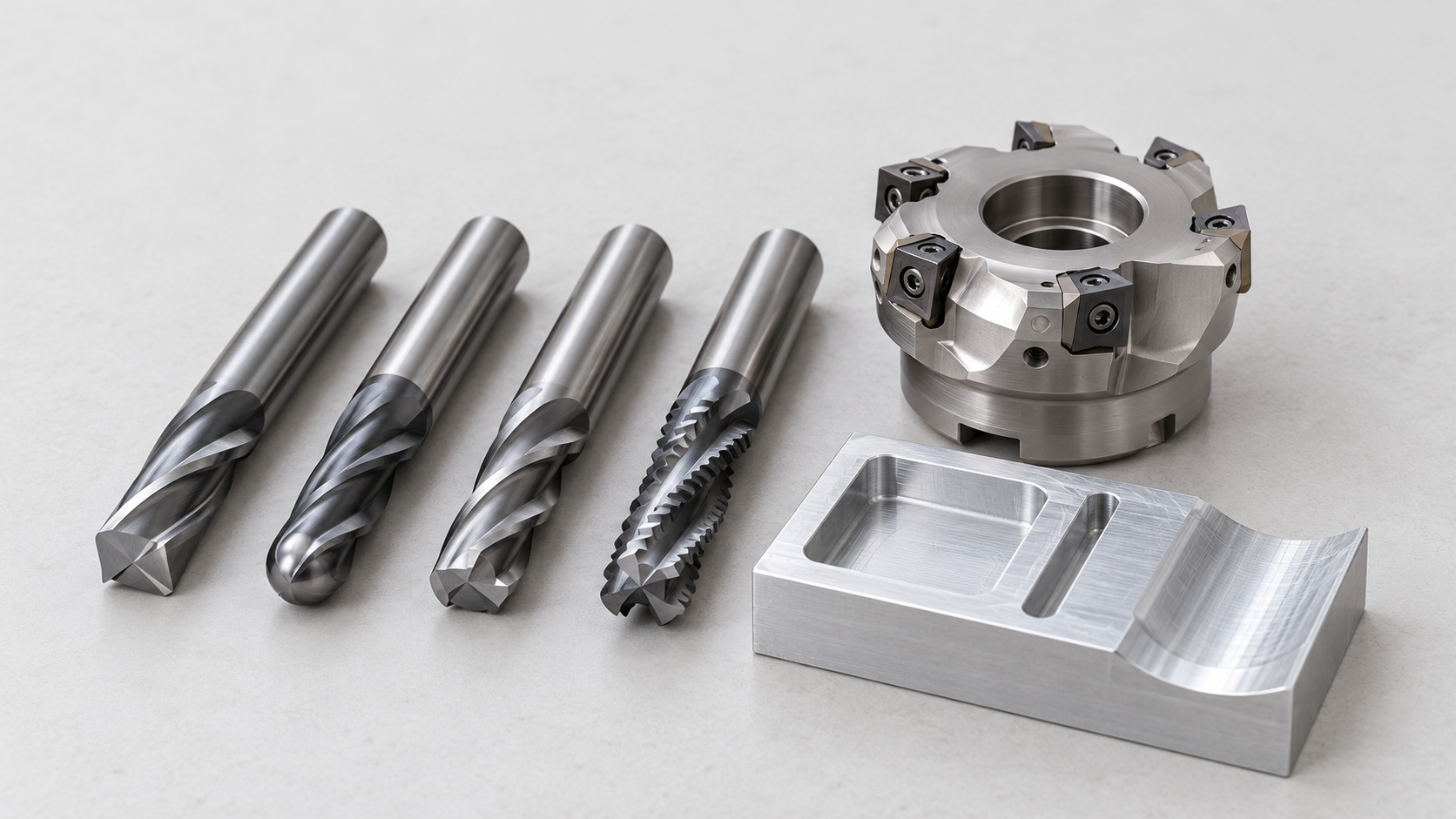
- Prototype stage (3D printing/CNC): Validate whether the structure assembles, whether interference exists, and whether the feel and dimensional trends are correct. 3D printing is fast and offers high geometric freedom; CNC is closer to the final part in material feel and fit precision.
- Small-batch stage (vacuum casting): Validate appearance and color, validate assembly with the actual material, and support small-scale trials or exhibitions. Silicone molds require low investment and are suitable for quantities in the tens.
- Mass production stage (injection molding): Validate batch consistency and unit cost. Mold investment is high, but after amortization the unit cost drops significantly.
When intermediate steps can be skipped
If the structure has already been validated with CNC parts and appearance requirements are not high, you can go directly to injection molding tooling; if it is only an internal functional part and the quantity is very small, vacuum casting may also be unnecessary, and small-batch CNC is more direct. Conversely, for cosmetic parts, colored parts, or parts that need the feel of the actual material, skipping vacuum casting and going directly to a steel mold carries relatively high risk—the cost of modifying a mold once is far higher than running one round of silicone molds.
The judgment criterion can be simplified into one sentence: Has the uncertainty that the next stage will spend money on already been reduced to an acceptable level by the previous stage? Prototyping validates structure, vacuum casting validates appearance and small batches, and injection molding validates cost and consistency. When you need to evaluate a specific route, you can start by comparing rapid prototyping capabilities or injection molding capabilities.
Materials and post-processing: Can cast parts be used as structural parts?
The difference in material selection between vacuum cast parts and injection molded parts is essentially due to different curing mechanisms. Vacuum casting uses two-component polyurethane, where the A/B components react and cure at room temperature or moderate temperature. Material properties depend on the formulation and mixing ratio, and batch-to-batch variation is usually greater than that of thermoplastics. Injection molding uses thermoplastic pellets, which are heated and melted, then cooled and set. Material properties are guaranteed by the supplier's grade, and batch consistency is better. This means: vacuum cast parts are suitable for validating appearance, assembly, and feel, while injection molded parts are suitable for structural parts under long-term load.
Logic for distinguishing structural parts from cosmetic parts
To judge whether a cast part can serve as a structural part, first ask three questions: is the load direction clear, are the consequences of failure acceptable, and is long-term fatigue life required. If the part mainly bears assembly stress, snap-fit force, or a slight drop, a vacuum-cast part is usually sufficient; if the part is a load-bearing bracket, a gear, or a component under long-term cyclic loading, injection-molded or CNC-machined parts should be prioritized. A common problem with vacuum-cast parts is internal bubbles and incompletely cured regions, which can become crack initiation points under load, so for cast parts used structurally, it is advisable to leave a safety margin on critical cross-sections rather than designing to theoretical strength.
Post-processing: sanding, painting, screen printing, and assembly
Post-processing of cast parts usually includes deflashing, sanding parting lines, filling, painting, screen printing, and assembly. Vacuum-cast parts often have more pronounced parting lines than injection-molded parts, because the silicone mold tends to produce flash at the parting surface, requiring more sanding work. Flash on injection-molded parts is usually thinner, but gate remnants need to be addressed. Before painting, it is advisable to perform an adhesion test first, especially on polyurethane parts, whose surfaces may retain mold release agent, making direct painting prone to craters or paint peeling. Screen printing and pad printing are sensitive to surface flatness, and curved surfaces or sink marks can easily cause incomplete prints. In terms of assembly, vacuum-cast parts have less dimensional consistency than injection-molded parts; if there is a mating relationship between parts, it is advisable to reserve adjustable assembly allowance, or perform secondary machining on critical mating dimensions.
If a part needs both appearance and a certain structural function, a common approach is: use vacuum casting to validate the cosmetic surface, and use CNC or injection molding for the structural part, selecting materials separately for the two. For specific material matching, refer to the material library, or go directly to AI chat quote to have engineering evaluate it.
Frequently Asked Questions (FAQ)
The following questions basically cover the points most often raised during quoting and review for casting-type processes. The answers try to give the judgment logic rather than throwing out a number.
How exactly do you choose between vacuum casting and injection molding?
Look at two things: batch size and what you need to validate right now. Vacuum casting uses silicone molds, with low mold investment and fast mold turnaround, suitable for small-batch trial production, appearance validation, and assembly validation in the range of dozens of pieces; injection molding uses metal molds, with high upfront investment, but the per-piece cost is amortized as batch size increases, suitable for mass production after the design is finalized. If the structure may still change and the appearance is still being adjusted, vacuum casting first is more prudent; if the design is already frozen and you are only waiting for volume production, then discuss tooling for injection molding.
Can cast parts be used as structural parts?
It depends. Vacuum-cast parts and injection-molded parts differ in material selection, internal density, and mechanical performance; whether they can bear load depends on the loading mode, load direction, and your safety margin, and cannot be generalized. Cosmetic parts, housings, and non-load-bearing brackets are usually fine; for parts that truly bear load or are under long-term load, it is advisable to tell the engineering team about the loading conditions and judge together whether to switch to CNC machining or adjust the structure, rather than directly applying the approach used for cosmetic parts.
Is later mold modification costly?
Modifying silicone molds is usually relatively flexible, and the cost of local repair or making a new mold is small, which is also why it suits iteration. Modifying an injection steel mold involves adjustments to the cavity, gate, cooling, or ejection structure; the larger the change, the higher the cost, and some changes even require re-machining the mold core. So before injection molding, confirming DFM issues such as draft angle, wall thickness, and gate location is far more cost-effective than modifying the mold afterward.
How small does a small batch have to be to be suitable?
There is no universal threshold; it depends on part size, structural complexity, and your cost sensitivity. Empirically, vacuum casting leans toward the range of dozens to a few hundred pieces, while injection molding only becomes cost-effective once the batch is large enough to amortize the mold cost. The real cutoff point is best determined by comparing total costs: amortize the mold investment over the expected batch onto each piece, then compare it with the per-piece cost of vacuum casting; the crossover point is your switching time.
How do you inspect the precision and appearance of cast parts?
First classify by surface: functional surfaces, cosmetic surfaces, and assembly surfaces each have their own standards; do not use one set of requirements to judge all surfaces. Functional and assembly surfaces focus on dimensions and fit, while cosmetic surfaces focus on visible defects such as sink marks, weld lines, porosity, and flash. Before acceptance, it is best to confirm critical dimensions and appearance benchmarks with the supplier, and if necessary, use 3D scanning for comparison. Specific tolerances and acceptance criteria should be based on the drawings and technical agreements confirmed by both parties, and it is not advisable to rely on experience-based defaults.
Key takeaways
- The core variable of casting-type processes is the mold: silicone molds suit small-batch duplication, steel molds suit mass injection molding, and the two differ completely in cost curves and modification flexibility.
- The value of vacuum casting (prototype duplication) lies in using silicone molds to quickly replicate parts with an appearance and feel close to injection-molded parts, making it suitable for small-batch trial production and market validation.
- The DFM focus of injection molding is on draft, wall thickness uniformity, gate location, and cooling; these determine batch consistency and per-part cost, not per-part precision.
- Common defects in cast parts (porosity, sink marks, weld lines, warping) can mostly be traced to the balance between filling and cooling, and acceptance should be judged in tiers combining functional and non-functional surfaces.
- Casting, CNC, and 3D printing are not substitutes for one another, but a combined route segmented by batch size, material, and appearance requirements.