Starting from a cracking case: why "no heat treatment" becomes a problem
The most troublesome rework in the workshop is often not dimensional out-of-tolerance, but parts suddenly cracking after assembly or a period of use. There was once a batch of CNC-machined steel connectors; all drawing dimensions were qualified, and they were pressed in smoothly during assembly, but after a few weeks of operation in the machine, fine cracks appeared at the stress-concentrated fillets. Tracing the process records revealed: the blank was a forging, and after rough machining it went directly to finish machining, with neither stress relief annealing in between nor a final tempering step. The part "had the right shape," but did not "have the right state."
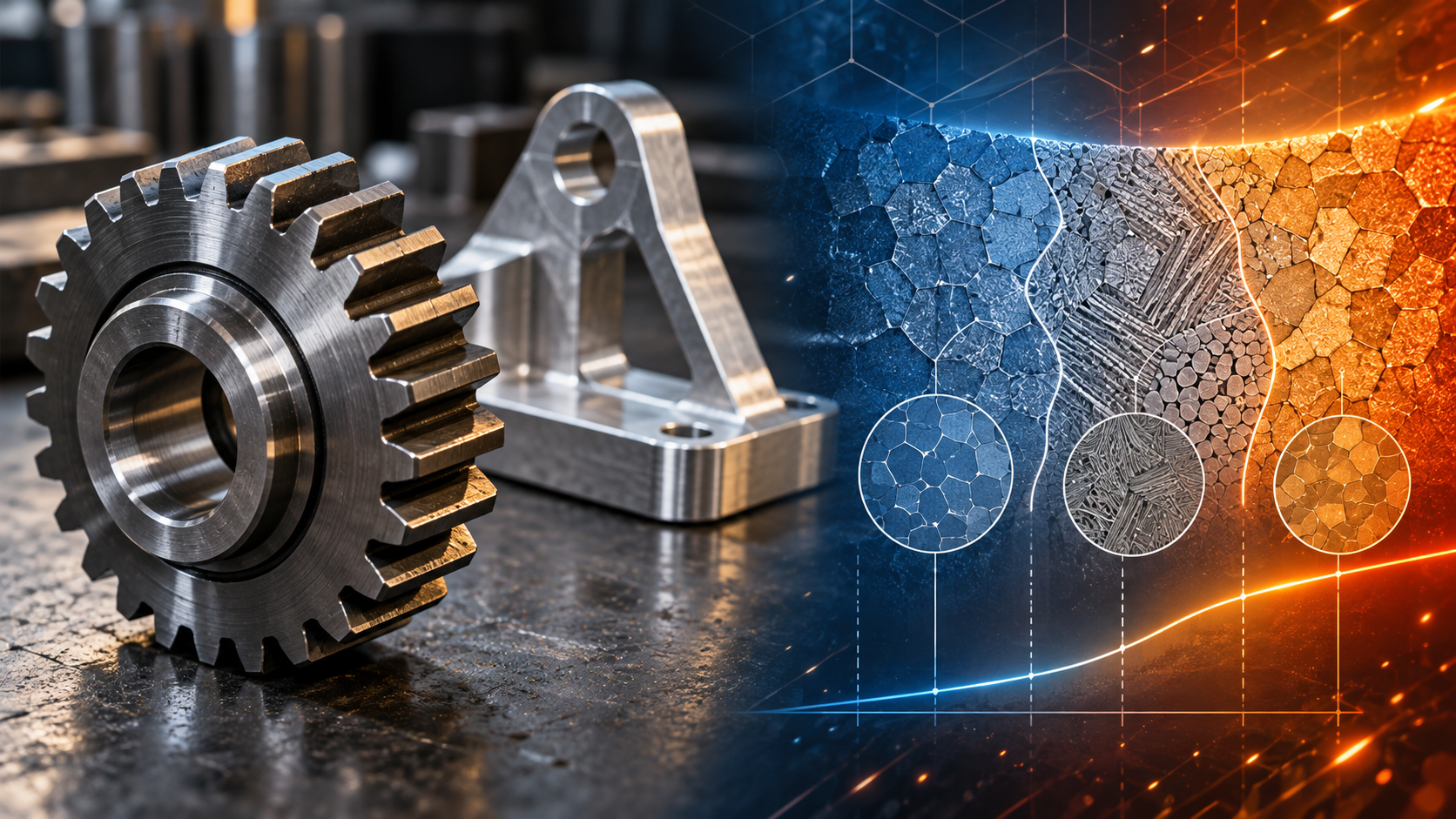
The root cause of this type of problem is: heat treatment is not a decorative process, but a means of controlling material properties and dimensional stability. It determines the material's internal microstructure, the distribution of residual stresses, and the balance between hardness and toughness. Without key heat treatment, a part may be hard enough but brittle, dimensionally acceptable in the short term but drifting in the long term, or fail prematurely under alternating loads.
Many engineers are used to focusing on material grade and machining accuracy, but treat heat treatment as "something the supplier will handle themselves." However, the material grade only specifies the composition range; what truly determines service performance is composition plus heat treatment state. For steel of the same grade, the performance difference between the annealed state and the quenched and tempered state may be greater than the difference between two different grades.
Therefore, the question "what materials require heat treatment" cannot be divided simply by metal/non-metal, but must return to three criteria: whether the material achieves the target performance through phase transformation or precipitation, whether the machining process introduces residual stresses that need to be released, and whether the service conditions impose requirements on hardness, toughness, or dimensional stability. The following content will unfold one by one along material systems, first establishing a common language, then discussing steel, aluminum, titanium and copper, and engineering plastics separately, and finally landing on drawing annotations and supplier communication.
What heat treatment is actually changing: structure, stress, and properties
Many people understand heat treatment as "heating the part red and then cooling it," but this only describes the operation, not the purpose. What is truly changed are three things inside the material: microstructure, residual stress, and the balance between hardness and toughness. Only by understanding these three layers can one judge whether a part actually needs heat treatment, and which type it needs.
Layer one: microstructure—the underlying structure that determines performance
The performance of metal is not determined only by chemical composition. For the same 45 steel, after slow cooling and rapid cooling, the internal grain size and phase composition are completely different, which is reflected macroscopically as "one can be filed, the other cannot." Heating gives atoms diffusion capability, holding allows the structure to homogenize, and cooling is the key to determining the final phase transformation path. Fast cooling tends to produce hard and brittle phases; slow cooling produces soft and tough phases. The essential difference among so-called quenching, normalizing, and annealing lies in the combination of heating temperature and cooling rate.
Grain size is equally important. Materials with coarse grains usually have unsatisfactory strength and toughness; refining grains through appropriate heating and cooling cycles can simultaneously improve multiple properties without changing the composition. This is also why normalizing or annealing is often arranged after forging and casting—not only to soften, but also to "straighten out" the structure.
Layer two: residual stress—the invisible source of deformation
Parts leave internal stresses during casting, forging, welding, cutting, and even straightening. These stresses are temporarily balanced within the part; once subsequent machining removes some material, the balance is broken and the part warps. The common "deformation after rough machining overnight" in CNC machining is mostly not a machine tool problem, but the release of residual stresses in the blank.
The role of stress relief annealing is to allow sufficient stress relaxation in the material at a relatively low temperature without significantly changing hardness. It does not seek performance improvement, only dimensional stability. For precision parts, the value of this step is often greater than increasing hardness.
Layer three: hardness and toughness—a pair of indicators that must be balanced
"The higher the hardness, the better" is an amateur judgment. High hardness usually means wear resistance and compressive resistance, but toughness decreases, notch sensitivity increases, and brittle fracture is more likely under impact. If a part is not tempered after quenching, it may be beautifully hard, yet crack when struck during assembly. The significance of tempering is to sacrifice some hardness in exchange for usable toughness.
| Heat treatment type | Main purpose | Effect on hardness | Typical applicable scenarios |
|---|---|---|---|
| Annealing | Soften, homogenize, improve machinability | Decrease | Castings, forged blanks, high-carbon steel before machining |
| Normalizing | Refine grains, homogenize structure | Slightly adjusted | Preliminary treatment for medium- and low-carbon steel |
| Quenching | Achieve high hardness and high wear resistance | Significantly improve | Cutting tools, dies, wear-resistant parts |
| Tempering | Adjust toughness, stabilize structure | Reduce (controllable) | Must be performed after quenching |
| Stress-relief annealing | Relieve residual stress, stabilize dimensions | Essentially unchanged | Precision parts, welded parts, after rough machining |

Looking at these three layers together, you can understand why the same grade of material exhibits vastly different properties under different heat treatment conditions. Writing only "45 steel" on a drawing is not enough; the supplier may by default receive annealed, normalized, or quenched-and-tempered stock, and the machining performance and service performance all differ. When we discuss materials individually later, we will repeatedly return to these three dimensions: microstructure, stress, and the balance between hardness and toughness.
Steel and alloy steel: the most typical and also the most complex heat treatment subject
In a hardware workshop, steel parts almost inevitably involve heat treatment from blank to finished product. The reason is straightforward: the mechanical properties of steel are not determined by chemical composition alone, but by the microstructure. The same heat of 45 steel can be soft enough to turn easily in the annealed state, yet after quenching and low-temperature tempering it can reach a hardness that makes a file slip—the difference lies entirely in heat treatment. So when a drawing only says "45 steel" without specifying the condition, there is a huge interpretive gap between the machinist and the heat treatment plant, and this is precisely the source of many dimensional and cracking problems.
Annealing, normalizing, quenching, tempering: what problem does each solve?
The main purpose of annealing is softening and homogenization. Forgings, castings, or cold-drawn stock often contain segregation and work hardening internally; direct cutting leads to rapid tool wear and poor surface quality, while annealing significantly improves machinability. Normalizing is commonly used to refine grains, prepare for subsequent quenching, or serve as the final heat treatment for low-carbon steel. Quenching pursues hardness and strength, but the quenched state has high internal stress and brittleness, so it is almost always used in combination with tempering. Tempering adjusts the hard and brittle structure obtained by quenching to an acceptable balance between strength and toughness—the so-called "quenching and tempering" is the combination of quenching plus high-temperature tempering.
There is also a type of process that is easily overlooked: stress-relief annealing. It does not change hardness; it only relieves residual stress from machining or welding. For shafts with a large length-to-diameter ratio, thin-walled sleeves, and welded frames, if stress is not relieved after rough machining before finishing, the part will slowly deform during subsequent storage or use, and the hole positions will be found to be misaligned only during assembly. This type of problem is especially common on precision parts, and it is recommended to specify in the process route whether a stress-relief operation should be inserted between rough and finish machining.

Carbon steel, alloy steel, stainless steel: where do the requirement differences lie?
Low-carbon steel has low strength and good plasticity, usually does not require quenching for strengthening, and is more often normalized or stress-relieved; medium- and high-carbon steel often obtains wear resistance or elastic properties through quenching and tempering, such as gears, shafts, and spring-type parts. When alloy steel is alloyed with elements such as chromium, molybdenum, and nickel, hardenability improves, and parts with larger cross-sections can also be through-hardened, but the process window is more sensitive and the control requirements for heating and cooling rates are higher.
The situation with stainless steel is more complex. Austenitic stainless steel (such as the 304 series) generally cannot be hardened by quenching and can only be strengthened by cold working; heat treatment is mainly used for solution treatment and stress relief; martensitic stainless steel can be quench-hardened and is often used for cutting tools and wear-resistant parts; precipitation-hardening stainless steel relies on aging precipitation strengthening. Therefore, there is no uniform answer to "does stainless steel need heat treatment"; it must be based on the specific grade and service requirements.
Surface hardening: when are carburizing and nitriding considered?
When a part needs a "hard surface and tough core," surface treatments such as carburizing or nitriding are considered. Carburizing is suitable for low-carbon steel or low-carbon alloy steel; after treatment, the surface is high-carbon while the core remains tough, and it is commonly used for gears, pins, and other parts subject to both wear and impact. Nitriding has a relatively low temperature and small deformation, making it suitable for parts that have already been finish-machined and are not expected to be ground afterward, but the cycle is usually longer. Both bring slight changes in dimensions and surface condition, and whether to leave grinding allowance and whether to arrange the process before or after finish machining must be confirmed with the heat treatment plant.
Aluminum alloy: solution treatment and aging, and the pitfalls of "natural aging"
The heat treatment logic of aluminum alloy is completely different from that of steel. Steel hardens through phase transformation (austenite to martensite), while aluminum alloy relies on solution treatment + aging precipitation. Simply put: dissolve alloying elements into the aluminum matrix at high temperature, then rapidly cool to "freeze" them in a supersaturated solid solution, and then through aging allow these elements to precipitate as fine dispersed phases, pinning dislocations and increasing strength. Without aging, solution-treated aluminum alloy is actually relatively soft, and its dimensions are unstable.
6061 and 7075: the difference behind the temper designations
The commonly seen 6061-T6 and 7075-T6 on drawings—that "T6" is the temper designation for solution treatment plus artificial aging. T6 means the material has already completed heat treatment at the factory and its strength is at the commonly used high end for that grade. T4 is usually natural aging after solution treatment, with lower strength than T6 but better plasticity, suitable for parts that subsequently need forming or bending. O temper is the annealed state, the softest and easiest to machine, but with the lowest strength.
Here is an easy pitfall to fall into: if you take T6 aluminum plate and bend it, it may very likely crack at the bend because T6 has limited ductility. In this case, either switch to T4 temper, bend it, and then age it, or perform local annealing before bending. Whether it can be bent and what bend radius to use should preferably be confirmed with the material supplier, and do not force it based on experience.
Stress relief: why "pause" after rough machining
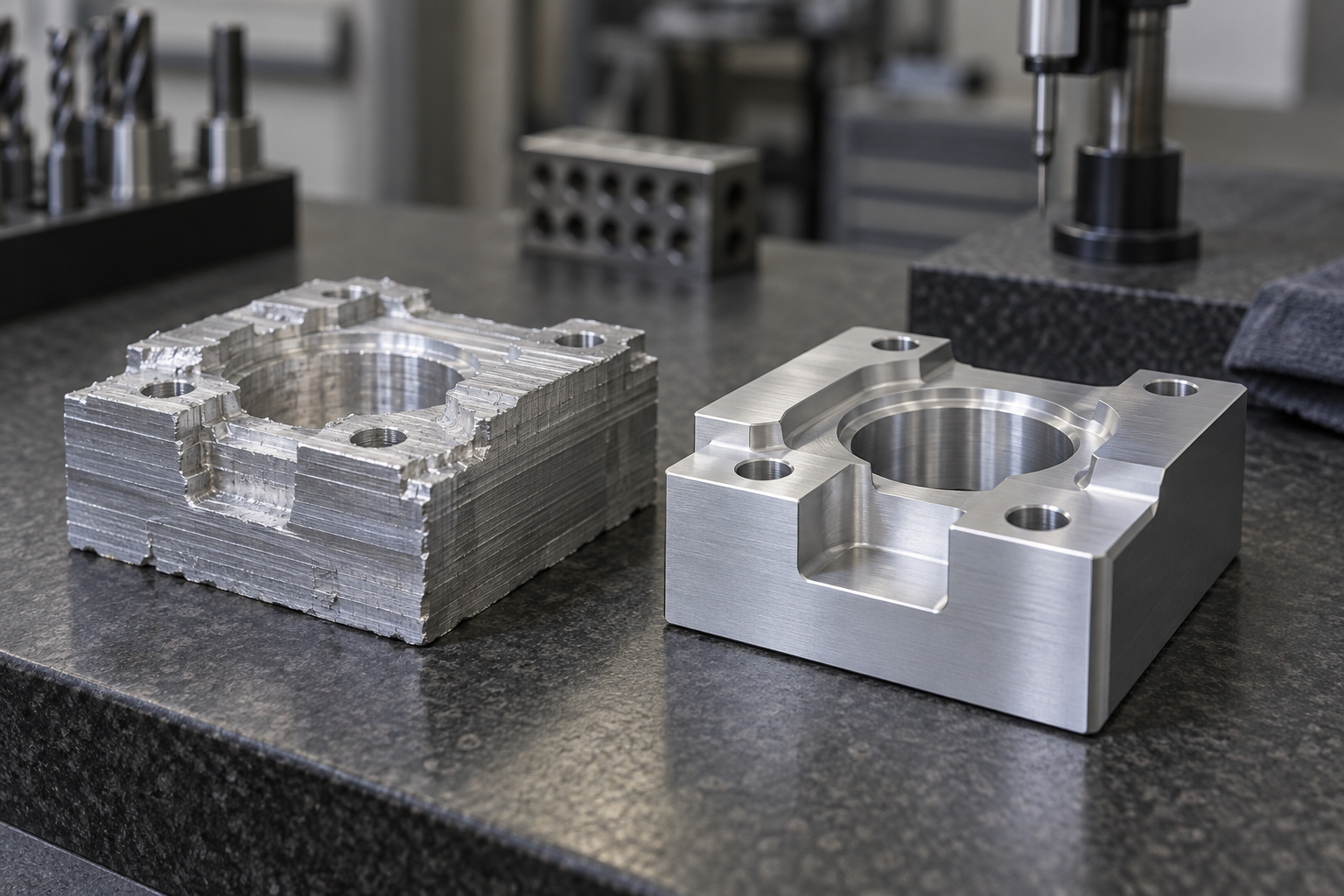
Deformation in aluminum alloy parts during machining is often not a problem with the tool or the machine tool, but rather residual stress in the blank being released during cutting. Rolled or extruded aluminum plate and bar have a non-uniform internal stress distribution. Once you cut away material on one side, the stress balance is broken, and the part bends or twists.
For aluminum parts with higher precision requirements, a common approach is: leave allowance in rough machining → stress relief (which can be heat treatment stress relief or natural resting to allow stress to release slowly) → finish machining to final dimensions. In this way, deformation occurs "in advance" before finish machining, rather than being exposed only when the part is already close to finished product.
Dimensional drift risk of natural aging
Some aluminum alloys are not immediately artificially aged after solution treatment, but instead are left at room temperature for "natural aging." This process may last several days or even longer, and strength will slowly climb, but dimensions are also slowly changing. If you finish-machine to final dimensions before natural aging has stabilized, the part may be out of tolerance a few weeks later.
Therefore, for aluminum parts with high dimensional stability requirements, materials with artificial aging (such as T6) are usually preferred, or it should be confirmed before machining that the blank has completed aging and is in a stable condition. Do not assume that "aluminum parts will be fine after sitting for a few days"—this assumption often causes problems in precision applications.
Titanium, copper, and other metals: choose as needed
Beyond steel and aluminum, materials such as titanium alloys, copper alloys, and magnesium alloys often have heat treatment needs that are more "scenario-dependent." Unlike carbon steel, they do not have a relatively universal anneal—quench—temper path; instead, they depend heavily on the specific grade, processing history, and service conditions. Applying steel's experience directly to these materials can, at best, fail to meet performance requirements, and at worst introduce new risks of cracking or distortion.
Titanium alloys: two main lines—stress-relief annealing and solution treatment plus aging
Titanium alloys are very common in CNC machining, especially in applications requiring high specific strength and corrosion resistance. The two types of heat treatment most often mentioned are stress-relief annealing and solution treatment plus aging. The purpose of stress-relief annealing is straightforward: residual stresses accumulated inside the material after rough machining, if not relieved, may cause warping during finish machining or subsequent use. For thin-walled, slender, or large-volume-removal titanium parts, engineering discussions often address whether to schedule a stress-relief step between roughing and finishing.
Solution treatment plus aging is used for titanium alloy grades that can be strengthened by heat treatment, improving strength through microstructural transformation. But there is a key premise here: not all titanium alloys can be strengthened by aging. Pure titanium and some alpha-type alloys mainly rely on annealing and work hardening, while alpha+beta-type or beta-type alloys may involve solution treatment plus aging. Whether it applies, and how temperature and time should be set, must be based on the grade and the material supplier's technical data, and cannot be applied by experience alone. Titanium alloys are also relatively sensitive to temperature and atmosphere, and the heat treatment process usually needs to be carried out in a controlled environment, which should be clearly confirmed with the heat treatment provider.
Copper alloys: stress-relief annealing and aging strengthening coexist
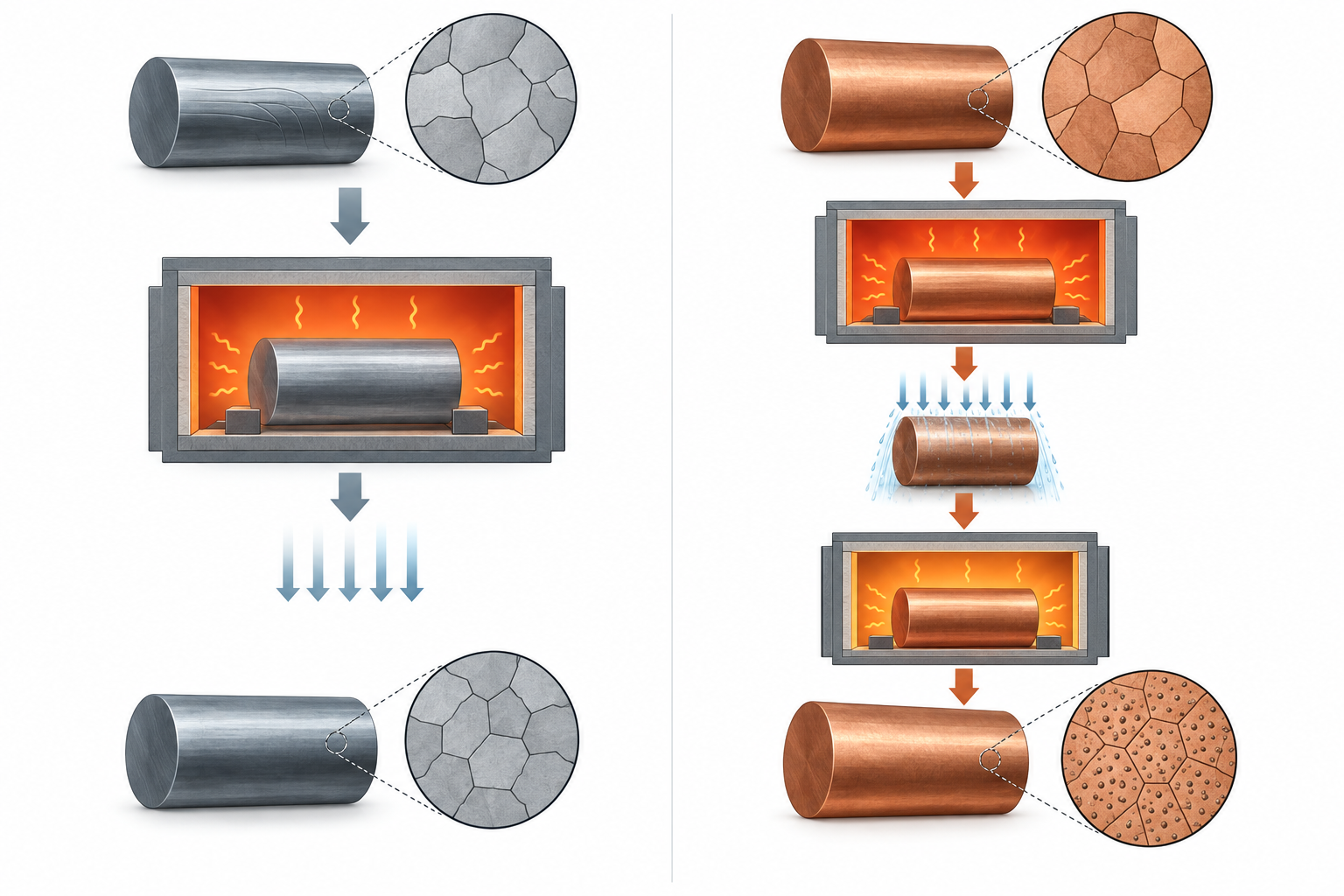
The heat treatment logic for copper alloys falls into two categories. The first is stress-relief annealing, suitable for copper parts that have undergone cold working or extensive machining. Copper has good thermal conductivity and high plasticity, but residual stresses after work hardening can also cause dimensional instability, especially in parts with requirements for electrical conductivity, thermal conductivity, or sealing; stress-relief annealing helps restore and stabilize performance. The second is aging strengthening, mainly for alloys that can be age-strengthened, such as beryllium copper and some chromium-zirconium copper, achieving a balance between strength and electrical conductivity through solution treatment plus aging.
It should be noted that the copper alloy grade system is complex, and the heat treatment behavior of brass, bronze, cupronickel, and beryllium copper differs greatly. Some grades mainly rely on annealing for softening, while others rely on aging hardening, so they cannot be generalized. At the material selection stage, the judgment should already include "whether heat treatment is needed and how electrical conductivity or strength changes after heat treatment," rather than adding the process after machining is complete.
Magnesium alloys and other metals: more dependent on specific operating conditions
Magnesium alloys have low density and are used in lightweight structures, but their heat treatment is also mainly stress-relief annealing and, for some grades, solution treatment plus aging, and they have relatively high requirements for temperature and atmosphere control, with a relatively narrow operating window. As for nickel-based alloys and superalloys, heat treatment is often the core step in achieving performance, and process parameters should be determined jointly by material specifications and professional heat treatment providers.
The overall principle is: the heat treatment of materials such as titanium, copper, and magnesium cannot be based on steel's experience. To determine whether heat treatment is needed, return to three questions—whether the part has undergone extensive machining or cold working, whether service requires specific strength or electrical/thermal conductivity, and whether dimensional stability is critical. Once the answers are clear, confirm the process route with the material supplier and heat treatment provider, rather than machining first and remedying later.
Do engineering plastics also need "heat treatment"?
Heat treatment of metal parts is supported by metallography, while plastics are often dismissed with one sentence: "Plastics don't need heat treatment." This statement is roughly true for ordinary PP and ABS, but once the material changes to engineering plastics such as PEEK, PPS, PA, and POM, especially injection-molded parts and 3D-printed parts, the situation changes. Plastic "heat treatment" is not quenching and tempering, but annealing and conditioning—with only one purpose: to release the internal stresses and incomplete crystallization that were forcibly frozen during the molding process.
During injection molding, the melt fills rapidly under high pressure; the surface layer cools first and the core later, and the molecular chains are frozen before they can arrange themselves in order, forming obvious orientation and residual stress inside. 3D printing is even more extreme: filament or powder is deposited layer by layer, and each layer repeatedly experiences "heating—rapid cooling," making interlayer stress and uneven crystallinity almost inevitable. A part may meet dimensions right off the line, but after a few days or under high-temperature service conditions it slowly warps and cracks, and the root cause is often here.
Annealing and conditioning: the plastic version of "stress relief"
The annealing method is to place the plastic part in an oven, hold it for a period near or below the material's glass transition temperature, and then cool it slowly. Holding allows the molecular chains to gain mobility, rearrange, and release stress; the crystallinity of semi-crystalline plastics (such as PEEK, PPS, and PA) also increases accordingly, improving dimensional stability and chemical resistance. Conditioning mainly targets PA (nylon): in the dry state it is hard and brittle, and after moisture absorption its toughness increases and dimensions also change, so a stable state is often achieved by controlling moisture absorption rather than letting the part "absorb water on its own" at the customer site.
It should be noted that the heat treatment window for plastics is much narrower than for metals. If the temperature is too low, stress release is insufficient; if the temperature is too high or the holding time is too long, the part may soften, collapse, discolor, or even degrade. Different grades, wall thicknesses, and filler ratios (glass fiber, carbon fiber) correspond to different processes, and recommended conditions usually need to be confirmed with the material supplier and verified through test pieces for dimensions and mechanical performance; the metal approach cannot be copied directly.
To judge whether a plastic part needs annealing, you can ask three questions: Is the part exposed to high temperature or humid conditions for a long time? Are there strict dimensional stability requirements (such as mating surfaces or sealing surfaces)? Has delayed warping or cracking been observed after molding? If any answer is "yes," it is worth including annealing or conditioning in the process route. For injection-molded parts, internal stress can also be reduced first through mold and packing parameters; heat treatment is a supplementary measure, not a panacea. If the part will later undergo CNC finishing, annealing is usually scheduled after rough machining and before finishing, to avoid machining stress stacking with molding stress.
Drawings and communication: how to write heat treatment requirements clearly
The place where heat treatment most easily goes wrong is often not the furnace, but the drawing. Many drawings only state "Material: 45 steel," with neither hardness requirements nor any indication of after which process step the heat treatment should be performed. The supplier can only guess based on experience, and the result is either insufficient hardness or out-of-tolerance deformation after heat treatment, ultimately leading to rework and disputes. Writing the requirements clearly is essentially front-loading the risk to the drawing stage.
At least these four things should be clearly stated on the drawing
- Heat treatment type: whether it is stress-relief annealing, quenching and tempering, quench and temper, or surface treatment such as carburizing or nitriding. Different types mean completely different subsequent machining paths.
- Target hardness range: give a range rather than a single point value, and specify the test location (surface or core). Hardness is the most direct acceptance indicator for heat treatment.
- Critical dimensions and machining sequence: which dimensions are guaranteed by finishing after heat treatment, and which are allowed to be completed before heat treatment. Quenched parts usually need allowance and are then ground or finish-milled after heat treatment.
- Whether straightening is allowed: slender shafts and thin-walled parts are prone to bending after heat treatment. Whether straightening is allowed and whether stress relief is needed again after straightening should be stated on the drawing or in the technical agreement.
If the part has clear mechanical property requirements, such as tensile strength or impact toughness, the performance indicators can also be directly specified, letting the heat treatment provider choose the process. However, note that performance indicators and hardness indicators sometimes do not fully correspond, so it is best to write both, or clearly state which one takes precedence.
When communicating with suppliers, confirming these items can save detours
Before placing an order, it is recommended to confirm with the supplier the material delivery condition (annealed, normalized, or pre-hardened), at which step the heat treatment will be performed, and whether there will still be CNC finishing after heat treatment. If heat treatment is scheduled after rough machining and before finishing, sufficient allowance must be left for finishing, and the effect of heat treatment distortion on datums must be considered. For parts with high dimensional stability requirements, scheduling a stress-relief anneal after rough machining and then finishing is a common practice.
In addition, heat treatment and subsequent machining often belong to different suppliers. Writing the requirements clearly on the drawing and specifying at procurement who is responsible for heat treatment and who is responsible for inspection can avoid the cycle of "the machining side saying the heat treatment side did not do it well, and the heat treatment side saying the drawing was not clear." For parts involving precision fits, it is recommended to agree in the technical agreement on the hardness testing method and sampling ratio.
Frequently asked questions (FAQ)
Regarding heat treatment, what engineers and procurement staff most often struggle with is usually not "whether to do it," but "to what extent, in what sequence, and how to inspect it." The following questions appear most frequently in actual quotations and drawing reviews, and the answers try to provide judgment logic rather than fixed parameters.
Do all metal parts need heat treatment?
No. Whether heat treatment is needed depends on the material system, service conditions, and machining path. Ordinary structural parts made of low-carbon steel, some aluminum profile brackets, and many copper alloy connectors can be used directly when loads are mild and dimensional requirements are not strict. What truly requires careful evaluation of heat treatment is usually parts that bear alternating loads, require wear resistance, require long-term dimensional stability, or accumulate obvious residual stress during machining. The starting point for judgment is not the broad category of "metal," but "what happens if this part fails."
Can finishing still be done after heat treatment?
Yes, but the sequence must be planned in advance. A common approach is to leave allowance during rough machining, then heat treat, then finish machine, so that deformation caused by heat treatment is excluded from the final dimensions. If the part has already been heat treated to a higher hardness, subsequent cutting will be more difficult, and tool wear and surface quality both need to be re-evaluated. Conversely, if you finish machine first and then heat treat, you must accept the risk that dimensions may drift, and remedy it by straightening or grinding if necessary. It is recommended to confirm the specific allowance and process sequence together with the machining party and the heat treatment plant.
Is higher hardness always better?
No. Increased hardness is usually accompanied by decreased toughness, and excessively high hardness makes parts more prone to cracking at points of impact or stress concentration. What engineering pursues is a match between hardness and toughness: wear-resistant surfaces need high hardness, while the overall structure that bears impact needs to retain toughness, so tempering is often used to adjust this. Marking a hardness range rather than a single value on the drawing is precisely to leave the heat treatment plant a reasonable process window.
How can you judge whether a supplier's heat treatment is done properly?
You can look at it from three levels: first, require heat treatment reports or hardness inspection records to confirm that the actual results fall within the drawing range; second, measure key dimensions before and after heat treatment to observe whether the amount of deformation is acceptable; third, perform destructive sampling inspection or metallographic observation at the first batch or first article stage (if conditions permit). For long-term suppliers, stable process discipline is more convincing than a single report. The specific acceptance method should be written into the technical agreement before placing the order.
Is the "heat treatment" mentioned for plastic parts the same thing as for metal?
No. Annealing or moisture conditioning of plastics is intended to release internal stresses frozen in during injection molding or printing, stabilize dimensions, and sometimes also to increase crystallinity; it does not involve the phase transformation strengthening seen in metals. Its temperature window is usually narrower, and improper treatment may cause deformation or reduced performance. Therefore, the "heat treatment" of plastic parts relies more on the recommended process from the material supplier and cannot simply copy metal experience.
Key takeaways
- The core purpose of heat treatment is not to "harden" but to bring the material's internal structure and residual stresses into a controllable state, thereby simultaneously satisfying strength, toughness, dimensional stability, and machinability.
- Steel, aluminum alloys, titanium alloys, copper alloys, and some engineering plastics may all require heat treatment, but the triggering conditions differ: some are for machinability, some for final performance, and some for dimensional stability.
- Annealing, quenching, tempering, solution treatment, aging, and stress relief annealing are different means for different objectives; mixing them up or omitting them will directly lead to cracking, deformation, or failure to meet performance requirements.
- Writing only "heat treatment" on a drawing is usually not enough; the target hardness range, key mechanical properties, type of heat treatment, and whether subsequent finish machining correction is allowed should be specified.
- Heat treatment is strongly related to the scheduling sequence of CNC machining, 3D printing, sheet metal, injection molding, and other processes. The earlier it is confirmed with the engineering side, the more rework and scrap can be avoided.