What parts make up an automotive pedal? Why materials can't be decided with a single blanket rule
In a 100–0 km/h emergency braking test, the pedal brackets of all three vehicles fractured completely, with pedal force at the moment of fracture around 1612N. After the news broke, discussion quickly slid into a single true-or-false question: plastic or metal? The question itself is wrong. In a real assembly, plastic and metal coexist, and their roles are clearly divided.
Take a pedal assembly apart, and there are at least three types of load-bearing components, each with a completely different load path:
- Pedal arm: directly bears the force and displacement of the foot, with a complex, curved shape. Production vehicles commonly use glass-fiber-reinforced engineering plastic injection molded as one piece, though some use stamped and welded steel plate.
- Mounting bracket: transmits the pedal arm's load to the vehicle's front bulkhead or firewall. This is the location that failed in the fracture news — what broke wasn't the pedal, it was the bracket. Whether the bracket uses PP+GF40 (polypropylene with 40% glass fiber), steel, or aluminum alloy directly determines the failure mode.
- Pivot and linkage: responsible for rotation while also bearing the bending moment and torque from lateral pedal actuation. Most of these remain metal parts, because they need wear resistance and resistance to repeated rotation.
So the correct question isn't "what material is an automotive pedal," but "which component, under what conditions, made with which process." For the same bracket, the stress distribution differs between frontal and lateral actuation; for the same material, toughness performance differs between -35°C and room temperature. Behind the material debate is actually a comprehensive trade-off among process route, production volume, cost, and validation conditions — which is what the following sections will break down.

How do you choose between plastic and metal pedals? What production volumes suit injection molding, stamping, die casting, and CNC machining
Let's put the conclusion up front: pedal material selection is not an ideological debate over "advanced plastic versus reliable steel," but the simultaneous solution of four variables — production volume, structural complexity, cost, and weight. Within the same automotive pedal, the pedal arm may be injection molded from glass-fiber-reinforced plastic, the mounting bracket stamped from steel, and the pivot die cast or turned from aluminum alloy — three processes coexisting is not a contradiction. What really needs to be asked is: what is this part's annual output, how complex is its structure, and what is its failure mode.
Injection molding: the first choice for large-volume complex structural parts
Mass-produced passenger vehicle pedal arms and some brackets commonly use glass-fiber-reinforced engineering plastics, mainstream being PP+GF30/GF40 or PA (nylon) with glass fiber — not ordinary consumer-grade plastic. The reason is that injection molding can form reinforcing ribs, clips, and mounting holes in one shot, eliminating multiple assembly steps, with per-piece cost rapidly amortized as volume rises. The trade-off is high upfront mold investment — industry-common injection molds run about 100,000–250,000 yuan, more expensive the more complex the structure and the more slides required. So the applicable boundary for injection molding is sufficiently large annual output and sufficiently complex structure; if volume doesn't reach that level, the mold cost can't be amortized into the per-piece price. A typical industry PP+GF40 bracket runs about 10–28 yuan per piece in mass production (depending on structural complexity); this range excludes mold cost, and varies greatly between suppliers.
Stamping: thin steel sheet, high volume, small structural parts such as brackets
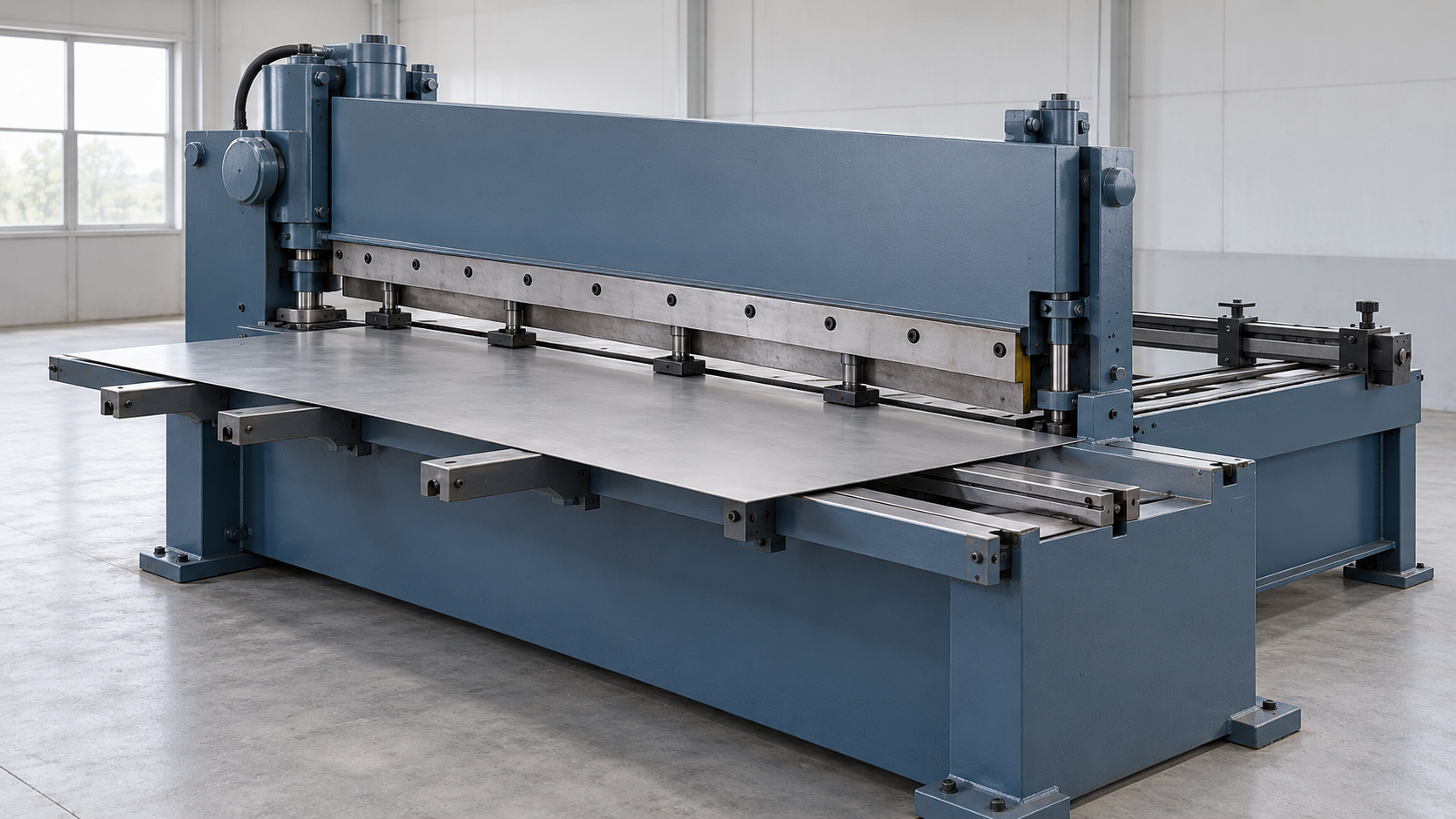
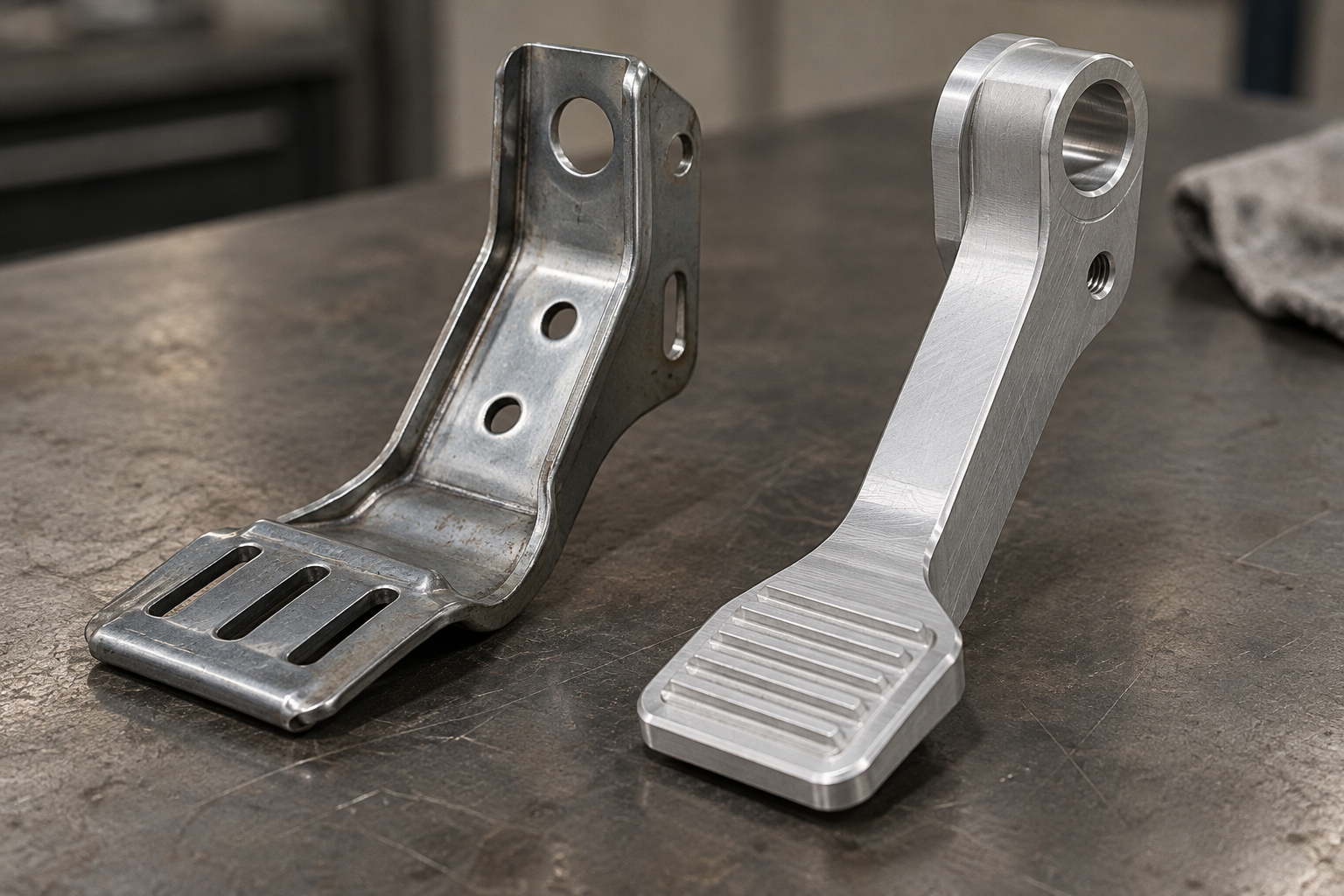
Sheet metal stamping is the comprehensive cold deformation of thin metal sheet, including shearing, punching, bending, welding, riveting, and forming. The fixed brackets, reinforcement plates, and connecting pieces in a pedal assembly are its typical parts: single variety, high output, and relatively small structural parts, which fall right within stamping's efficiency range. The load-bearing capacity of steel plate brackets is usually very strong. Public reports mention that a certain model's steel pedal can withstand over 3000N of pressure; this magnitude is for reference only, and specific values are subject to OEM specifications and drawings. The failure risk of stamped parts mostly lies in stress concentration at bend radii and blanked edges. During design, one should focus on fillet radius and material thickness transitions, not just the material grade.
Die casting and CNC machining: lightweight medium-to-high volume vs. low-volume prototyping
Aluminum alloy die casting is suitable for medium-to-high volume brackets that require weight reduction and integrated forming. Mold costs are higher than injection molding; in the industry, die-casting molds commonly cost about 150,000–400,000 RMB, and a typical industry aluminum die-cast bracket is about 25–50 RMB per piece (excluding mold cost). It is lighter than steel, but wall thickness and internal porosity control are difficult points, and heat treatment and deburring processes cannot be omitted.
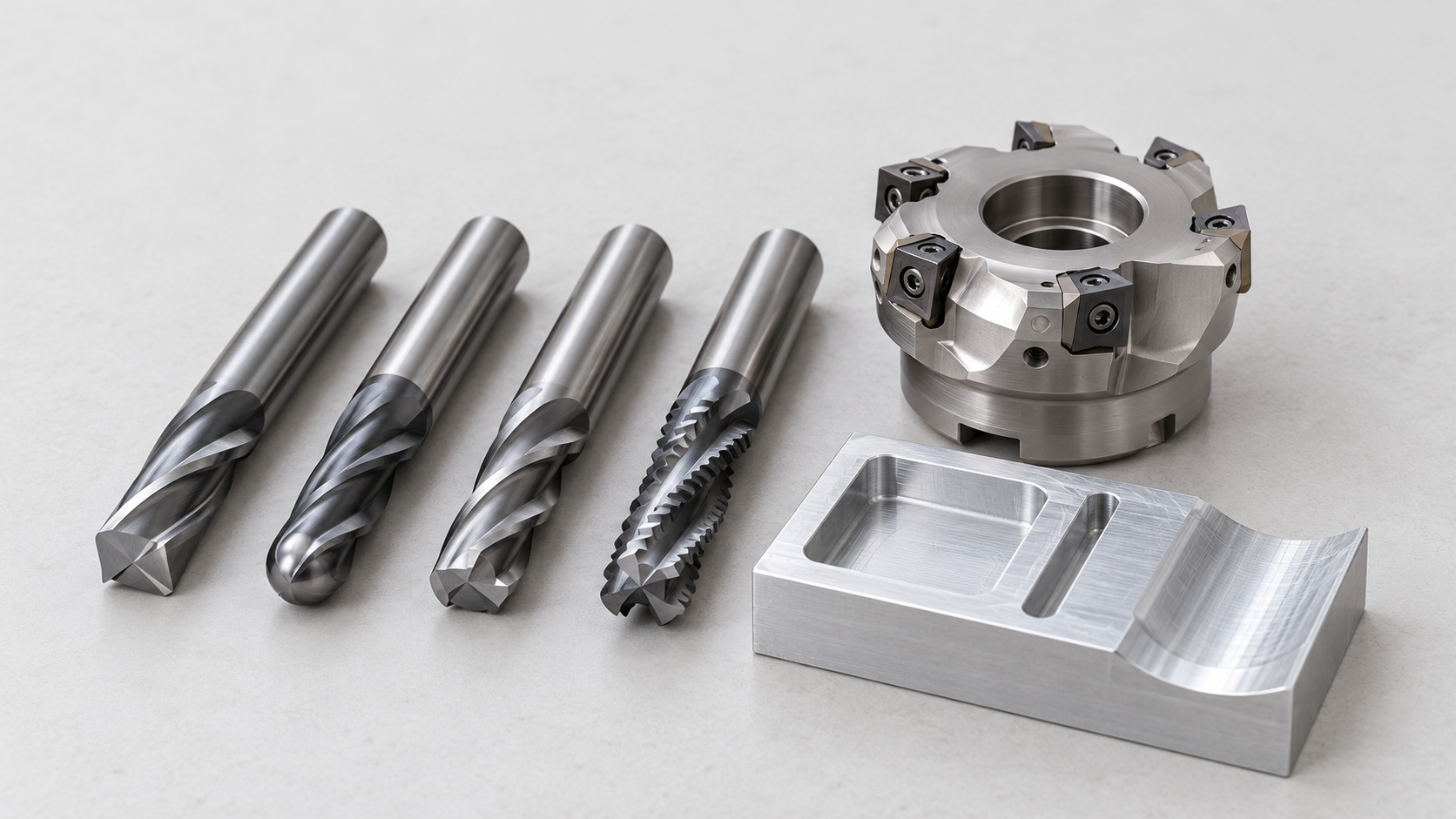
CNC machining has a completely different positioning: no mold is needed, and changing the drawing changes the part, making it suitable for low-volume prototyping, modified parts, and fixtures. Aluminum, steel, stainless steel, and titanium can all be machined, and surface treatments can include anodizing, polishing, powder coating, and electroplating. The trade-off is high per-piece labor time; a typical industry small-batch turned aluminum alloy part is about 80–120 RMB, far higher than mass-produced injection-molded or die-cast parts. Its value is not in the per-piece price, but in quickly obtaining a physical part that can be installed on a vehicle. To evaluate the machining path for such samples, you can start by comparing CNC machining capabilities and injection molding capabilities, then decide which route to take.

What roles do sheet metal stamping and CNC machining each play in pedal manufacturing?
These two processes are discussed together because they are most easily confused: both can produce metal parts, and both are associated with "steel," but their positions in a pedal project are completely different. To give the judgment in one sentence—sheet metal stamping is the primary forming method for mass-produced metal pedal parts, while CNC machining is a complementary method for prototypes, tooling, and low-volume parts.
Sheet metal stamping: the primary forming method for mass-produced brackets and reinforcement plates
Sheet metal processing is a comprehensive cold deformation process for thin metal sheet, including shearing, punching/cutting, bending, welding, riveting, and forming. Stamped sheet metal is especially suitable for products with a single variety, high output, and relatively small structural parts. The fixed brackets, reinforcement plates, connecting pieces, and mounting base plates in a pedal assembly are exactly this type of part. Its advantages are fast cycle time, low per-piece cost, and good batch consistency; the trade-off is high mold investment, and changing the structure means changing the mold.
The failure modes of stamped parts also follow their own patterns: fractures mostly occur at bend radii and blanked edges. The outer side of a bend is stretched and thinned, and stress concentrates when the radius is too small; burrs and microcracks at blanked edges are fatigue initiation points. Therefore, bend radius, hole edge distance, and deburring requirements on drawings are not appearance issues, but life boundaries. Public reports state that steel plate brackets can "withstand over 3000N of pressure"; this is only an order-of-magnitude reference, and specific values are subject to OEM specifications and drawings.
CNC machining: prototypes, fixtures, and low-volume metal pedal arms
The role of CNC machining is "obtaining metal parts without making a mold." Aluminum, steel, stainless steel, and titanium are all common materials, and surface treatments can include anodizing, polishing, powder coating, and electroplating. For pedal prototypes, inspection fixtures, welding fixtures, and modified metal pedal arms, changing the drawing changes the part, and the iteration pace is fast, which is very valuable for early verification of assembly relationships and ergonomic dimensions.
The limitations must be made clear: per-piece labor time is high, and the per-piece cost of low-volume metal parts is significantly higher than mass-produced stamped or die-cast parts; more critically, the fiber orientation, residual stress, and surface condition of CNC-machined parts differ from mass-produced injection-molded or die-cast parts, so fatigue performance cannot be directly extrapolated. Prototype verification is about assembly and stiffness, not a mass-production safety conclusion.
What safety metrics matter for a brake pedal: pedal force, fatigue, temperature, lateral conditions
Let's start with one judgment: pedal safety isn't held up by a single force value—it's a combination of operating conditions. Static pedal force is only the entry-level item. What really determines whether the bracket will break at the fillet years later is fatigue, temperature, and lateral stepping.
Static pedal force: first look at the magnitude, then look at the components
OEMs and regulations set a force threshold that the pedal assembly must not fail under. Two magnitudes have appeared in public reports: in an emergency braking test of one model, the pedal force at the moment the bracket broke was about 1612N, while another automaker announced that its pedal can withstand more than 3000N. These two numbers cannot be directly compared—one is the measured load at fracture, the other is the design load capacity, and the model, components, and operating conditions are all different. Specific limits are subject to the drawings and OEM specifications; do not use news numbers as acceptance criteria.
Fatigue and temperature: glass fiber reinforced plastics and metals have different failure paths
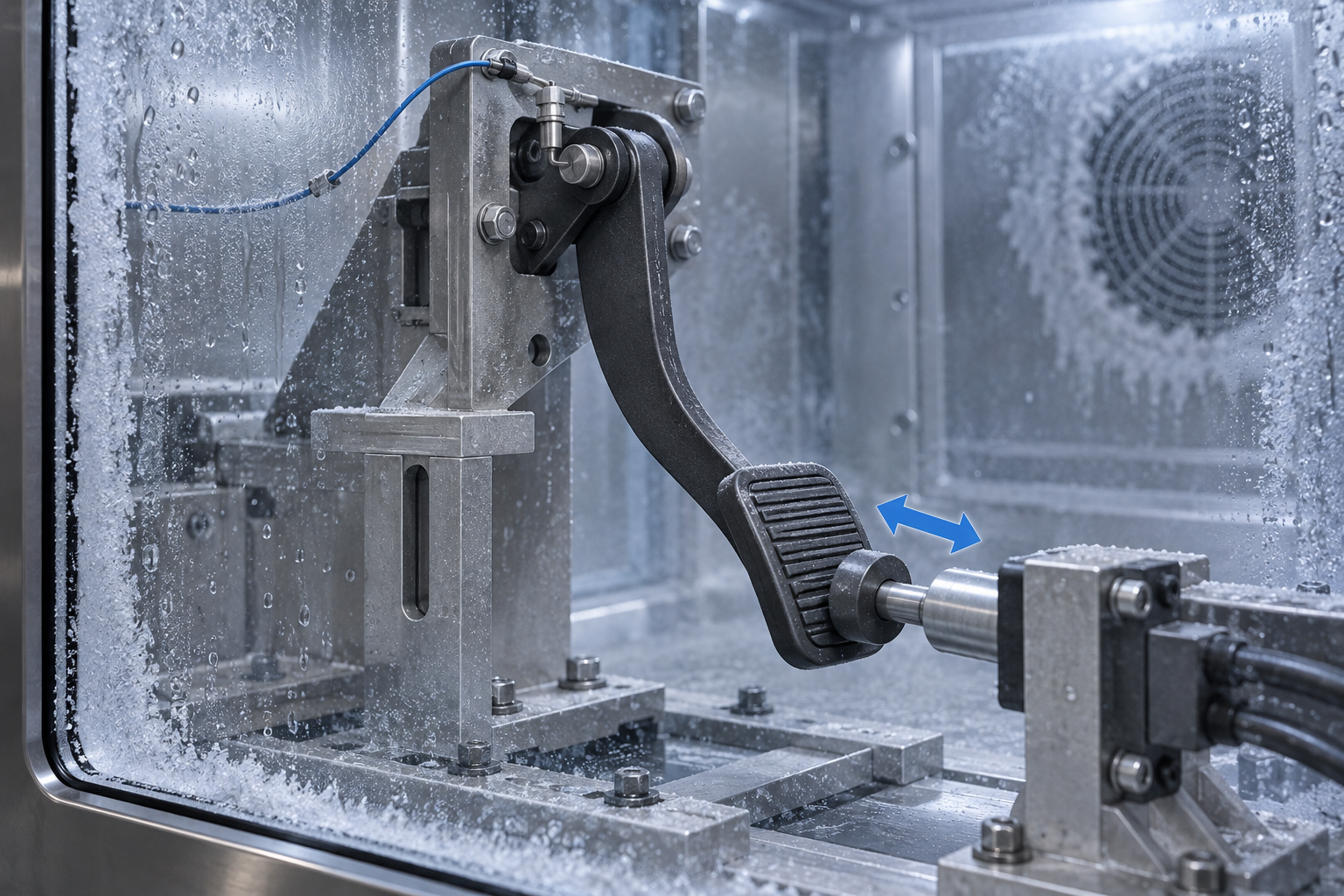
The pedal is a high-frequency actuation part—pressed dozens of times a day, which becomes hundreds of thousands of times over ten years. Fatigue life is determined by the number of cycles and the load spectrum. The fillet at the bracket root and the pivot hole wall are common crack initiation locations. Temperature must be considered separately: validation often covers conditions such as -35°C, room temperature, and 80°C, because the low-temperature toughness of glass fiber reinforced PP or PA decreases more noticeably than that of steel, and the risk of low-temperature embrittlement cannot be extrapolated from room-temperature data. Metal parts perform more stably at low temperatures, but attention must be paid to the weld heat-affected zone and casting porosity.
Lateral conditions: a high-incidence fracture item that must be validated together with forward loading
Off-center stepping, angled stepping, or foot position shifting during a collision will all change the load from axial to lateral. At this time, the area near the pivot is subjected to both bending moment and torque, and the bracket root and pivot hole become stress concentration points. In design, this is addressed by enlarging fillets, adding ribs, increasing glass fiber content, or locally changing to metal inserts, but these measures must all be validated simultaneously under both forward and lateral conditions, and repeated at the most severe temperature point. Looking only at the static forward force value will miss the real failure mode.
Why do forward stepping and lateral stepping produce very different test results?
The same bracket may pass under forward stepping but break under lateral stepping—this is not a rigged test, but rather because the load paths of the two conditions are fundamentally different. During forward stepping, the force is transmitted roughly axially along the pedal arm, and the mounting bracket is mainly subjected to compression and unidirectional bending, with a relatively uniform stress distribution on the cross-section. During lateral stepping, the foot position shifts to the edge of the pedal, steps at an angle, or the body causes the foot position to shift during a collision, so the load direction deviates from the design path and simultaneously generates bending moment and torque near the pivot.
The superposition of these two internal forces changes the critical cross-section. The bracket root and the fillet transition zone around the pivot hole are already locations of geometric discontinuity, and the stress concentration factor rises noticeably under lateral conditions. The anisotropy of glass fiber reinforced plastics further amplifies this problem: during injection molding, glass fibers orient along the flow direction, and strength perpendicular to the orientation is lower. If the lateral load happens to fall in the weak orientation direction, failure will come more suddenly. Metal parts do not have the fiber orientation problem, but welding or as-cast defects are likewise prone to cracking under torque.
How to handle lateral conditions in design
There are several common approaches: enlarge the transition fillet at the bracket root to reduce stress concentration; add ribs in the direction of lateral loading to increase the section moment of inertia; increase glass fiber content, or change the most critical local area to a metal insert; optimize the fit clearance between the pivot and the hole to reduce additional bending moment. These measures all have costs—larger fillets take up space, ribs affect injection molding flow and warpage, and inserts add assembly steps. Which set to choose depends on how much weight the lateral load actually carries in the vehicle operating conditions.
During validation, forward and lateral directions must be tested separately; you cannot draw a conclusion by testing only one direction. A more reliable approach is to repeat lateral loading at multiple temperature points—at low temperature, plastic toughness decreases, and the failure risk under lateral conditions is highest. Common validation temperatures in the industry cover conditions such as -35°C, room temperature, and 80°C; which points to test, how much load to apply, and how many cycles to run are subject to OEM specifications and drawing requirements, and vary greatly among different models. Only by combining lateral conditions with temperature in testing can you truly reach the failure boundary of this component.
Can CNC-machined or 3D-printed pedals for small-batch trial production directly replace mass-production validation?
So what can CNC-machined and 3D-printed pedal samples validate?
What should be locked down at the prototype stage and the mass-production stage, respectively
- Prototype stage: clearly state what this round of validation is for (assembly, human-machine, stiffness), and do not put prototype results into safety reports; material grades may be approximate for now, but the drawing must be marked "non-mass-production process."
- Transition stage: before mass production, small-batch real parts are needed, which can use hand-made replica tooling/vacuum casting or small-batch injection molding, so that the material system and forming method are as close to mass production as possible, but the differences from the final injection-molded part must still be indicated.
- Mass-production stage: lock down the process route, material grade and glass fiber content, mold condition, and gate location. Changing material, changing molds, or modifying gates all count as process changes, and fatigue data must be re-evaluated.

Frequently Asked Questions
The following questions are the points most likely to be asked after reading the earlier breakdown of materials, processes, and safety indicators.
Should automotive pedals use plastic or metal?
There is no one-size-fits-all answer. In a pedal assembly, the pedal arm, mounting bracket, and pivot/linkage are three types of components with different operating conditions. In mass-production passenger vehicles, pedal arms and some brackets commonly use glass-fiber-reinforced PP or PA injection-molded parts, while load-bearing pivots and some metal brackets still use steel or aluminum alloy. Material selection depends on a comprehensive solution involving batch size, structural complexity, cost, and weight, not a contest between advanced and outdated.
What batch sizes are suitable for injection molding, stamping, die casting, and CNC machining, respectively?
Injection molding is suitable for large-batch complex integrated structures; mold costs are high, but the per-piece cost is diluted. Stamping is suitable for thin-sheet bracket types with a single variety and high output. Die casting is suitable for medium-to-large-batch aluminum alloy parts; they are light, but mold costs are high. CNC machining is suitable for small batches, trial production, and modification, with no need to open molds and with the part changing when the drawing changes, but per-piece labor hours are high. Typical industry injection molds are about 100,000–250,000 yuan, and die-casting molds are about 150,000–400,000 yuan, depending on the structure and supplier.
Which safety indicators for brake pedals are mainly considered?
At least four: static pedal force, fatigue life, temperature cycling, and forward and lateral pedaling conditions. Public reports have mentioned two orders of magnitude, 1612N and above 3000N, indicating large differences among vehicle models and components; specific values are subject to drawings and OEM specifications. These items must be validated in combination; looking only at static force values will miss real failure modes.
Why is lateral pedaling more likely to cause problems than forward pedaling?
During forward pedaling, the load is transmitted along the axial direction of the pedal arm, and the bracket is mainly subjected to compression and bending; lateral pedaling (off-center pedaling, angled pedaling, or foot position shift during a collision) causes bending moments and torque to superimpose near the pivot, making the bracket root and pivot hole stress concentration points. In design, this is usually addressed by increasing fillets, adding reinforcing ribs, increasing glass fiber content, or locally changing to metal inserts. During validation, both forward and lateral conditions must be repeated at the most severe temperature point.
Can pedals made by CNC machining or 3D printing for small-batch trial production directly replace mass-production validation?
No. CNC-machined parts and 3D-printed parts differ from mass-produced injection-molded or die-cast parts in fiber orientation, internal density, residual stress, and surface condition, and their fatigue performance in particular is not equivalent. Prototypes can validate assembly, ergonomics, and preliminary stiffness, but to extrapolate to mass-production safety conclusions, validation parts must be made with processes and materials consistent with mass production, and the material grade, glass fiber content, and mold condition must be locked down.
Key takeaways
- A pedal assembly is not a single material: the pedal arm, mounting bracket, and pivot/linkage often fall into three separate routes — plastic, steel, and aluminum alloy.
- The mainstream material for mass-produced plastic brackets is glass-fiber-reinforced PP or PA (nylon), with glass fiber content commonly in the 30%–40% range — not ordinary consumer-grade plastic.
- Volume determines the process: injection molding suits large-volume complex structures, stamping suits large-volume simple parts, die casting suits medium-to-large-volume aluminum alloy parts, and CNC machining suits low-volume prototyping and modification.
- There are at least four safety metrics: static pedal force, fatigue life, thermal cycling (e.g., -35°C/room temperature/80°C), and frontal and lateral pedal-actuation conditions.
- The process used for validation samples must match the production process — fatigue results from CNC or 3D-printed samples cannot be directly extrapolated to mass-produced injection-molded parts.