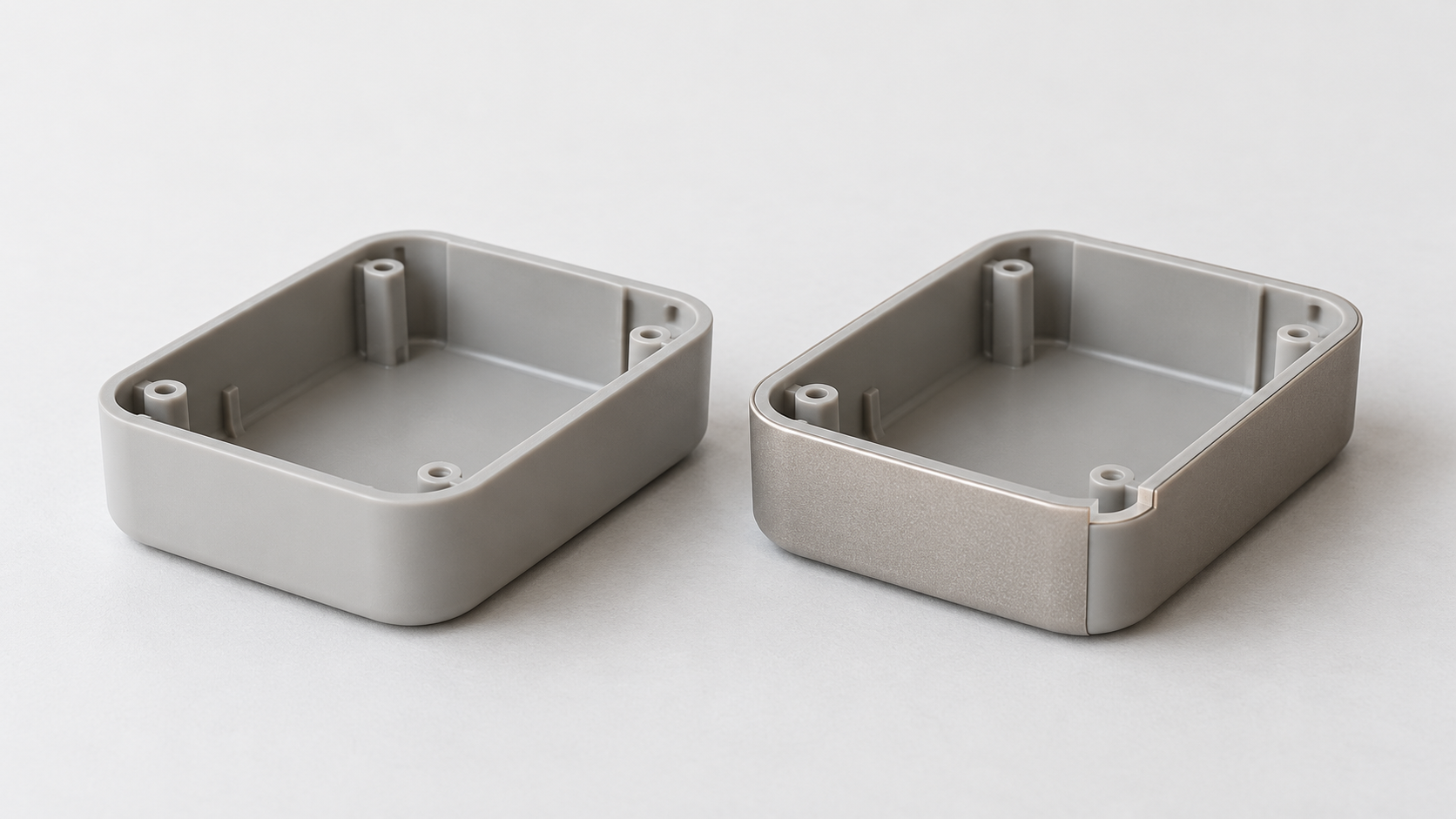
First Distinguish In-Mold Decoration Injection Molding, Conventional Injection Molding, IML, IMR, and INS
When a plastic housing requires a high-gloss finish, metallic texture, scratch resistance, curved-edge wrapping, and a viewing window at the same time, “IMD” in a supplier quotation does not necessarily refer to the same process. Conventional injection molding primarily addresses filling the mold with plastic melt, cooling, and demolding; in-mold decoration injection molding integrates the pattern or decorative layer into the surface of the molded part during molding. This article discusses the terminology based on process characteristics and does not treat different suppliers’ naming conventions as a unified standard.
| Process terminology | Core characteristics | Preliminary applicability |
|---|---|---|
| Conventional injection molding | No decorative film is placed in the mold; spray coating, screen printing, or labeling may be performed afterward | Single-color parts, standard textures, relatively simple structures, and applications that allow post-processing |
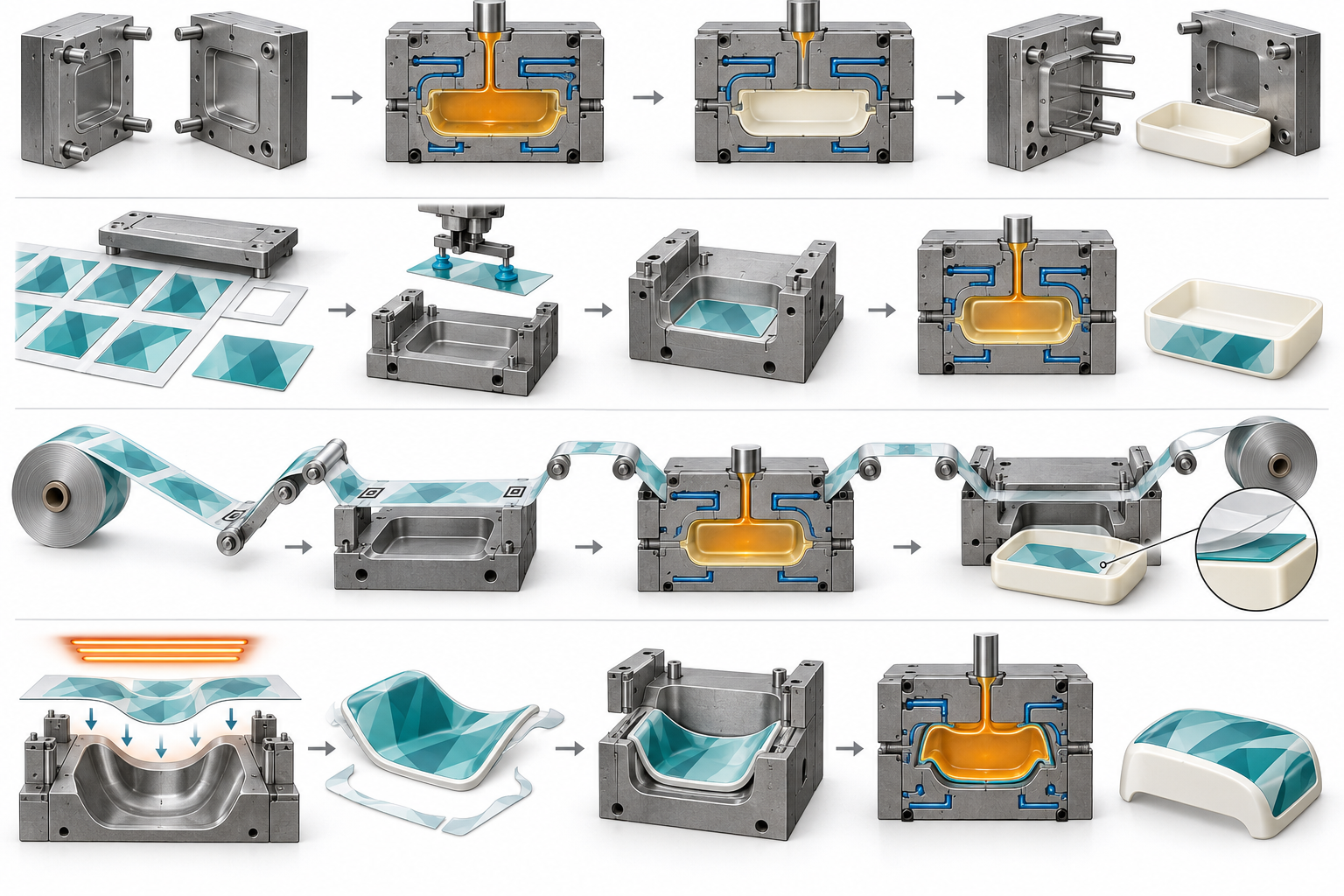
| IML | The preprinted film insert is cut and positioned before being placed in the mold; after molding, the entire film insert remains on the surface of the molded part | Flat or mildly curved, low-stretch cosmetic surfaces |
| IMR | Roll material is conveyed and aligned, and the pattern is transferred to the surface of the molded part; the carrier film is normally separated from the molded part | Exterior surfaces requiring continuous film supply and automated decoration |
| INS or high-stretch insert injection molding | The film insert is preformed first, then die-cut, positioned, and injection molded | Housings with deep curves, wraparound edges, or patterns requiring significant three-dimensional elongation |
Therefore, in-mold injection molding and conventional injection molding are not simply substitute options differentiated as “premium” and “basic.” First, consider the housing geometry and pattern elongation: for flat or mildly curved surfaces, IML can be evaluated first; roll-to-roll transfer and continuous automation can be addressed with IMR; for deep three-dimensional curves, high-stretch solutions such as INS should be evaluated. If only a single color or a general texture is required, conventional injection molding combined with post-processing may be more reliable. When requesting quotations, ask suppliers to clearly specify whether the film insert remains on the part, which layer contains the pattern, and how elongation on curved surfaces and in wraparound-edge areas will be verified.
Comparison of the Process Flows for Conventional Injection Molding and In-Mold Decorative Injection Molding
The core process of conventional injection molding is relatively straightforward: plastic pellets are melted and injected into the mold cavity, then the part is formed through filling, packing, cooling, and demolding. Surface textures or colors are typically produced by the plastic itself, the mold surface, or subsequent spraying or screen printing. The main risks are concentrated in sink marks, warpage, weld lines, bubbles, and demolding deformation; key design considerations include the gate, venting, wall thickness, and draft direction.
IML and IMR Add Film-Insert Loading and Alignment
IML typically involves printing and cutting the film insert first, followed by placing and positioning it in the mold cavity using a robot or manually. Plastic is then injected from the back of the film insert so that the film insert bonds to the molded part. Because the entire film insert remains on the surface of the finished product, the film boundary, positioning errors, wrinkles, bubbles, and contamination can all become cosmetic defects. The pattern on the film insert must also be checked for shifts or local deformation caused by the filling pressure and temperature.
IMR places greater emphasis on roll-material conveyance, continuous alignment, and in-mold transfer. During injection molding, the pattern is transferred from the film material to the surface of the molded part, while the carrier film normally does not remain as the outer layer of the finished product. This can reduce some manual film-loading operations, but roll tension, indexing position, transfer completeness, and the surface-protection structure require separate validation. Scratch resistance and chemical resistance cannot be assessed solely from the name “IMR.”
High-Stretch Insert Injection Molding Also Requires 3D Forming First
For structures with deep curves, wraparound edges, or patterns that must extend significantly with the housing, high-stretch insert injection molding such as INS typically adds steps including film-insert preforming, die cutting or laser cutting, three-dimensional positioning, and mold loading, followed by injection molding from the back. The added processes allow the film insert to conform more closely to complex housings, but they also introduce risks such as pattern deformation after stretching, edge lifting, preform springback, positioning deviations, and clamping damage. During mold trials, the film-insert process and the plastic-part injection-molding process should be evaluated as a whole, rather than validating only the dimensions of the plastic part.
| Process | Added process steps | Key risks |
|---|---|---|
| Conventional injection molding | Melting, mold filling, cooling, demolding | Shrinkage, warpage, weld lines, demolding deformation |
| IML | Printing, die cutting, positioning, mold insertion, backside injection | Misalignment, wrinkles, bubbles, contamination, film boundary defects |
| IMR | Roll-fed film transport, stepwise registration, in-mold graphic transfer | Incomplete transfer, pattern misalignment, mismatch in protective-layer performance |
| High-stretch insert injection molding | Preforming, punching, 3D positioning, injection | Stretching deformation, springback, lifting, positioning errors on complex curved surfaces |
What Structures Are Suitable for Ordinary Injection Molding, IML, or High-Stretch Insert Injection Molding
The geometry of a plastic housing is the first criterion when selecting an injection molding process. Do not assume that IML or high-stretch insert injection molding is automatically the more advanced option. First confirm whether the appearance surface is flat, how much the film needs to stretch, whether the pattern must wrap over the edges, and whether the assembly structure will occupy the film area.
| Structural and Appearance Conditions | Preferred Options to Evaluate | Key Decision Criteria |
|---|---|---|
| Monochrome, ordinary texture, simple structure, and allows post-processing | Conventional injection molding | Compare the total cost, change flexibility, and appearance risks of spray coating, screen printing, or post-applied labels |
| Flat or gently curved surfaces, with limited pattern stretching and full retention of the film insert | IML | Confirm the film insert boundaries, positioning method, cutting accuracy, and surface protective layer |
| Requires continuous roll-stock decoration, with the pattern located primarily on the outer surface | IMR | Confirm the transfer location, surface structure after base-film separation, and durability validation method |
| Deeply curved surfaces, pronounced wraparound edges, areas around windows, or patterns requiring extensive extension | Injection molding with high-stretch inserts such as INS | Evaluate preforming, punching, three-dimensional positioning, and pattern deformation risks |
Conventional injection molding does not necessarily mean a low-end solution. When the housing can use the natural color or texture of the plastic, or can accept post-processing, and the product is revised frequently while annual volume has not yet stabilized, reducing film printing, preforming, and in-mold positioning may be more effective for controlling project risk. In contrast, IML is better suited to flat or gently curved surfaces with limited stretching. If the pattern must extend continuously along a deep curve, a low-stretch film insert is prone to pattern distortion, wrinkling, or edge lifting. In such cases, high-stretch insert injection molding should be considered rather than simply increasing the film-insert size for conventional IML.
Confirm pattern stretching and splicing areas during the DFM stage
During the design review, overlay the pattern file onto the three-dimensional housing and mark the areas where deformation, splicing, trimming, and the absence of decoration are permitted. The film-insert edges must also be kept away from screw bosses, snaps, sealing surfaces, and areas subject to frequent friction to prevent interference or edge peeling during assembly. The final solution should be confirmed using molded trial parts, rather than judged solely from two-dimensional renderings or a supplier's process designation of “in-mold injection molding.”
How to validate appearance, scratch resistance, and functional integration in in-mold decorated injection molding
In-mold decorated injection molding is not inherently more scratch-resistant. After IML molding, the complete film insert is generally retained. Surface performance depends on the combination of film material, ink position, transparent protective layer, and plastic substrate. IMR, by contrast, transfers the decorative pattern to the surface of the molded part, with the base film separating from the product; validation therefore focuses on the adhesion, abrasion resistance, and edge stability of the transfer layer. The selection of PET, PC, PMMA, or composite film should be confirmed based on appearance, curved-surface stretching, operating temperature, and cleaning media, rather than judged solely by the process designation “IML” or “IMR.”
Validate the pattern and the structure together on the visible surface of the injection-molded part
During mold trials and pilot production, first confirm the pattern position, color difference, local stretching distortion, and the relative dimensions of windows and key markings. Then inspect for bubbles, silver streaks, wrinkles, film warpage, scratches, and edge lifting. In deep-curved or wraparound areas, pay particular attention to whether the pattern has been thinned, displaced, or obscured. If the film insert serves both decorative and functional roles, such as light transmission, light blocking, or key identification, backlight uniformity, light-transmission areas, and assembly clearances must also be included in the inspection rather than relying solely on visual appearance checks.
Scratch and chemical resistance must correspond to the actual use environment
Scratch resistance, adhesion, and chemical-resistance validation should be defined according to the substances actually contacted, cleaning methods, temperature and humidity, and frequency of use. Common tests may include post-scratch appearance, adhesion of the ink or transfer layer, exposure to cleaning agents, edge peeling, and friction interference after assembly. The specific load, medium, and acceptance grade must be defined by the product specification. During acceptance, it is recommended to document appearance-defect samples, inspection lighting, viewing distance, and sampling rules, and to record defects separately for incoming film materials, post-injection parts, and assembled parts. This prevents material issues, injection-molding defects, and assembly damage from being treated as the same category.
DFM for In-Mold Decoration Injection Molding Production: Film Insert Positioning, Gates, Demolding, and Assembly
DFM for in-mold decoration injection molding must inspect not only the plastic part itself, but also treat the film insert as a component that requires positioning, clamping, forming, and inspection. The parting line, gate, and ejection locations shown on standard injection molding drawings may directly affect the graphics, viewing windows, and high-gloss cosmetic surfaces.
Confirm the Film Insert Datums and Boundaries Before In-Mold Injection Molding
Before mold trials, the film insert's locating holes, datum edges, clamping areas, and cutting tolerances should be clearly defined, and the 3D data should identify hidden edges, wraparound widths, and permitted splicing areas. Whether vision-based positioning, automatic film feeding, or manual loading is used, the positioning datums and operating direction should remain consistent. Deep cavities, sharp corners, and areas with large curvature increase the risk of film insert wrinkling, warping, and graphic misalignment. When graphics cross curved surfaces, additional allowance should also be reserved for evaluating stretch deformation and print registration.
Injection Molding Gate, Demolding, and Assembly Interference Must Be Checked Together
The gate location and melt flow direction should avoid the primary cosmetic surfaces, or mold trials should verify whether weld lines, flow marks, and pressure variations fall within acceptable areas. Insufficient venting may cause bubbles, silver streaks, or localized poor adhesion. The plastic part must still be designed with controlled sharp corners, deep cavities, and abrupt wall-thickness transitions, and the demolding direction must be checked to determine whether the film insert may be stretched, scratched, or pulled out of position.
The film insert edges should also maintain sufficient clearance from screw bosses, snap-fits, sealing surfaces, guide posts, and assembly datums to prevent film pinching, whitening from ejection, interference, or edge lifting. The mold-trial plan should define the acceptance criteria for graphic position, color difference, wrinkles, bubbles, scratches, adhesion, and assembly function, rather than inspecting only the plastic part dimensions.
Cost, Yield, and Post-Processing Comparison of Standard Injection Molding and In-Mold Decoration Injection Molding
Standard injection molding and in-mold decoration injection molding are not simply a choice between “low cost” and “high cost.” The front-end process for standard injection molding is relatively direct, typically requiring only plastic pellet drying, melt filling, cooling, and demolding. If the housing uses a single color or texture, or will receive labels later, processes such as film printing, preforming, and in-mold positioning can be omitted. However, when the product requires a high-gloss finish, metallic texture, multicolor graphics, or localized functional markings, standard injection molding may still require painting, screen printing, pad printing, labeling, or other post-processing. Each additional process increases handling, tooling, cosmetic inspection, and batch-to-batch consistency management requirements.
The Cost of In-Mold Decoration Injection Molding Comes from the Complete Production System
IML, IMR, or high-stretch film-insert injection molding may reduce some painting and labeling work, but this does not necessarily mean that the total cost will be lower. The cost calculation should include film material, printing waste, graphic utilization, cutting, preforming, clean handling, manual or automated mold loading, vision-based positioning, mold loading methods, and cosmetic inspection. The potential for reducing post-processing is more worthwhile to evaluate when the graphics are stable, annual volumes are high, and automation conditions are mature. If the product is frequently revised or graphic utilization is low, film insert scrap may offset some of the savings.
Injection Molding Yield Must Be Compared by Defect Mode and Statistical Criteria
Yield should not be evaluated solely by the final pass rate. Standard injection molding mainly requires monitoring of sink marks, weld lines, color differences, flash, and warpage. In-mold decoration injection molding must additionally track film insert misalignment, wrinkles, bubbles, silver streaks, scratches, edge lifting, graphic stretching, and assembly interference. During procurement, suppliers should be required to state separately the scrap criteria for the injection-molded part, film insert preprocessing, and final assembly, and comparisons should be made after pilot production using the same inspection standards. The final decision should consider annual volume, cosmetic grade, change frequency, cost of defects, and post-processing requirements, rather than applying a fixed price or yield conclusion for a particular process.
RFQ Information Checklist for In-Mold Decoration Injection Molding and Standard Injection Molding
An RFQ for in-mold decoration injection molding and standard injection molding cannot consist only of a housing 3D file and annual volume. The supplier must simultaneously assess the plastic part structure, cosmetic zones, film insert process, and subsequent assembly. Otherwise, “IMD” in the quotation may be merely a vague process name, making it impossible to directly compare cost, risk, and delivery boundaries.
RFQ Information Must Cover Appearance, Structure, and Service Environment
- 3D housing model, 2D drawings, parting or demolding direction, and the locations of assembly datums, snap-fits, screw bosses, and sealing surfaces.
- Cosmetic-zone map identifying high-gloss areas, textures, metallic effects, viewing windows, button areas, permitted splice lines, and non-cosmetic clamping areas.
- Graphic source files, color requirements, and material and color assumptions. If the film insert structure has not yet been determined, explicitly require the supplier to separately evaluate IML, IMR, or high-stretch film-insert solutions.
- Requirements for resistance to scratching, chemicals, cleaning agents, perspiration, temperature and humidity, ultraviolet light, or other service conditions, together with any existing inspection specifications or reference samples.
- Estimated annual usage, batch-to-batch variation, revision change frequency, and acceptable limits for edge regions, pattern offset, and appearance defects.
Require the supplier to provide a verifiable process flow and validation plan.
When responding, the supplier should clearly state whether conventional injection molding requires painting, screen printing, or post-applied labeling. For in-mold decoration injection molding, the supplier should specify the film material structure, the locations of the printed surface and protective layer, whether preforming is required, the cutting method, the mold-loading plan, and the positioning datums. For roll-to-roll transfer solutions, the film-feeding and alignment methods should also be confirmed. For deep-curved housings, the supplier should explain how pattern stretching, edge wrapping, and film edges will be handled.
The mold-trial plan should not simply state "appearance confirmation." It should list evaluation items such as pattern position and distortion, color difference, bubbles, wrinkles, silver streaks, film warpage, edge lifting, sink marks, weld lines, scratches, and assembly interference, and should define the sampling method, sample quantity, defect classification, and statistical basis for production yield. Only when all of this information is complete can the total cost and mass-production risks of conventional injection molding and in-mold decoration injection molding be meaningfully compared.
Common questions about selecting between in-mold injection molding and conventional injection molding
In-mold injection molding and conventional injection molding are not simply higher- and lower-end alternatives. Conventional injection molding primarily addresses the forming of plastic parts, whereas IML, IMR, and high-stretch insert molding incorporate a decoration layer, pattern, or functional film into the molding process. The final solution should be determined based on the housing geometry, film stretching, appearance durability requirements, annual usage, and trial-production data.
Does IMD mean the same thing as IML?
Not exactly. In this article, IMD is used as a general term for in-mold decoration-related processes. IML usually refers to placing a preprinted film into the mold and molding it together with the plastic, with the entire film retained on the surface of the finished part. Terminology boundaries may vary among suppliers, so during quotation requests, ask the supplier to describe the specific process.
Can conventional injection molding replace in-mold decoration injection molding?
When the housing structure is simple and a single color, texture, painting, screen printing, or post-applied label can meet the appearance requirements, conventional injection molding may be more suitable. However, when complex patterns, edge wrapping, integrated windows, or relatively stable surface decoration are required, post-processing steps, durability validation, and defect risks should be compared as well.
What film-related risks should be the focus for deep-curved housings?
Particular attention should be paid to pattern stretching after preforming, film springback, edge lifting, wrinkles, cutting deviations, and three-dimensional positioning stability. Deep-curved or highly wrapped structures generally cannot directly use low-stretch IML solutions; high-stretch insert molding processes such as INS should be evaluated and confirmed through mold trials.
Which offers better durability, IMR or IML?
This cannot be determined solely from the process name. IML retains the film, whereas IMR typically transfers the pattern onto the surface of the finished part. Actual scratch resistance, chemical resistance, and adhesion performance also depend on the film material, ink location, transparent protective layer, plastic substrate, and service environment, and should be validated according to the product specifications.
What items should be checked during acceptance of an in-mold injection trial production run?
It is recommended to cover pattern position and distortion, color difference, bubbles, silver streaks, wrinkles, scratches, film warpage, edge lifting, sink marks, weld lines, adhesion, and assembly interference. The specific sampling method and acceptance limits should be jointly confirmed by the product, quality, and supplier teams before trial production.
Key takeaways
- Conventional injection molding primarily addresses the molding of plastic parts, whereas in-mold decoration injection molding integrates film decoration or pattern transfer into the molding process.
- Flat or slightly curved, low-stretch appearance surfaces are generally more suitable for IML; deep curves, wrapped edges, and significant pattern stretching require evaluation of high-stretch insert solutions such as INS.
- IML typically retains the film, while IMR generally transfers the pattern from a roll stock onto the surface of the molded part; actual performance depends on the film material, ink, transparent protective layer, and operating environment.
- The DFM of in-mold decoration injection molding involves not only the plastic part, but also the film datum, preforming, trimming, positioning, gating, demolding, and appearance inspection.
- Cost and yield must be compared using project trial-production data; the more economical solution cannot be determined solely by claims of “reduced post-processing” or by the process name.