What Is On-Demand Manufacturing: First Distinguish Push Production from Pull Production
When it comes to manufacturing, most people picture rows of assembly lines, piles of parts bins, and production schedules arranged according to annual plans. Factories first forecast how much they can sell this year, then decide how many lines to open, how much material to stock, and how much finished goods inventory to hold—this logic has operated for over a hundred years and has indeed supported modern industry. But it has one premise: demand must be roughly predictable. Once market tastes change and orders fluctuate, the cost of inaccurate forecasts becomes unsellable goods in the warehouse and cash tied up on the books.
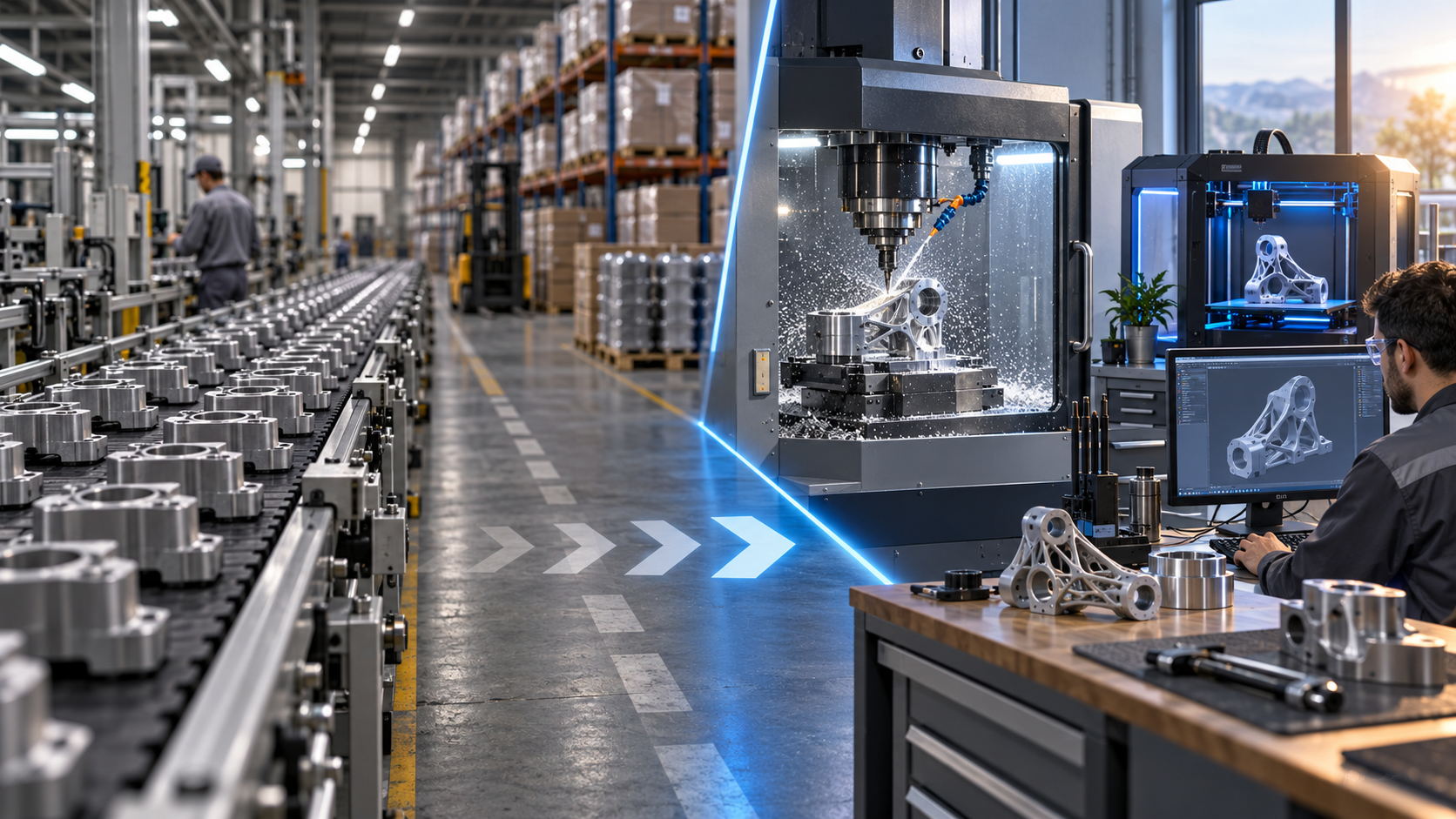
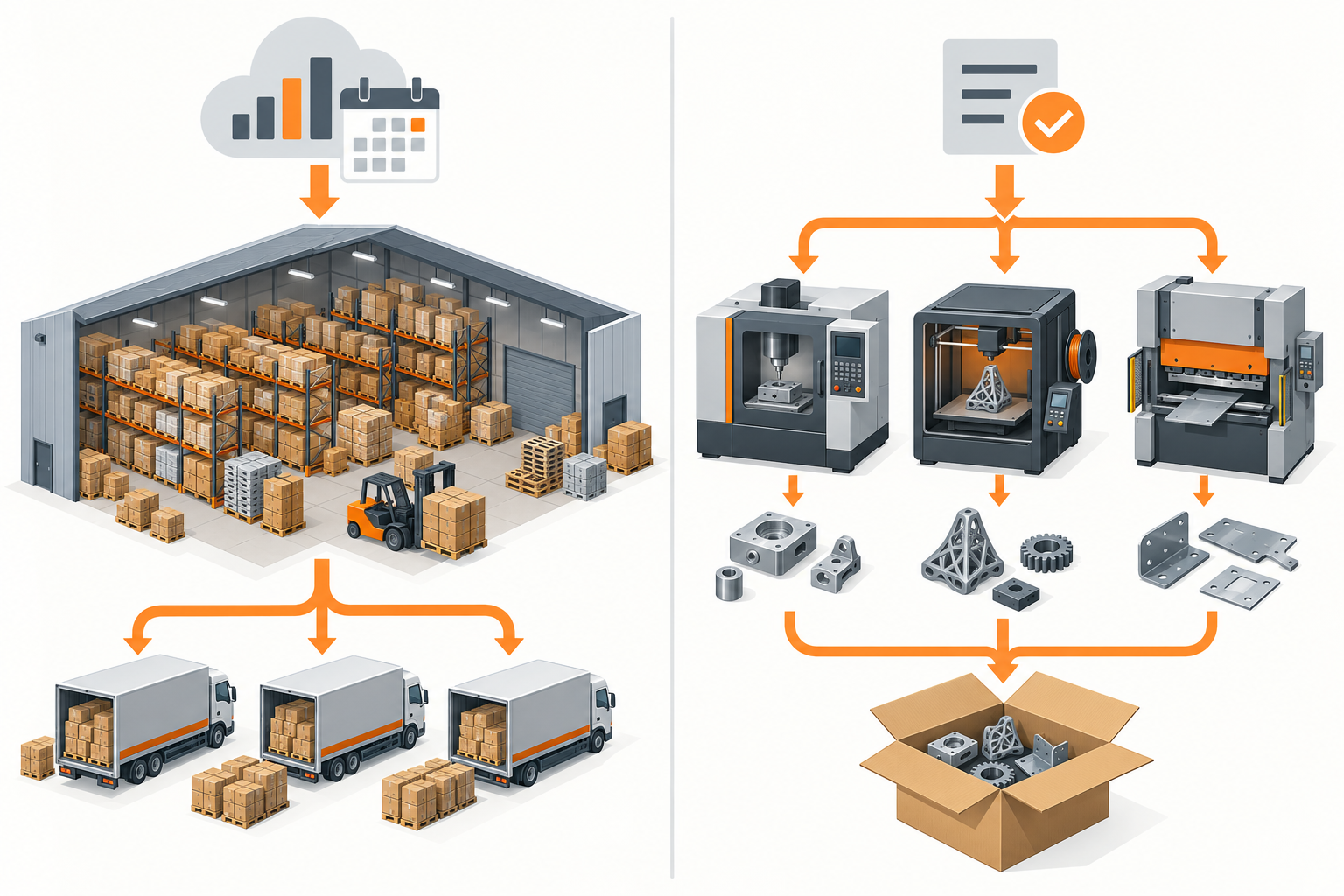
On-demand manufacturing is aimed at this premise. It is also called make-to-order, and its core is just one sentence: production starts only after a real order is received. Without an order, there is no scheduling, no material preparation, and no finished goods inventory. In production management terms, it belongs to "pull" production—demand pulls products out of the production line; while traditional make-to-stock belongs to "push," where forecasts push products into the warehouse and then wait for customers to buy them.
These two terms sound abstract, but they determine almost all subsequent differences. Push production schedules based on sales forecasts, and the factory bets on "the demand I guess"; pull production is triggered by orders, and the factory only responds to "the demand that has already been confirmed." If the bet is right, economies of scale bring extremely low unit costs; if the bet is wrong, inventory, stagnant materials, and discount clearance all have to be counted into the cost. The entire value proposition of on-demand manufacturing—low inventory, low waste, high flexibility—grows out of this one definition of "no forecasting, only responding."
There is one more point worth clarifying first: on-demand manufacturing is not a single process, but a way of organizing production. It can be achieved with CNC machining, and also with 3D printing, sheet metal, or prototype vacuum casting. What truly makes it possible is digital design files, online quoting and manufacturability feedback, and a set of flexible capacity that can quickly switch orders. These conditions only truly matured after the spread of Industry 4.0 and cloud technology, so although on-demand manufacturing is an old concept, it has only become practical in the last decade or so.

Once you understand the dividing line between push and pull, the following questions become easier to answer: how exactly does on-demand manufacturing operate, where is it stronger than traditional manufacturing, and in which scenarios is it not cost-effective. These will be unpacked one by one in the sections below.
How On-Demand Manufacturing Works: The Process from Uploading CAD to Delivery
The best way to understand how on-demand manufacturing works is not to look at definitions, but to follow a part through the entire process. Suppose you have a bracket design and want to make a few pieces first to verify assembly. The traditional path is to send emails, wait for quotes, and confirm repeatedly; several days may pass and you may still be discussing the process. On-demand manufacturing compresses this path into a self-service process, with the core being just one sentence: use digital files to trigger production, and let quoting and manufacturability judgment run through first in seconds.
Step 1: Upload a 3D model or 2D drawing
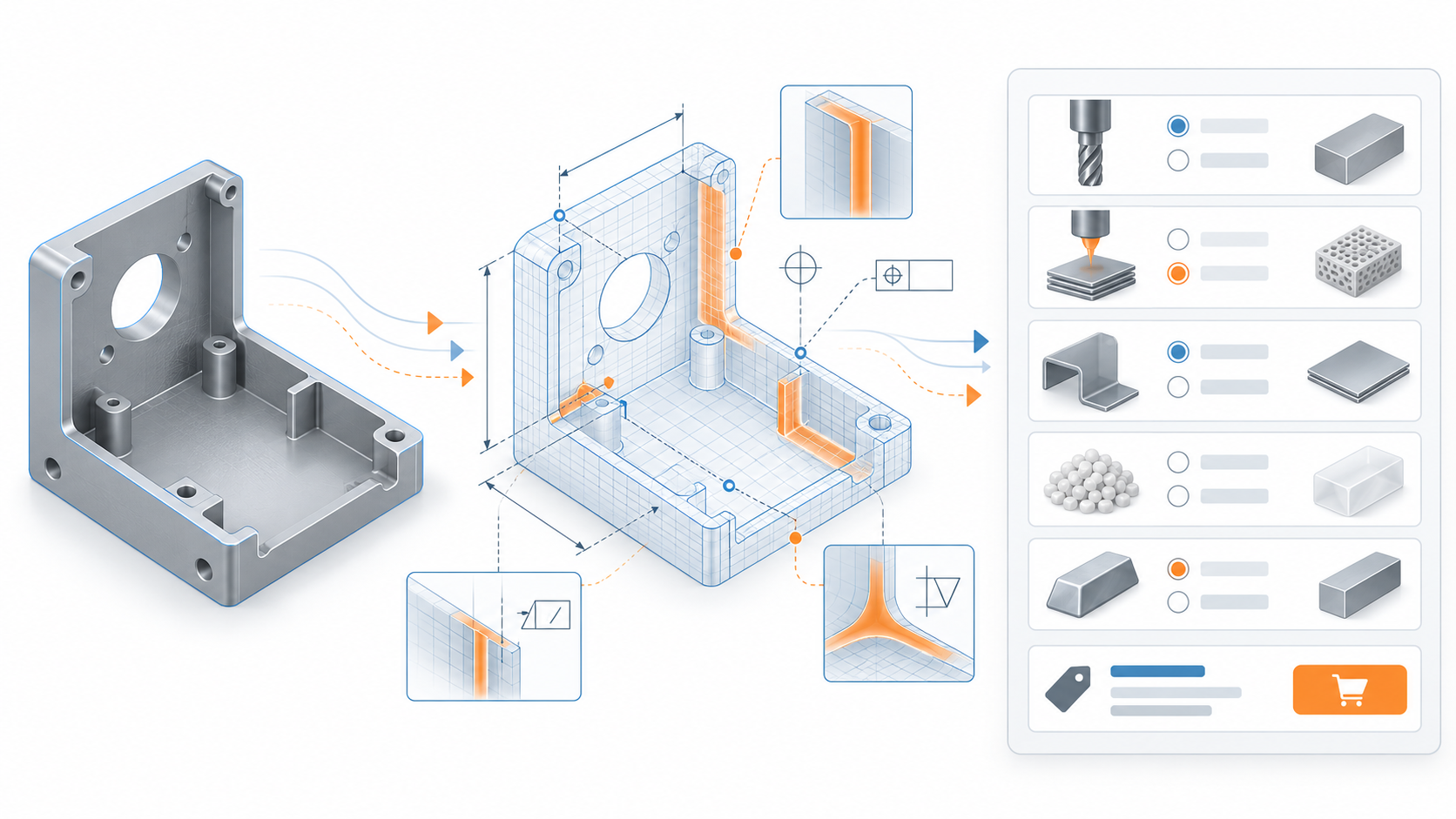
You upload common 3D formats such as STEP, STP, and IGES, or 2D drawings such as DWG, DXF, and PDF. The system first parses the geometry: identifying solids, wall thickness, hole positions, overhanging surfaces, and minimum feature sizes. This step is critical because it hands over work that used to rely on engineers reading drawings with their eyes to algorithmic pre-screening—whether the geometry has obvious problems is checked at the first gate.
Step 2: Automated DFM feedback and quoting
This is the key enabling step that distinguishes on-demand manufacturing from traditional RFQs. Based on the geometry, selected process, and material, the system automatically provides two things: first, manufacturability feedback (DFM), such as walls that are too thin, internal right angles where tools cannot reach, or sheet metal bend radii that are too small; second, pricing and process options. In the past, this round of communication relied on back-and-forth emails and often consumed several days; now it can be completed self-service on the page, and manufacturability issues are exposed in advance rather than discovered only after the part is made badly. The complete workflow of on-demand manufacturing from uploading drawings to receiving goods provides a more detailed breakdown of this chain.
Step 3: Choose process and material
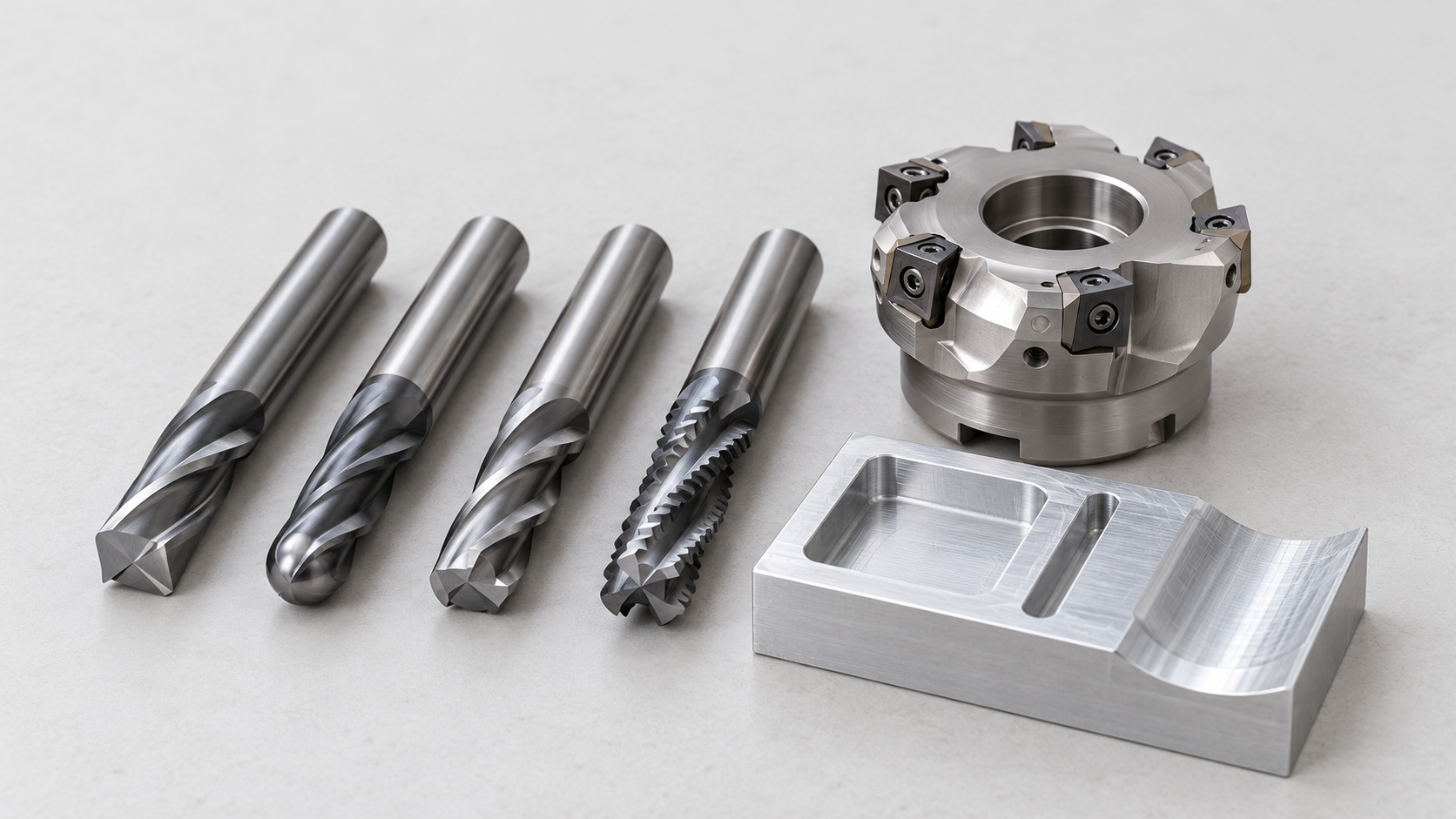
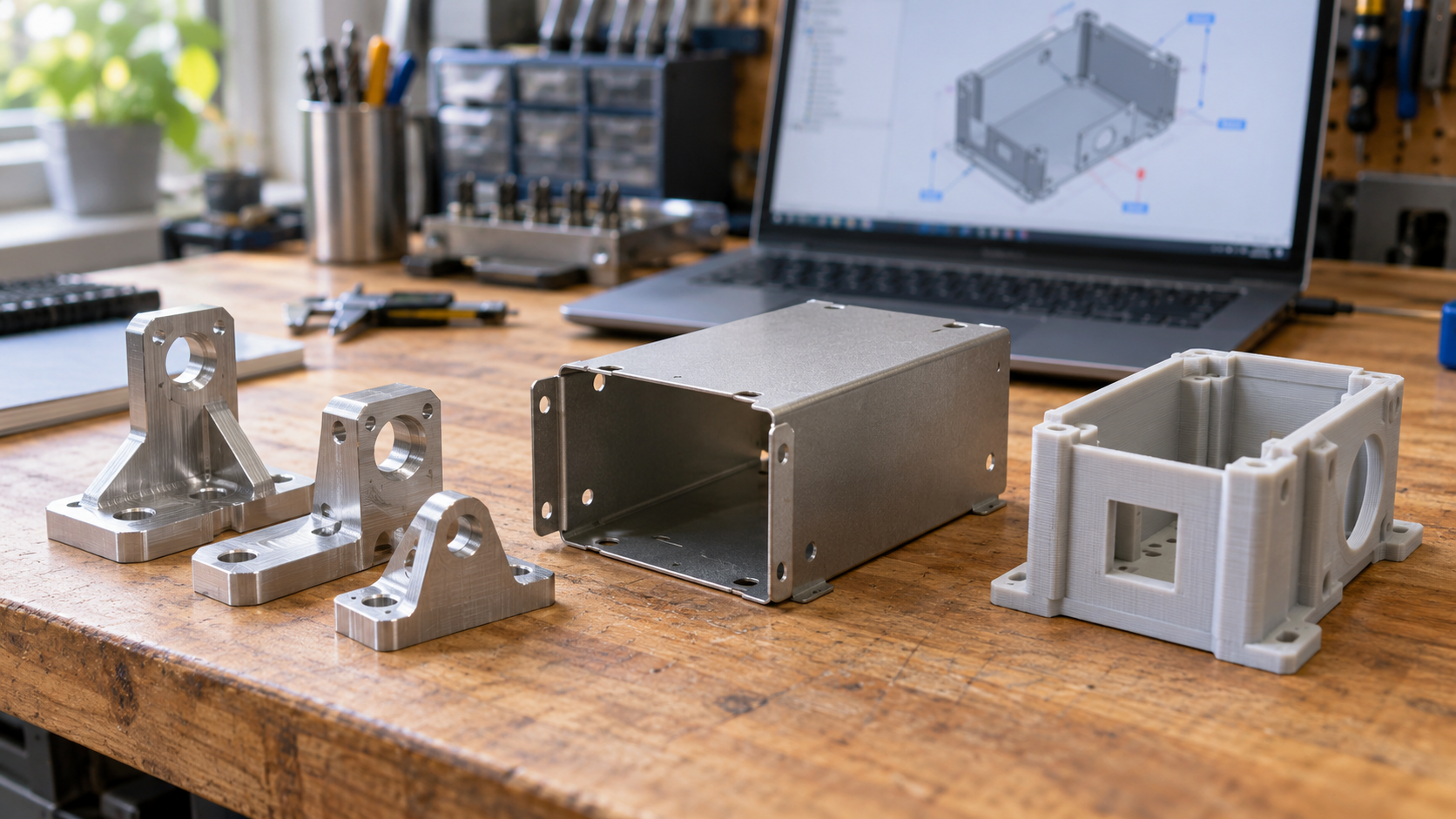
Quoting is not a fixed single path. The system usually provides multiple process options, and you choose according to the application: for functional parts that need strength, go with CNC machining, using aluminum alloy or engineering plastics; for concept validation or complex internal cavity structures, use 3D printing, where FDM, SLA, SLS, MJF, and DMLS each have their applicable scope; for enclosures, chassis, brackets, and other sheet parts, go with sheet metal fabrication, with cutting, bending, and welding completed as a set. For small-batch plastic parts there are also two paths: prototype vacuum casting is suitable for transitional volumes of a few dozen pieces, while injection molding requires tooling and only becomes cost-effective at the mass production stage. Material options can be compared item by item in the materials library.
Step 4: Confirm the order, machining, and delivery
After confirmation, the order enters scheduling. The manufacturer machines according to drawing tolerances, surface roughness requirements, and inspection plans, then performs post-processing (deburring, anodizing, sandblasting, heat treatment, etc.), then issues inspection records for critical dimensions, and finally ships. Throughout the chain, the more complete the drawing information, the more accurate the quoting and DFM judgment in the earlier steps; if only an outer shape is given without critical dimensions and datums, the system can only provide a rough quote, and manual confirmation is still needed later.
Looking at this process as a whole, the reason on-demand manufacturing can "produce only after an order" does not rely on any single-point technology, but on the combination of online quoting + automated DFM feedback + digital manufacturing processes. When quoting is fast, small batches are worth accepting; when DFM is moved upstream, there is less rework; when processes are digitized, parts can be produced without tooling. If any one of these three conditions is missing, the on-demand model cannot run.
Differences Between On-Demand Manufacturing and Traditional Manufacturing: Inventory, MOQ, Flexibility, and Customization
Inventory Logic: Stockpiling for Forecasts, or Producing for Zero Inventory
MOQ and Economies of Scale: On-Demand Manufacturing Does Not Pursue Absolute Low Prices
Flexibility and customization: design changes don't have to wait for an entire batch of tooling to be scrapped
Key technologies supporting on-demand manufacturing: CNC, 3D printing, and sheet metal
CNC machining: the workhorse process for functional metal and plastic parts
3D printing: no mold required, from prototype to small-batch trial production
Sheet metal fabrication: a common path for enclosures, brackets, and housings

Advantages of on-demand manufacturing: lower inventory, less waste, faster turnaround, and support for innovation
To understand the advantages of on-demand manufacturing, you do not need to memorize a pile of adjectives; just return to that one main line: production is triggered by real orders, not by sales forecasts. Problems such as inventory, waste, turnover, and iteration are essentially all brought about by "producing in advance." Remove that advance step, and the following benefits grow out of the logic rather than being labels pasted on.
Lower inventory: no stockpiling of finished and semi-finished goods for forecasts
The heaviest cost of traditional push production is not on the machines but in the warehouse. To cope with forecast deviations, delivery fluctuations, and peak seasons, companies often purchase raw materials in advance, make semi-finished goods in advance, and build up finished goods in advance. Each layer ties up capital, space, and management labor, and once the forecast is wrong, this inventory becomes dead stock.
On-demand manufacturing removes this layer of "in advance": production is scheduled only after an order is received, materials can be purchased by project, and finished goods are shipped as soon as they are done, without first entering the warehouse and waiting to be shipped out. Lowering inventory costs does not rely on squeezing suppliers, but on reducing the very act of "stocking up for uncertain demand." For small and medium-sized enterprises with tight cash flow, this point is often more critical than the per-piece processing fee.
Reducing waste is the other side of the same coin. Obsolete inventory, semi-finished goods that can no longer be used after a revision, and dead stock stuck in the warehouse because forecasts were too high all ultimately go to scrap or discounted disposal. Once production is demand-triggered, this scrap risk declines accordingly; at the same time, material utilization in digital processes themselves is also improving—3D printing builds up layer by layer, while CNC removes material, so their waste structures differ, but both can feed material according to the actual number of parts rather than the quantity that "might sell."
Fast turnaround and flexibility: designs can change, and the production line does not have to wait
The most intuitive manifestation of on-demand manufacturing's flexibility is engineering changes. In traditional batch manufacturing, a dimensional change may require modifying tooling, changing fixtures, and retrial production, and the cost of change is high, so designs are often forced to "freeze" early. The on-demand model is driven by digital files: change a toolpath in CNC, change a slice layer in 3D printing, or change a flat pattern in sheet metal, and the next version can be produced. Engineering changes do not have to wait for an entire batch of tooling to be scrapped.
Turnaround speed is also a result of this logic. Digital processes eliminate the wait for tooling and dedicated fixtures, commonly ranging from days to weeks in the industry—but this range depends on process, material, post-processing, and scheduling, and is not a fixed promise; confirm specifics according to the drawing and supplier. Fast is relative to "starting from zero tooling," not a claim that all parts can arrive overnight.
More friendly to small and medium-sized enterprises and hardware startup teams
On-demand manufacturing has another often overlooked benefit: it lowers the "betting threshold." The traditional batch model requires putting down mold costs and large-volume orders first, and if it does not sell, that becomes a sunk cost; the on-demand model can first make dozens of pieces to validate the market, then scale up once it works. This directly supports innovation—hardware startup teams, research groups, and new internal corporate projects can all use small batches to turn ideas into physical objects that can be assembled, tested, and demonstrated.
It must be emphasized that these advantages are not unconditional. They hold on the premise that "demand fluctuates greatly, batch sizes are not large, and iteration is frequent"; if demand is highly stable and batch sizes are very large, economies of scale are still more cost-effective—this point will be expanded in the limitations section later.
Limitations and challenges of on-demand manufacturing: high volume, IP, supply chain, and quality
On-demand manufacturing is not a free upgrade. It changes the starting condition of production from "forecast inventory" to "actual orders," and the costs shift accordingly: the per-unit cost curve, the exposure of intellectual property, dependence on upstream materials and capacity, and quality consistency when multiple processes coexist all become issues that must be actively managed. Clarifying these boundaries first is more useful than listing only the advantages.
Uneconomical at high volume: the per-unit cost curve is not advantageous under the on-demand model
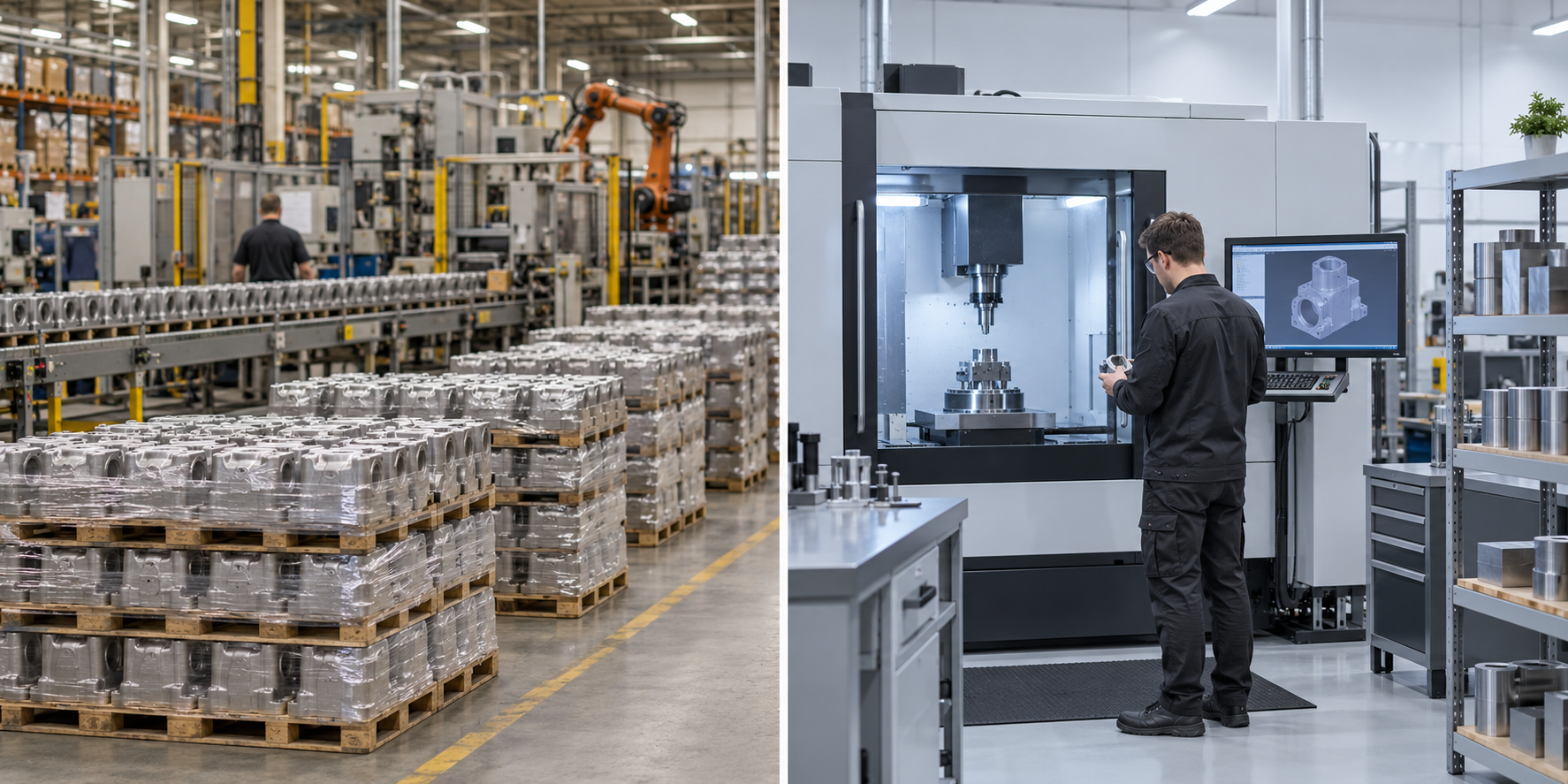
The core logic of traditional batch manufacturing is economies of scale: one-time investments such as mold costs, production line debugging, and dedicated fixtures are spread across thousands or tens of thousands of pieces, and per-unit cost falls rapidly with quantity. On-demand manufacturing skips this amortization. Take injection molding as an example: the cost of a mold is fixed, and whether you make 500 pieces or 500,000 pieces, the mold cost itself does not change, but the difference when spread across each piece is an order of magnitude.
So under the on-demand model, the curve of per-unit cost falling with quantity is noticeably flatter. A common situation in the industry is: for dozens to hundreds of pieces, on-demand CNC machining and 3D printing are often more cost-effective than tooling-based injection molding; once the quantity climbs to thousands or more, the advantages of injection molding and dedicated production lines quickly overtake them. This dividing point is not fixed; it depends on part size, material, tolerance requirements, and mold structure, and must be calculated in a specific project—quote the on-demand per-piece price and the tooling-amortized price separately using the same drawing, then compare, rather than judging by feel. In extreme cases, the on-demand model also has limited capacity ramp-up capability in a short time: it can quickly start small batches, but it may not be able to deliver hundreds of thousands of pieces within a few weeks.
Intellectual property risk: when drawings are sent out to manufacturers, boundaries must be drawn before ordering
On-demand manufacturing relies on the flow of digital files, and 3D models and 2D drawings need to leave the company and be handed to the manufacturer for parsing, quotation, and processing. This step naturally expands the exposure of intellectual property. The risk is not only "whether the other party will copy it," but more practically: who sees the model as it passes between different systems, how long it is retained, and whether it can be redistributed.
There are several actionable practices: sign an NDA and specify intellectual property ownership and confidentiality periods in the contract; for critical assemblies, send out only the necessary parts rather than the whole-machine model; remove structural information unrelated to processing from the model; and prioritize service providers with permission management and access audit mechanisms. It should be noted that this article does not evaluate the confidentiality level of any specific supplier—these terms must be confirmed item by item at the inquiry stage, rather than assuming the other party necessarily has them.
Supply chain dependence: the on-demand model is still constrained by material supply and capacity scheduling
On-demand manufacturing is often described as "asset-light, no inventory," but inventory has only shifted from the finished goods end to the upstream. Whether special-grade aluminum alloys, high-temperature alloys, medical-grade resins, and sheet metal plates of specific thicknesses are in stock directly determines whether a project can start on schedule. When materials are short, the on-demand model is not faster than the traditional model—it also has to wait for materials to arrive.
Capacity scheduling is another layer of dependence. On-demand platforms or factories serve a large number of small orders at the same time, and when a certain type of process (such as 5-axis CNC or large-format SLS) is fully booked, queue times for new orders lengthen. Mitigation methods include confirming material availability in advance, accepting equivalent material substitution options at the drawing stage, and scheduling urgent and regular parts separately. No specific lead time is promised here—common industry ranges are from days to weeks, depending on process, material, post-processing, and the scheduling situation at the time, and should be confirmed with the manufacturer before ordering.

Quality control challenge: when multiple processes coexist, inspection standards must be agreed in advance
On-demand manufacturing often means a batch of parts is split among different processes or even different factories: structural parts go to CNC, enclosures go to sheet metal, and validation parts go to 3D printing. Each process has a different default tolerance band, surface roughness, and post-processing capability. If the drawing only specifies nominal dimensions without tolerances, datums, and roughness requirements for critical dimensions, each party will follow its own habits, and fit issues will appear during assembly.
The controllable approach is to front-load quality requirements into the drawing and quoting stage: clearly mark the tolerance band for critical dimensions, the datum system, surface roughness Ra requirements, and whether a first article inspection report or full dimensional inspection report is needed; specify which gage to use—calipers, micrometers, plug gauges, a coordinate measuring machine, or custom fixtures; for sheet metal parts, state the bend angle tolerance and the allowable deformation range after welding. The earlier these agreements are made, the less rework and wrangling later. One caveat: different suppliers have different inspection capabilities and report formats, so these must be clarified before order confirmation—do not assume all manufacturers can provide the same level of inspection data.
Typical applications of on-demand manufacturing: aerospace, automotive, medical, and robotics
The previous sections covered how on-demand manufacturing works, where its advantages lie, and where its boundaries are. But these are still abstract concepts. To understand "why on-demand is needed," the best way is to look at which industries have already made it standard practice—because these industries happen to share one thing in common: demand quantities are not large, but precision, customization, or iteration speed requirements are high. Large-volume assembly lines are instead uneconomical in these scenarios, or even impossible.
Aerospace: small batches, high precision, and frequent design changes
Aerospace parts have two characteristics: low quantities and strict requirements. An aircraft's structural parts and tooling may require only a few to a few dozen pieces, but tolerance bands are often very tight, and materials are often difficult-to-machine materials such as aluminum alloy, titanium alloy, or stainless steel. This combination offers no advantage under the traditional high-volume manufacturing approach—building a dedicated mold or production line might run only a few dozen pieces before stopping.
The role of on-demand manufacturing here is to use CNC machining to cut finished parts directly from small blanks, without needing a mold. Design changes are also the norm: aerodynamic shape adjustments, mounting hole position changes, and tooling adaptation to different batches will all invalidate the previous drawing version. Under the on-demand model, you can simply re-quote and re-schedule after changing the drawing, without waiting for an entire mold to be scrapped and redone. The limitations are equally obvious: if a part eventually goes into mass production, on-demand manufacturing can only cover the stage from trial production to small batches, and the mass production stage still requires a dedicated production line.
Automotive: prototype vehicles and modification parts, many varieties, low quantities
On-demand demand in the automotive industry is concentrated at two ends: the front end is prototype vehicles and engineering validation vehicles, and the back end is modification parts and aftermarket parts for niche models. At the prototype stage, a vehicle's parts may be made in only one or two sets, but they involve multiple processes such as sheet metal brackets, plastic interior parts, and metal structural parts. What this stage fears most is waiting—waiting for molds, waiting for tooling, waiting for scheduling—all of which slow down the vehicle validation pace.
The typical combination for on-demand manufacturing here is: sheet metal fabrication for body brackets and mounting plates, 3D printing for rapid validation of appearance and assembly relationships, and CNC machining for functional parts requiring strength. Modification parts are even more typical: a model may sell only a few dozen sets, but customers have high requirements for material and surface treatment, so using the on-demand model for small batches is more reasonable than holding inventory. One thing to note: the automotive industry has high requirements for material certification and traceability, so on-demand manufacturing still needs to confirm material sources and inspection standards in advance.
Medical: quickly obtaining custom or small-batch devices and tooling
On-demand demand in the medical industry comes from several sources: customized surgical guides, small-batch inspection fixtures, small device enclosures during clinical trial stages, and replacement parts needed for equipment repair. What these scenarios have in common is—very low quantities, but no time to wait. The loss from one piece of equipment being down may far exceed the manufacturing cost of the part itself.
On-demand manufacturing here usually takes two paths. One is 3D printing, suitable for parts with complex shapes, single-digit quantities, and the need for rapid delivery, such as surgical planning models or non-load-bearing guides. The other is CNC machining, suitable for metal or engineering plastic parts requiring certain strength, sterilization resistance, or chemical corrosion resistance. The medical industry has additional requirements for material biocompatibility and cleanliness, and this part cannot be automatically solved by on-demand manufacturing—material grades, surface treatment, and inspection requirements need to be clearly written in drawings and orders. In other words, on-demand manufacturing solves "speed" and "small batches," but does not automatically solve "compliance."
Robotics and automation: fast iteration pace, validate while building
Robotics companies and automation integrators are probably the type of customer that uses on-demand manufacturing most naturally. The reason is straightforward: products are still iterating rapidly, and structural parts and joint connectors are being changed in almost every version. The arm segment designed today may need mounting hole positions changed tomorrow due to motor selection changes; the gripper validated this week may need to be remade with different materials next week.
Under this pace, traditional mold-making or high-volume scheduling does not match at all. A common approach is to use 3D printing to quickly produce appearance and assembly validation parts, and after confirming the structure is fine, use CNC machining for load-bearing parts and precision mating parts. Sheet metal is used for control cabinets, mounting base plates, and cable brackets. The limitations should also be stated clearly: robot parts often involve multi-axis machining and tighter positional tolerances. If the supplier's fixturing plan and gages are not well agreed, small batches can instead be prone to batch-to-batch variation. Therefore, under the on-demand model, critical dimensions, datums, and inspection methods on drawings need to be marked in advance even more than in high-volume production.
What the four industries have in common
Looking at the four scenarios above together, what on-demand manufacturing truly solves is not "cheapness," but matching demand quantity with manufacturing method. Aerospace wants precision and freedom to change at small batches; automotive wants rapid response with many varieties and low quantities; medical wants customization and small batches within short lead times; robotics wants an iteration pace that keeps up with the design pace. If these needs are forced into the logic of high-volume manufacturing, either costs spiral out of control or they simply cannot be done.
Conversely, these industries also expose the boundaries of on-demand manufacturing: mass production is uneconomical, material and compliance responsibilities still need to be controlled by the buyer, and inspection standards must be agreed in advance when multiple processes collaborate. On-demand manufacturing is a matching tool, not a universal cure—used in the right scenario, it saves inventory, mold costs, and waiting; used in the wrong scenario, it cannot save per-unit cost.
Frequently asked questions (FAQ)
The following questions are the ones most likely to be asked after reading the previous sections. The answers try to give boundaries rather than promises.
Are on-demand manufacturing and rapid prototyping the same thing?
No, but the two often overlap. Rapid prototyping refers to "using digital processes to obtain verifiable samples as quickly as possible," with the focus on iteration speed; on-demand manufacturing refers to the scheduling and supply logic of "producing only when demand is triggered," with the focus on inventory, minimum order quantities, and capacity organization. An on-demand manufacturing platform can accept both single-piece prototypes and small batches of several hundred pieces, but prototyping is only one entry scenario, not the entire definition. Conversely, traditional factories can also do rapid prototyping, but their production organization still follows forecasts and batch scheduling.
Can on-demand manufacturing replace high-volume injection molding?
Usually not, and it should not be used that way. The per-unit cost of injection molding drops significantly with volume, and mold costs need to be spread over sufficient output to be worthwhile; when quantities reach the thousands or tens of thousands, the efficiency advantages of dedicated production lines and molds outweigh the flexibility of the on-demand model. The more suitable range for on-demand manufacturing is single pieces to small and medium batches: validation stages, trial production stages, spare parts, tooling, and parts with uncertain demand or designs still being changed. When it truly reaches mass production, the common approach is to first do small-batch validation on demand, then switch to injection molding or a dedicated production line.
Why can online quoting produce results in seconds, and where are its accuracy boundaries?
Because the system parses the geometry itself: bounding box dimensions, volume, machinable features, material usage, process time estimates, and then applies the rule library for that process. It calculates an "estimate based on model information," not a final settlement price. The boundaries are mainly in three places: first, tolerances, roughness, heat treatment, surface treatment, and gaging requirements on drawings may not all be automatically recognized; second, risks requiring human judgment such as fixturing difficulty, thin-wall deformation, deep cavities, and irregular datums; third, material grade and batch differences. So automated quoting is suitable for quick price comparison and production scheduling estimates, but before formally placing an order, it is still advisable to have engineering confirm critical tolerances and the inspection plan.
Is on-demand manufacturing more likely to leak drawings?
The risk does exist, because models and drawings must be sent out to the manufacturer—this comes from the model itself, not from a problem with any particular factory. Controllable practices include: signing an NDA before ordering; sending only the files needed for the current process rather than the full assembly all at once; marking only the necessary critical mating dimensions and using general tolerances for the rest; and prioritizing suppliers that can clearly explain file permissions and retention policies. It should be noted that no party can give a guarantee of "absolutely no leakage"; what can be discussed is process, responsibility, and traceability.
For a small-batch on-demand project, should the process or the material be decided first?
Generally, first define the functional constraints, then the process, and finally settle on the material grade. First ask clearly: is this part a load-bearing structural part, an appearance part, or a fixture/jig? What precision level is required? What are the operating temperature, medium, and assembly method? These answers will first filter out a group of processes—for example, if tighter tolerances and metal strength are needed, CNC machining is usually more direct; if only validating appearance and assembly relationships, 3D printing is faster; for thin-sheet parts such as enclosures and brackets, sheet metal is more reasonable. Once the process is set, choose the material within the available range based on strength, temperature resistance, cost, and post-processing method. Conversely, locking in the material grade first often limits you to unnecessary processes.
Key takeaways
- The core of on-demand manufacturing is not "speed," but that the production trigger point changes from sales forecasts to real orders, belonging to pull production logic.
- What makes it work is digital manufacturing processes (CNC, 3D printing, sheet metal, vacuum casting, injection molding) plus online quoting and automated DFM feedback.
- The advantages are concentrated in reducing inventory, cutting waste, and supporting small-batch and custom iteration; the cost is that unit costs are not advantageous at high volumes, supply chain dependence, and IP control pressure.
- It is best suited for small-batch, customized, frequently iterated, or high-value high-precision scenarios, rather than all parts should be made on demand.
- To judge whether an on-demand project can be done, first look at geometric complexity, material, tolerance band, and batch size, then discuss lead time and price.