What Waterjet Cutting Actually Is: Explaining "High-Speed Erosion" in One Sentence
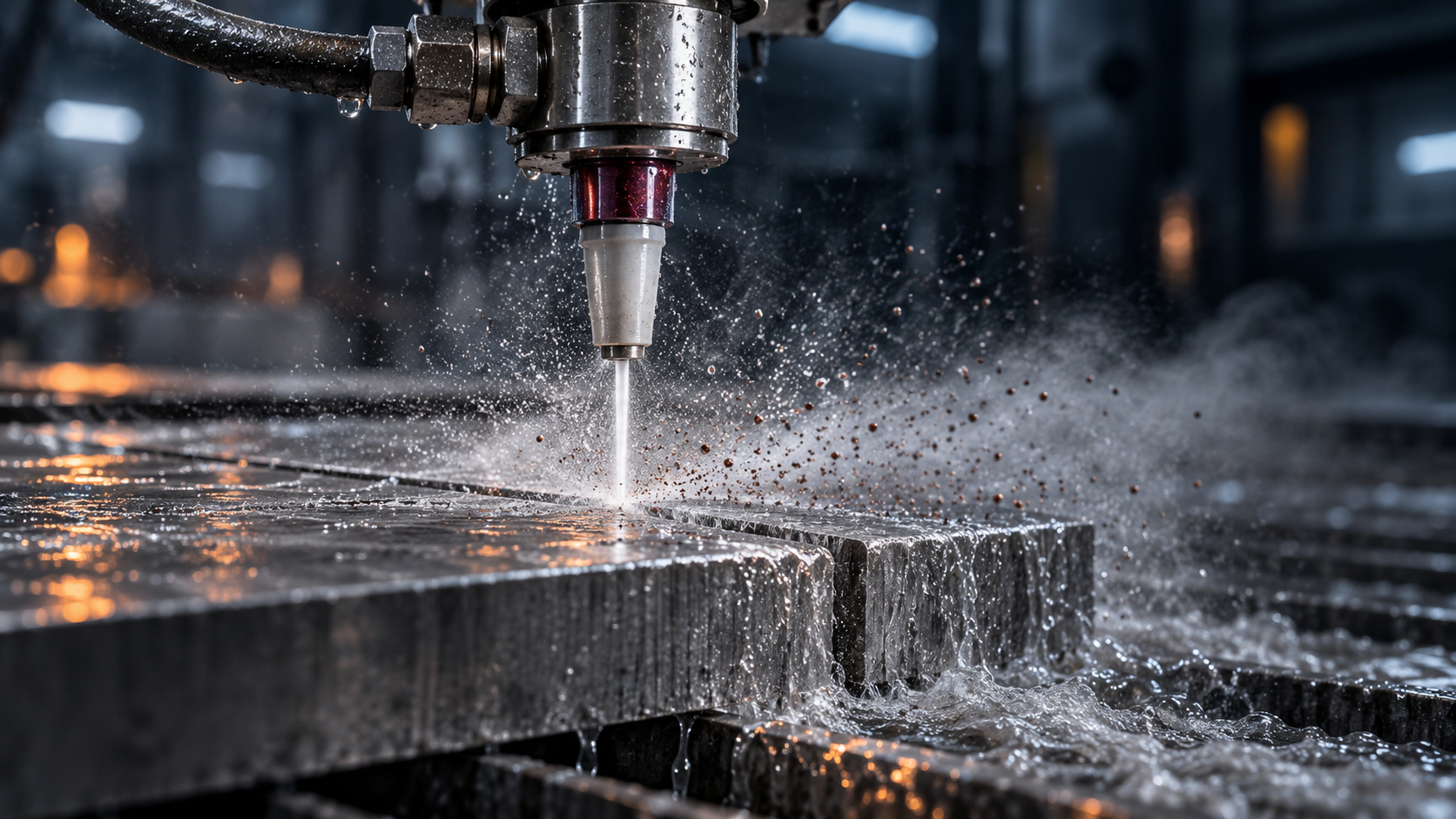
First, a counterintuitive fact: waterjet cutting does not rely on heat, but on speed. Ordinary tap water, after being pressurized by a high-pressure pump, is ejected from a very small jewel nozzle at a speed approaching or even exceeding the speed of sound. What actually cuts the material is the erosion of the material by this high-speed water flow—like an extremely fine stream of sand continuously scouring, grinding the material away bit by bit, rather than burning or melting it.
So the precise definition of waterjet cutting is: a cold cutting process that uses an ultra-high-pressure water jet (a mixed jet of water and abrasive when abrasive is added) to perform high-speed erosion on a material, thereby forming a kerf. It belongs to the category of mechanical abrasion and is completely different in physical mechanism from cutting methods such as laser, plasma, and flame that rely on thermal melting.
The term "cold" is not rhetorical. Because the entire process does not heat the material to its melting point, there is no heat-affected zone at the edge of the kerf—metal will not change its metallographic structure due to cutting heat, nor will it turn blue or discolor; for some heat-sensitive stainless steels, Hastelloy alloys, and Inconel alloys, this is often more important than cutting quickly.
This article will explain "how it is done" along a physical chain: how tap water becomes a supersonic jet, how pure waterjet and abrasive waterjet differ, what stages a single cut goes through from pressurization to water collection, which materials are suitable, and which ones require caution. The order follows the water, rather than starting with history or advantages.

How Waterjet Works: From Tap Water to a Supersonic Jet
First, the conclusion: waterjet cutting does not rely on heat, but on speed. Water itself is not an abrasive; it is simply accelerated fast enough to grind material away bit by bit like sandpaper. So to understand how a waterjet works, the key is not "what kind of fire is used," but "how the water is accelerated."
The starting point of this acceleration chain is tap water. Before the water enters the equipment, it must first be filtered to remove particulates and impurities—they would wear down seals and nozzles, and would also make the jet unstable. The filtered water is fed into a high-pressure pump. The rated pressure of waterjets commonly seen in the industry is on the order of about 60,000–94,000 psi (about 4,100–6,400 bar), which falls into the ultra-high-pressure range; for specific values, refer to the equipment nameplate and manufacturer specifications, as they vary considerably between models.
How pressure becomes speed: the role of the jewel orifice
High pressure by itself does not cut anything. What actually completes the "conversion" is the small-diameter jewel orifice at the tip of the cutting head (commonly made of sapphire or diamond). Water is forced through this extremely small aperture, and at that instant the pressure is converted into kinetic energy, and the jet velocity can enter the supersonic range. In other words, the pump is responsible for "accumulating potential energy," and the nozzle is responsible for "releasing kinetic energy."
The orifice diameter, aperture roundness, and inner wall quality directly determine whether the jet is "coherent." If the orifice wears, enlarges, or develops a nick, the jet will diverge, cutting capability will drop, and the kerf will become wider and rougher. This is also one of the reasons the nozzle is classified as a waterjet consumable.
Different pump types differ in efficiency more than you might imagine
Although they are all "high-pressure pumps," the ways they are implemented are not the same. There are two common types:
- Crankshaft direct-drive triplex plunger pump: the motor directly drives the plungers in reciprocating motion through a crankshaft, with fewer energy transfer stages, and typical industry efficiency is about 85%–90%.
- Hydraulic intensifier pump: low-pressure hydraulic oil drives a piston with an enlarged area ratio to intensify pressure; the structure is mature, but every conversion stage has losses, and efficiency is often about 65% or lower.
These two figures are only typical industry magnitudes, not guaranteed values for any specific machine; actual efficiency is also affected by maintenance condition, water temperature, nozzle wear, and other factors. But the direction is clear: direct-drive pumps are usually more energy-efficient and generate less heat, resulting in lower electricity and cooling burdens during long continuous cutting.
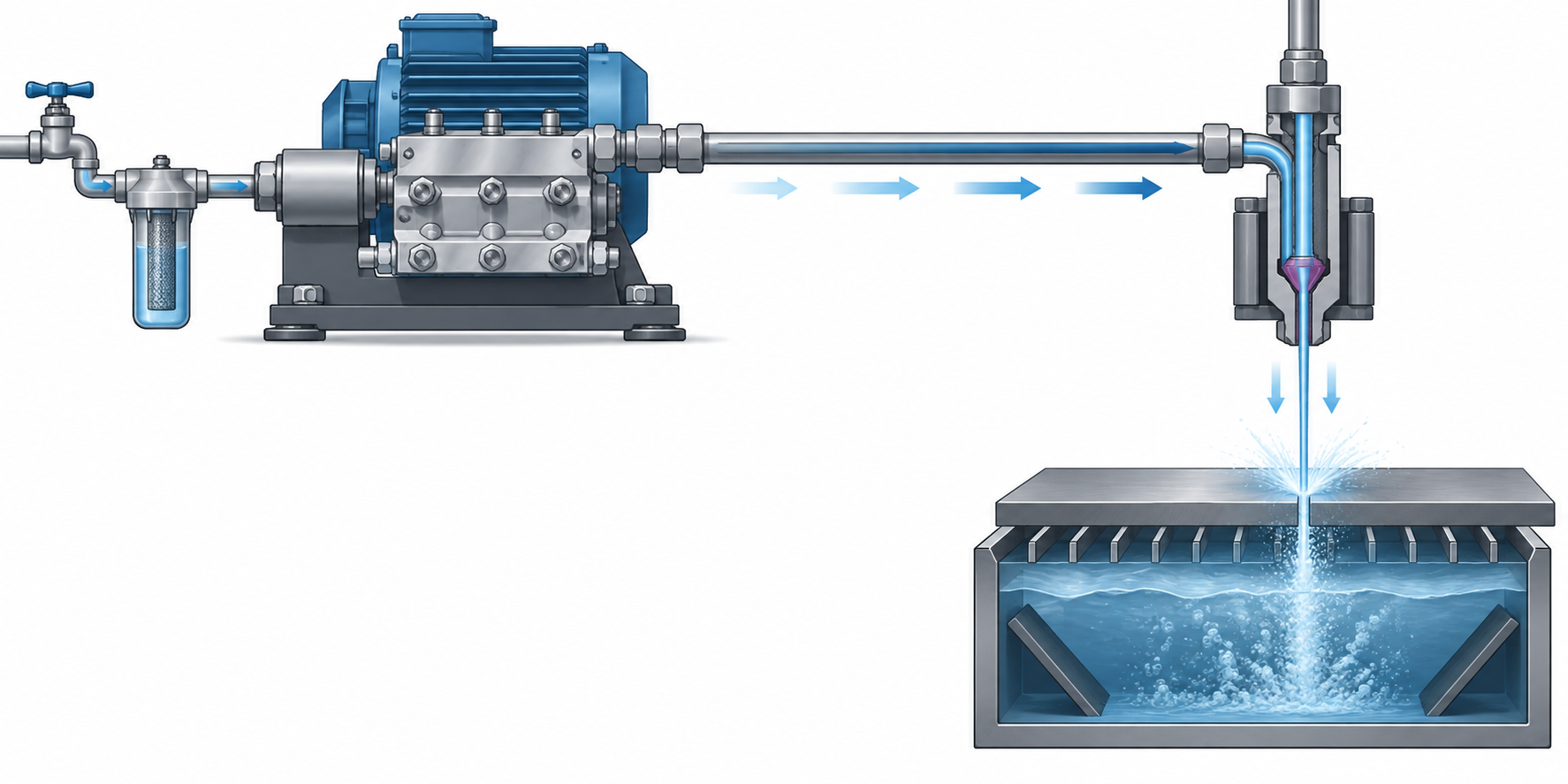
Remember this passage, and everything that follows—abrasive addition, piercing, cutting—will have a foundation: every operation in waterjet cutting is essentially about managing "the quality of this jet." The more coherent and concentrated the jet, the narrower and cleaner the kerf; once the jet diverges, no parameter can save it.
Pure waterjet and abrasive waterjet: when to use which
The previous section covered pressurization and the nozzle. But what really determines what a waterjet can cut is whether there is "sand" in the cutting head. Waterjets come in two basic forms: pure waterjet, which uses only water, and abrasive waterjet, which mixes abrasive into the water. This section uses the logic of "material → recommended type → points to note" to clearly explain the basis for selection.
Pure waterjet: cutting by the kinetic energy of water itself
A pure waterjet does not add waterjet abrasive. High-pressure water passes through the jewel orifice to form a supersonic jet, impacting the material with the kinetic energy of the water itself. Its cutting capability is limited—the momentum density of a water jet is far lower than that of a water-abrasive stream mixed with abrasive—so it is only suitable for soft materials: foam, rubber, gaskets, some plastics, food (such as portioning frozen food), paper products, carpet, and so on.
The advantages of a pure waterjet lie here: clean kerf, no abrasive residue, no need for abrasive recovery, and low operating cost. When cutting foam and rubber, the edges usually do not require secondary treatment. But if you use a pure waterjet to cut 6 mm thick aluminum plate, the result is usually that it cannot cut through or the cut surface is rough—this is using the wrong type, not an equipment problem.
Abrasive waterjet: the abrasive delivery system turns water into an abrasive slurry
An abrasive waterjet has one additional key component in the cutting head: the abrasive delivery system. High-pressure water first passes through a small-diameter jewel orifice to form a coherent water jet; the high-speed water flow passes through a venturi to create negative pressure, drawing waterjet abrasive (commonly garnet in the industry) into the mixing chamber at a metered rate, and then through a ceramic mixing tube the water and abrasive are accelerated into a high-speed water-abrasive slurry that is ejected.
The key lies in the "mixing tube." The nozzle (jewel) is responsible for converting pressure into velocity, while the mixing tube is responsible for evenly entraining abrasive into the jet. The mixing tube is made of ceramic; its inner diameter and length affect cutting efficiency and kerf taper; it is a consumable and gradually wears down from abrasive erosion. Abrasive is not a case of the coarser the better: coarse grit cuts fast but leaves a rougher kerf, while fine grit gives a fine kerf but is slower. The common garnet mesh size in the industry is a trade-off between 80 mesh and 120 mesh, with the specific choice based on equipment and material trials.

Material → Recommended type → Points to note
- Foam, rubber, soft plastics, food: pure waterjet recommended; note to secure the material to avoid the jet blowing the workpiece off course.
- Aluminum, steel, stainless steel, copper: abrasive waterjet recommended; note kerf taper, thick plates may require compensation or secondary machining.
- Stone, tile, glass: abrasive waterjet recommended; note the starting point and support for brittle materials to avoid edge chipping.
- Composite materials (carbon fiber, laminates): abrasive waterjet recommended; note interlayer delamination and dust collection.
- Thin sheets and stacked layers: abrasive waterjet can cut stacked layers to improve efficiency; note interlayer misalignment, which requires clamping.
An easily overlooked point: pure waterjet and abrasive waterjet are not an either-or piece of equipment; many machines can switch between the two modes by changing the cutting head or shutting off the abrasive supply. However, once the abrasive delivery system is connected, the water circuit, mixing tube, and collection tank all need corresponding maintenance. When selecting, first look at material hardness, then thickness, and finally kerf requirements—these three steps can basically determine which one to use.
If a part contains both soft and hard materials, the common approach is zone cutting or head-changing, rather than forcing a single mode to handle everything. For your specific drawing, it is best to clearly state the material grade, thickness, and kerf tolerance before placing the order, so the process side can determine whether to use pure water or abrasive. AGX's CNC machining capabilities and sheet metal capabilities pages list the follow-up processes that can be integrated; waterjet-cut parts usually still need bending, drilling, or deburring.
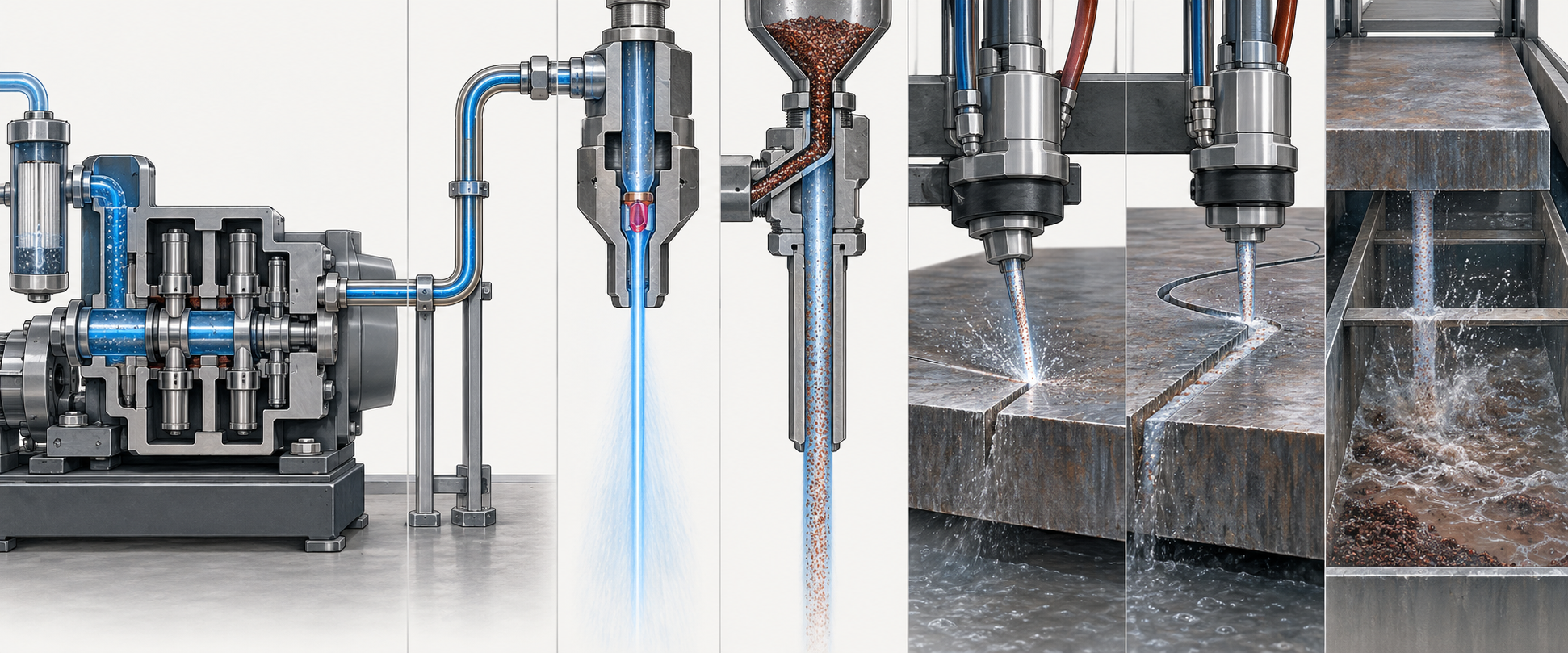
The complete steps of a waterjet cut: pressurization, delivery, nozzle, mixing, piercing, cutting, collection
Steps one to three: pressurization, delivery, and nozzle forming
Step four: when abrasive is added, where does the abrasive mix in?
Steps five to six: first piercing, then cutting a kerf along the path
Step seven: the catcher tank collects water and abrasive, and how the whole chain works together
What waterjets can and cannot cut: the boundaries of materials and thickness
Waterjet cutting does have a very wide range of applications, but "wide" does not mean "without boundaries." Making the boundaries clear is far more useful than claiming "no material limitations"—because what really determines whether a cut is possible and whether it is good is often thickness, material structure, and those few lines of notes on the drawing.
Material dimension: from foam to titanium alloy, the difference lies in "which knife to use"
Line them up by hardness, and the selection logic emerges. Foam, rubber, sponge, some foods, and low-density composite materials can be cut with a pure waterjet; the kinetic energy of the water jet is enough to cut them, and it also saves abrasive cost and subsequent cleanup. Hard materials such as metal, stone, glass, and ceramics require switching to an abrasive waterjet, relying on the abrasive action of the water-abrasive mixed jet to chew through.
The middle ground requires caution. For example, carbon fiber composites, laminates, and honeycomb structures can be cut by waterjet, but delamination or frayed edges may appear at the kerf edge, so test cuts are needed to confirm parameters; laminated glass and some brittle stones are prone to chipping at the moment of penetration, so cutting usually has to start from the edge or use a lead-in cut. These are not "cannot be cut," but rather "the method must be adjusted according to material characteristics."
Thickness dimension: the thicker it is, the less forgiving taper and speed become
The first change brought by increased thickness is kerf taper. The jet's energy gradually decays during penetration, so the entry is wide and the exit is narrow, especially obvious in thick plates. A common industry practice is to compensate by reducing cutting speed, adjusting nozzle height, or making multiple passes, but the compensation itself lengthens processing time. The second change is decreased cutting speed; the feed rate for thick metal may be only a fraction of that for thin plate, which is also why waterjet is often weighed against plasma and laser in thick-plate scenarios.
There is another easily overlooked point: stack cutting. Cutting multiple thin sheets stacked together in one pass sounds efficient, but if there are gaps between layers or clamping is not secure, the jet will spread in the gaps, causing the lower layer's kerf to shift and the edges to be rough. Stack cutting requires secure clamping and alignment, and the total thickness is still constrained by equipment capability.

Before ordering, these things must be clearly written on the drawing
- Material grade and condition: the same 304 stainless steel may cut differently in annealed and cold-rolled states; composite materials must specify the layup direction.
- Thickness and tolerance requirements: for thick plates, the tolerance band for critical dimensions must be specified; do not assume by default that "waterjet is very accurate." Common industry waterjet tolerances can reach around the 0.001 inch level, but that is under ideal conditions; thick plates, taper, and equipment condition all affect it, and the actual result should be based on test cuts or gauge measurements.
- Cut quality grade: Is it enough that the part is simply cut off, or is a roughness requirement on the cut face and no dross also required? This directly determines cutting speed and cost.
- Start point and lead-in position: The initial pierce leaves a small hole in the material. If the part surface cannot have a pierce mark, specify starting from the edge or leaving a process allowance.
- Stacked or single piece: For stacked cutting, state the clamping method and alignment datum; otherwise, misaligned cuts mean rework.
Writing these into the drawing or process specification saves far more trouble than arguing afterward about "why the cut has taper." The boundaries of waterjet cutting are essentially a set of engineering conditions that can be communicated and verified in advance, not a simple "it can cut" or "it can't cut."
Waterjet vs. other cutting methods: what no heat-affected zone means
First, a comparison dimension that is easily overlooked. Plasma, laser, and flame cutting all rely on heat to melt or oxidize and blow away the material, leaving a heat-affected zone (HAZ) on both sides of the cut. Waterjet cutting is high-speed erosion; energy enters the material as kinetic energy, and near the kerf there is no melting, no oxide scale, and none of that narrow band of altered microstructure. That is what "no heat-affected zone" means in actual production.
It matters especially for heat-sensitive materials. Some stainless steels, Hastelloy, and Inconel tend to precipitate phases or change grain state after heating, and adding a milling or annealing step after thermal cutting drives up both cost and time. Waterjet-cut edges are usually usable directly, with only deburring or finishing afterward. This is not to say the waterjet cut face is perfect—it will have striations left by abrasive erosion and some taper—but there is no heat problem.
Order-of-magnitude comparison of speed and tolerance
Thermal cutting has an obvious speed advantage on thick metal. Common industry orders of magnitude are: thick-plate plasma may run at about 200 inches per minute, while waterjet may only be about 15 inches per minute. The gap is more than tenfold, so for high-volume carbon steel parts with low cut-face requirements, thermal cutting is often more cost-effective. Conversely, for thin sheet, irregular contours, and parts that need to be formed in one pass without secondary processing, waterjet's speed disadvantage is less pronounced.
On tolerance, waterjet may reach the order of about 0.001 inch, while plasma is about 0.015 inch. Both figures are "may," heavily affected by machine condition, nozzle wear, material thickness, and cutting speed, and cannot be treated as equipment promises. When actually placing an order, the better questions are: which dimensions of this part are marked as critical on the drawing, and does it need secondary processing after cutting?
When "no heat-affected zone" is really worth paying for
Three scenarios are worth prioritizing. First, the material itself is heat-sensitive, such as alloy parts that have already been heat-treated and whose microstructure you do not want to disturb after cutting. Second, the part is thin or slender in shape, where heat input easily causes warping, while waterjet produces almost no thermal distortion. Third, composite and laminated parts, where thermal cutting can char or delaminate the resin, while waterjet is a cold separation process.
Conversely, if your part is thick carbon steel plate, simple in contour, loose in tolerance, and high in volume, thermal cutting is usually more economical. The value of waterjet is not in "being able to cut," but in "keeping the material in its original state after cutting." The recommended order of judgment is: first check whether the material is heat-sensitive, then whether it is prone to distortion, and only last compare speed.

It should be noted that what is discussed here is the qualitative difference of "whether there is heat effect," not a ranking of the two processes as better or worse. The choice depends on material, thickness, tolerance, and batch size. Once the cutting method is determined, the clearer the tolerance band, surface roughness requirements, and deburring notes on the drawing, the fewer disputes there will be over quotation and acceptance.
What to watch out for when operating a waterjet: consumables, safety, and daily maintenance
We have taken waterjet cutting from tap water all the way to the cut edge, and now we return to the shop floor: how this equipment is maintained day to day, where it fails first, and what people standing nearby need to watch out for. Most waterjet cutting failures are not "sudden breakdowns," but consumables wearing away bit by bit and parameters drifting little by little, only discovered when the cut face develops taper or the material is not cut through.
Consumable life: watch the nozzle first, then the high-pressure components
Waterjet cutting consumables differ by orders of magnitude in consumption. Parts that directly contact the jet, such as jewel nozzles and mixing tubes, commonly last on the order of about 100 hours in the industry; pressure-bearing components such as high-pressure pumps and accumulators may reach the order of about 10,000 hours. These are only order-of-magnitude references; actual life is heavily affected by pressure, water quality, abrasive type, and start-stop frequency, and it is normal for the same machine to differ by several times under different operating conditions.
To judge whether a nozzle should be replaced, you don't have to wait until it completely fails: watch the jet. A normal water jet is a thin, concentrated stream; once the nozzle wears, the jet diverges, the kerf widens, and the taper increases. For abrasive waterjets, also check the mixing tube—once the inner wall is worn into a bell mouth, abrasive acceleration efficiency drops, showing up as slower cutting and rougher cut faces under the same parameters. Nozzle alignment is also a daily item—if the nozzle and mixing tube are not coaxial, the jet will deflect, and one side of the kerf will be noticeably worse than the other.
Water quality and abrasive supply: the invisible source of stability
Water must be filtered before entering the pump. Suspended particles and hardness components in the water accelerate wear on high-pressure seals and jewel nozzles, and also cause scaling in the lines. Filtration precision and water treatment methods vary with equipment requirements; follow the manufacturer's specifications—do not skip this based on experience.
The abrasive supply for an abrasive waterjet must be stable, dry, and free of clumping. If the abrasive flow rate fluctuates, cutting capability fluctuates with it, and the cut face will show stripes that alternate between coarse and fine. Common garnet abrasive comes in different mesh sizes; coarse mesh cuts faster but leaves a slightly rougher kerf, while fine mesh is the opposite. Changing abrasive mesh is equivalent to changing a whole set of process parameters—speed and compensation values must be re-matched. Key points for inspecting the abrasive supply system are whether the hopper bridges, whether conveyance is uniform, and whether hoses are worn through.
Safety: high-pressure jets, abrasive dust, and noise
Even after attenuation through the nozzle, an ultra-high-pressure jet still has dangerous residual energy. Never put your hands or any body part into the cutting area, and never look directly at the jet. High-pressure lines, fittings, and accumulators are pressure-bearing components; to check for leaks, observe indirectly with cardboard or a mirror—do not feel with your hands. A high-pressure water needle can penetrate skin, and this type of injury is a clearly recognized serious accident category in the industry.
- Keep the cutting area enclosed or add guarding; do not open doors during operation
- Pay attention to ventilation and protection for abrasive dust, especially in enclosed workshops
- Noise levels are usually high; wear hearing protection based on on-site measurements
- After stopping the machine, depressurize before handling nozzles, mixing tubes, and other components
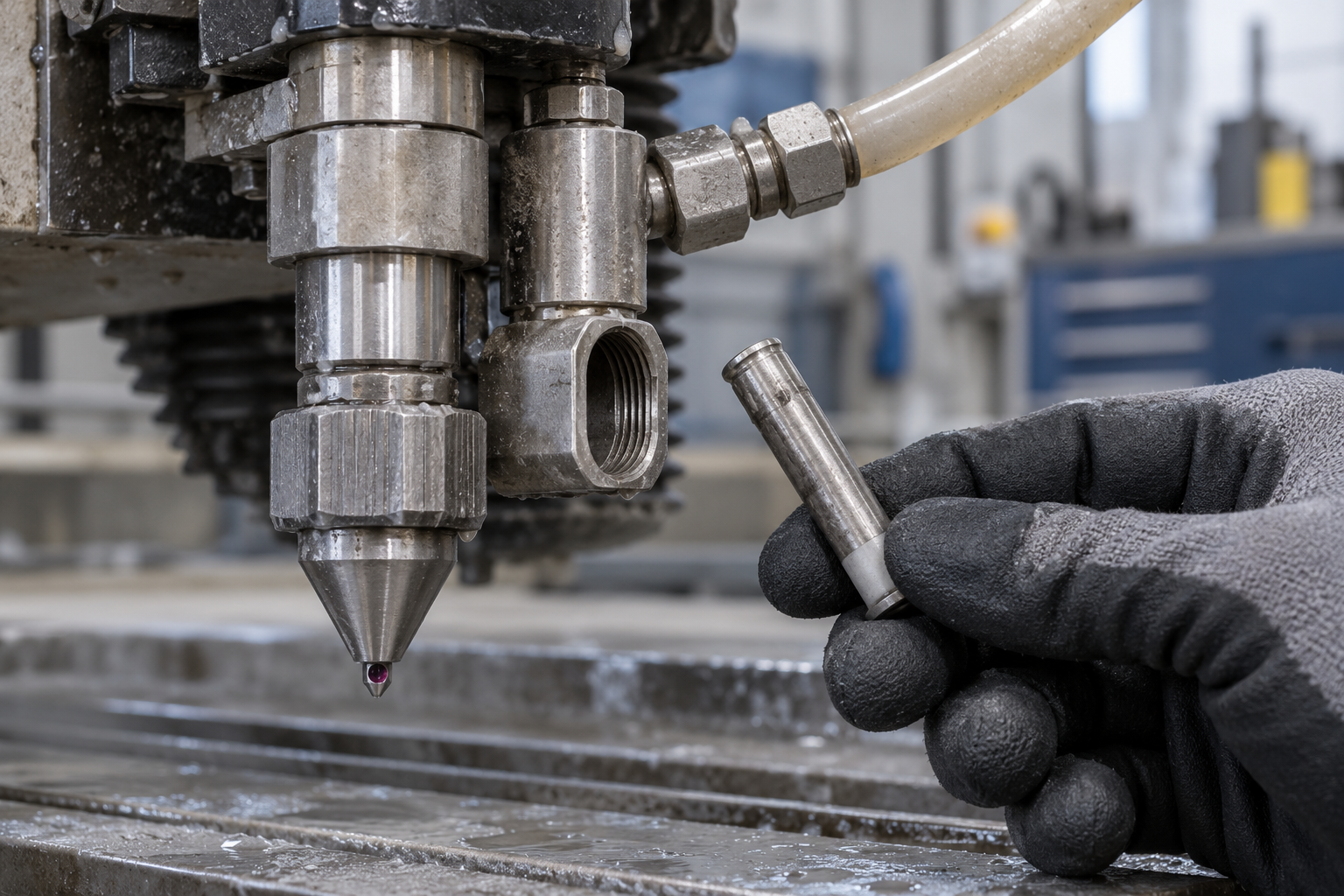
The maintenance rhythm does not need to be complicated: check the jet and cut face every shift, periodically inspect nozzle alignment, abrasive flow rate, and high-pressure line fittings, and replace seals according to the manufacturer's interval. Putting these items into a table and recording them is far less trouble than investigating cut-face problems after the fact.
Common problems in waterjet cutting
The problems below basically all come from the chain described earlier: "pressurization → transmission → nozzle → mixing → piercing → cutting → collection." Answers give magnitudes and bases for judgment where possible; specific values still depend on the equipment nameplate, material grade, and drawing requirements.
Why is waterjet cutting not considered thermal cutting?
Because it relies on high-speed erosion, not melting or oxidation. High-pressure water (water plus abrasive in the abrasive case) strikes the material surface at extremely high speed, stripping material particles away bit by bit. The entire process involves no combustion and no arc. Therefore, there is basically no heat-affected zone near the kerf, and heat-sensitive materials such as stainless steel, Hastelloy, and Inconel are not prone to discoloration or microstructure changes from cutting heat. Conversely, it is not completely without heat—the pump and lines generate heat, but that is on the equipment side, not the material side.
Can a pure waterjet cut metal?
The common industry practice is: pure waterjets are mainly used for soft materials such as foam, rubber, food, and some soft plastics; for hard materials such as metal, stone, and glass, it is usually necessary to switch to an abrasive waterjet, that is, mixing garnet or similar abrasive into the cutting head to form a high-speed water-abrasive slurry before it is sprayed out. A pure waterjet is not entirely incapable of cutting thin metal, but efficiency and kerf quality are usually unsatisfactory. Before actually placing an order, it is best to clearly state the material grade and thickness so the process provider can determine which form should be used.
Why is the initial piercing slow?
Because when the water first contacts the material, it needs to pierce through the material before it can enter the normal cutting path. In this initial piercing stage, the jet is continuously eroding at a single point, so the speed is naturally slower than cutting along a path; the thicker and harder the material, the longer the piercing time. In some working conditions, low pressure or drilling is used to pre-open a hole first, and then the contour is cut, the purpose being to shorten piercing time and reduce the impact on the nozzle and material. Therefore, when quoting and scheduling production, the number of piercing points also needs to be included in the calculation.
What tolerance can waterjet cutting generally achieve?
The common order of magnitude in the industry is: waterjet can possibly achieve about 0.001 inch (about 0.025 mm), while thermal cutting such as plasma is often at about 0.015 inch (about 0.38 mm). However, this number is greatly affected by equipment condition, material thickness, cutting speed, and nozzle wear, and thick plates are often looser. If there are critical dimensions on the drawing, it is recommended to clearly mark the tolerance band and datum so that the process provider can confirm whether it can be achieved stably; do not assume that "waterjet is definitely very accurate."
What should be noted when cutting thick plates?
As thickness increases, common phenomena are greater kerf taper and lower cutting speed, and sometimes the feed rate also needs to be reduced to ensure full penetration. Although stack cutting can improve efficiency, layers are prone to misalignment and edge quality is inconsistent. Before placing an order, it is worth specifying clearly on the drawing: material grade, thickness, critical dimension tolerances, whether deburring or chamfering is required, and surface roughness requirements. The more specific this information is, the more basis there is for process judgment.
Key takeaways
- Waterjet cutting relies on high-speed erosion, not thermal melting: the jet has no heat-affected zone, and heat-sensitive materials are unlikely to discolor or change structure due to cutting.
- Pure waterjet and abrasive waterjet are two routes: soft materials use pure water, while hard materials such as metal, stone, and glass usually require an abrasive like garnet.
- The key nodes of a single cut are pressurization → transmission → nozzle → (abrasive) mixing → initial piercing → cutting → collection, among which "initial piercing" is the separate step in which the water first penetrates the material.
- Pressure determines jet speed and also cutting capability; the higher the pressure, the equipment, consumables, and operating costs usually rise along with it.
- Waterjet is not "unlimited in thickness": the thicker the material, the more tapered the kerf may be and the slower the speed, so tolerances and taper need to be clearly written on the cutting order.