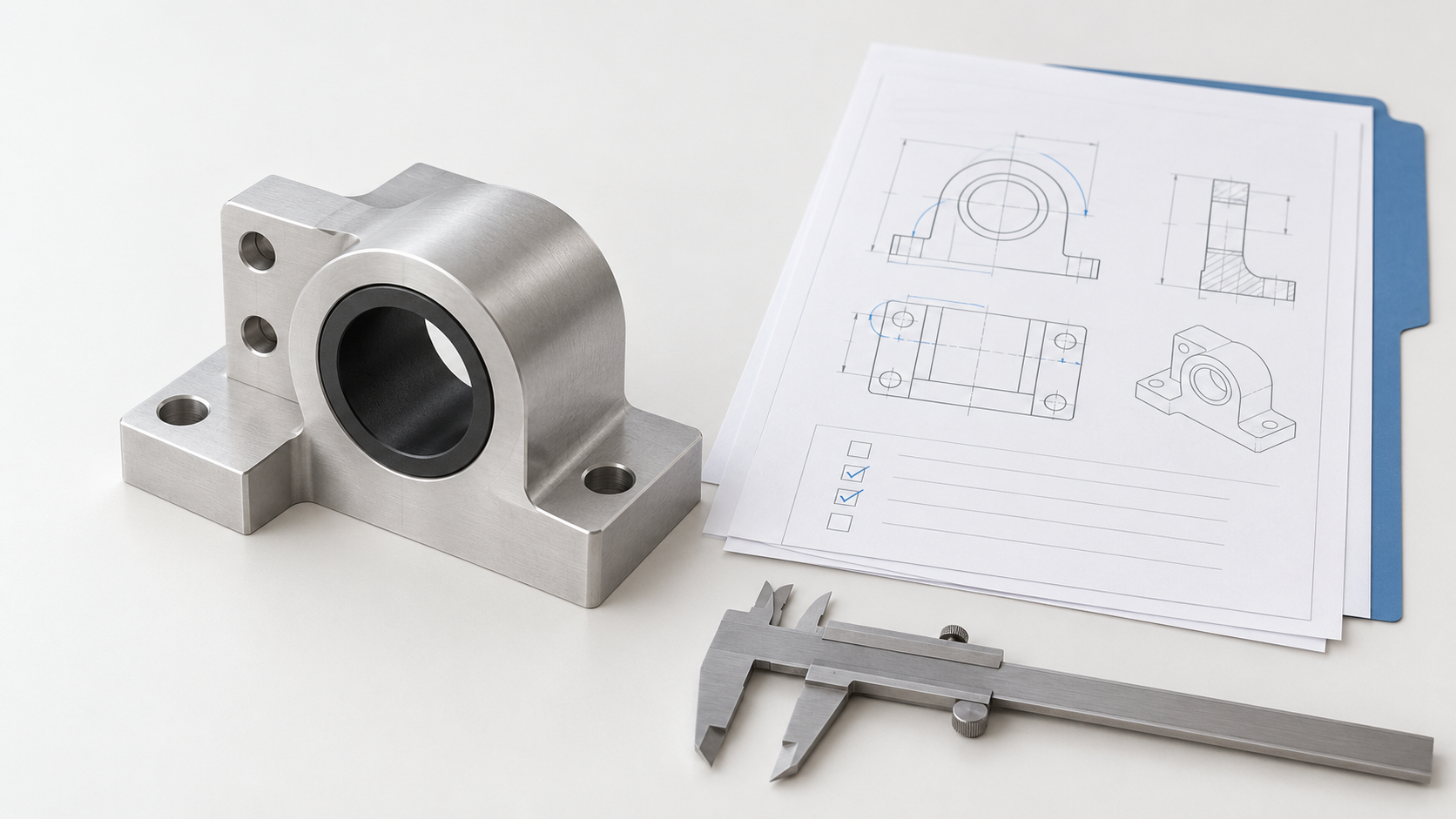
What Information Must Be Confirmed in a Custom Part RFQ? Start by Building a Quote-Ready Requirements Package
It is a common failure point in custom manufacturing projects for a supplier to quote based on the 3D model, only for the first article to require rework because the 2D datums, surface treatment, or inspection method was not defined. The buyer’s first deliverable should not be just a price, but a requirements package in which both parties have confirmed the revision, scope, and acceptance method.
| Information Category | Required Documents or Information | Why It Is Needed | Risk if Missing |
|---|---|---|---|
| Geometry and Dimensions | 3D CAD model, 2D drawing, GD&T, datums, and revision number | To define machining features, critical dimensions, inspection datums, and revision relationships | The supplier may quote against the wrong revision, making the first article impossible to evaluate |
| Materials and Quantity | Material grade, condition, annual demand, batch size, and delivery schedule | Evaluate the process route and economics of CNC machining, 3D printing, sheet metal fabrication, injection molding, or pattern replication | Material substitutions, fixture, or mold solutions require subsequent price revisions |
| Post-Processing and Assembly | Surface treatment, heat treatment, mating components, assembly drawings, and functional requirements | Clarify whether dimensions are to be accepted after machining, after treatment, or in the assembled condition | Appearance, fit, or durability requirements may be overlooked |
| Quality and Delivery | Critical characteristics, inspection methods, packaging, target dates, and special testing | Arrange inspection fixtures, measurement methods, packaging, and delivery milestones in advance | Unclear quotation scope and incomplete first-article documentation |
The document package should also identify CTQs such as sealing surfaces, mating holes, locating datums, moving surfaces, and assembly interfaces, and specify which dimensions require dedicated gauges or functional inspection. Revision numbers for models, drawings, and BOMs must be traceable; missing information should be included in a gap list with assigned owners and closure dates.
How can technical confirmation be completed for a custom machining project? First lock down the revision, datums, and critical characteristics
After receiving an RFQ for custom parts, the supplier should not quote based solely on the 3D model. First verify the document revision numbers, whether the model matches the 2D drawing, the material grade and condition, special processes, acceptance methods, and target date. If the drawing is still being revised or dimensions conflict between the model and drawing, first create a gap list, with procurement, engineering, quality, and the supplier each confirming the responsible person and response date.
Check these four datums first during custom manufacturing technical confirmation
Technical confirmation should include at least four items: document version, dimensional datums, material and condition, and inspection criteria. The datum cannot simply be stated as “machine according to the model”; the datum surfaces or axes used for locating, measurement, and assembly must be clearly specified. The material must also distinguish the grade, heat-treatment condition, and surface-treatment requirements; otherwise, the same part may be quoted, machined, and accepted based on different assumptions.
Next, identify the CTQs (critical quality characteristics): sealing surfaces, mating holes, locating datums, moving surfaces, and assembly interfaces typically require separate specifications for tolerances, surface roughness, inspection methods, and functional requirements. The supplier’s process recommendations should be recorded in a separate column from the design requirements; a “recommended tolerance relaxation” must not be treated directly as an approved change. For custom CNC machining, also confirm tool accessibility, fixturing datums, and the measurement conditions for deep cavities. If these issues have not been resolved, the project should not proceed to formal quotation or manufacturing.
Turn Gaps into Traceable Approval Records
- Issue: Identify conflicting or missing documents, features, and risks.
- Responsibility: Clearly specify whether the response is to be provided by customer engineering, procurement, quality, or the supplier.
- Decision: Record the selected datum, material, inspection method, or alternative solution.
- Revision: Update the approved drawings, 3D data, inspection plan, and effective date.
Only when all critical issues have been closed and the responsible person has completed approval does a custom manufacturing project have a comparable basis for quotation. If any items remain to be confirmed, they should be listed separately in the quotation as assumptions, with a clear statement that unresolved items cannot trigger the initiation of mold, fixture, or batch machining work.
What does a DFM review for custom manufacturing examine? Check manufacturability risks by process
A DFM review in custom manufacturing is not limited to determining whether a part “can be made”; it must also confirm the process route, inspection method, and cost boundaries. For parts with complex thin walls, deep cavities, tight tolerances, or multiple processes, discovering risks only after quotation often leads to drawing revisions, rework, or a reassessment of the delivery schedule.
| Stage | Primary question | Output |
|---|---|---|
| DFM | Can the current design be manufactured consistently using the target process? | Process risks, modification recommendations, and cost assumptions |
| Simulation | How will specific filling, cooling, warpage, or deformation risks manifest? | Targeted analysis results |
| Inspection | Does the part conform to the approved drawings and acceptance requirements? | Measurement data and disposition records |
| Customer approval | Are the function, tolerances, and alternative solutions acceptable? | Controlled Version and Release Decision |
CNC Custom Machining: Check the Tooling, Fixturing, and Datums First
In CNC custom machining, check whether the tool can reach deep cavities and internal corners, whether the fixture provides sufficient support, and whether datum transfer will amplify positional errors. Sealing surfaces, mating holes, locating datums, and moving surfaces should be identified separately; all dimensions must not be treated with the same priority. Tolerances and surface roughness must also be evaluated in conjunction with the material, tooling, and machining sequence. Where necessary, reaming, tapping, grinding, or additional inspection should be specified as separate operations.
Injection Molding and MIM Custom Manufacturing: Distinguish Molded Dimensions from Secondary Machining
Injection molding or MIM projects typically require evaluation of wall thickness, draft angles, parting lines, undercuts, ejection, and shrinkage effects. DFM first determines the mold design; mold flow analysis is then used to further assess filling, weld lines, air traps, cooling, and warpage. The two cannot replace each other. For critical holes, threads, or high-precision mating surfaces, it should be clarified before mold fabrication whether they will be guaranteed by molding, post-sintering machining, or secondary processes such as CNC machining and reaming.
Sheet Metal and Casting Custom Machining: Include Deformation and Machining Allowances in the Review
For sheet metal custom machining, verify the bending sequence, hole-to-edge distance, welding deformation, and accessibility for inspection fixtures. For casting or die casting, confirm the parting line, draft direction, machining allowances, and the conditions for subsequent machining of critical features. Every DFM comment should clearly specify the applicable feature, risk, recommended solution, inspection method, and impact on cost or delivery. Processes not involved should not be subject to rules from other processes, and the manufacturing plan should not be frozen directly before customer approval.
How Should DFM Comments Be Converted into Custom Machining Decisions? Use an Issue Log to Stop Repeated Quote Revisions
DFM comments must not stop at the words “recommend optimization.” Each comment should be entered into an issue log to form a closed loop of issue—risk—solution—approval—freeze. This is the only way to distinguish issues that genuinely require drawing changes, issues that can be controlled through the process, and issues that require additional secondary machining or inspection, thereby avoiding repeated changes to quotations and lead times over multiple rounds of communication.
| Issue Log Fields | Information to Record |
|---|---|
| Issue and Applicable Feature | Feature number, hole location or cavity position, and the drawings and 3D versions involved |
| Risk and Solution | Impact on function, tolerances, fixturing, tool accessibility, or inspection; recommended drawing changes, process alternatives, or secondary machining |
| Commercial and Responsibility | Impact on cost/lead time, inspection method, customer decision, responsible person, and deadline |
| Basis for Closure | Approval records, updated drawings or process documents, and the final frozen version |
Write Mating Hole or Deep Cavity Issues as Approveable Decisions
For example, mating holes produced by CNC machining may present risks to dimensional accuracy and coaxiality due to tool accessibility, depth-to-diameter ratio, or fixturing orientation. The supplier may propose adjusting the hole diameter, tolerances, or fixturing datums, or leaving stock for secondary operations such as reaming or boring; however, these are only process recommendations and do not mean that the supplier assumes functional responsibility on behalf of the customer. The customer must still confirm the mating relationship, sealing requirements, and acceptable cost changes.
Before DFM approval, all high-risk comments must have a clear disposition: revise the drawing and release a new version, maintain the design and control it through the process, or add secondary processing/special inspection. The decision should be recorded in the controlled drawing, quotation assumptions, and inspection plan; unresolved critical issues should not proceed to tooling, fixturing, or mass production.
How should custom manufacturing quotations and delivery plans be reviewed? Verify process boundaries and cost assumptions
A custom manufacturing quotation cannot be evaluated based solely on the total price. The purchaser must also confirm which documents, quantities, and process routes the supplier used for the calculation, as well as which items have not been included. Otherwise, tooling, fixtures, secondary processing, or inspection requirements may be added only at the first-article stage, causing the quotation and delivery plan to be revised accordingly. A comparable quotation should first clearly state its assumptions and exclusions.
Which costs and responsibilities should be separated in a custom machining quotation?
| Item | What the purchaser should verify | Common boundary issues |
|---|---|---|
| One-time costs | Whether molds, fixtures, inspection gauges, programming, or tooling are itemized separately | Who bears the cost of tooling modifications and prototyping iterations |
| Per-unit manufacturing | Whether materials, machining, forming, sheet-metal bending, or welding are included | Whether the quantity tiers and batch sizes covered by the quotation are clearly specified |
| Post-processing and inspection | Secondary CNC operations, tapping, reaming, heat treatment, surface treatment, and inspection methods | Whether subcontracted operations, reports, and reinspection are charged separately |
| Delivery items | Packaging, transportation, first-article delivery, and production batches | How design changes, rework, and delays are handled |
For mold, injection molding, casting, or MIM projects, responsibility for dimensions must also be distinguished among the molded, as-cast, sintered, and post-machining states. Some features can be controlled through the molding or sintering process, while others may require machining allowance to be left and then completed by CNC machining, reaming, or tapping. The shrinkage behavior of one process cannot be applied directly to all custom parts. The drawing should clearly specify the final acceptance condition, and the quotation should identify the processes for which the supplier is responsible.
What release milestones should be established in a custom manufacturing delivery plan?
The purchaser should divide the plan into milestones such as requirements confirmation, DFM closure, tooling or fixture kickoff, first-article manufacturing, FAI submission, corrective action, and production authorization, and specify the inputs, outputs, and approver for each milestone. Quantity tiers, delivery batches, and whether the first articles are included in the production quantity should also be confirmed in the contract or purchase order. If the drawing, material, process route, or acceptance requirements change, their impact on cost and schedule should be reassessed rather than assuming that the original quotation remains applicable.
Release conditions: The quotation assumptions, exclusions, quantities and batches, process responsibilities, and change-control rules have all been confirmed in writing; before tooling or volume machining begins, the drawing revision, material grade, special requirements, and approved DFM conclusions have been frozen.
How should first article inspection (FAI) acceptance be conducted? Closing the loop item by item from drawing characteristics to measurement evidence
For first article acceptance in custom manufacturing, it is not sufficient to submit only a “full dimensional report showing conformity.” The objective of FAI is to demonstrate that the parts actually manufactured were produced from an approved design revision and completed using the agreed material, processes, and inspection methods. At a minimum, the acceptance documentation should be traceable to the approved engineering drawing, 3D digital product data, BOM, material grade and batch, process specifications, production operations, supplier or source information, and surface treatment and heat treatment records.
What evidence must be recorded for custom-part FAI?
| Acceptance item | Content to be recorded | Evidence that must not be omitted |
|---|---|---|
| Dimensional and geometric characteristics | Characteristic number, drawing requirement, datum, measured value, and disposition | Measurement equipment or method, sample condition, and inspector |
| Material and special processes | Material, batch, heat treatment, surface treatment, and process condition | Material certificate, treatment record, or subcontractor source |
| Function and assembly | Mating holes, sealing surfaces, locating surfaces, moving surfaces, and assembly interfaces | Functional test, fit results, abnormal-condition photos, or test records |
| Appearance and delivery | Burrs, scratches, color, cleanliness, packaging, and marking | Appearance Acceptance, Packaging Requirements, and Approval Records |
It is recommended that each characteristic be organized into six fields: “Characteristic—Requirement—Actual Measurement—Disposition—Evidence—Approver.” For example, for a CNC-machined mating hole, do not enter only the hole diameter; also specify the measuring instrument or inspection method used, the measurement datum, whether the part has undergone surface treatment, and the assembly result with the mating part. For injection-molded, cast, or MIM parts, also clearly identify whether the dimensions are in the molded, as-cast, or sintered condition, or are the result after secondary operations such as reaming, tapping, or grinding; dimensional responsibility for different processes must not be mixed.
What should be done to close a custom manufacturing project when the first article is nonconforming?
Every nonconforming item must have a formal disposition: rework followed by reinspection, acceptance under concession with the required approval, or revision of the drawing followed by reconfirmation of the design requirements. If the dimensions are compliant but the material certification, surface treatment records, functional testing, or packaging requirements are missing, the project still must not be released directly. The FAI report should be confirmed by Engineering, Quality, and the customer-designated approver. The first article provides a basis for production authorization only when the documentation is complete, deviations have been closed, and functional and assembly requirements have been verified.
When is a new first article inspection required after a change to a custom part?
A custom manufacturing project must not treat first article inspection as a one-time formality. Changes to the drawing or 3D model, material grade, or surface treatment will affect the approved product baseline. When the key process route, tooling, fixtures, equipment, production location, or subcontractor changes, the scope of the first article should also be reevaluated. Even if the part geometry remains unchanged, the previous report should not be reused directly whenever the change could affect dimensions, material condition, assembly, or function.
Complete FAI or partial FAI? First define the scope based on the impact of the change
If the design revision, primary process, or supplier conditions undergo a significant change, a complete FAI is generally required, with the drawing characteristics, material lots, processes, and measurement evidence re-associated. If the change involves only a surface treatment, local dimension, or single process, a partial FAI covering the affected characteristics may be considered, while retaining the original first article report as the baseline. “Complete” or “partial” must not be determined solely by the supplier; the final scope should be confirmed according to the customer’s quality system, contract, and applicable industry requirements. The FAI form is also not a universally mandatory format for every project.
Control Custom Manufacturing Changes with Eight Gates
- Requirements complete: Drawings, models, materials, quantities, and acceptance requirements are identifiable.
- Technical confirmation: Owners have been assigned for datums, key characteristics, and documentation gaps.
- DFM closed: High-risk recommendations have been decided and incorporated into the controlled revision.
- Quotation assumptions confirmed: The boundaries of responsibility for tooling, fixtures, secondary processing, inspection, and changes are clear.
- Revision frozen: The drawing revision number, 3D data, and inspection plan are locked before manufacturing.
- First article manufactured: The sample is produced using the approved process and material conditions.
- FAI approved: Dimensional, material, surface, assembly, and functional evidence is complete.
- Production authorization: All deviations have been formally dispositioned, and the scope of revalidation after the change has been approved.
If any one of these gates is not passed, the custom machining project should not automatically proceed to the next stage. The purchaser should retain the correspondence among the change request, impact assessment, customer decision, and revised FAI to prevent the supplier from continuing to cite an old first article conclusion after changing the production location or process.
Common Delivery Issues in Custom Manufacturing Projects
The key to a custom manufacturing project is not simply handing the parts to the supplier, but maintaining a single traceability chain linking the requirements documents, DFM decisions, quotation assumptions, and first article evidence. The following questions focus on several points in custom part delivery that are most likely to cause rework and disputes over release.
With only a 3D model, can a quote for custom parts be provided directly?
It can serve as input for a preliminary assessment, but it is usually insufficient to produce a formal, auditable quotation. The purchaser should also provide 2D drawings or clearly specify the dimensional, tolerance, and datum requirements, as well as the material grade, production quantity and schedule, surface treatment, assembly relationships, and inspection methods. If this information is missing, the supplier should list the assumptions and items requiring confirmation. Formal manufacturing should not begin until critical gaps have been closed.
Must every DFM comment proposed by the supplier result in a drawing revision?
Not necessarily. DFM comments should first be assessed for their impact on function, cost, lead time, and inspection. Some issues require revisions to the drawing or model; others can be controlled through fixturing, tooling, process parameters, or the inspection plan; still others require secondary processing or dedicated gauges. The final solution should be approved by the customer and incorporated into the controlled revision; it must not be confirmed only verbally in an email.
If the first article meets dimensional requirements but the material or surface treatment documentation is missing, can it be released?
Generally, it cannot be released based solely on the dimensional report. First-article acceptance should also verify the material and lot, heat-treatment or surface-treatment records, appearance, assembly fit, functional testing, and applicable special-process evidence. If the documentation is not yet complete, release should be deferred in accordance with the project quality procedure, or an authorized responsible person may issue a written concession acceptance specifying the conditions for submitting the missing information and closing the issue.
After a supplier changes the production location or process, should a complete FAI or a partial FAI be performed?
First assess whether the change affects product characteristics, process capability, material condition, inspection methods, or supply-chain responsibilities. If the scope of impact is broad, a complete FAI may be required; if it involves only identified changed characteristics, a partial FAI or targeted revalidation may be appropriate. However, the final scope should be determined according to the customer contract, quality system, and applicable industry requirements; the previous first-article report must not be reused directly.
Key takeaways
- A custom part RFQ should include the 3D model, 2D drawing with GD&T, material, quantity and delivery schedule, surface treatment, critical characteristics, and inspection methods.
- DFM is not about the supplier making recommendations unilaterally. It is about recording process risks, alternatives, cost and lead-time impacts, and customer approvals in the same issue log.
- Quotations must clearly define the boundaries and assumptions for tooling, fixtures, secondary processing, inspection, surface treatment, packaging, and changes.
- Before tooling, fixture fabrication, or volume production begins, the drawing revision, 3D data, material, special requirements, inspection plan, and approved DFM conclusions should be frozen.
- First article acceptance (FAI) must link each drawing characteristic to the measured value, measurement method, material lot, and disposition of deviations. When a major change occurs, the scope of the FAI should be reassessed.