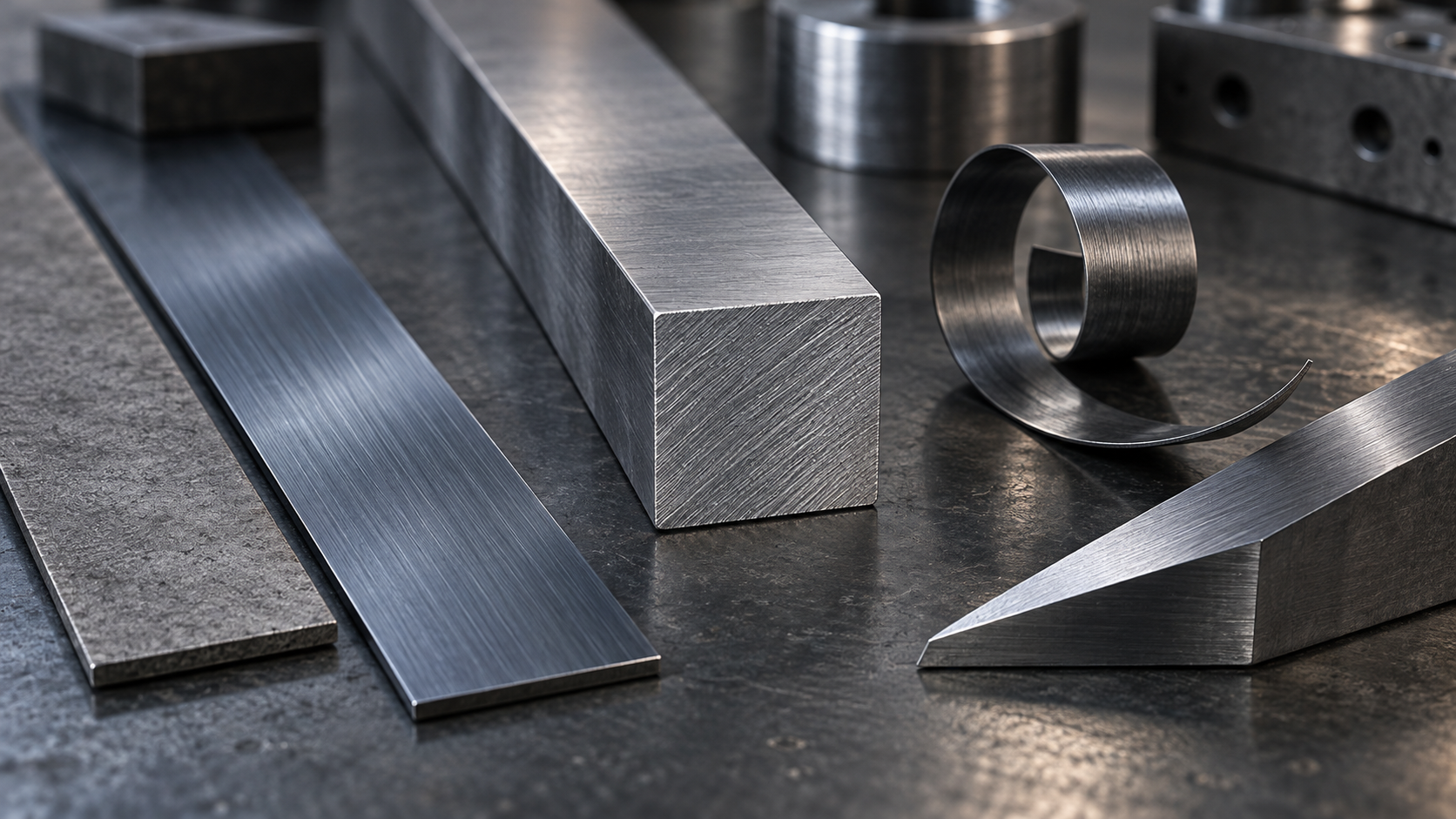
What Is High-Carbon Steel? First, See How Carbon Content Changes Steel Performance
Conclusion first: SK2 is not necessarily harder than a finished SK4 product in every delivery condition. The grade, chemical composition, supply condition, and heat treatment of high-carbon steel must be evaluated together; do not judge it solely by the number following SK.
High-carbon steel is a class of carbon steel categorized by carbon content. It is not a single grade, nor is it stainless steel or steel that is “naturally already hard.” Engineering references generally classify steel with a carbon content of approximately 0.60% or higher as high-carbon steel, but the classification boundaries are not completely consistent among different standards and industry references, and the upper limit may also be defined differently. Therefore, the applicable standard and material certificate should still be verified during procurement or processing.
The effect of carbon in steel is first reflected in its hardening potential. Compared with low-carbon steel, medium- and high-carbon steels can generally achieve higher hardness, strength, and wear resistance after appropriate heat treatment; however, as carbon content continues to increase, ductility and toughness tend to decrease, and the material becomes more sensitive to impact, bending, and edge notches. In other words, the effect of carbon content is not a one-way improvement in performance, but a trade-off between wear resistance and formability and crack resistance.
Low-carbon steel is generally easier to weld, stamp, and bend; medium-carbon steel achieves a certain balance between strength and machinability; and high-carbon steel is better suited to components requiring edge retention, contact wear resistance, or elastic response. However, high-carbon steel that has not undergone hardening, tempering, or other specified heat treatment may still have a supply-condition hardness suitable for cutting or forming. When comparing SK2, SK4, SK5, and SK7 later in this article, the focus should likewise be on the “composition gradient plus condition differences,” rather than creating a hardness ranking detached from processing conditions.
What Performance Does High-Carbon Steel Offer? Balancing Hardness, Strength, Wear Resistance, and Toughness
The advantage of high-carbon steel is not that it is “naturally very hard,” but that it can achieve high hardness, strength, and wear resistance after suitable heat treatment. Increasing carbon content generally increases hardening potential, making the material more suitable for withstanding edge wear, abrasive wear, or localized contact loads. In applications such as blades and wear-resistant tools, this resistance to plastic deformation and wear is precisely what matters.
Higher Hardness in High-Carbon Steel Also Means Less Toughness and Forming Margin
Even under the same heat-treatment conditions, further increases in hardness and wear resistance are generally accompanied by decreases in ductility, impact toughness, and crack resistance. When high-carbon steel is subjected to sudden impact, notch stresses, or repeated bending, greater attention must be paid to edge chipping, fracture, and fatigue cracks; welding, stamping, deep drawing, and high-deformation bending are also more difficult than with low-carbon steel. Actual material selection should not focus only on “which type is harder”; it should also consider whether the component will experience stable wear or instead be subjected to impact, elastic deformation, and repeated loading.
High-Carbon Steel Is Not Stainless Steel; Rust Protection Requires Separate Design
High-carbon steel typically does not contain sufficient corrosion-resistant alloying elements such as chromium, and its carbon content alone does not provide stainless properties. It may still rust in humid environments, so rust-preventive oil, surface treatment, packaging, and storage management should be arranged according to the service conditions. Final performance also depends on the grade, cross-sectional dimensions, supply condition, and quenching and tempering schedule; for materials that have not undergone heat treatment, the finished-product hardness cannot be inferred directly from the high-carbon steel grade.
What are the differences in carbon content among SK2, SK4, SK5, and SK7?
According to commonly referenced data from JIS G 3311, the primary difference among SK2, SK4, SK5, and SK7 is the carbon-content gradient: SK2 is the highest and SK7 is the lowest. Carbon content generally affects hardening potential, hardness, and wear resistance, but the SK numbers are not simply a hardness ranking. Actual performance also depends on the supply condition, cross-sectional dimensions, heat treatment, and inspection conditions.
| Grade | Reference carbon content range | Performance tendency | Typical applications and main risks |
|---|---|---|---|
| SK2 | Approximately 1.15%—1.30% | Relatively high hardness and wear resistance | Blades and wear-resistant tools; higher risk of impact damage and edge chipping |
| SK4 | Approximately 0.90%—1.00% | Relatively high hardness and wear resistance | Cutting or general-purpose tools; increased difficulty in forming and welding |
| SK5 | Approximately 0.80%—0.90% | A balance of hardness, wear resistance, and toughness | General-purpose tools, thin sheets, or elastic components; bending cracks must be controlled |
| SK7 | Approx. 0.60%—0.70% | Relatively greater toughness and bending capability | Springs and general tools; relatively lower wear resistance and final hardness |
These values are reference ranges under specific standards and data conditions and should not replace material certificates. Different versions of standards, specification and grade conversions, as well as annealed, cold-rolled, or hardened conditions, may result in actual differences. Therefore, when selecting high-carbon steel, first confirm the applicable standard and chemical composition, then evaluate the target hardness, load, impact, and forming method. Finished-product performance should not be inferred solely from the sequence of grade designations.
How do the properties and applications of SK2, SK4, SK5, and SK7 differ?
Under the same heat-treatment conditions, SK2 and SK4 generally favor higher hardness and wear resistance, SK5 represents a balance between hardness, wear resistance, and toughness, while SK7 places relatively greater emphasis on a certain degree of bending capability and resistance to cracking. However, this is only a starting point for material selection; the grade numbers should not be treated directly as a hardness ranking for finished products.
| Grade | Performance tendency | Typical application areas | Main risks |
|---|---|---|---|
| SK2 | Higher carbon content, suitable when hardness and wear resistance are priorities | Blades, precision cutting tools, or wear-resistant tools | Higher risk of edge chipping or cracking under impact or bending |
| SK4 | Relatively high hardness and wear resistance, while allowing a certain degree of machinability | Cutting tools, blades, and wear-resistant components | Excessive hardening reduces toughness and increases forming difficulty |
| SK5 | A relatively balanced combination of hardness, strength, wear resistance, and toughness | General-purpose tools, thin-sheet parts, and certain resilient components | The heat-treatment condition still needs to be verified under high loads or significant impact |
| SK7 | Lower carbon content, generally favoring toughness and adaptability to bending | Parts requiring a certain degree of elasticity, bending capability, or crack resistance | Wear resistance and hardenability are generally inferior to those of higher-carbon grades |
For example, when blades or cutting edges need to retain their edge, the hardness and wear resistance of SK2 and SK4 are usually prioritized; however, if a part is subjected to repeated bending, assembly preload, or minor impact, excessive hardness may translate into a risk of edge chipping and fracture. SK5 is often regarded as a balanced choice among high-carbon tool steels, while SK7 may be more suitable for thin sheets or resilient structures that require bending and forming.
The final application also depends on cross-sectional dimensions, load, impact, bending direction, supply condition, and heat-treatment process. The performance of the same grade may differ significantly after annealing, cold rolling, or quenching and tempering. Therefore, the part's failure mode should be assessed first, followed by selection of SK2, SK4, SK5, or SK7, with confirmation based on the material certificate and actual hardness data.
Why does the hardness of high-carbon steel of the same grade still vary? Effects of heat treatment and supply condition
The grade only specifies a range of chemical composition and cannot directly represent the hardness of the finished product. Even when the grade is SK5, high-carbon steel strip may be supplied in an annealed, cold-rolled, full-hard, or quenched-and-tempered condition; these conditions correspond to different microstructures, residual stresses, and machining characteristics. Annealing generally reduces hardness, making cutting, stamping, and bending easier; cold rolling increases strength and hardness, but may also increase anisotropy and the risk of forming cracks.
The supply condition of high-carbon steel affects hardness and machining difficulty
For example, based on reference data for a specific cold-rolled strip, SK5 is approximately 150—190 HV in the annealed condition, approximately 170—210 HV in the lightly rolled or skin-passed condition, approximately 240—280 HV in the rolled condition, and approximately 260—300 HV in the full-hard condition; SK7 may range from approximately 140—180 HV when annealed to approximately 250—290 HV in the full-hard condition. These values can only serve as examples for evaluating a specific material condition. They cannot be applied to all sheet, bar, or heat-treated materials, nor should they be converted to HRC without a valid basis.
What problems do annealing, cold rolling, and quenching and tempering address, respectively?
If a part will subsequently require substantial material removal, blanking, or bending, it is generally advisable to first confirm that it is supplied in an annealed or relatively soft condition suitable for machining, and then obtain the target properties through subsequent heat treatment. The cold-rolled condition is suitable for strip requiring a certain level of strength and dimensional stability, but tool load, burrs, and the risk of bending cracks may increase. The full-hard or quenched-and-tempered condition is used when final wear resistance and load-bearing performance are required; hardness is generally higher, but toughness may decrease and the risk of chipping or fracture may increase. The final assessment should be based on the material certificate, actual hardness, cross-sectional dimensions, and heat-treatment records, rather than solely on the SK2, SK4, SK5, or SK7 grade designation.
What should be considered when machining and bending high-carbon steel?
The machining difficulty of high-carbon steel depends first on its supply condition, not solely on whether it is designated SK2, SK4, SK5, or SK7. Annealed or relatively soft conditions are generally more suitable for blanking, turning, milling, and stamping; if the material has already been work-hardened by cold working or has undergone quenching and tempering, tool load will increase, along with the risks of edge chipping, vibration, and dimensional change. Cutting parameters, tool edge condition, and fixture rigidity should be determined according to the actual hardness.
Cutting, shearing, and edge treatment of high-carbon steel
Burrs and notches on sheared edges cannot be overlooked. For thin strip or resilient components, burr orientation, edge collapse, and even small notches may become crack initiation points. Where necessary, deburring, edge blunting, or finishing should be arranged, and the cut-surface quality should be inspected on the first piece. Forced stamping in the hardened condition may accelerate punch wear and even cause localized chipping; if the process permits, forming should generally be performed first in an easier-to-machine condition, followed by subsequent heat treatment.
Bending direction, radius, and crack risk in high-carbon steel
Cold-rolled high-carbon steel strip has rolling directionality, and the bending direction affects its tendency to crack. The risk of cracking increases further when the bending radius is too small, burrs are present on the edges, or the outside of the bend passes directly through a sheared notch. It is not sufficient to judge solely by saying that “SK7 bends better than SK5”; thickness, hardness, rolling direction, and bending angle must also be considered. Drawings or process documents should specify the rolling direction, inside bend radius, edge treatment, and inspection method, and these requirements should be verified using first-article samples or bend specimens.
- Confirm the standard corresponding to the grade, the supply condition, and the actual hardness; do not use the grade designation as a substitute for the material certificate.
- Specify the rolling direction, burr orientation, and deburring requirements, especially for thin sheets, strips, and repeatedly bent parts.
- Visually inspect or examine under magnification the outside of bends, punched edges, and sheared sections; add crack inspection when necessary.
- When precision machining is required after hardening, allow for heat-treatment distortion and grinding stock, and recheck critical dimensions.
What parameters must be confirmed before selecting SK2, SK4, SK5, or SK7?
When selecting a high-carbon steel grade, do not look at the number after SK first and then infer the hardness. A more reliable sequence is to first determine the part’s function and failure mode, then determine the supply and heat-treatment conditions, and finally compare whether SK2, SK4, SK5, or SK7 is suitable.
- [object Object]
- [object Object]
- [object Object]
- [object Object]
- [object Object]
- [object Object]
Before final procurement or machining, request the material certificate and corresponding inspection data, and at minimum verify the grade standard, chemical composition, supply condition, hardness or strength, dimensions, and rolling direction. The actual performance of the finished product also depends on the cross-sectional dimensions and heat-treatment process, so results cannot be guaranteed based solely on the grade designation.
Common Questions About High-Carbon Steel and SK2, SK4, SK5, and SK7
The final performance of high-carbon steel cannot be determined by the grade designation alone. Carbon content, applicable standards, supply condition, and heat-treatment condition can all affect hardness, toughness, and machining risks. The following questions address the judgments most easily confused when comparing SK-series grades.
Is high-carbon steel naturally hard?
No. High-carbon steel is simply a category of steel classified by carbon content, generally referring to steel with a carbon content of approximately 0.60% or higher. In an annealed or softened condition, it may be easy to machine and form; only after quenching, tempering, or other strengthening treatments does it acquire the corresponding hardness and wear resistance.
Is SK2 necessarily harder than SK5?
Not necessarily. Based on compositional references under the same standard, SK2 generally has a higher carbon content than SK5 and tends to offer higher hardness and wear resistance. However, if the two grades are in different supply or heat-treatment conditions, their actual hardness values may overlap. When comparing finished products, the material certificate and hardness inspection data should be the basis.
Is SK7 necessarily more suitable for bending?
This cannot be determined absolutely. SK7 has a relatively low carbon content and generally offers a certain degree of toughness and bendability. However, bending results also depend on the strip thickness, annealed or cold-rolled condition, rolling direction, bend radius, and sheared edges or burrs. In a high-hardness condition, SK7 may also develop edge cracks.
What should be confirmed in the material certificate when purchasing SK steel?
At a minimum, confirm the applicable standard and grade, chemical composition, dimensions, supplied condition, hardness or strength, heat-treatment requirements, as well as the rolling direction and edge condition of the strip. If the part will be bent, stamped, or subjected to impact, also confirm the target radius, loading conditions, and inspection methods in advance to avoid selecting the material based solely on the designations SK2, SK4, SK5, or SK7.
Key takeaways
- High-carbon steel generally refers to a category of steel with a carbon content of approximately 0.60% or higher, although the classification boundaries are not completely consistent across different sources.
- Increasing carbon content generally benefits the hardness, strength, and wear resistance achieved after hardening, but reduces ductility, toughness, and weldability and bendability.
- According to reference data from JIS G 3311, the carbon content of SK2, SK4, SK5, and SK7 decreases in that order, but the grade numbers cannot be directly treated as hardness levels.
- The hardness and processing difficulty of the same grade may differ significantly depending on whether it is supplied in the annealed, cold-rolled, full-hard, or quenched-and-tempered condition.
- When selecting SK steel, confirm the applicable standard, chemical composition, supply condition, thickness, rolling direction, heat treatment, and actual load simultaneously.