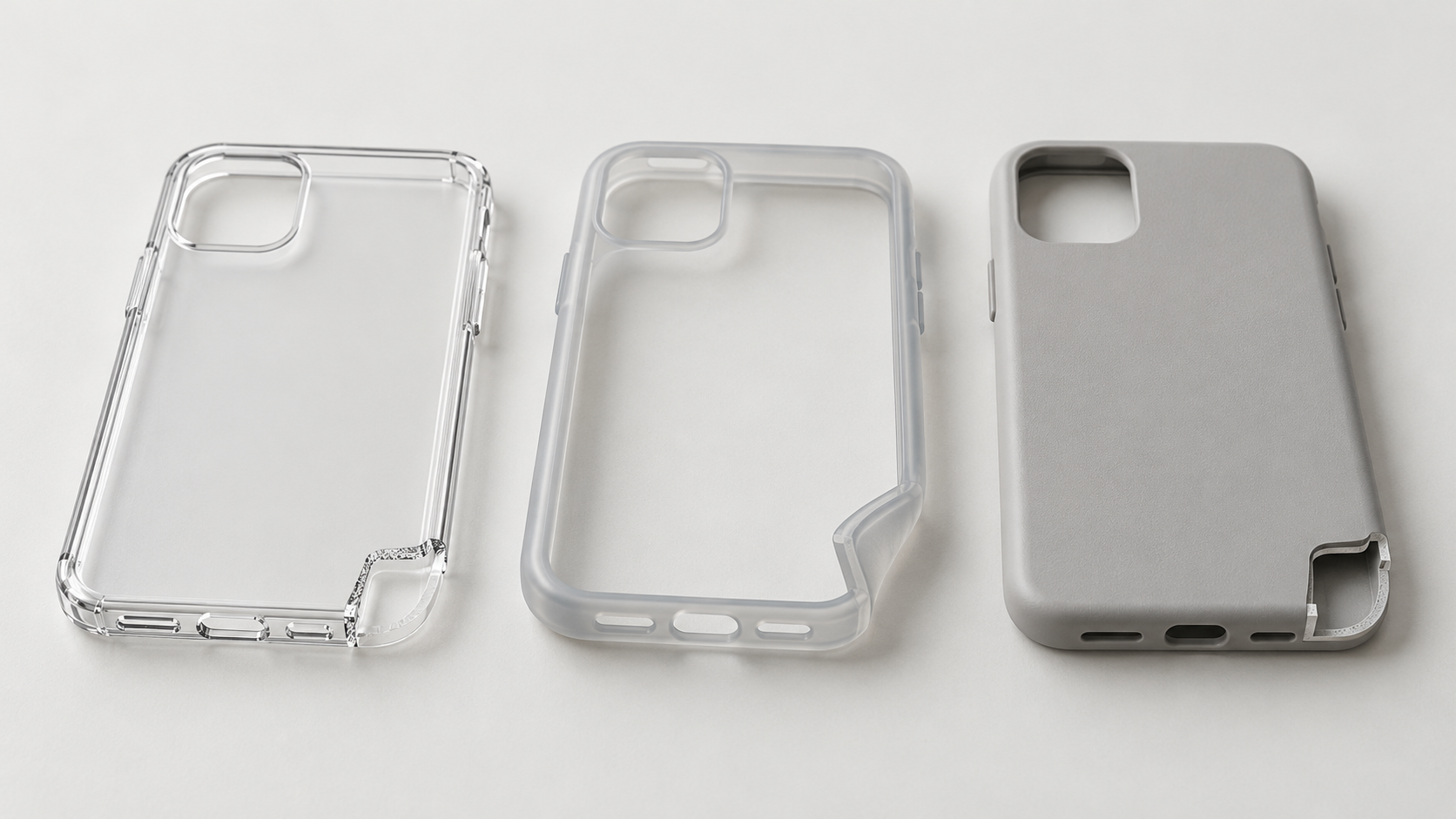
Why Injection-Molded Smartphone Case Material Selection Cannot Be Based Only on Whether the Case Is Soft or Hard
What material is best for a smartphone case? This question cannot be answered simply with “soft case” or “hard case.” Injection molding projects typically face three sets of conflicting requirements: toughness and cushioning are needed during drops; snap-fits, buttons, and the frame must remain stable during assembly; and the appearance must provide transparency, minimal weld lines, low sink marks, and sufficient scratch resistance. PC, TPU, and PC+ABS are only material candidates and cannot independently determine the final result.
- Prioritize PC: When the product requires a transparent hard shell, rigid support, stable snap-fits, and good dimensional retention, focus on validating transparency, weld lines, scratch resistance, and the drop-resistant design.
- Prioritize TPU: When the product requires flexible edges, button coverage, wear resistance, and localized cushioning, focus on validating hardness, rebound, compression set, yellowing, and long-term adhesion.
- Evaluate PC+ABS: When the product requires a balance of stiffness, toughness, flowability, and appearance, the specific grade and modification system should be defined, and dimensional accuracy, appearance, and drop performance should be compared using samples made with the same mold and structure.
Therefore, smartphone case material selection should work backward from the product objectives to define the injection molding solution: first establish the priorities for transparent appearance, rigid support, flexible edges, and wear resistance, then validate them in combination with the structure, mold, and injection molding process window. Thin-wall parts in particular require an assessment of filling balance, gate location, packing pressure, cooling, and demolding before mold fabrication. Conclusions should not be based solely on the feel of a sample.
PC Injection-Molded Smartphone Cases: Trade-Offs Between Rigidity, Transparency, and Dimensional Stability
If the product requires a transparent hard shell, precise contours, and stable snap-fits, PC is typically the first material to evaluate. It offers good impact strength, rigidity, toughness, transparency, and dimensional stability, making it suitable for supporting camera openings, button windows, and screen edges. This does not mean that PC smartphone cases are inherently more drop-resistant; wall thickness, radii, ribs, assembly clearances, and drop orientation can also change the results.
The main risks in PC injection-molded smartphone cases involve thin-wall filling and appearance control. Improper gate placement or insufficient venting may cause weld lines, flow marks, silver streaks, black specks, or localized short shots; uneven packing pressure and cooling may lead to sink marks, warpage, or demolding deformation. Transparent parts also require attention to material drying, melt shear, mold-surface cleanliness, and contamination control. PC surfaces are relatively prone to scratching. If spray coating, UV clear coating, or other post-processing is used, coating adhesion, scratch resistance, and edge durability must also be validated separately.
What Performance Indicators Should Be Validated for PC Injection-Molded Smartphone Cases?
- Key external dimensions, snap-fit engagement, button rebound, and the fit clearance after assembly;
- Transparency, haze, weld lines, flow marks, silver streaks, black specks, and surface scratches;
- Warping, edge deformation, and drop-test results, with the test conditions and sample structure recorded together.
TPU Injection-Molded Phone Cases: How Flexible Edge Coverage, Wear Resistance, and Cushioning Affect Fit
Material selection conclusion: TPU injection-molded phone cases are better suited to flexible edge coverage, button coverage, and areas requiring cushioning and wear resistance. Their elasticity and rebound help absorb localized impacts, but they cannot be directly equated with a specific drop height or service-life rating. Actual performance also depends on the hardness grade, wall thickness, radii, edge-coverage cross-section, and assembly clearance.
TPU Phone Case Fit and Rebound Require Long-Term Validation
TPU’s flexibility makes it suitable for covering phone edges and can also improve button feel and localized cushioning. However, hardness, rebound speed, and compression set affect whether the edges loosen, whether the buttons become sluggish, and how well the case remains fitted after long-term use. Changes in temperature and humidity, repeated assembly and disassembly, and contact with perspiration may also alter the feel or dimensions. During acceptance, check the assembly clearance, button rebound, edge lift, and retention force after repeated assembly and disassembly, rather than relying on tactile feel alone.
Appearance and Molding Risks of TPU Injection Molding
Thin-wall TPU parts also require attention to potential issues such as sticking to the mold, sink marks, haze, yellowing, and incomplete texture replication. Material drying, mold venting, draft angles, mold temperature, and cooling conditions all affect the result; transparent or translucent appearances require especially strict control of contamination, flow marks, and surface defects. After the material is selected, use trial-mold samples to measure edge deformation, critical dimensions, and surface condition before deciding whether to adjust the hardness, structure, or injection-molding process window.
PC+ABS Phone Cases: A Compromise Candidate Balancing Stiffness, Toughness, and Processability
PC+ABS phone cases are suitable for projects seeking a balance among stiffness, impact performance, processing flowability, and appearance. However, PC+ABS is not a single material with fixed properties. The PC/ABS ratio, specific grade, and flame-retardant, weather-resistant, or color-modification treatments all affect stiffness, toughness, shrinkage, and surface appearance, so it cannot be directly stated that PC+ABS is necessarily better than PC.
Structural and Appearance Trade-Offs in PC+ABS Phone Cases
For phone cases with snap-fits, button openings, and thin-wall profiles, PC+ABS can serve as a candidate solution balancing stiffness, toughness, and molding flowability. During actual mold trials, attention should be paid to filling balance, flow marks, gloss variation, color difference, and sink-related deformation; painted versions also require separate validation of coating adhesion, scratch resistance, and edge coverage. The higher the appearance grade, the less the mold surface, venting, material drying, and injection-molding process window can be set based solely on experience.
What to Request When Purchasing PC+ABS Phone Case Material
- Specify the exact grade and PC/ABS ratio, and confirm the requirements for flame retardancy, weather resistance, and color modification.
- Request the supplier’s TDS, recommended drying conditions, shrinkage data, and target surface grade.
- Compare snap-fit engagement, warping, appearance, and drop performance using the same mold, identical wall thickness, and identical test conditions.
Dimensional Stability in Phone Case Injection Molding: Uneven Shrinkage, Warpage, and Gate Location
When injection-molded phone cases have difficult-to-install snap-fits, uneven frame fit, or rebound after assembly, the cause is often not limited to the material itself. Filling balance in thin-wall structures, gate location, pressure-holding transfer, cooling-temperature differences, and demolding forces can all alter the final dimensions. PC is generally more suitable for rigid geometries, but excessive local flow length can still lead to weld lines, sink marks, or warpage; TPU’s flexibility and rebound make the measurement reference and assembly condition more sensitive.
Identify the Source of Deformation First, Then Adjust the Gate and Process
In engineering practice, mold-flow analysis should first be used to compare the number and locations of gates and the flow fronts, while observing whether filling is balanced and whether weld lines fall in cosmetic or load-bearing areas. The packing and cooling方案 should then be evaluated. More gates are not necessarily better; an inappropriate number or layout may cause flow marks, more weld lines, and differences in shrinkage. In one smartphone case research example, optimizing the gates for a specific model reduced weld lines by approximately half. However, its mold temperature of 52.5℃, melt temperature of 241℃, injection time of 0.3984 s, and deformation of 0.5846 mm applied only to that geometry, material, and simulation conditions and cannot be directly used as a universal processing window.
Validate injection-molded smartphone cases using critical dimensions and assembly conditions
After mold trials, measure the overall profile, snap-fit positions, button openings, camera opening, and frame flatness at the same time, then recheck clearances, warpage, and ejector whitening after assembly onto the phone or inspection fixture. If individual dimensions are acceptable but the assembly is still misaligned, the cause should generally be traced back to uneven shrinkage, uneven cooling, or demolding deformation rather than simply modifying local dimensions.
Surface quality and composite structures: validating everything from transparent appearances to rigid shells with soft edges
The resin appearance and post-processing appearance of injection-molded smartphone cases must be accepted separately
The surface quality of an injection-molded smartphone case is not determined by the material alone. For transparent PC, attention should be paid to flow marks, silver streaks, weld lines, black specks, haze, and scratches. Raw-material drying, shear, venting, mold-surface condition, and cleanliness can all change the result. TPU should be evaluated for sticking to the mold, sink marks, texture replication, haze, and yellowing. For PC+ABS, pay attention to flow patterns, gloss variation, color difference, and the adhesion and scratch resistance of subsequent coatings. Spray coating, vacuum metallization, transfer printing, and UV clear coating are independent post-processing systems; the inherent properties of the resin cannot replace coating durability testing.
Overmolding of rigid shells with soft edges must validate the interface and differential shrinkage
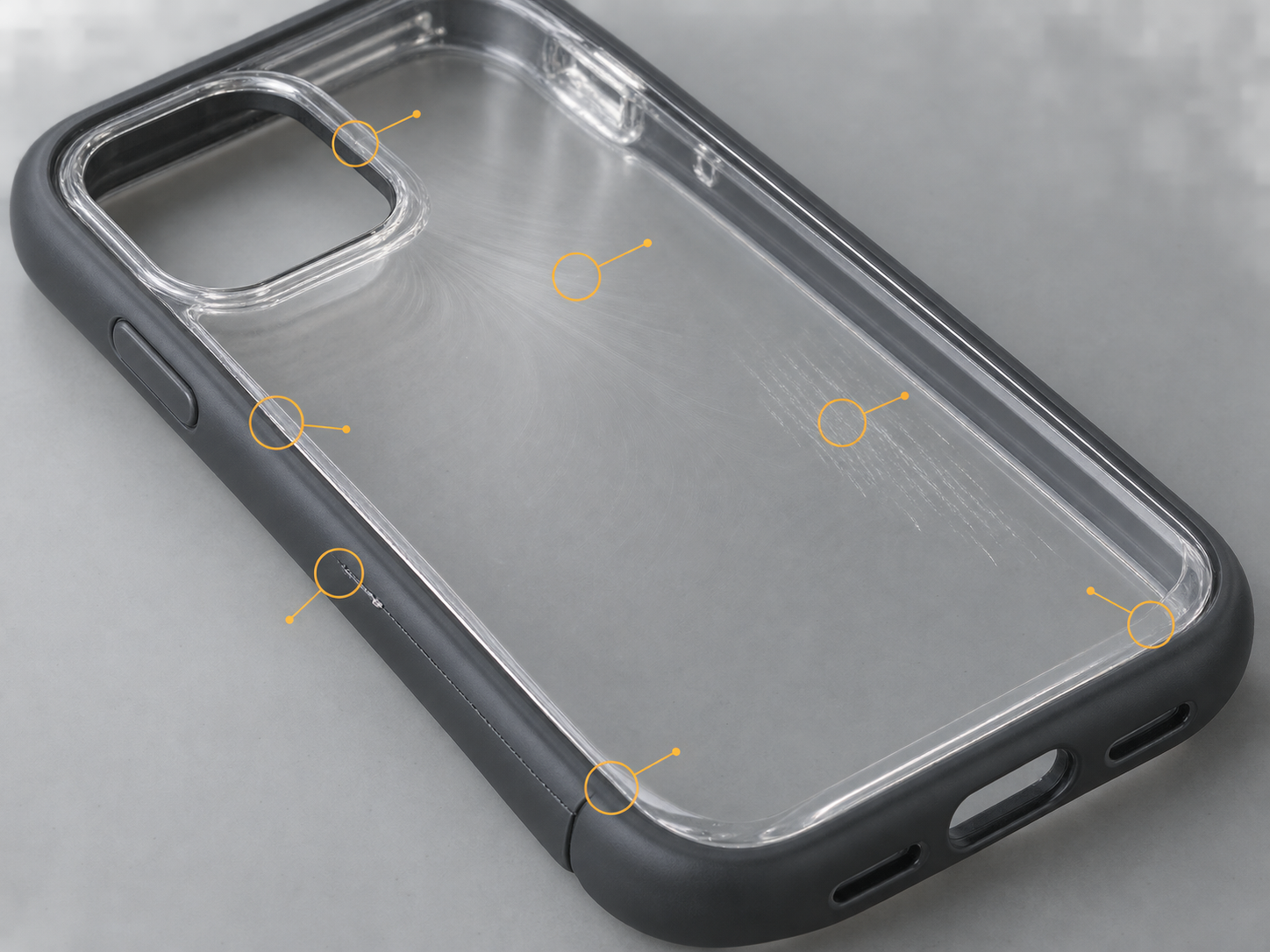
When using a PC substrate with a TPU or TPE edge, do not focus only on the concept of a rigid backplate with a soft edge. First confirm the compatibility of the two materials, interfacial bonding, and secondary molding temperature, then inspect differential shrinkage, warpage, edge flash, parting lines, and fit in the button areas. After the samples are completed, also observe interface changes after bending and exposure to sweat or cleaning agents, as well as the risk of delamination during long-term use. Insufficient interfacial bonding means that an acceptable appearance does not necessarily indicate structural reliability.
Smartphone case material selection and prototype acceptance: how to base decisions on test data
Smartphone case material selection should not end with deciding which material is most impact-resistant. Instead, decisions should be made according to product objectives: when a transparent rigid shell, rigid support, and stable snap fits are required, PC should be evaluated first; when flexible edging, wear resistance, and cushioning are required, TPU should be evaluated; when a balance of toughness, rigidity, flowability, and appearance is needed, the specific grade of PC+ABS should be evaluated. If a rigid backplate with a soft edge is used, interface bonding and secondary molding validation must also be added.
Lock in the material and key inputs before prototyping
- Geometric data: Provide the 3D model, wall-thickness requirements, mating dimensions for snap fits and buttons, and clearance conditions around the camera and screen frame.
- Material data: Specify the exact grade, color, and surface class of the PC, TPU, or PC+ABS, and obtain the supplier's TDS, recommended drying conditions, and shrinkage data.
- Acceptance conditions: Define appearance-defect limits, the warpage reference, the assembly target, drop orientations, and the number of test cycles in advance. If spray coating, UV clear coating, or plating is used, adhesion, scratch resistance, and edge durability should also be specified separately.
How to close the loop for first articles and small-batch production
First articles should be checked for overall dimensions, snap-fit engagement, button rebound, warpage, ejector whitening, weld lines, flow marks, silver streaks, haze, color difference, and surface scratches at the same time; do not rely solely on tactile judgment. During the small-batch stage, also monitor dimensional drift, long-term fit, coating durability, and drop-test results. The final conclusion should be tied to the material grade, structure, injection-molding window, and test conditions rather than ranking PC, TPU, and PC+ABS in a fixed order.
Frequently asked questions about material selection for injection-molded smartphone cases
Smartphone case material selection cannot be judged solely by softness, hardness, or hand feel. The drop resistance, fit, appearance, and molding performance of PC, TPU, and PC+ABS must all be confirmed in combination with the material grade, structure, wall thickness, mold, and test conditions.
Is there an absolute drop-resistance ranking among PC, TPU, and PC+ABS?
There is no universal ranking. PC is generally suitable for providing rigid support, TPU's elasticity and cushioning characteristics are beneficial for flexible edge protection, while PC+ABS must be evaluated based on the specific blend grade. The final result also depends on wall thickness, corner radii, frame height, assembly clearances, drop orientation, and test method.
Why can transparent phone cases still develop weld lines and haze?
Transparency is not determined by PC resin alone. Gate location, flow-front convergence, venting, shear, material drying, mold surface condition, and contamination control all affect weld lines, silver streaks, flow marks, and haze. These factors should be confirmed through mold-flow analysis, mold trials, and appearance inspection.
Why do TPU edge protectors need rebound and long-term fit validation?
TPU's flexibility and rebound help cushion the edges, but different hardnesses, structures, and processes affect compression set, button rebound, and edge retention. Temperature and humidity, long-term assembly, and repeated removal and reassembly may also change the fit, so dimensional, fit, and durability validation should be performed.
What is the difference between PC+TPU composite phone cases and PC+ABS blended materials?
PC+ABS is a blended material, with the focus on the specific grade, ratio, and modification system. PC+TPU generally refers to a composite or overmolded structure consisting of a rigid substrate and a flexible material, requiring additional validation of interfacial bonding, differential shrinkage, flash, parting lines, and long-term delamination. The two cannot be compared according to the same material logic.
Key takeaways
- PC is suitable for smartphone case structures requiring rigid support, a transparent appearance, and stable snap-fits, but scratch resistance and coating durability must be validated separately.
- TPU is suitable for flexible edges, wear-resistant areas, and cushioning zones, but rebound, compression set, mold sticking, and yellowing must be confirmed based on the specific grade and process.
- PC+ABS is a compromise candidate balancing stiffness, toughness, processability, and appearance. Not all PC+ABS grades should be treated as having uniform performance.
- Drop resistance and dimensional stability are not determined by material alone; wall thickness, radii, gate design, packing pressure, cooling, and assembly clearances are equally important.
- Composite structures combining a hard shell with soft edges must be validated for material compatibility, interfacial bonding, differential shrinkage, flash, and long-term delamination.