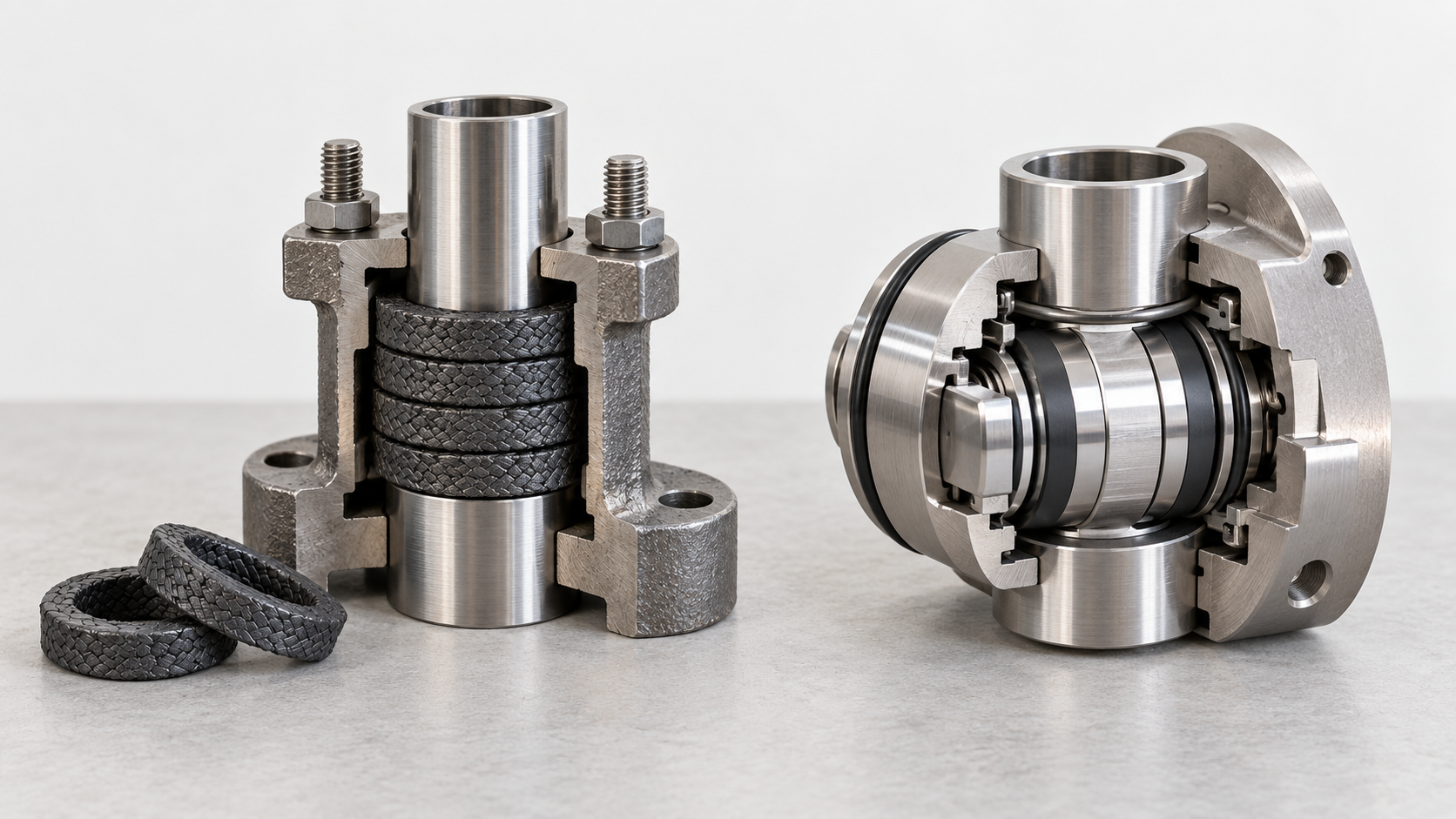
Packing Seals vs. Mechanical Seals: Compare Allowable Leakage Before Procurement Price
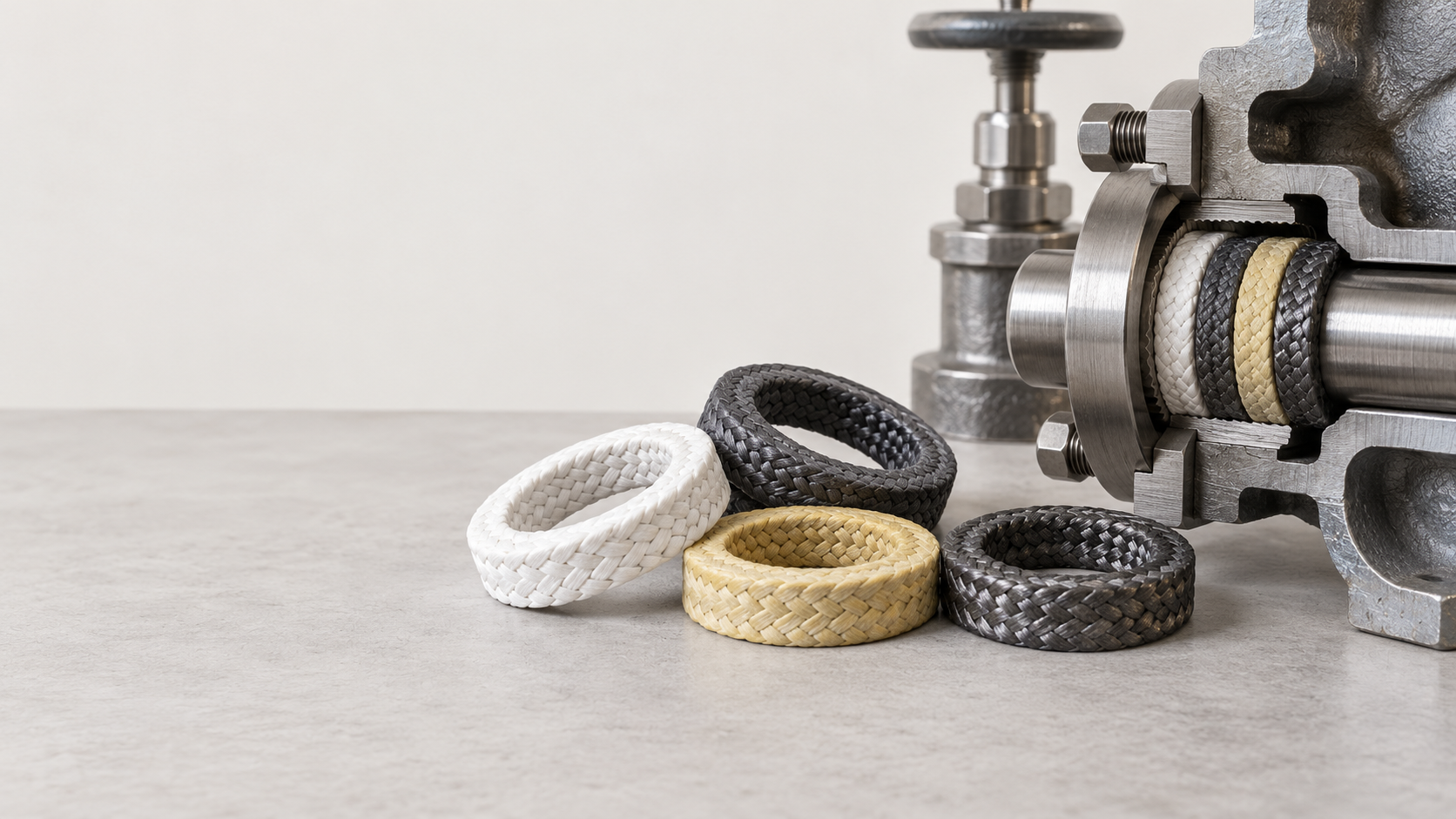
When selecting a seal for an industrial pump, packing seals have a lower initial cost, are familiar to maintenance personnel, and allow operating conditions to be controlled by adjusting the gland. These advantages still apply to equipment handling clean water or allowing controlled leakage. Mechanical seals generally reduce visible leakage, but this does not mean they will necessarily be more durable or more economical after installation. They are more sensitive to seal chamber dimensions, shaft-system accuracy, installation methods, and flushing or barrier-fluid conditions.
The first difference between the two is not “low price or high price,” but rather how much leakage the site allows. Packing requires a certain amount of leakage for lubrication and heat dissipation. Supplier literature has cited “approximately 1 drop per minute for every 25 mm of shaft diameter” as an ideal rule-of-thumb example, but this is not a universal acceptance standard for all pumps and media. If the medium is toxic, flammable, volatile, highly corrosive, or if leakage could contaminate the product or pump room, the decision should start with a mechanical seal, with a dual-face configuration evaluated where necessary.
Therefore, packing seals and mechanical seals should be compared in the following sequence: first confirm the properties of the medium and the leakage limits, then verify pressure, temperature, and rotational speed; next inspect the shaft or shaft sleeve condition, coupling alignment, seal chamber space, and installation length; and finally confirm whether maintenance personnel can consistently provide flushing, cooling, filtration, or barrier fluid. Continuous packing leakage, flush fluid, shaft sleeve wear, and cleaning requirements may increase lifecycle costs, while mechanical seals may add requirements for installation accuracy, auxiliary systems, and shutdown replacement. The correct selection should be determined collectively by these operating conditions.
Selecting Packing Seals or Mechanical Seals by Medium: Clean Liquids, Slurries, and Hazardous Media
The medium is the first screening criterion in industrial pump seal selection. For clean, room-temperature water where a small amount of controlled leakage is acceptable and adjustment is convenient on site, a packing seal can be evaluated. Its advantages are a familiar design and generally lower initial procurement and retrofit barriers, but the gland condition, leakage, and shaft sleeve wear must be checked continuously. If standing water is not permitted in the pump room, or if leakage could contaminate equipment, products, or bearings, the low visible leakage of a mechanical seal may be more valuable.
For media containing particles, slurries, or substances prone to crystallization, a single-face mechanical seal should not be selected simply because it leaks less. First confirm the particle concentration, particle size, crystallization tendency, medium temperature, seal chamber pressure, and shaft speed, then determine the face materials, design, and flushing method. External clean-liquid flushing helps isolate particles but adds piping, filtration, and medium-dilution management requirements. Under certain conditions with high solids content, sufficient maintenance personnel, and allowable controlled leakage, packing may instead be easier to adjust in the field.
For toxic, flammable, volatile, highly corrosive, or product-contamination-sensitive media, mechanical seals should be evaluated first. Where the consequences of leakage are severe, a dual-face seal and barrier-fluid system may also be required. A dual-face seal is not an automatic solution; the compatibility of the barrier fluid with the medium, pressure relationship, replenishment method, and monitoring requirements must be confirmed. Procurement documentation must also provide temperatures and pressures under normal, maximum, and start-stop conditions, rather than only the pump nameplate parameters.
- Clean liquids: Verify allowable leakage, maintenance frequency, shaft sleeve wear, and pump-room drainage conditions.
- Slurries or crystallizing media: Verify solids content, particles, and flushing conditions; avoid comparing only the procurement price of the mechanical seal.
- Hazardous media: verify leakage-control objectives, material compatibility, barrier fluid, and alarm/interlock requirements.
How pressure, temperature, and speed affect industrial pump seal selection
The applicable limits of packing seals and mechanical seals cannot be determined solely from the pump nameplate pressure or rated speed. Pressure, temperature, and speed simultaneously affect the loading on the seal faces, frictional heat, the risk of medium vaporization, and the wear and leakage stability of the packing. During selection, the pump type, seal-chamber pressure, and medium condition should be confirmed together.
Pressure affects seal-face loading and leakage stability
Mechanical seal faces must operate under an appropriate specific pressure. Excessive pressure may increase face loading and frictional heat, while pressure fluctuations or transient changes during startup and shutdown may cause the faces to open briefly and produce leakage. Packing seals should not simply be tightened more as pressure increases; excessive tightening increases shaft-sleeve wear and heat generation, while insufficient tightening may result in uncontrolled leakage. The purchaser should provide the normal pressure, maximum pressure, and seal-chamber pressure during startup, shutdown, and abnormal operating conditions, rather than providing only the system design pressure.
Temperature and speed determine frictional heat and vaporization risk
Rising temperature reduces the vaporization margin of some media and also affects the performance of face materials, elastic components, and packing. As speed increases, the relative sliding speed of the seal faces and frictional heat increase; if flushing, cooling, or heat dissipation is inadequate, the mechanical seal may experience thermal deformation, dry friction, or face opening. For packing, high-speed operation generally means greater frictional power loss and wear. Temperature, pressure, or flow limits given in the source can only serve as examples for specific pump series and cannot be directly generalized as universal limits for all industrial pump seals. The final step should be to verify the pump and seal manufacturers’ datasheets and confirm conditions such as startup, shutdown, dry running, and sudden changes in medium temperature.
Operating costs of packing seals: leakage, flush fluid, shaft-sleeve wear, and maintenance
Packing seals usually have a lower purchase price, and maintenance personnel are familiar with gland adjustment and packing replacement. However, they are not a seal type that can simply be “installed and forgotten.” Packing requires a certain amount of leakage for lubrication and heat dissipation. Excessively low leakage may cause overheating, hardening, and shaft-sleeve wear, while excessive leakage results in medium loss, pump-room pooling, and ongoing cleaning work. An empirical example provided by AESSEAL states that, under ideal conditions, leakage is approximately one drop per minute for every 25 mm of shaft diameter. This figure is suitable only as an example for judgment in the source and is not a uniform acceptance criterion for all pumps, media, and sites.
Operating costs also include flush fluid and medium dilution. For clean-water pumps, the direct value loss from minor leakage may be limited; for high-value, corrosive, or hazardous media, leakage increases the costs of procurement, collection, treatment, and safety protection. Once flush fluid enters the pump chamber, it may also change the medium concentration or affect subsequent processes. If continuous leakage travels along the shaft end into the bearing area, it may contaminate the grease and shorten the maintenance interval.
Do not compare only the purchase prices of packing and mechanical seals
Packing also consumes on-site maintenance time: during operation, personnel must monitor dripping, gradually adjust the gland, and arrange repairs when grooves develop in the shaft or shaft sleeve. Supplier literature has used an example to illustrate that the frictional energy consumption of a packing-sealed pump may be significantly higher than that of a balanced mechanical seal, with the comparison reaching approximately six times; however, this figure is affected by the pump type, tightening force, speed, and test boundaries and cannot be generalized as a universal conclusion. During procurement, medium loss, flush fluid, shaft-sleeve replacement, bearing contamination, and shutdown maintenance should all be included in the calculation and compared with the costs of the mechanical seal assembly, installation verification, and auxiliary systems.
Before converting from a packing seal to a mechanical seal, shaft-system accuracy and installation dimensions must be checked
Converting a packing seal to a mechanical seal is not as simple as removing the packing and installing a new assembly. Mechanical seal faces require stable relative motion and uniform loading; shaft-system vibration, a mismatched installation length, or a misaligned gland can all cause premature leakage. If a new seal leaks immediately after operation begins, do not first assume that the seal itself is defective. Troubleshooting should proceed in the order of the shaft system, dimensions, assembly, and auxiliary piping.
Check the shaft and bearing condition first when converting to a mechanical seal
During disassembly and inspection, confirm the runout, wear, scratches, corrosion, and surface condition of the shaft or shaft sleeve, paying particular attention to whether a deep groove has formed at the original packing compression position. If the shaft-sleeve surface is already out of round or rough, even a new mechanical seal with intact faces may become unstable because of vibration and eccentricity. Also check bearing clearance, pump-shaft axial movement, coupling alignment, and the condition of the base and fasteners. Misalignment transfers periodic displacement to the seal faces, manifesting as dynamic leakage, temperature rise, or abnormal noise.
Verify mechanical seal chamber dimensions and installation conditions
Before modification, obtain the existing seal design, shaft diameter, seal-chamber drawings, and operating records, and measure the seal-chamber inside diameter, effective depth, installation length, shaft-shoulder position, and locating dimensions. The mating surfaces between the gland and chamber must be flat, and the bolt holes and threads must ensure uniform tightening; dimensional errors must not be compensated for by tightening at an angle. If the installation lengths of the new and old designs differ, also confirm the spring compression, axial positioning, and working position of the seal faces to avoid overcompression, insufficient compression, or spring failure.
- Information required before modification: medium, pressure, temperature, speed, startup and shutdown records, leakage location, and existing flush piping.
- On-site dimensions: shaft diameter, shaft-sleeve condition, seal-chamber space, installation length, gland face, and bolt conditions.
- Commissioning Confirmation: static leakage, dynamic leakage, vibration, seal chamber temperature, and flushing conditions; if any abnormality is found, recheck alignment and assembly stresses.
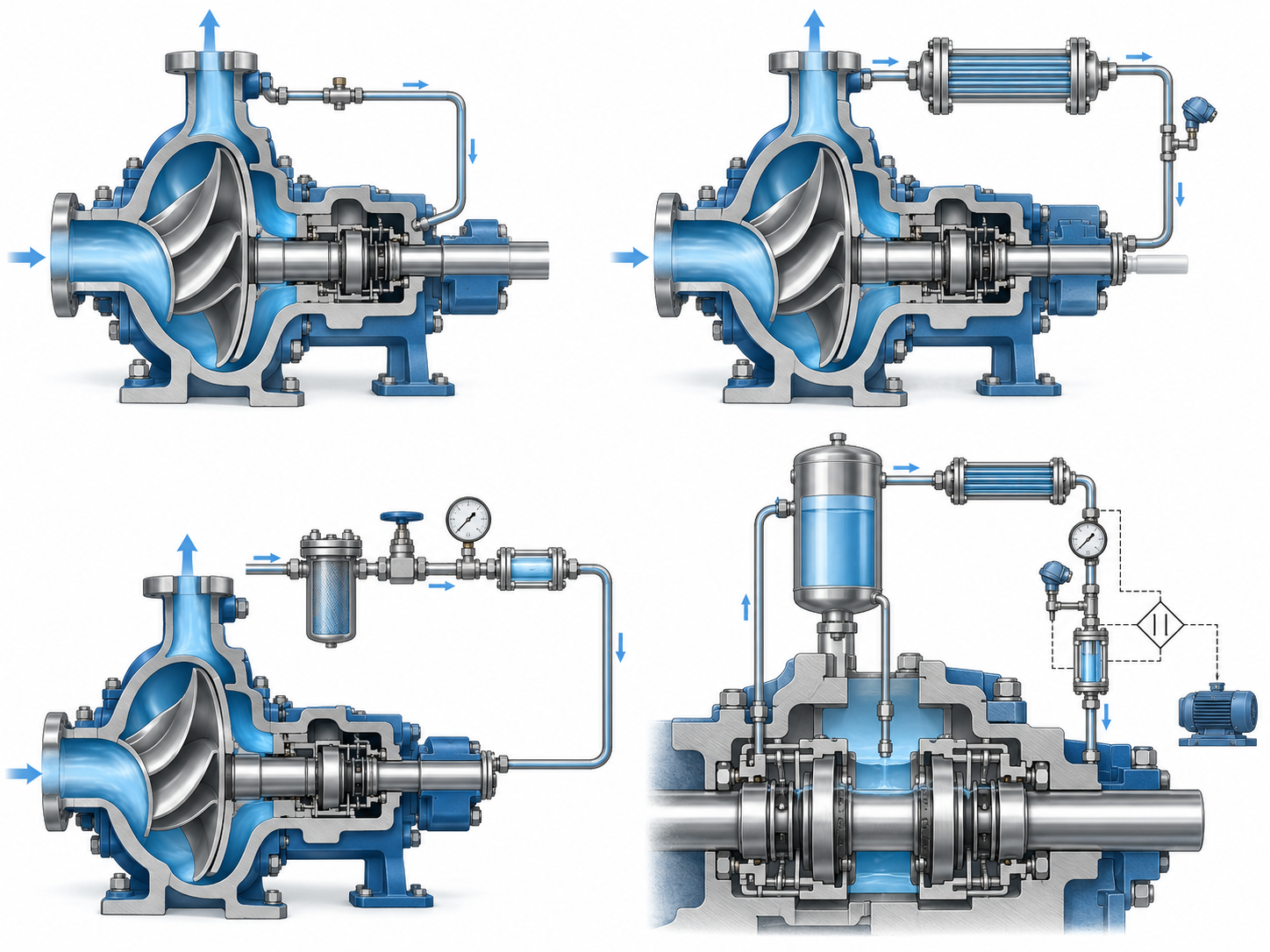
Plan 11, Plan 21, Plan 32, and Double Mechanical Seals: How to Configure the Seal Support System
Mechanical seal selection cannot be limited to purchasing the seal assembly. Flushing, cooling, barrier or buffer fluid, filtration, instrumentation, and interlocks together constitute the industrial pump seal system. Plan 11 is generally understood as circulation or flushing with the pumped fluid, Plan 21 adds cooling to the circulating fluid, and Plan 32 introduces flushing with an external clean fluid. These are typical approaches, not configurations that can be applied without regard to operating conditions.
Plan 11, Plan 21, and Plan 32 Must Be Confirmed Based on Operating Conditions
Media containing particles, media prone to crystallization, or high-temperature media may clog flush ports, accelerate face wear, or cause vaporization in the seal chamber. The supplier needs to determine the configuration based on seal chamber pressure, fluid temperature, vaporization risk, particle concentration, and the properties of the external flush fluid. Procurement documents should specify the filter, pressure gauge or transmitter, temperature monitoring points, and the method for confirming flush flow or pressure.
Double Mechanical Seals Also Require a Barrier or Buffer Fluid System
For toxic, flammable, highly volatile, or zero-discharge media, a single mechanical seal may be insufficient to meet risk-control requirements, and a double mechanical seal should be evaluated. Double mechanical seals typically require a barrier or buffer fluid reservoir, circulation piping, pressure monitoring, and level management; the barrier fluid pressure generally needs to be higher than the corresponding pressure of the sealed medium, but the specific differential must be confirmed by the seal design. During acceptance, it is not enough to check only whether the faces leak; the condition of the flush or barrier fluid, seal chamber temperature, abnormal noise, and interlock operation should also be checked.
Industrial Pump Seal RFQ and Acceptance Checklist for Engineering Procurement
When requesting quotations for packing seals and mechanical seals, it is not enough to write only “mechanical seal for a pump of a certain model” or “replace one set of packing.” The supplier needs to know the actual operating conditions; otherwise, the materials, face combination, and flushing scheme may all be selected incorrectly. The RFQ document should describe normal, maximum, startup, and shutdown conditions.
Industrial Pump Seal RFQ Information
- Medium name, composition, solid particle concentration, particle size, tendency to crystallize, corrosiveness, and whether it is toxic, flammable, or highly volatile.
- Flow rate, head, rotational speed, seal chamber pressure, temperature range, and startup, shutdown, and abnormal operating conditions.
- Shaft diameter, shaft sleeve material and surface condition, seal chamber dimensions, installation length, pump type, and the seal configuration currently in use.
- Leakage limits, material compatibility, the source and pressure of the flush or barrier fluid, and requirements for filtration, temperature monitoring, alarms, and interlocks.
Acceptance Items for Packing Seals and Mechanical Seals
- Confirm whether static and dynamic leakage comply with project requirements; “temporarily leak-free after installation” must not be treated as a complete acceptance conclusion.
- Record the seal chamber temperature and flush flow or pressure, and check whether the filter, instruments, piping, and interlocks actually function.
- Observe vibration, abnormal noise, bearing contamination, shaft sleeve heating, and changes in leakage during startup and shutdown.
- Archive the acceptance records, the seal manufacturer's data sheet, the pump manufacturer's documentation, and the applicable standards together. The final solution should be confirmed by the equipment and seal manufacturers based on the complete operating conditions, rather than being concluded from a single seal type.
Common Questions About Packing Seals and Mechanical Seals
There is no fixed superiority of packing seals or mechanical seals independent of operating conditions. The assessment should consider the allowable leakage rate, the hazard level of the medium, its tendency to contain particles and crystallize, pressure and temperature, rotational speed, shaft-train condition, and the flushing or barrier-fluid conditions.
Is a packing seal necessarily cheaper than a mechanical seal?
Not necessarily. Packing generally has a lower initial purchase cost and is easy for on-site personnel to adjust, but ongoing leakage, flushing-fluid consumption, product loss, shaft-sleeve wear, and cleaning and maintenance all contribute to operating costs. A mechanical seal may increase component, installation-precision, and auxiliary-system costs, but where significant leakage is not permitted, the overall cost should be compared on a life-cycle basis.
Can mechanical seals never be used with media containing particles or slurry?
No. For media containing particles, the particle concentration, particle size, crystallization tendency, face materials, seal-chamber pressure, and flushing plan must all be confirmed. In some operating conditions, a suitable face design and flushing with an external clean fluid may be used; on other equipment with better maintenance conditions, packing may be easier to adjust. The decision cannot be based solely on the fact that “mechanical seals leak less.”
When converting from packing to a mechanical seal, which items are most commonly overlooked?
Particular attention should be paid to shaft or shaft-sleeve runout, surface wear, coupling alignment, bearing condition, seal-chamber dimensions, installation length, gland loading, and bolt conditions. Also confirm that the flushing piping is usable. Early leakage from a new mechanical seal may result from shaft-train vibration, dimensional mismatch, or gland misalignment, and is not necessarily a quality problem with the seal itself.
Can a dual mechanical seal prevent leakage simply by adding barrier fluid?
No. A dual seal also requires the barrier-fluid properties, pressure, temperature, circulation method, filtration, pressure or level monitoring, and any necessary alarms and interlocks to be properly matched. The barrier-fluid pressure generally needs to be higher than the corresponding pressure of the sealed medium, but the specific differential must be confirmed based on the seal design, seal-chamber pressure, and medium conditions. If the auxiliary system is unsuitable, a dual seal can also fail.
Key takeaways
- Packing seals and mechanical seals should first be screened according to allowable leakage and medium-related risks, rather than initial procurement price alone.
- For media containing particles, slurries, or substances prone to crystallization, the face materials, seal chamber pressure, and flush plan must be confirmed together.
- Before converting from packing to a mechanical seal, the shaft or shaft sleeve runout, coupling alignment, seal chamber dimensions, and installation length must be rechecked.
- Plan 11, Plan 21, Plan 32, and dual-face seal barrier-fluid systems are all part of seal selection and cannot be determined independently of the specific pump type.
- Mechanical seal acceptance should not be based only on whether liquid leaks after installation; flushing, temperature, vibration, start-stop conditions, and the risk of bearing contamination must also be checked.