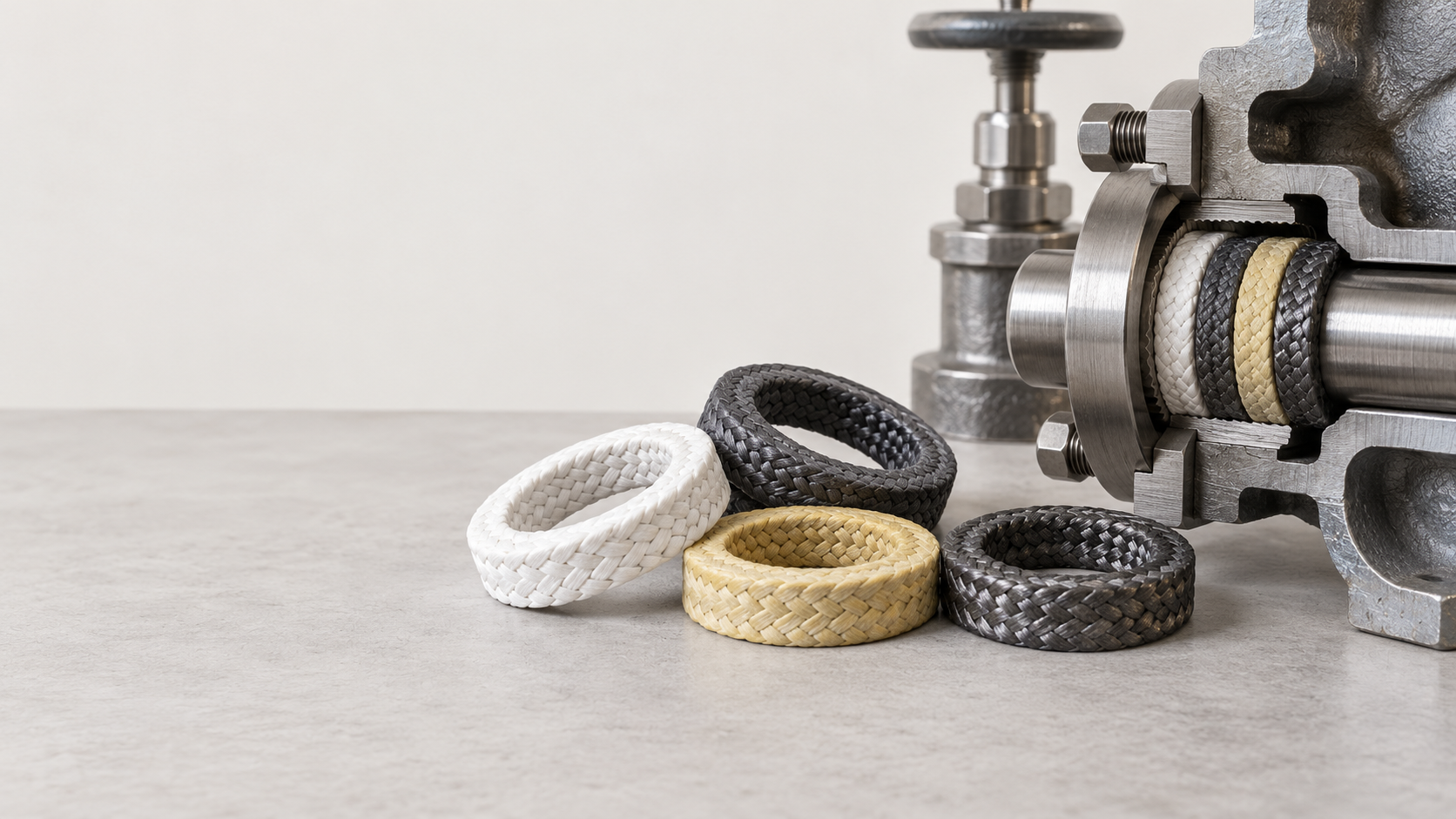
What Is Packing Sealing? Why Both Pump Shafts and Valve Stems Can Use It, but Work Differently
A common maintenance-site question is this: dripping from pump-shaft packing and external leakage from valve-stem packing can both be described as "packing leakage," but they cannot be handled using the same approach. Pump shafts typically rotate continuously, so the packing must cope with frictional heating, sliding against the shaft surface, and lubrication during operation. Valve stems, by contrast, may move up and down reciprocally, rotate, or open and close frequently. In addition to leak tightness, attention must be paid to the packing's ability to follow the movement and to the operating load on the valve stem.
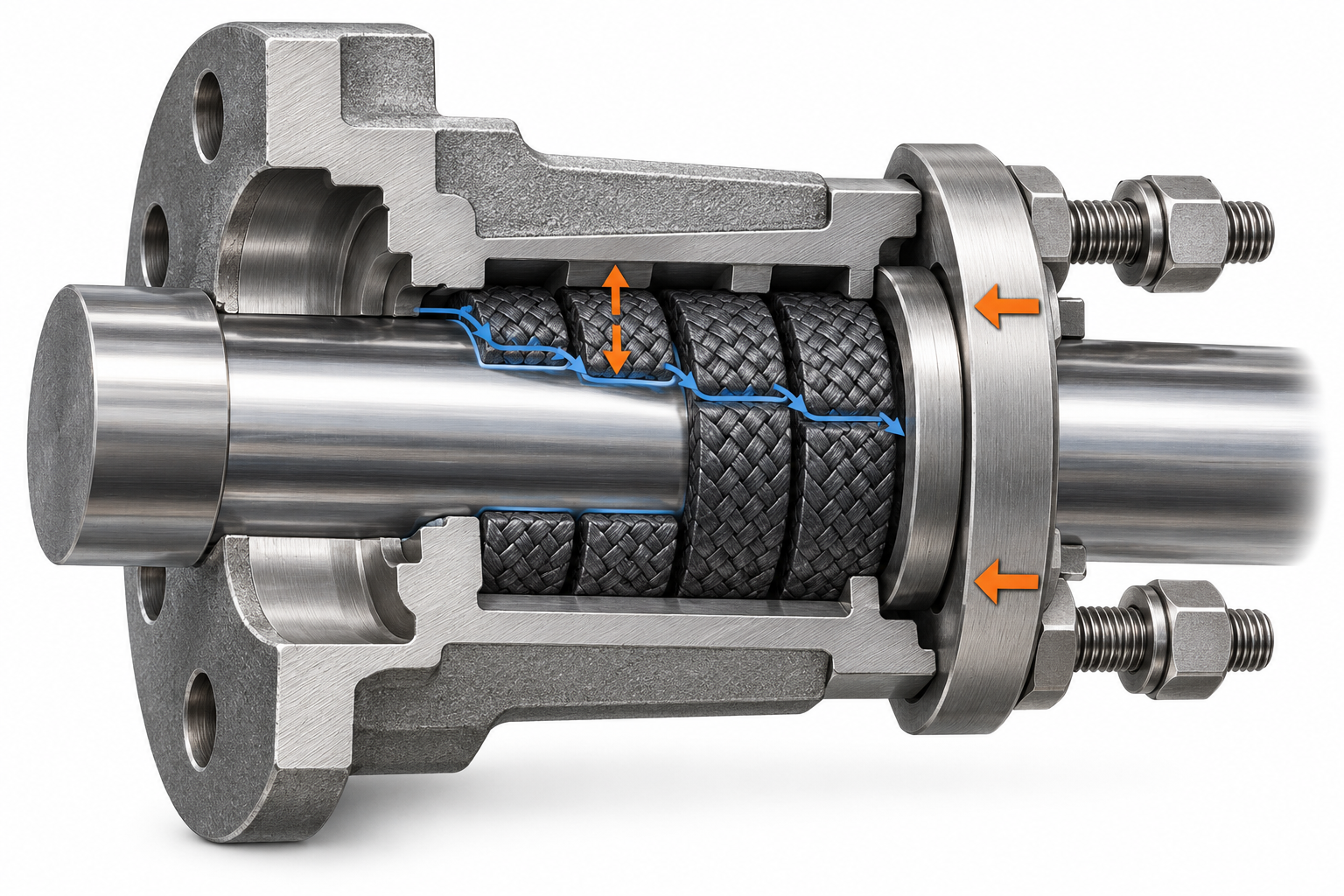
Packing is a flexible braided strip material installed in a stuffing box or seal chamber. After installation, the gland compresses the packing radially, causing it to conform simultaneously to the shaft or stem surface and the stuffing-box wall, thereby restricting leakage of the medium outward through the clearance. It is not a completely fixed gasket; instead, it works through the combined effects of the material structure, compression state, and suitable lubrication. Therefore, packing selection should not be based solely on cross-sectional size or material name. The equipment's type of motion, medium, and operating conditions must first be confirmed.
This article focuses on external leakage from the stuffing box: for example, dripping around a pump shaft or seepage outward from the valve-stem gland area. If a medium continues to pass through the valve seat after the valve is closed, that is internal leakage at the closure member or valve seat and cannot be directly attributed to the packing. During troubleshooting, first identify the leakage location, then inspect the packing, gland, stuffing box, and shaft or stem surface condition. If internal and external leakage are conflated, subsequent material replacement or gland adjustment may miss the root cause.
How Packing Creates a Seal: The Relationship Between Radial Compression, the Labyrinth Effect, and Lubrication
Once installed in the stuffing box, packing does not seal the clearance by simply blocking it with one solid piece of material. The axial force applied by the gland causes the braided packing to deform radially, conforming to the shaft, valve stem, and inner wall of the stuffing box to form continuous sealing contact. Small passages may still exist between the packing and the shaft or stem, but the medium must pass through multiple tortuous paths, with its pressure gradually reduced through repeated throttling. This is commonly referred to as the labyrinth effect.
Radial Compression of Packing Is Not Always Better When Increased
Packing also requires suitable lubrication to reduce friction and temperature rise. For continuously rotating pump shafts, excessive compression increases shaft resistance and makes it difficult for frictional heat to dissipate in time. For reciprocating or rotating valve stems, overcompression may make operation more difficult and accelerate wear on the stem surface. Conversely, insufficient compression leaves leakage paths. Therefore, the goal after installation is not to pursue absolute "zero dripping," but to balance sealing, temperature rise, operating load, and packing service life within the limits permitted by the equipment requirements.
Use Operating Conditions to Determine Whether Packing Compression Is Appropriate
During trial operation, observe changes in leakage, gland temperature rise, shaft or valve-stem movement, and the remaining adjustment allowance at the same time. If the temperature rises significantly after operation, movement becomes more difficult, or leakage rapidly worsens, do not simply continue tightening the gland. Instead, recheck the lubrication, packing cross section, cut and installation arrangement, shaft or stem surface, and stuffing-box condition. Packing seals depend on the combined performance of the material, structure, and installation; increasing compression force alone generally cannot replace an examination of the root cause.
What Operating Conditions Should Be Considered First When Selecting Packing: Media, Temperature, Pressure, Particles, and Motion Type
The first step in packing selection is not to choose PTFE, graphite, or aramid based on experience alone, but to first create an operating-conditions profile. The same cross-sectional size used in a clean-water pump, an abrasive slurry pump, and a steam valve is exposed to different levels of friction, temperature rise, chemical attack, and extrusion risk. Without key operating data, a reliable recommendation usually cannot be made based solely on the term “packing” or a string of dimensional specifications.
What Should Be Recorded in a Packing Operating-Conditions Profile
- Equipment and motion type: Specify whether the application involves a pump shaft or valve stem, continuous rotation or reciprocating motion, as well as the rotational speed, actuation frequency, and whether frequent starts and stops occur.
- Media information: Record the medium name, concentration, viscosity, acidity or alkalinity, whether it contains solid particles, and the requirements for leakage and contamination control.
- Temperature and pressure: Provide normal values, peak values, and possible start-up and shutdown fluctuations. For steam, high-temperature water, and similar conditions, also specify the thermal cycling conditions.
- Structural dimensions: Provide the shaft or valve stem diameter, stuffing box width and depth, packing cross-section, gland configuration, and whether cooling, flushing, or lubrication is available.
- Existing failure symptoms: Record the leakage location and trend, operating temperature rise, valve stem actuation load, packing wear pattern, and whether the shaft or stem has scratches, pitting, bending, or eccentricity.
For example, abrasive slurries should first be evaluated for wear resistance, strength, and extrusion resistance; for chemical media, concentration, temperature, and compatibility should be checked first; for high-temperature water or steam, thermal conduction and post-operation gland adjustment should also be considered. These are only screening guidelines, not fixed conclusions independent of supplier data. During procurement, provide this operating-conditions profile together with the stuffing box dimensions and existing failure symptoms.
What Risks Should Be Considered for PTFE, Graphite, Aramid, and Carbon-Fiber Packing?
Packing materials should not be selected solely based on which one has the “highest temperature resistance.” First confirm the medium, temperature, pressure, motion type, and shaft or stem condition, then screen materials based on their characteristics. The categories below are typical evaluation directions and do not constitute a uniform industry standard; the specific product data and media compatibility chart must still be checked.
PTFE Packing: Focus on Chemical Compatibility, Low Friction, and Contamination Restrictions
PTFE packing is typically evaluated based on chemical resistance, self-lubrication, and low-contamination requirements, making it suitable for chemical media or applications that are particularly sensitive to contamination. However, the specific concentration, temperature, pressure, and reinforcement structure all affect the application limits, so suitability cannot be concluded solely from the term “corrosion resistant.”
Graphite, Aramid, and Carbon-Fiber Packing: Check Thermal, Wear, and Strength Risks Separately
- Graphite packing: Focus on high temperature, thermal cycling, media compatibility, and shaft or stem wear risks. Graphite generally helps provide high-temperature resistance and reduce friction, but performance varies considerably with the braiding structure, reinforcement method, and operating environment. In oxidizing media, at higher surface speeds, or when the shaft surface is in poor condition, selection should not be based solely on the advertised temperature rating.
- Aramid packing: Focus primarily on wear resistance, extrusion resistance, and mechanical strength. It is often considered for abrasive media or high-wear conditions. However, aramid is relatively hard; if it rubs directly against a shaft or stem at high speed, is over-compressed, or is inadequately lubricated, it may increase wear on the shaft sleeve or valve stem. Therefore, the motion type, surface condition, and compression level should also be checked.
- Carbon-fiber packing: Typically evaluated based on requirements for temperature resistance, low friction, thermal conductivity, or wear resistance, but its specific performance depends on the carbon-fiber type, braiding structure, impregnation material, and combination with other packing materials. When used on pump shafts or valve stems, check media compatibility, rotational speed or actuation frequency, pressure, and the potential for galvanic corrosion or shaft or stem wear.
Differences in Packing Selection for Pumps and Valves: Rotating Shafts, Reciprocating Valve Stems, and High-Frequency Actuation
Although both involve leakage from the stuffing box, the operating conditions faced by pump-shaft packing and valve-stem packing are different. Pump shafts usually rotate continuously, and friction between the packing and shaft surface continuously generates heat. Therefore, special attention should be paid to rotational speed, lubrication, shaft surface condition, and temperature rise during operation. Valve stems, by contrast, may move up and down reciprocally, rotate, or operate intermittently. In addition to sealing performance, attention should be paid to the packing's low friction, conformability, and the operating load on the valve.
Pump-Shaft Packing: Check Frictional Heating and Shaft Surface Condition First
Pump packing should not be selected solely by cross-sectional dimensions or a "temperature-resistance rating." For slurry applications containing solid particles, wear resistance, strength, and extrusion resistance generally require priority evaluation. However, if the packing is too hard or compressed too tightly, it may still increase sleeve wear and heat generation. After installation, observe leakage, temperature rise, and the remaining adjustment range of the gland. Continuous tightening must not be used as a substitute for checking the shaft, stuffing box, and lubrication condition.
Valve-Stem Packing: Consider Low Friction, Conformability, and Operating Load Together
Valve packing must maintain contact as the valve stem moves. In high-frequency opening and closing or control-valve applications, excessive compression may make stem movement more difficult and may even affect operation. If the packing lacks sufficient conformability, external leakage may occur after movement. For chemical media or low-contamination applications, first verify material compatibility and contamination restrictions. For hot water, steam, and similar applications, thermal conduction, temperature changes, and the gland's adjustment capability must also be considered. These guidelines are only a starting point for screening; final selection must still be based on specific product data and the equipment manual.
Pump shafts and valve stems should therefore not be assumed to use the same type of packing. When purchasing, provide at least the equipment type; shaft or valve-stem dimensions; stuffing-box dimensions; medium and concentration; temperature; pressure; rotational speed or operating frequency; particle conditions; and existing failure symptoms. If the shaft or stem already has scratches, pitting, bending, or eccentricity, simply replacing the packing may not eliminate the leakage.
Packing Installation Procedure: Removing the Old Packing, Cleaning, Cutting Rings, Staggering Joints, Installing the Packing, and Adjusting the Gland
Packing installation should not begin with "stuffing in the new packing." It should begin with safe shutdown, isolation of the medium, and release of residual pressure. The gland should not be removed directly while the pump shaft or valve stem is still moving, heating up, or under pressure. Installation quality generally depends on the condition of the stuffing box and shaft or stem, as well as the load applied by the gland—not merely on the packing material itself.
Removing the Old Packing and Inspecting the Stuffing Box
When removing old packing, use suitable packing-removal tools to avoid scratching the valve stem, pump shaft, or stuffing box. Remove residual packing, hardened material, and deposits as thoroughly as possible. If old packing remains at the bottom, the new packing may not be compressed evenly. After cleaning, inspect the shaft or stem for scoring, pitting, ovality, bending, or eccentricity. Also check the inner wall of the stuffing box for corrosion, burrs, and localized damage. If the shaft or stem surface has already been damaged, simply replacing the packing may not eliminate external leakage.
Cutting Rings, Installing the Packing, and Adjusting the Gland
- Measurement and matching: Check the stuffing-box width and depth and the shaft or stem dimensions. Confirm that the packing cross-section matches the equipment manual and the supplier's requirements; do not determine it solely from the dimensions of the old packing.
- Clean, even cuts: Measure and cut each ring individually. The cut ends should be flat and fit closely, without forming a noticeable opening or local overlap. Keep cut packing clean and prevent sand or metal chips from becoming mixed in.
- Install one ring at a time: Press each ring individually into the stuffing box, ensuring that the packing conforms to the bottom and the cavity wall. Stagger the joints of adjacent rings. Follow the equipment manual or the packing supplier's requirements for the specific staggering arrangement.
- Apply compression evenly: When installing the gland, tighten the fasteners alternately and evenly, avoiding pressing one side fully down first. Keep the gland parallel and leave room for subsequent adjustment. "The tighter it is, the less it leaks" is not a universal principle.
- Test-run and recheck: After startup, observe leakage, temperature rise, the operating load on the shaft or valve stem, and the gland position. If leakage increases abnormally, movement becomes more difficult, or temperature rise is significant, shut down and inspect the packing installation, lubrication, uneven gland loading, and shaft or stem condition rather than continuing to tighten.
How to Troubleshoot Packing Leakage: From Gland Loading to Shaft or Stem and Stuffing-Box Condition
The symptoms of packing leakage only indicate the priority inspection direction; they do not directly prove a single cause. During troubleshooting, first distinguish external leakage from the stuffing box from internal leakage through the valve seat. Then, based on whether the equipment rotates continuously or moves reciprocally, inspect the condition of the gland, packing, shaft or stem, and stuffing box.
| Leakage or Operating Symptoms | Priority Inspection Items for Packing Leakage |
|---|---|
| Still leaks when the equipment is stationary | Check media compatibility, whether the packing has been fully installed, and whether the gland is being loaded evenly. |
| Leakage develops gradually as the equipment heats up during operation | Check for over-tightening, lubrication, frictional heating, thermal expansion, and material suitability limits. |
| Significant leakage on one side of the gland | Check for uneven gland loading, residue in the stuffing box, shaft misalignment or eccentricity, and whether the packing cross-section is properly matched. |
| Leakage worsens rapidly after startup | Check whether the cut ends are square, whether the joints form openings, and whether the shaft or valve stem has scratches or pitting. |
| The valve stem becomes harder to operate | Check the compression, lubrication, and whether the packing is compatible with the valve stem's type of movement. Avoid continuing to tighten it blindly. |
Packing still leaks after replacement? Check the underlying condition first
If leakage continues after new packing has been installed, do not immediately switch to a more expensive or “higher-temperature-resistant” material. Check the shaft or pump shaft for scoring, ovality, bending, eccentricity, and surface roughness. Also confirm the stuffing box dimensions and cleanliness, the packing construction, and the available gland adjustment range. If the shaft is already damaged, simply replacing the packing often will not eliminate the leakage.
When purchasing packing or requesting a quotation from a supplier, provide not only the packing cross-section but also the equipment type, shaft or valve stem dimensions, stuffing box dimensions, medium and concentration, temperature, pressure, presence of particulates, rotational speed or actuation frequency, and existing failure symptoms. Ask the supplier to provide the material construction, compatibility basis, and installation recommendations, and verify them against the equipment manual, site safety procedures, and specific product data.
Packing FAQ
Assessing packing leakage cannot be based solely on the material name. The shaft or valve stem's type of movement, media compatibility, stuffing box condition, gland loading, and site safety requirements must also be considered. The following questions address the key points of selection, installation, and external leakage troubleshooting discussed in this article.
Is packing better when it is tightened as much as possible?
No. Proper compression helps form a seal, but excessive compression can increase shaft friction, operating temperature, and wear, make the valve stem harder to operate, and even worsen leakage. Adjust it evenly according to the equipment manual and the packing supplier's requirements, then observe leakage, temperature rise, operating load, and the remaining gland adjustment range during the test run.
Can replacing the packing with a higher-temperature-resistant type directly solve the leakage?
Not necessarily. If the leakage is caused by a scratched valve stem, a bent or eccentric shaft, residue in the stuffing box, improper cuts, uneven gland loading, or insufficient media compatibility, simply upgrading to a higher-temperature-resistant material may not help. First confirm the actual temperature, medium, pressure, and movement conditions, then inspect the installation and the condition of the underlying surfaces.
Can the same packing be used for pump shafts and valve stems?
It cannot be determined solely from appearance or cross-sectional specifications. A pump shaft typically rotates continuously, so attention should be paid to frictional heat generation, lubrication, rotational speed, and shaft surface condition; a valve stem may move reciprocally up and down or rotate, so low friction, followability, and operating load are the key considerations. Even when the materials are identical, the structure, braiding method, and applicable limits should be confirmed by the supplier based on the operating conditions.
Is valve internal leakage necessarily a packing problem?
Not necessarily. Packing primarily concerns external leakage from the valve stem stuffing box. If the medium continues to pass through the valve seat after the valve is closed, the closure member, valve seat sealing surfaces, foreign matter, and operating condition should generally be inspected first. Internal leakage should not be directly attributed to the packing.
After replacing the packing, what should be checked first if external leakage persists?
It is recommended to inspect, in sequence, the shaft or valve stem surface for scoring, pitting, ovality, bending, and eccentricity, then verify the stuffing box dimensions, residual old packing, packing cross section, staggered joints, the installation of each ring, and whether the gland is subjected to uniform loading. At the same time, reconfirm the medium compatibility, temperature, pressure, and movement conditions, and follow the equipment manual, material data, and site safety procedures.
Key takeaways
- Packing selection should begin by confirming the sealing location and type of motion: pump shafts typically rotate continuously, while valve stems may move up and down reciprocally or rotate.
- The medium, temperature, pressure, solid particulates, rotational speed or actuation frequency, as well as the condition of the shaft, stem, and stuffing box, all affect packing suitability.
- PTFE, graphite, aramid, and carbon-fiber packing can only serve as initial screening options. The compatibility and application limits of the specific product must ultimately be verified.
- During installation, remove all old packing and residue, install the packing ring by ring, keep the cuts neat and staggered, apply uniform gland pressure, and retain sufficient adjustment allowance.
- If leakage persists after packing replacement, recheck the shaft or stem surface, bending and eccentricity, stuffing-box condition, gland loading, and operating conditions rather than simply upgrading the material grade.