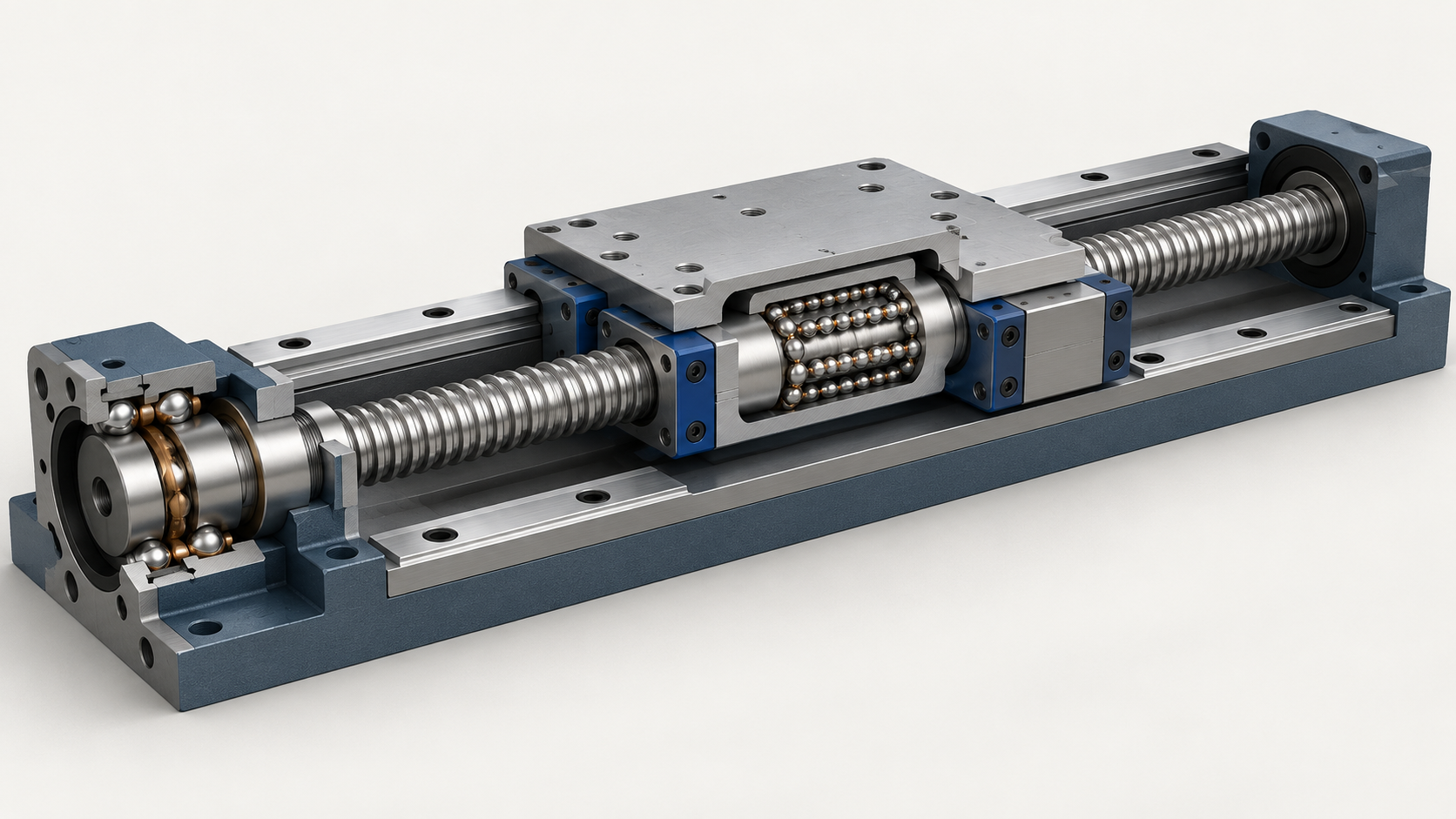
When a CNC feed axis exhibits reversal error, first examine the coupling among the three types of preload
When a CNC feed axis exhibits quadrant protrusions during circular interpolation, or reversal error, vibration, and drive-current fluctuations at the instant of direction reversal, the issue should not be attributed prematurely to ball-screw accuracy. Ball-screw nut preload, linear-guide preload, and support-bearing preload jointly form part of the feed axis's stiffness and friction chain.
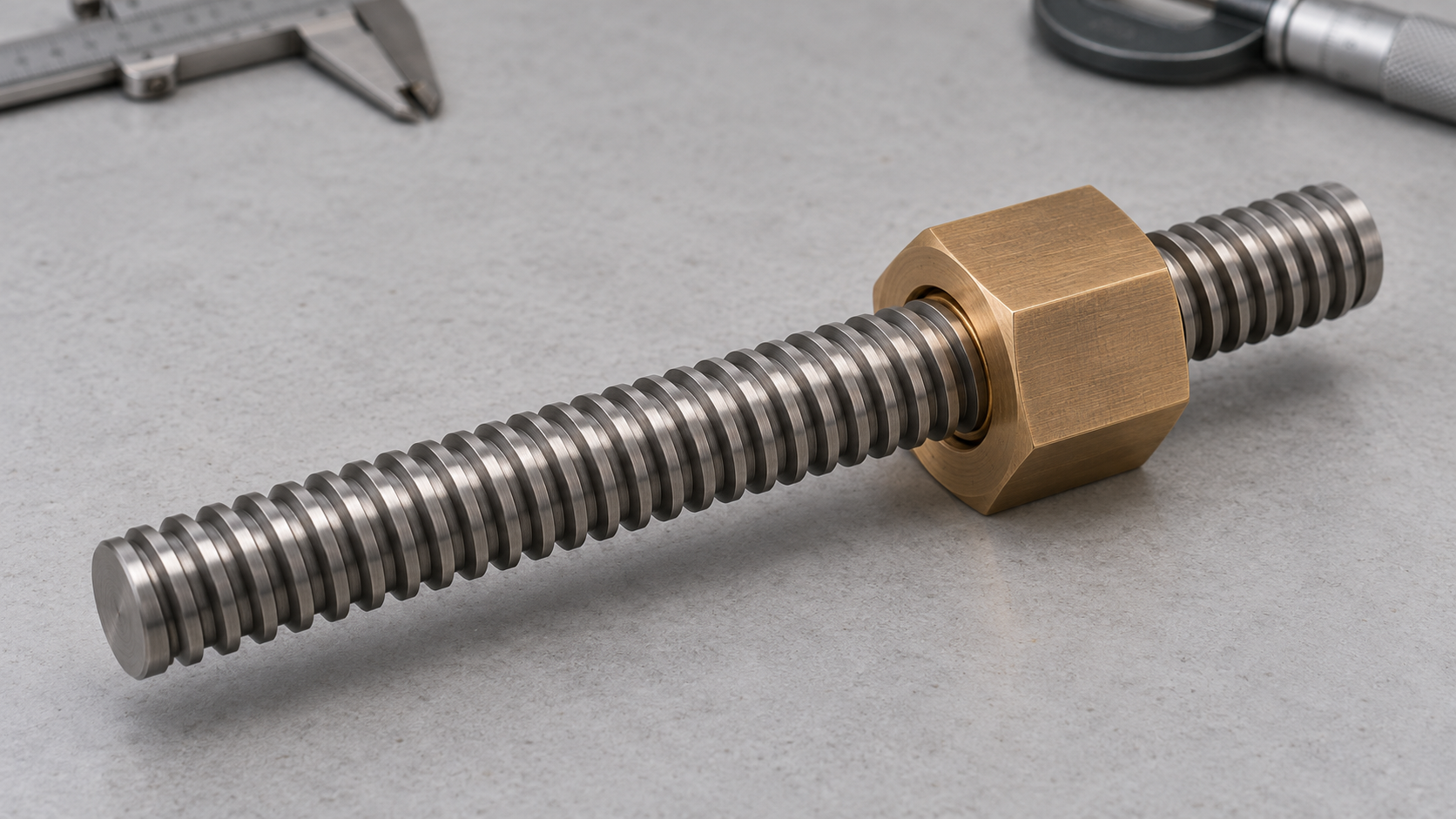
Ball-screw nut preload primarily affects axial clearance, contact stiffness, and friction torque during direction reversal. Insufficient preload may cause increased backlash, reduced stiffness, and reversal-motion error; excessive preload may increase drive load, frictional heating, and thermal drift. Linear-guide preload affects the guideway stiffness, motion resistance, and table attitude. Poor parallelism may also cause localized binding or concentrated loading. Support-bearing preload changes the axial and radial support conditions at the ends of the ball screw and affects temperature rise and rotational stability.
Therefore, a high-precision ball screw does not necessarily mean a high-precision complete axis. When reversal error occurs, troubleshooting should proceed in the following order: “mechanical condition—friction variation—assembly error—servo parameters—thermal condition.” First confirm the axial clearance and the preload conditions of the nut and bearings, then check guideway parallelism, installation datums, and lubrication cleanliness. Next, observe the drive current, vibration, and noise during direction reversal, and finally use reversal-error or roundness-type tests to verify dynamic performance. Only by measuring and recording the three types of preload separately and correlating them with the abnormal behavior can it be determined whether the issue is caused by insufficient preload, excessive preload, or a combination of assembly and control-parameter errors.
What Input Parameters Are Required for Selecting Ball-Screw, Linear-Guide, and Bearing Preload?
Preload selection cannot be inferred from the words “high precision” alone. A usage-conditions table should be established first, followed by verification of service life, stiffness, torque, and thermal condition. The preload conditions for ball screws, linear guides, and support bearings differ, but all three share the loads and motion errors of the feed axis.
- Mass and external loads: Record the axial loads resulting from the table, fixtures, workpiece, and cutting forces. These determine the axial force on the ball screw, load distribution among the guide blocks, and the equivalent bearing load.
- Installation orientation and travel: A horizontal axis is primarily affected by motion and cutting loads; a vertical axis must also account for gravity, braking, and measures to prevent downward motion. Effective travel, reciprocation frequency, and duty cycle directly enter the service-life calculation.
- Speed, acceleration, and lead: Maximum speed affects the ball screw's critical speed, frictional heating, and lubrication requirements; acceleration increases inertial force and drive torque, so selection cannot be based on average speed alone.
- Target service life and load spectrum: Rapid traverse, cutting feed, dwell, and impact conditions should be distinguished and calculated according to the actual cycle rather than replaced with a single static load. For linear guides, the direction of moments and load differences among the guide blocks must also be recorded.
- Guideway Resistance, Lubrication, and Contamination Protection: Guideway resistance, seal condition, lubrication method, and contamination conditions can affect drive current, temperature rise, and wear. The support arrangement, fixed-end configuration, and floating-end configuration must also be confirmed against the supplier’s catalog.
Supplier confirmation items should include the ball screw and nut model, accuracy grade, and preload method; the preload grade of the linear guide blocks; the preload structure of the support bearings; and the rated load and lubrication recommendations. On site, measure installation parallelism, datum surface condition, drive torque or current, temperature rise during continuous operation, and actual reversal error. Only by correlating these inputs and outputs one by one can it be determined whether the positioning problem is caused by insufficient preload, excessive preload, or assembly error.
How does ball screw preload balance axial backlash, rigidity, and frictional heating?
The primary purpose of ball screw preload is to maintain stable contact between the balls and raceways, reduce axial backlash, and increase the contact rigidity of the nut during reversal and changes in cutting load. Insufficient preload may cause reversal error, vibration, or reduced positioning repeatability in the feed axis; however, these symptoms may also result from the ball screw support, linear guide parallelism, or servo parameters, so nut failure cannot be determined from symptoms alone.
Typical Consequences of Insufficient and Excessive Preload
Excessive preload does not necessarily mean higher accuracy. As contact force increases, friction torque, drive load, and lubrication requirements may rise, making temperature rise and thermal drift more likely during continuous reciprocating operation. If lubrication or cleanliness is inadequate, wear of the raceways and balls may also accelerate. For high-speed feed axes, increased static rigidity cannot offset dimensional changes caused by deteriorating thermal conditions.
Determining Ball Screw Preload Based on Load, Speed, and Thermal Conditions
Low, medium, and high preload levels should be selected in conjunction with the axial load spectrum, rotational speed, acceleration, target rigidity, duty cycle, and allowable temperature rise. The supplier should confirm the specific preload method, friction torque, and applicable rotational speed. Some manufacturer documentation provides rated-load ratios or life declarations for specific products; such data cannot be generalized directly to all ball screws. During acceptance testing, record the preload setting, drive current or torque, axial backlash, reversal error, and temperature rise after reciprocating operation. Ball screw preload is properly selected only when static rigidity, dynamic reversal performance, and thermal stability all meet the requirements.
How Do Linear Guide Preload and Installation Parallelism Affect Feed-Axis Motion?
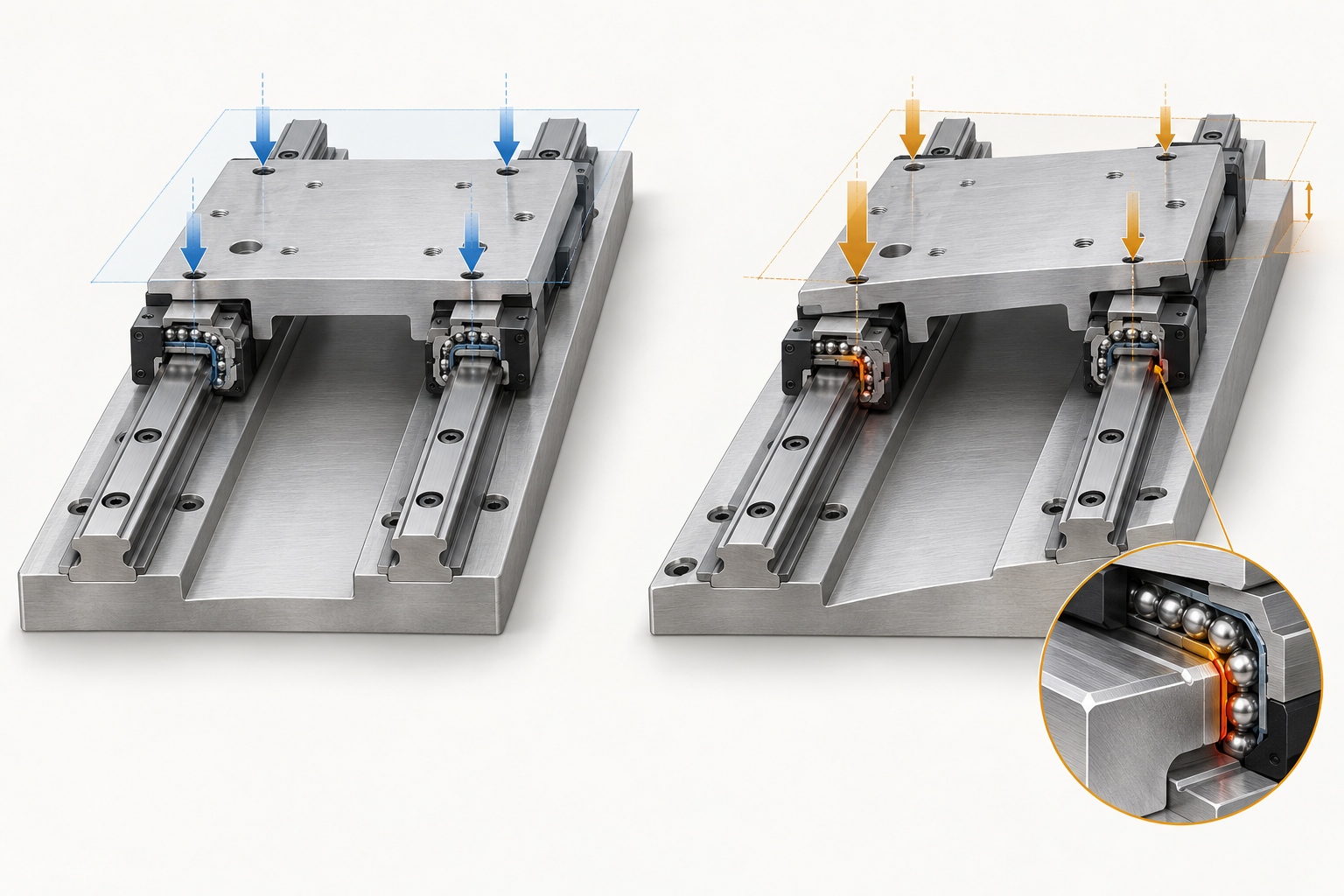
Linear guide preload primarily changes the contact condition between the carriage blocks and raceways. With insufficient preload, guideway clearance and attitude variation may increase, making the table more susceptible to pitch, yaw, and local displacement under cutting forces or acceleration and deceleration; excessive preload increases motion resistance, frictional heating, and drive load. Selection should not be based solely on “high rigidity”; the actual load distribution, moments, speed, acceleration, stroke, and target service life must also be considered.
Guide Preload Affects Rigidity and Load Distribution
In structures with two guide rails or multiple carriage blocks, differences in mounting-surface height and lack of parallelism can cause some carriage blocks to carry load first, resulting in uneven load distribution. Increasing guide preload cannot correct base errors and may instead intensify binding, stick-slip, noise, and localized wear. Inspection should include the guide datum surfaces, carriage-block height differences, parallelism, end-stop conditions, and changes in drive current or friction torque during reciprocating operation.
Mounting Datums, Cleanliness, and Lubrication Must Be Confirmed Separately
Before installing the linear guides, remove burrs, chips, rust, and oil sludge from the base and the bottoms of the guide rails, and confirm that there are no foreign particles on the contact surfaces. Tighten the fasteners progressively in the specified sequence to prevent the guide rails from being pulled out of alignment by the bolts; then check carriage motion resistance and table parallelism. Insufficient lubrication increases friction and temperature rise, while excessive lubricant or contamination entering the raceways may also cause resistance fluctuations. Final acceptance should record the preload setting, parallelism, cleanliness, lubrication condition, temperature rise, and abnormal wear on the same inspection form.
How Does Support-Bearing Preload Affect Rigidity, Skidding, Temperature Rise, and Service Life?
Preload in the ball screw support bearings primarily changes axial and radial support rigidity. With insufficient preload, the rolling elements may lack the necessary minimum load during light-load conditions, reversal, or acceleration and deceleration, making localized skidding, friction fluctuations, and wear more likely. With appropriate preload, the bearings can transmit the ball screw’s axial force more stably, reducing support-end displacement that would otherwise contribute to feed-axis positioning error.
Preload Must Meet the Minimum-Load Requirement, but More Is Not Better
Excessive support-bearing preload increases rolling contact force, friction torque, and drive load, while making lubrication and heat dissipation more sensitive. During continuous reciprocating or high-speed operation, the additional heat may cause thermal expansion of the bearing housing, ball screw, and machine-tool structure, appearing as positioning drift, increased noise, or a continuously rising temperature. Therefore, the preload setting should be confirmed based on equivalent load, rotational speed, duty cycle, lubrication method, and contamination conditions, rather than being selected solely for static rigidity.
Criteria for Determining Why Screw Support Bearings and Spindle Bearings Must Not Be Used Interchangeably
Screw support bearings focus primarily on axial positioning, reverse stiffness, driving torque, and thermal drift. Spindle bearings must also handle higher speeds, radial cutting forces, dynamic stiffness, and modal response, so their preload strategies and verification methods are different. Bearing life can use L10 or L10h as the basic rating life concept: among identical bearings from the same batch, approximately 90% will not experience their first fatigue failure before reaching this life. However, this is not a guarantee for any individual machine. The actual load spectrum, speed, lubrication, cleanliness, assembly accuracy, and cooling conditions must still be considered.
How should the stiffness, driving torque, and life of a preloaded ball screw and linear guide be verified?
The preload of ball screws, linear guides, and support bearings cannot be evaluated separately from the load spectrum. Verification should begin with the moving mass, axial external load, installation orientation, travel, speed, acceleration, and duty cycle. Vertical axes must also account for gravity and braking conditions; for horizontal axes, cutting forces, guide resistance, and inertial forces during acceleration and deceleration should be checked. Record these inputs first, then determine the load distribution among the screw nut, each guide block, and the support structure.
First verify axial stiffness and guide deformation
Stiffness calculations should not consider only the screw itself. Axial elongation and contraction of the screw, nut contact stiffness, the bearings and bearing housing, the mounting base, and the guideways and blocks all contribute to total deformation. The guides should also be checked for local loads based on the load distribution among the blocks and the overturning moment, preventing any one block from carrying an abnormal load due to parallelism or height differences. When preload increases contact stiffness, an uneven base or contamination on the mounting surfaces may first appear as increased motion resistance rather than improved effective positioning accuracy.
Then verify driving torque, thermal load, and life
Driving torque should account simultaneously for the external load, acceleration torque, transmission efficiency, and friction torque caused by preload. Excessive preload may increase motor current, nut temperature rise, and lubrication requirements, while changing the acceleration and deceleration response during high-speed reciprocation. Life verification must return to the equivalent load, speed, duty cycle, lubrication, dust protection, and contamination conditions. The rated-load ratio or life hours of a particular brand cannot replace the calculation. Ultimately, the calculation assumptions, support method, preload setting, and measurement method should be documented, and the assessment should be corrected using measured torque, current, temperature rise, and vibration results.
How can CNC feed-axis positioning accuracy, reversal error, and thermal stability be verified?
After adjusting the preload, do not evaluate positioning accuracy based on a single measurement. CNC feed-axis acceptance should establish a closed loop of static accuracy, dynamic performance, thermal stability, and life verification, while correlating any abnormalities with ball-screw nut preload, linear-guide preload, support-bearing preload, assembly condition, and servo parameters.
First confirm static positioning accuracy, then check reversal error
Static checks include the installation references, guide parallelism, axial backlash of the screw, positioning accuracy, and repeatability. Then perform reciprocating motion in both directions, recording reversal error, drive current or friction torque, acceleration and deceleration response, vibration, noise, and quadrant spikes during circular interpolation. If an error occurs at the instant of reversal, do not immediately conclude that the screw accuracy is insufficient. Uneven preload, fluctuating guide resistance, misalignment of the bearing supports, and servo gains may all contribute and should be isolated and verified individually.
CNC feed-axis thermal stability and life verification
Run the machine continuously at the actual speed, travel, acceleration, and duty cycle. Record the temperature rise at the screw support end, nut housing, guide blocks, and areas near the bearings, while also observing thermal drift, drive load, lubrication condition, and abnormal wear. Supplier claims regarding reduced dynamic friction torque, rated-load ratios, or life hours for specific products cannot replace testing on the actual machine. The final acceptance record should include at least the preload setting and measurement method, positioning and repeatability results, reversal error, temperature rise, vibration, cleanliness, lubrication conditions, and installation parallelism.
FAQ: Common Questions About Preload Verification for Ball Screws, Linear Guides, and Bearings
Preload verification cannot focus solely on the parameters of individual components. Ball screws, linear guides, and support bearings respectively affect axial backlash, guide stiffness, support conditions, friction torque, and temperature rise. Ultimately, these factors also interact with installation parallelism, lubrication, the load spectrum, and servo parameters to determine positioning error in the CNC feed axis. The following questions are suitable for item-by-item review during acceptance and technical confirmation with suppliers.
Is higher preload always better for ball screws, linear guides, and bearings?
No. Increasing preload to a certain level may improve stiffness, reduce backlash, or maintain the required minimum load, but it may also increase friction torque, drive load, temperature rise, and lubrication requirements. Selection should be based on the load, speed, acceleration, target stiffness, and thermal conditions, within the range specified in the supplier's catalog, and confirmed through torque, current, temperature-rise, and dynamic-accuracy testing.
Can the accuracy grade of a ball screw represent the positioning accuracy of the entire feed axis?
No. The screw accuracy grade is only one part of the error chain. Nut preload, support bearings, guideway parallelism, installation datums, structural rigidity, thermal drift, servo compensation, and measurement methods all affect the final positioning accuracy and repeatability. During acceptance, the entire axis should be tested rather than checking only the screw grade.
When quadrant protrusions occur, are they necessarily caused by insufficient ball screw preload?
Not necessarily. Fluctuations in friction torque during reversal may be related to screw preload, but they may also result from changes in linear guideway resistance, bearing preload, assembly misalignment, lubrication conditions, or servo parameters. The cause should be identified by combining reversal error, circularity or ballbar-type dynamic tests, drive current, and mechanical inspections; a high-precision screw should not be replaced directly.
Can the same criteria be used to assess linear guideway preload and support bearing preload?
No. Guideway preload mainly affects guiding rigidity, slider motion resistance, attitude stability, and load distribution, whereas bearing preload affects axial or radial support rigidity, minimum load, skidding, friction, and temperature rise. The grades, units, assembly methods, and test items for the two should be confirmed separately according to the specific model and the manufacturer's specifications.
What preload and acceptance data should be requested from the supplier when purchasing?
At a minimum, confirm the specific model, preload or pre-tensioning method, accuracy grade, rated load, applicable speed, lubrication recommendations, installation tolerances, and test conditions. Also require the measurement method for backlash or preload state to be clearly specified. For the entire axis, the agreement should also cover positioning accuracy, repeatability, reversal error, drive torque or current, temperature rise, vibration, and load spectrum. The rated-load ratio, service life in hours, or reduction in friction torque specified for a particular product cannot substitute for validation on the actual machine.
Key takeaways
- Higher preload is not always better: insufficient preload can cause clearance and inadequate stiffness, while excessive preload may increase friction torque, temperature rise, and drive load.
- The preload conditions for ball-screw nuts, linear-guide blocks, and support bearings differ, so preload grades, units, or values cannot be applied directly across them.
- The ball-screw accuracy grade is not equivalent to the positioning accuracy of the complete axis. Guideway parallelism, support stiffness, assembly cleanliness, thermal drift, and servo parameters must also be checked.
- Verification should cover static accuracy, dynamic reversal error, drive torque or current, temperature rise, vibration, lubrication, and service-life calculations.
- Supplier confirmation should clearly specify the preload method, accuracy grade, test conditions, load spectrum, lubrication recommendations, and installation tolerances. Specific values should be based on the model catalog and measured results.