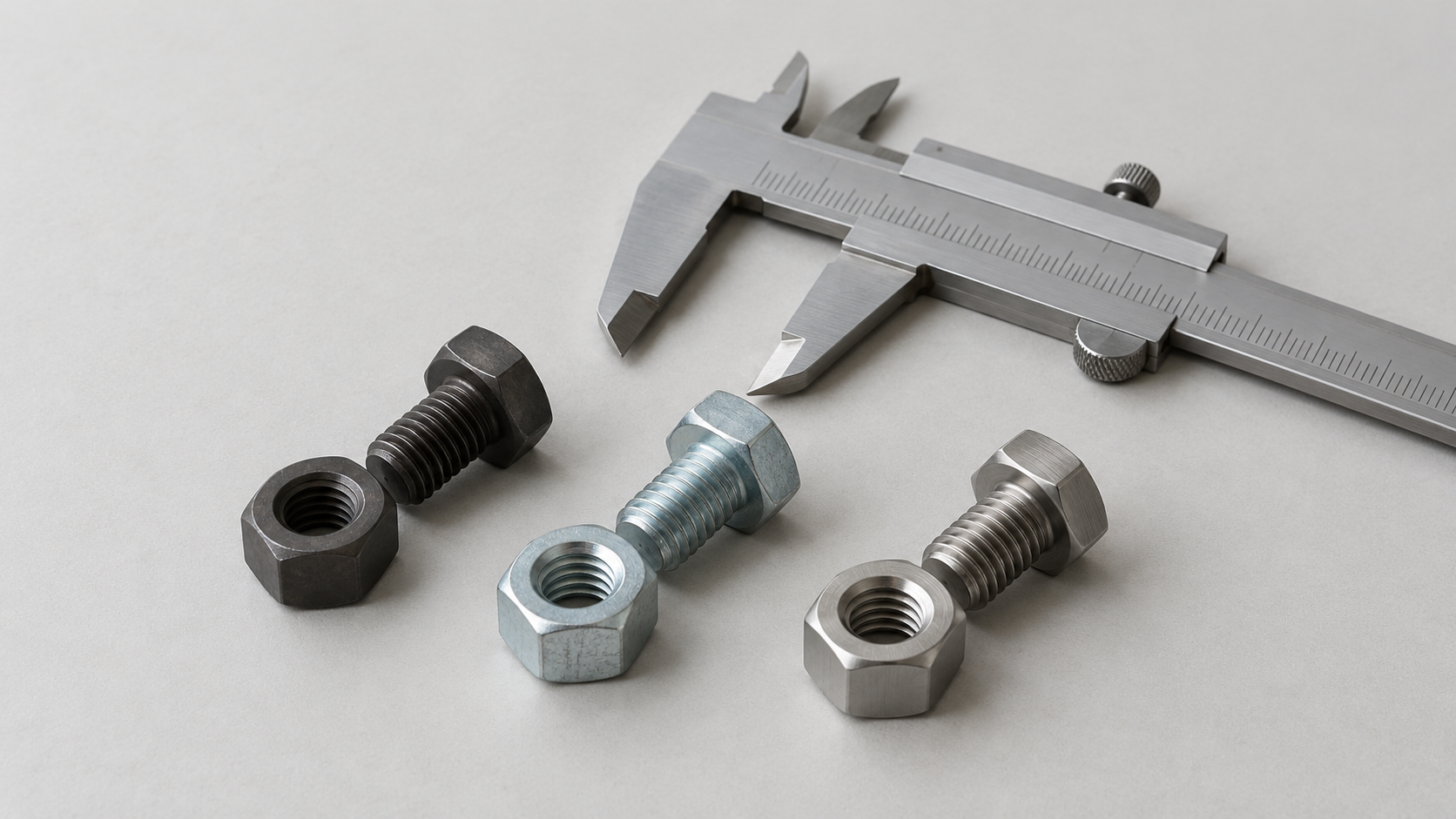
How to Write Hex Nut Procurement Specifications: Complete the Thread, Standard, and Property Requirements First
In industrial equipment procurement, a hex nut should not be specified simply as “M12.” An executable example specification might read: GB/T 6170, M12×1.5, hex nut, property class 10, specified material and surface treatment, accepted in accordance with the applicable standard. This is only an example; the formal requirements should still be based on the drawing, purchase contract, and current edition of the adopted standard.
M12 indicates only the nominal thread diameter and cannot replace the pitch; M12 coarse-thread nuts and fine-thread specifications such as M12×1.5 cannot be assembled together directly. Procurement documents should also specify the standard and edition, product type, thread tolerance, mechanical property class, material or material standard, surface treatment, and product grade or dimensional tolerance requirements. For traceable joints, the lot number, quantity, and inspection-document requirements should also be stated.
- Standard field: Specify the applicable national standard, international standard, or company drawing requirement. Do not use vague terms such as “national-standard nut.”
- Thread field: Include at least the nominal diameter, pitch, or coarse-/fine-thread designation, and verify compatibility with the mating bolt.
- Property and material fields: Specify the property class and the material grade or material standard separately. Do not substitute “high strength” or “304 nut” for complete requirements.
- Surface treatment field: Clearly specify the treatment type, such as plain finish, passivation, electroplating, or hot-dip galvanizing, and state whether it affects thread fit and assembly acceptance.
These fields should remain consistent across the drawing, BOM, purchase order, and incoming inspection records. During acceptance, do not only check the package markings; also correlate the markings with the lot, dimensions, thread fit, and necessary material or performance evidence to prevent discovering a connection mismatch only after the supplier has substituted a similar specification.
DIN 934, ISO 4032, and GB/T 6170: Related Standards Do Not Mean Direct Substitution
When procuring hex nuts, DIN 934, ISO 4032, and GB/T 6170 are often compared as a group of standards. They have corresponding or similar elements in the names, dimensional fields, and product classifications of hex nuts, but “related” does not mean that any specification can be substituted directly. Supplier data sheets can serve as selection references, but the final determination should still be based on the procurement documents, drawings, and current edition of the adopted standard.
| Items to Check | Items to Confirm Before Procurement or Substitution |
|---|---|
| Standard and Version | Specify whether the DIN, ISO, or GB/T standard is used, and confirm the year, revision status, and scope of application. |
| Nut Type and Dimensional Series | Confirm whether it is the specified hexagon nut type and whether dimensions such as nut height m, width across flats s, and width across corners e are consistent. |
| Product Grade | Check whether it is classified as Grade A, Grade B, or another grade; do not look only at the nominal diameter and width across flats. |
| Performance and Threads | Confirm the performance grade of the steel or stainless steel, thread tolerance, and whether coarse or fine threads are required. |
| Surface Treatment | Confirm whether the condition is plain, passivated, electroplated, or hot-dip galvanized, as well as the effects of the treatment on thread fit and assembly friction. |
For example, if the BOM only states “DIN 934 M12 nut,” it may still omit the performance grade, material, surface treatment, and thread tolerance; if GB/T 6170 is used instead, approval cannot be granted merely because the names are similar. During acceptance, the substitute part’s standard version, dimensional series, markings, and inspection basis should be checked item by item. Where necessary, require the supplier to provide the material, performance, or inspection documents for the corresponding batch. Similar standard names can only narrow the scope of verification; they cannot replace technical confirmation.
Coarse, Fine, and 6H Threads: How to Avoid Bolt Mismatch with Hexagon Nuts
The nominal diameter d of a hexagon nut cannot, by itself, represent the thread specification. Taking M12 as an example, the procurement document should also specify the pitch P, whether the thread is coarse or fine, the thread tolerance, and the standard and version used. M12 coarse threads and M12×1.5 fine threads have different pitches and cannot be mixed; forcing them together may damage the threads or cause binding at the initial stage of assembly.
The Procurement Marking Must Specify the Diameter, Pitch, and Tolerance Together
It is recommended that the hexagon nut marking be written as a complete combination of “standard and version + thread specification + performance grade + material/surface treatment.” For example: “According to the applicable standard, M12×1.5, internal thread 6H, performance grade as specified on the drawing.” Here, 6H cannot be assessed independently of the applicable formal standard; it is necessary to confirm the corresponding thread system, product type, and dimensional range. If coarse threads are used, this should also be explicitly stated as standard coarse thread rather than simply writing “M12.”
Perform Go/No-Go and Fit Checks First During Incoming Inspection
During acceptance, thread ring gauges, go/no-go gauges, or a matching bolt with a confirmed specification may be used for fit inspection in accordance with the contract or applicable standard. Before inspection, remove oil, metal chips, and protective materials, and check whether the internal threads have burrs, impact damage, rust, or coating buildup. The go gauge should pass smoothly, while the no-go gauge must be assessed according to the adopted standard and inspection procedure; do not draw conclusions based solely on feel.
- Check the nominal diameter, pitch, and thread direction of the bolt and hexagon nut.
- Confirm that the coating or passivation has not caused localized sticking, abnormal friction, or a false pass.
- Record the inspection lot, measuring instrument or gauge ID, acceptance decision, and location of any abnormality.
How to Select the Mechanical Property Class of Hex Nuts: Consider Steel Classes Separately from A2/A4 Stainless Steel
The material designation, mechanical property class, and surface treatment of a hex nut are three separate fields and must not be oversimplified as simply a “304 nut” or a “high-strength nut.” Common steel property classes in engineering procurement include 6, 8, and 10; common designations for stainless steel products include A2-70 and A4-70. However, these are only common options. Actual applicability still depends on the formal standard adopted, nut size, manufacturer, and the mating bolt.
When selecting a nut, first consider the connection design rather than simply pursuing the “higher the class, the better” approach. The property class should match the bolt class, design load, bearing capacity of the connected parts, and connection type. Conventional steel classes may be used for ordinary indoor steel equipment; high-load connections require verification of the strength requirements for the bolt–nut combination; stainless steel connections should be evaluated according to the A2 or A4 system and the applicable standards, and A2-70 must not be directly interpreted as steel class 10. For applications involving frequent disassembly and reassembly, also consider thread wear, galling risk, and installation procedures.
What Performance Information Should Be Specified Separately in Procurement Documents
- Material: Specify the material designation or applicable material standard, rather than writing only “carbon steel” or “304.”
- Property class: Clearly specify the numerical class for steel or the stainless steel classification system, and identify the applicable standard.
- Mating requirements: Specify the mating bolt size, property class, and connection load requirements.
- Traceability basis: For critical lots, material certificates, the basis for the property class, lot numbers, and sampling inspection records may be required. The specific documents should be determined according to the contract and risk level.
During incoming inspection, supplier identification, material and property-class documentation, and lot numbers should be cross-referenced; where necessary, hardness, tensile, or chemical composition verification should then be arranged in accordance with the applicable standard. Even if the incoming hex nuts pass inspection, this does not mean that a standard torque value can be applied directly during assembly. The final value must also be determined based on the mating bolt, friction conditions, lubrication, and connection design.
Carbon Steel, Stainless Steel, and Nonferrous Metal Hex Nuts: Matching Materials to the Environment
Material selection for hex nuts should not be based on the name alone. The mating bolt, design load, environmental medium, and disassembly method must also be checked together. For ordinary indoor steel equipment, carbon steel or alloy steel nuts are generally considered first, with the mechanical property class and surface treatment clearly specified. If the connection is exposed to prolonged moisture, corrosive media, or cleaning requirements, the suitability of stainless steel, coated steel parts, or other materials must be evaluated.
Stainless Steel Hex Nuts Should Not Be Specified Simply as “304”
Writing only “304 nut” in a procurement document is generally insufficient. The applicable material standard, property class, thread size, nut type, and surface condition should also be specified. Common stainless steel classes in engineering procurement include A2-70 and A4-70, but they cannot be directly interpreted according to the numerical classes for steel, nor can they replace strength verification of the mating bolt. A4 materials are often used where higher corrosion resistance is required, but the final determination should still be based on the environment, connection design, and current applicable standards.
Hex Nut Material, Bolts, and Disassembly Conditions Must Be Evaluated Together
When stainless steel nuts are used with stainless steel bolts, frequent assembly may cause thread galling. The mating condition, cleanliness requirements, and necessary anti-seize measures should therefore be specified in the procurement and assembly procedures. Dissimilar-metal combinations also require evaluation of the risk of galvanic corrosion; material price or appearance alone is not sufficient for comparison. For connections requiring repeated maintenance, thread wear resistance, disassembly feasibility, and lubrication conditions should be considered together. During incoming inspection, the material designation, property class, lot traceability, and surface condition should be recorded separately; “material compliant” does not mean that the connection combination has been fully validated.
Electroplating, Hot-Dip Galvanizing, Passivation, and Black Oxide: Surface Treatment Is More Than Rust Prevention and Appearance
The surface condition of hex nuts should be specified as an acceptance-oriented procurement field, rather than simply “zinc plated” or “plain finish.” Plain finish, passivation, electroplating, hot-dip galvanizing, and black oxide correspond to different treatment methods, coverage requirements, and assembly conditions. Similar colors do not indicate that the treatment types are the same. Procurement documents should clearly specify the surface treatment name, applicable standard or technical requirements, and whether appearance, coverage, and coating-thickness criteria apply.
Surface treatment can also alter the internal thread condition of a hex nut. Coating buildup may affect the thread fundamental deviation, making bolt insertion rough or causing sticking and even increasing the risk of thread stripping; changes in the treatment condition can also affect friction conditions. Therefore, inspection must not focus only on color and the presence or absence of rust. It should also check thread go/no-go characteristics, mating with the corresponding bolt, and whether the treatments on the nut and bolt are compatible. Specific coating thicknesses, tolerances, and acceptance methods shall be based on the contract and the current version of the applicable standard.
- Appearance: Check for areas of missed plating, peeling, obvious buildup, burrs, impact damage, and abnormal corrosion.
- Threads: Confirm that there is no coating blockage or binding; where necessary, recheck with a go/no-go gauge or a matching bolt.
- Assembly: Before assembly, confirm the friction, lubrication, and surface treatment conditions. Do not directly apply generic torque values without specified conditions.
Hex Nut Dimensional Inspection and Incoming Acceptance: From m, s, and e to Pre-Assembly Verification
Acceptance of hex nuts should not be based solely on appearance or whether a wrench fits. The standards, drawings, or technical specifications in the purchasing documents should be converted into recordable inspection items, with the current applicable standard and contractual requirements serving as the final basis for acceptance.
Six Actions for Incoming Acceptance of Hex Nuts
- Documentation and identification: Verify the standard and its revision, specifications, property class, material or material standard, surface treatment, lot number, and packaging markings; for critical connections, request material, performance, or inspection documentation as required by the contract.
- Appearance and surface: Check for cracks, burrs, impact damage, corrosion, deformation, and coating buildup. The same color does not indicate the same type of surface treatment.
- Key dimensions: Check the nominal diameter d, pitch P, nut height m, width across flats s, width across corners e, and chamfers against the drawing or standard values. Common measuring tools include calipers, micrometers, thread pitch gauges, and dedicated inspection gauges. Wrench fit must not be used as a substitute for dimensional acceptance.
- Thread fit: Use the corresponding go/no-go gauge, or perform a fit check with a verified, qualified matching bolt. Pay attention to binding, looseness, burrs, and contamination. Plating may alter the fit of internal threads; where necessary, recheck after surface treatment.
- Required performance verification: Whether hardness, tensile strength, chemical composition, or coating inspections are required should be determined by the applicable standard, contract, and connection risk. Fixed inspection items should not be applied indiscriminately.
- Lot records: Record the lot number, sampling scope, measuring or inspection gauges, measured results, and acceptance status so that nonconforming parts can be traced and problems within the same lot are not concealed by conforming samples.
Acceptance does not mean that assembly parameters can be applied directly. Tightening torque and axial force are also affected by the materials of the bolt and nut, coefficient of friction, lubrication, surface treatment, bearing capacity of the connected parts, and installation method. Before assembly, recheck thread compatibility and whether the coating causes binding, and determine the torque based on the connection design or assembly specification; do not treat a generic torque value as an acceptance criterion for hex nuts.
Common Questions About Hex Nut Selection and Acceptance
The specification, standard substitution, property class, and incoming inspection of hex nuts must be evaluated in conjunction with the purchasing documents, the current applicable standard, and the specific connection design. The following questions address several common misconceptions discussed in the main text.
Is M12 sufficient to describe a hex nut specification?
No. M12 usually indicates only the nominal thread diameter. The pitch or coarse/fine thread, nut type, applicable standard and revision, property class, material, surface treatment, and necessary dimensions or product grade should also be specified. M12 coarse-thread and M12 fine-thread nuts cannot be mixed directly.
Can DIN 934 directly replace GB/T 6170?
No, they cannot be directly substituted based solely on the standard designations. Although they have a related or similar relationship, the standard revision, dimensional series, nut type, product grade, property class, thread tolerance, and surface treatment must still be checked item by item. Ultimately, the drawing, purchase contract, and current version of the applicable standard shall prevail.
Can A2-70 be understood as a steel Class 10 hex nut?
No. A2-70 belongs to the stainless steel property class system. Steel grade designations and stainless steel A2/A4 grades cannot be directly converted on a one-to-one basis. Selection must also take into account the matching bolts, design load, corrosive environment, temperature conditions, and assembly and disassembly requirements, while confirming the basis for the material and performance specifications.
Is it sufficient to inspect only the across-flats dimension and thread when receiving hex nuts?
Usually not. Incoming inspection should cover, at a minimum, documentation and identification, appearance and surface treatment, main dimensions, thread fit, and lot records. For critical connections, supporting documentation for the material, hardness, mechanical properties, or coating may also be required. The across-flats dimension s, across-corners dimension e, nut height m, pitch, chamfer, and other features should be evaluated against the drawing or standard values; it is not sufficient to check only whether a wrench can fit.
Key takeaways
- M12 indicates only the nominal thread diameter. When procuring, you must also specify coarse or fine thread, pitch, standard, property class, material, and surface treatment.
- DIN 934, ISO 4032, and GB/T 6170 are related, but the standard edition, dimensional series, product grade, and tolerances must be checked item by item and must not be treated as fully interchangeable.
- Steel numerical property classes and stainless-steel A2/A4 grades belong to different marking systems. Selection should consider the mating bolts, design loads, and service environment.
- Incoming inspection of hex nuts should cover documentation and markings, appearance, key dimensions such as m/s/e, thread fit, and the necessary basis for material and mechanical performance verification.
- Acceptance of a nut does not mean that the assembly torque can be applied directly. The preload is also affected by friction, lubrication, surface treatment, and the joint design.