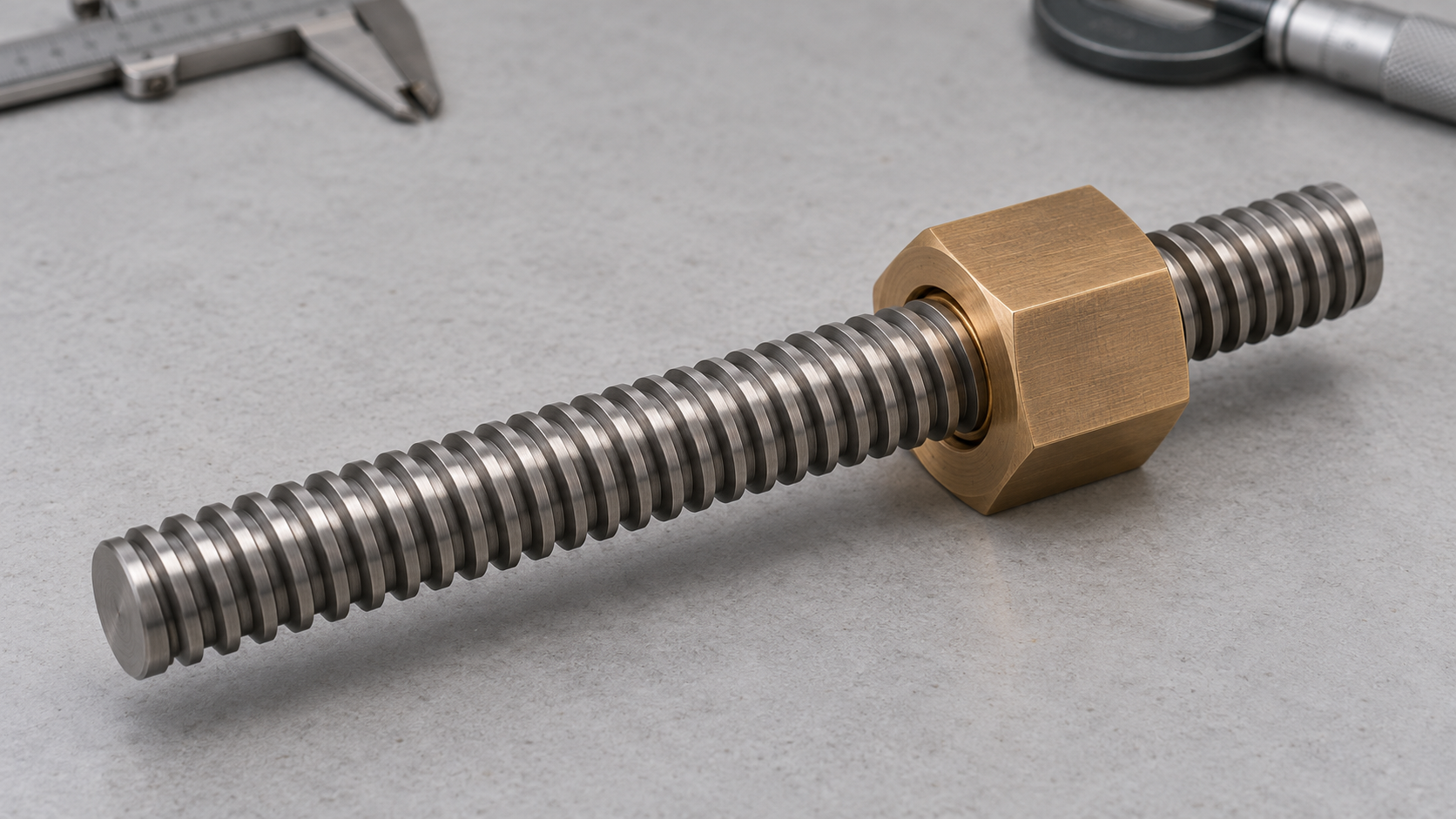
Why Choose a Trapezoidal Thread Lead Screw for CNC Actuators: Trade-Offs Among Self-Locking, Efficiency, and Positioning Backlash
A single lead screw may need to drive a load, hold its position, and meet the positioning and service-life requirements of a CNC actuator. In practice, it is often impossible to maximize self-locking, efficiency, speed, and accuracy simultaneously. Selecting a trapezoidal thread lead screw is essentially an engineering compromise constrained by operating conditions and cost: it is generally better suited to low-speed, intermittent operation and transmissions that must hold position after power loss. However, a “trapezoidal thread” does not inherently guarantee safe self-locking, nor can it replace a braking or holding mechanism.
Low-Speed Lifting and Clamping Actuators: Start with Load Direction and Power-Off Conditions
For low-speed lifting, clamping, or pushing mechanisms, the primary design considerations are typically axial load, load direction, duty cycle, and the holding state after power loss. A smaller lead may help reduce the tendency to back-drive, but the actual result is also affected by the lead angle, lubrication, material pairing, wear, vibration, and impact. Mechanisms with vertical loads or involving personnel safety should be further evaluated for mechanical brakes, locking pins, or other redundant holding measures. When procuring or preparing drawings, do not simply state “self-locking required”; specify the load direction, static holding conditions, and verification method.
High-Speed Repetitive-Positioning Slides: Prioritize Efficiency, Heat Generation, and Axial Backlash
High-speed repetitive-positioning slides place greater emphasis on linear speed, rotational speed, drive torque, heat generation, reverse backlash, and repeatability. The sliding friction of a trapezoidal thread lead screw affects efficiency and service life. Although a preloaded nut can reduce axial backlash, it may also increase friction and motor load. If the mechanism requires high dynamics, low backlash, and relatively high operating efficiency, a ball screw should be evaluated as a comparison option, and the lead screw should be assessed together with the motor, guide components, coupling, and feedback system. Passing gauge or component dimensional inspection does not mean that the assembled actuator will achieve the target positioning performance.
What Parameters Should Be Verified When Selecting a Trapezoidal Thread Lead Screw: Load, Speed, Service Life, and Nut Pairing
Selection of a trapezoidal thread lead screw should begin with the operating conditions rather than by matching the nominal diameter to a catalog model. At a minimum, specify the axial load and its direction, effective travel, target linear speed, duty cycle, ambient temperature and contaminants, allowable axial backlash, positioning or repeatability requirements, and whether the position must be held after power loss. Load capacity cannot be cited independently of lead, rotational speed, and service-life conditions. The heat generation, wear, and drive torque of the same lead screw may differ completely between low-speed intermittent operation and continuous high-speed operation.
Write the Operating Conditions as Specifications Before Selecting a Trapezoidal Thread Lead Screw
| Parameters | Unit or field | What to confirm during selection |
|---|---|---|
| Axial load | N, load direction | Operating load, peak load, and whether a vertical load is present |
| Speed and travel | mm/s, mm | Effective travel, reciprocating frequency, acceleration/deceleration, and duty cycle |
| Accuracy requirements | mm, angle, or grade | Positioning, repeat positioning, allowable clearance, and lead error |
| Service life conditions | Number of cycles or travel distance | Lubrication interval, environmental contamination, temperature, and maintenance method |
| Nut pairing | Material, clearance, preload | Friction, wear, torque, heat generation, and replacement conditions |
The nut material and lubrication method should be evaluated together with the screw material, load, and operating environment. Engineering plastic nuts may be suitable for certain low-speed, low-noise applications, whereas metal nuts require particular attention to wear, lubrication, and mating clearance. Preloaded nuts help reduce axial clearance, but they also increase friction, drive load, and heat generation; “preload” alone must not be treated as a guarantee of accuracy. Procurement documents or drawings should separately specify the load, speed, service-life assumptions, nut material, lubrication conditions, and acceptance clearance to avoid simply stating “high-precision trapezoidal lead screw.”
How lead, pitch, and hand affect the speed and back-driving risk of trapezoidal threaded lead screws
First distinguish between pitch and lead, then assess speed and back-driving risk. Pitch is the axial distance between corresponding points on adjacent thread profiles; lead is the theoretical axial displacement of the nut after one rotation of the screw. In single-start trapezoidal threads, the lead equals the pitch; in multi-start threads, the lead equals the pitch multiplied by the number of starts. Writing only “pitch” without specifying the lead on a drawing or RFQ can easily lead to incorrect assessments of linear speed, resolution, and motor selection.
How Lead Changes Linear Speed, Resolution, and Drive Requirements
Under ideal conditions that ignore slip and elastic deformation, linear speed can be estimated as linear speed = rotational speed × lead. As the lead increases, the travel speed is higher at the same rotational speed, but the displacement per revolution also increases, so control resolution generally decreases, and the effect of load changes on positioning error may become more pronounced. With a smaller lead, the screw requires a higher rotational speed to reach the same speed; friction, heat generation, and efficiency must also be evaluated in combination with the nut material, lubrication, and duty cycle. Therefore, for low-speed lifting or clamping mechanisms, holding capability and drive torque are typically checked first; for high-speed, repetitive-positioning slides, rotational speed, efficiency, temperature rise, and axial clearance should be examined carefully, and ball screw solutions should be compared.
How Handedness and Lead Angle Affect Back-Driving Risk
Right-hand or left-hand threads primarily determine the direction of motion and assembly compatibility; they do not by themselves indicate self-locking capability. The lead angle changes with the lead, and the lead angle and friction conditions together affect whether the load can back-drive the screw. In engineering practice, a comparison of the lead angle and friction conditions is commonly used for an initial assessment, but lubrication condition, material pairing, wear, vibration, impact, and load direction can all change the actual result. A trapezoidal thread is not automatically self-locking or safe; for vertical loads, power-off holding, or mechanisms related to personnel safety, mechanical brakes, holding mechanisms, or other redundant measures should be evaluated separately. Specifications should state the pitch, lead, number of starts, handedness, rotational speed, and load direction, and suppliers should be required to confirm the conditions used for back-driving verification.
How to Select Machining Methods for Trapezoidal Thread Screws: Turning, Milling, Grinding, or Lapping
Process selection should be determined jointly by production volume, material condition, and drawing tolerances. A “trapezoidal thread screw” does not follow one fixed machining route: for one-off or small-batch production, CNC turning is typically evaluated first; when dimensional, material, or fixturing conditions are restrictive, thread milling may be considered; for higher precision or hardened screw shafts, thread grinding should be evaluated. Lapping is primarily used for mating-surface adjustment and improvement of contact conditions; the process name cannot replace specifications for lead, thread profile, or pitch-diameter tolerances.
Turning Trapezoidal Thread Screws: For Small Batches, First Check Tooling and Feed Consistency
CNC turning is suitable for one-off production and small-batch prototypes. A form tool can create the thread profile directly, but tool rigidity, cutting-edge strength, and chip evacuation conditions affect the quality of the thread root. When the cutting volume for a trapezoidal thread is substantial, stepped cutting should be used to avoid vibration, overheating, or edge chipping caused by a single deep pass. Before finishing, confirm the outside diameter, runout groove, and effective thread length to prevent overcutting at the thread root. Multiple passes must also use the same feed reference and tool compensation; otherwise, an asymmetric thread profile or inconsistent fit may result. When purchasing, require the supplier to specify the tool type, machining datum, and inspection methods for critical dimensions.
Evaluating Milling, Grinding, and Lapping of Trapezoidal Thread Screws by Precision and Material Condition
Thread milling is suitable for specific diameters, materials, or equipment conditions. Its tool path is flexible, but fixturing rigidity and control of screw-shaft runout directly affect lead and thread-profile consistency. For mass production, dedicated thread-machining solutions can be further evaluated to improve cycle time and repeatability. Thread grinding is generally used for higher precision requirements or hardened workpieces; attention must be paid to wheel dressing, grinding burn, thermal deformation, and machining cost. Lapping can adjust local contact conditions, but it may alter the mating clearance; without clearly defined stock-removal amounts and final inspection methods, lapping should not be used as a blanket remedy to “improve precision.” For small batches, focus on turning stability; for production parts, evaluate the consistency of dedicated machining; and for precision parts, confirm grinding capability, heat-treatment condition, and the lead inspection plan before requesting quotations.
How Screw-Shaft and Nut Materials, Lubrication, and Preload Affect Axial Clearance
A trapezoidal thread screw should not be evaluated based on the screw shaft alone; the nut material, lubrication method, and preload condition must be confirmed as a matched set of conditions. When a metal screw is paired with an engineering-plastic nut, friction, wear, temperature, and contaminants are typically the primary concerns; with a metal nut, material hardness, surface condition, lubricant-retention capability, and the risk of galling must also be checked. Different material combinations change drive torque, efficiency, no-load heat generation, and the rate at which axial clearance changes.
| Item | Conditions to Confirm | Impact on the Actuator |
|---|---|---|
| Screw-Shaft Material and Surface | Material, heat treatment or surface treatment, corrosion resistance, and hardness | Affects wear, friction, and dimensional stability |
| Nut Material | Engineering plastics, acetal, or metal materials; whether internally lubricated | Affect load capacity, temperature rise, noise, and service life |
| Lubrication conditions | Lubricant type, replenishment interval, temperature, and dust environment | Affect the coefficient of friction, efficiency, and backdriving behavior |
| Preload method | Single-nut clearance, double-nut preload, or adjustable structure | Reduce axial clearance, but increase friction and drive load |
A preloaded nut can compress the clearance between mating threads, reducing backlash during reversals and making it suitable for actuators that require positioning repeatability. However, a higher preload is not always better. Excessive preload increases starting and running torque, raises heat generation, and may accelerate wear on the working surfaces of the threads. Engineering plastic nuts also require consideration of temperature changes, material creep, and clearance drift after long-term loading. During design, allowable axial clearance, drive torque, and operating cycles should be included together in the specification.
Parameters in supplier documentation can serve only as examples for specific products. For example, some catalogs may specify 303 stainless steel screw shafts, internally lubricated acetal or other engineering thermoplastic nuts, and an efficiency range of approximately 35%–85%. These values depend on lead, load, rotational speed, lubrication, and service-life conditions and cannot be generalized as universal specifications for all trapezoidal thread screws. During procurement, suppliers should be required to state the material pairing, lubrication condition, preload definition, and test conditions, rather than merely indicating “low clearance” or “high efficiency.”
How to inspect trapezoidal thread screws: lead accuracy, pitch diameter, three-wire measurement, and gauges
Inspection of trapezoidal thread screws must not be limited to the outside diameter or go/no-go gauges. It is recommended to proceed in stages: “dimensions—thread function—assembly movement.” This section focuses on the first two stages: first confirming part dimensions and geometric accuracy, then confirming the thread profile and the actual fit between the screw and nut.
Dimensions and lead accuracy of trapezoidal thread screws
Routine dimensional checks should include the outside diameter, effective thread length, shaft-end dimensions, steps, keyways, and bearing areas. Geometric characteristics should also include screw straightness, the concentricity of the shaft ends to the datum axis, and the thread start and end positions. Pitch is the axial distance between corresponding points on adjacent thread profiles, whereas lead is the axial movement produced by one revolution of the thread; the two must not be confused for multi-start threads. Lead accuracy should clearly specify the measurement length, measurement direction, datum position, and allowable error; simply stating “high precision” is insufficient.
Pitch diameter of trapezoidal thread screws: three-wire measurement and fit inspection
The pitch diameter of an external thread can be measured indirectly using the three-wire method: place three wires of equal diameter into the thread grooves on opposite sides, measure the measurement over wires M with an outside micrometer, and then calculate the pitch diameter based on the applicable thread angle, pitch, wire diameter, and correction relationship. Some references explain the principle of wire selection using an approximate relationship of 0.518p for a 30° thread angle, but this simplified value cannot be directly used as an acceptance formula for all trapezoidal threads. The wire diameter, measuring force, micrometer calibration status, measurement position, and calculation formula should all be verified in accordance with the applicable standard or metrology procedure.
Thread go/no-go gauges or a qualified nut can be used to check the thread profile and functional fit, but passing the fit check does not mean that lead accuracy, straightness, and shaft-end concentricity are all acceptable. GB/T 8124-2004 mainly addresses the technical requirements for trapezoidal thread gauges and does not automatically cover all dimensions and motion performance of the screw itself. Inspection reports should separately record the measurement method, measuring instrument identification number, measurement position, and basis for acceptance.
From part inspection to actuator acceptance: concentricity, no-load torque, and reverse backlash
A qualified trapezoidal thread lead screw does not mean that the complete actuator is qualified. Assembly acceptance should inspect the lead screw, support bearings, coupling, nut housing, and guide components as one motion chain. Insufficient shaft-end concentricity, a misaligned bearing housing, or an improperly installed coupling can all convert lead screw runout into periodic friction, increased no-load torque, and binding over the full stroke. Before installation, confirm the shaft-end dimensions, datums, runout or concentricity requirements; after assembly, perform a low-speed manual or jog check.
Motion performance inspection after assembling a trapezoidal thread lead screw
Testing should be performed progressively under no-load, low-speed, and specified-load conditions, rather than relying solely on a thread gauge for acceptance. Record whether there are binding points, abnormal noise, or localized torque surges over the full stroke, and measure no-load torque, axial clearance, backlash, and repeatability. Test records should specify the measurement datum, stroke position, speed, load direction, ambient temperature, and temperature-rise conditions; acceptance values should come from the drawing, project acceptance documentation, or confirmed supplier specifications. Smooth nut engagement only indicates that the local thread function is basically normal; it cannot replace verification of positioning performance after assembly.
- Concentricity and installation runout between the shaft end, bearing, and coupling;
- Binding, runout, and abnormal noise during manual or low-speed operation;
- No-load torque, full-stroke operating condition, and backlash;
- Positioning or repeatability testing under the specified load, with temperature-rise retesting when necessary.
Trapezoidal Thread Lead Screw Purchasing and Drawing Communication Checklist: Turn Requirements into Acceptance-Capable Specifications
When purchasing or requesting quotations, do not write only “trapezoidal thread lead screw,” “high precision,” or “self-locking.” The trapezoidal thread lead screw must be broken down into fields that are manufacturable, measurable, and acceptable; otherwise, even if the supplier delivers parts with identical dimensions, differences may still arise in lead, clearance, nut matching, and assembly performance.
What trapezoidal thread lead screw parameters should be specified on drawings and RFQs
- Thread definition: Specify the applicable standard or designation, nominal diameter, pitch, lead, number of starts, and hand; for multiple-start threads, pitch and lead must be stated separately and clearly.
- Motion range: Specify the effective stroke, threaded working length, end configuration, shoulders, keyways, installation datums, and shaft-end concentricity requirements.
- Materials and matching: Specify the lead screw material, heat treatment or surface treatment, nut material, lubrication method, matched-nut identification number, and whether a preload structure is used.
- Accuracy and clearance: Specify lead accuracy or lead error over the full length, measurement length, straightness, thread pitch-diameter requirements, and permitted axial clearance; do not replace numerical values or inspection methods with “low clearance.”
- Acceptance method: Specify inspection of the outside diameter and shaft-end dimensions, thread go/no-go gauge or mating inspection, lead measurement, the applicability of the three-wire measurement method, and records of no-load torque, backlash, and full-stroke operation after assembly.
Lead accuracy, straightness, efficiency, and load data in supplier catalogs must be checked item by item for units, measurement length, lead specification, rotational speed, load, and life assumptions. Conditions from different product documents cannot be mixed directly. When submitting an RFQ or drawing for a trapezoidal thread lead screw, also provide the axial load, load direction, speed, duty cycle, environment, power-loss holding requirements, and the matching motor, guide, and feedback scheme. This is the only way to distinguish part-dimensional acceptance from actuator-performance acceptance and reduce subsequent rework.
Frequently Asked Questions
The final assessment of a trapezoidal thread lead screw cannot be based solely on the thread designation. Load, lead, clearance, materials, lubrication, machining method, and assembly acceptance conditions should all be specified together on the drawing or RFQ.
Do trapezoidal thread lead screws necessarily have self-locking capability?
Not necessarily. Self-locking depends on the lead angle, friction conditions, lubrication, material pairing, wear, vibration, and impact. Mechanisms involving vertical loads or personnel safety should not rely solely on the self-locking capability of trapezoidal lead screws; mechanical brakes or other load-holding measures should be evaluated.
What is the difference between pitch and lead when selecting a trapezoidal thread lead screw?
Pitch is the axial distance between adjacent threads; for a single-start thread, the lead equals the pitch, while for a multi-start thread, the lead equals the pitch multiplied by the number of starts. Lead affects linear speed, resolution, driving torque, and the risk of back-driving.
Can three-wire measurement be used directly as the acceptance basis for trapezoidal thread lead screws?
The three-wire method can be used to indirectly measure the pitch diameter of an external thread, but the wire diameter, thread angle, measuring force, gauge calibration, and calculation corrections must all be compatible with the applicable standard. It cannot replace inspections of lead, thread profile, straightness, fit, and motion performance after assembly.
What requirements should at minimum be specified on drawings when purchasing trapezoidal thread lead screws?
At minimum, the thread designation, nominal size, pitch, lead, number of starts, hand, effective length, shaft-end configuration, material and heat treatment, nut material, lubrication, preload method, lead accuracy or error, straightness, fit clearance, and acceptance method should be specified.
Key takeaways
- Selecting a trapezoidal thread lead screw is essentially a trade-off among self-locking, efficiency, speed, accuracy, and cost. It cannot be assessed independently of the motor, guide system, and feedback system.
- Pitch is not the same as lead; for a multiple-start thread, the lead equals the pitch multiplied by the number of starts. Lead directly affects linear speed, drive torque, and the risk of back-driving.
- The drawing should clearly specify the thread designation, lead, number of starts, hand, effective length, material, nut pairing, lead error, and inspection method, rather than simply stating “trapezoidal lead screw.”
- Inspection should cover dimensions, thread function, and assembly motion performance. The three-wire method can be used to measure the pitch diameter of an external thread, but the formula and measuring wires must be confirmed according to the applicable standards and metrology procedures.
- For low-speed lifting or clamping mechanisms, the potential self-locking capability of a trapezoidal lead screw should not be treated as the sole safety braking measure. Vertical loads, impact, and applications involving personnel hazards require additional holding or braking measures.