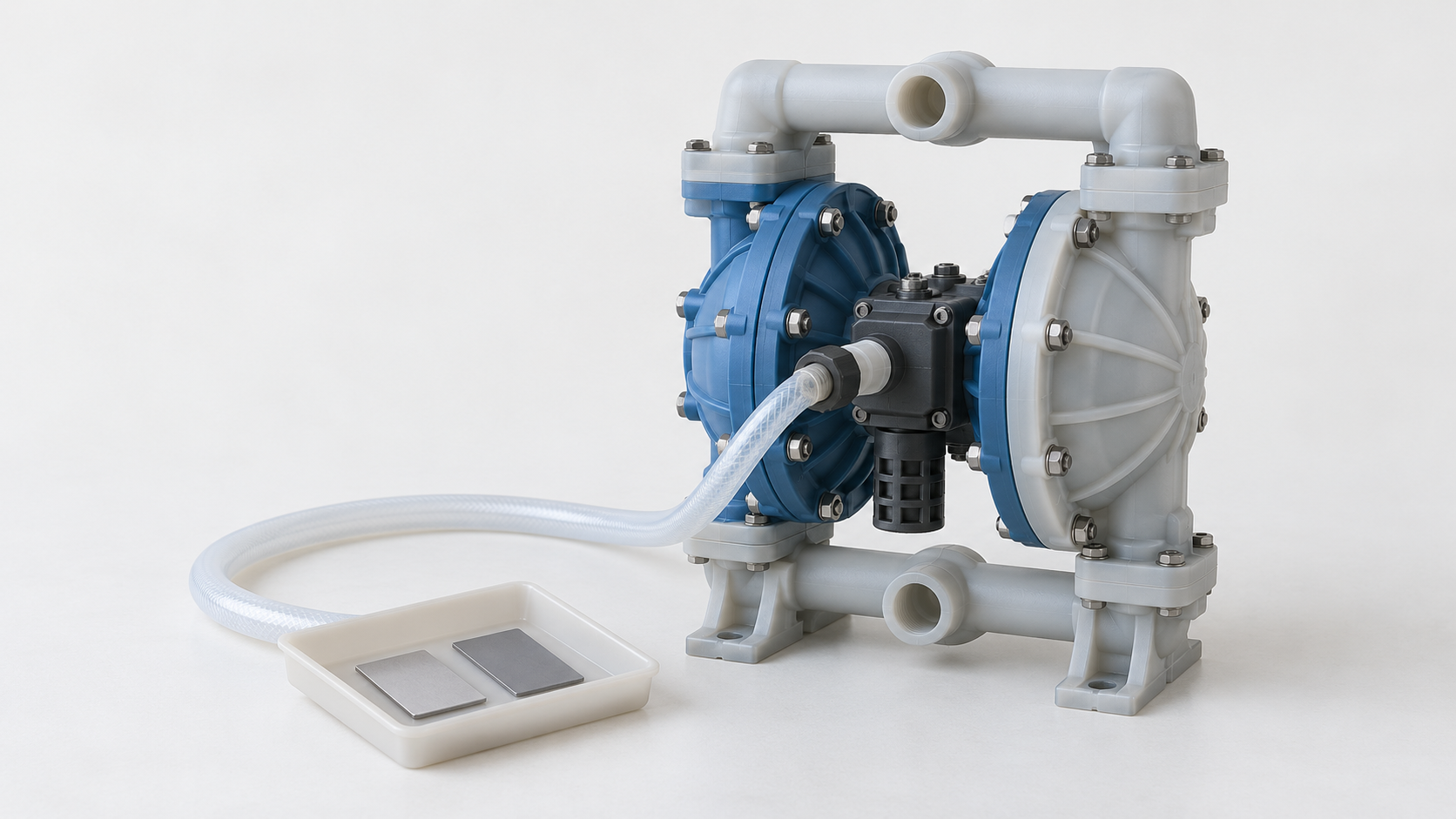
Why Surface Treatment and Chemical Production Lines Choose Pneumatic Diaphragm Pumps
On electroplating tank replenishment or chemical cleaning lines, a pneumatic diaphragm pump may continue running while its flow rate gradually decreases; the exhaust port may develop a chemical odor or even discharge liquid droplets. This situation should not be attributed simply to “insufficient pump power.” The diaphragm, O-rings, check balls, sealing and clamping surfaces, air supply filter, and blocked piping can all produce similar symptoms. The real selection challenge is how to place corrosion-resistant materials and leak protection within the same decision chain.
A pneumatic diaphragm pump uses compressed air to drive the two diaphragms in alternating reciprocating motion: one side draws in liquid while the other discharges it. It is a positive-displacement pump commonly used for chemical transfer, replenishing electroplating or anodizing baths, and circulating cleaning solutions. It can also handle certain media containing solids or having relatively high viscosity. Because the pump body does not rely on a motor directly immersed in the medium, it is suitable, when properly configured, for processes that require the drive side and wetted side to be isolated.
However, a pneumatic diaphragm pump is not an unconditionally corrosion-resistant or maintenance-free solution. Outlet pulsation may affect flow stability and downstream filtration, while compressed air increases energy consumption. The diaphragm, check balls, valve seats, and seals are also wear components that require regular inspection. During procurement, confirm the medium’s concentration, temperature, particle content, viscosity, operating mode, and cleaning conditions, then verify the complete set of wetted-end materials rather than looking only at the pump body designation or an individual PTFE or PVDF material label.
How a Pneumatic Double Diaphragm Pump Works and Which Components Actually Contact the Medium
A pneumatic double diaphragm pump is driven by compressed air and does not rely on a motor to rotate an impeller directly. The air valve alternately directs compressed air into the two pump chambers: the diaphragm on one side moves outward, creating negative pressure in the chamber and drawing in liquid; the diaphragm on the other side moves inward, pushing the liquid toward the outlet. The air valve then switches, reversing the actions on both sides so that suction and discharge alternate continuously. Each reciprocating cycle produces a discharge pulsation, so the outlet flow is not completely steady. Where necessary, system response should be evaluated together with piping supports or pulsation-damping measures.
The Wetted Components and Air Side of a Pneumatic Diaphragm Pump Must Be Considered Separately
Material selection cannot focus only on the housing. The actual checklist should include the pump body and chambers, inlet and outlet manifolds, diaphragm, check balls, valve seats, O-rings, and the sealing surfaces and fastening components at the connections. One side of the diaphragm contacts the medium, while the other withstands compressed air and reciprocating loads. The check balls and valve seats repeatedly experience impact, passage of particles, and chemical immersion. The air valve itself usually does not directly contact the pumped liquid, but humid compressed air, contaminants, or an abnormal exhaust path may still affect changeover and operating stability.
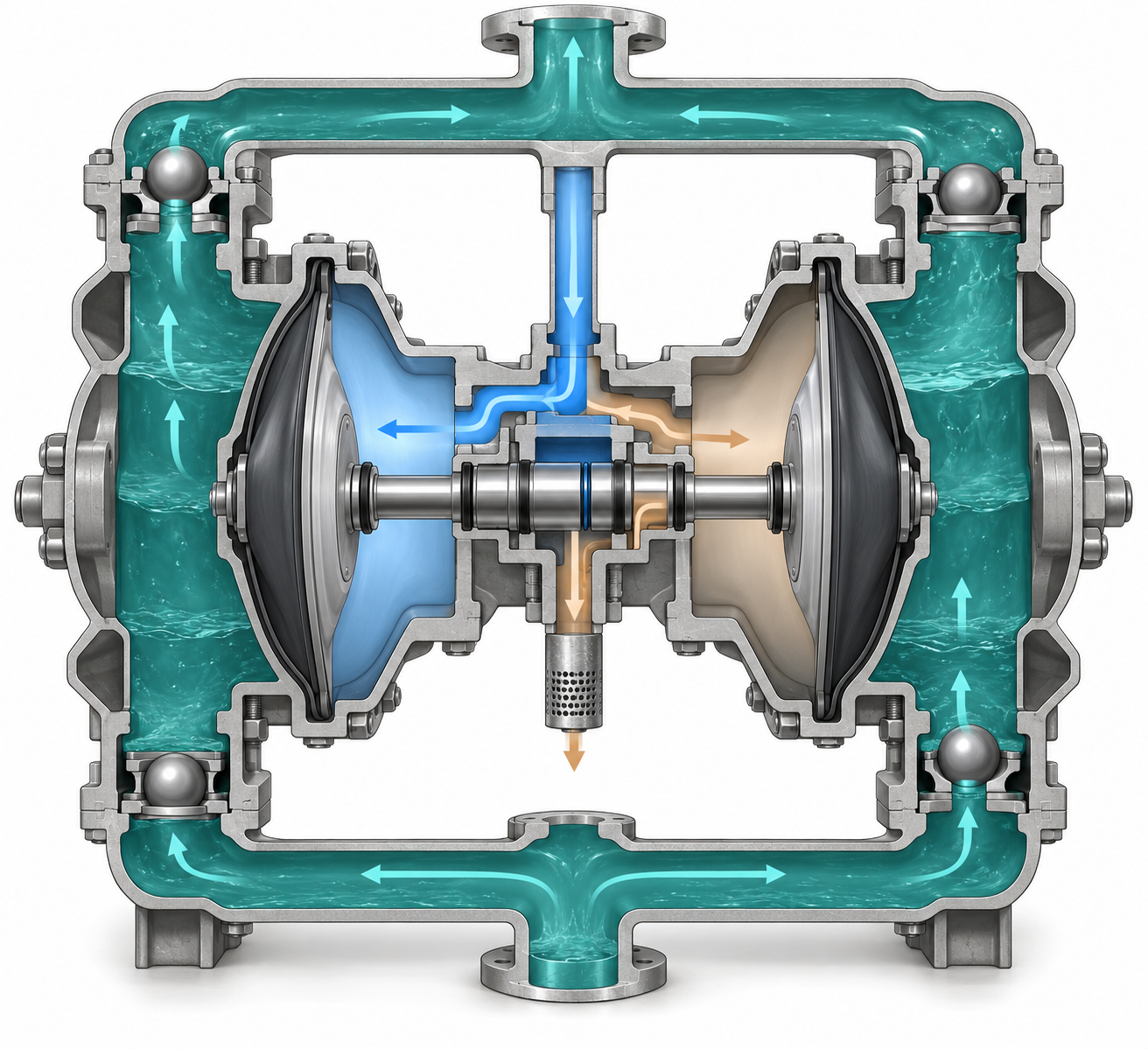
This structure also explains why “corrosion-resistant pump body” does not mean “the entire air-operated double-diaphragm pump is corrosion-resistant.” The liquid may not have entered the air side, but external leakage, liquid in the exhaust, or a process-media odor can still occur after the diaphragm, O-rings, or manifold seals fail. Subsequent selection and troubleshooting should verify each item in the order of “process-side materials—sealing connections—air and exhaust systems,” rather than merely recording the pump housing material.
How to Select Corrosion-Resistant Materials for Air-Operated Double-Diaphragm Pumps: Start by Creating a Wetted-End Materials List
A corrosion-resistant pump body does not mean that the entire air-operated double-diaphragm pump is corrosion-resistant. When handling plating solutions, acidic or alkaline cleaning solutions, or chemicals, the process medium may also contact the manifolds, diaphragm, ball valves, valve seats, O-rings, and the sealing surfaces and fasteners at the connections. Swelling, embrittlement, corrosion, or wear at any one of these points may cause reduced flow, external leakage, or liquid in the exhaust.
Wetted-End Materials of an Air-Operated Double-Diaphragm Pump Must Be Checked Item by Item
- Pump body and manifolds: Confirm the suitability of polypropylene, PE, PVDF, or metal systems for the actual process medium.
- Diaphragm, ball valves, and valve seats: Focus on chemical attack, temperature fluctuations, particle erosion, and the risk of crystallization-induced sticking.
- O-rings and sealing surfaces: Verify elastomer swelling, hardening, permeation, and sealing stability after clamping.
Before purchasing, first compile the process-medium name, concentration range, maximum and minimum temperatures, pressure, viscosity, solids content, particle characteristics, crystallization tendency, and cleaning method. PTFE, PVDF, and stainless steel are merely material options and cannot be ranked universally without considering operating conditions. Use the SDS, the supplier’s chemical compatibility chart, and data for the specific model to confirm compatibility under mixed chemicals, fluctuating concentrations, and intermittent operation.
How to Compare PE, PTFE, PVDF, and Stainless Steel: Put Material Names Back into the Operating Context
Material selection for an air-operated double-diaphragm pump cannot stop at asking which plastic or metal was used for the pump body. The concentration and temperature of acidic or alkaline cleaning solutions may change with replenishment, heating, or tank replacement; plating solutions also require attention to mixed components and additives. PE, polypropylene, PVDF, PTFE, and stainless steel may all appear in different wetted-end configurations, but the material name alone does not mean compatibility with every process medium. During purchasing, cross-check the SDS, the supplier’s chemical compatibility chart, and the data sheet for the specific model.
Compare the Complete Wetted End First Rather Than Looking Only at the Pump Body
Check the pump body and manifolds, diaphragm, ball valves, valve seats, O-rings, and all wetted fasteners and sealing components item by item. Elastomers may swell, harden, embrittle, or allow permeation; even when the pump body shows no obvious corrosion, O-ring failure can cause external leakage or liquid in the exhaust. For viscous media such as coatings and resins, also confirm whether the cleaning fluid and material-change process will alter the contact conditions of the seals.
Particles, Crystals, and Viscosity Can Change Valve Performance
Particle-laden contaminated liquid may accelerate wear of the ball valves and valve seats, while crystallization may cause the valve balls to stick or the pump chamber to become clogged; increased viscosity will change suction capability, changeover frequency, and actual flow rate. Therefore, material verification must also include solids content and particle size, viscosity range, continuous or intermittent operation, dry-run risk, maximum and minimum temperatures, and the flushing plan after shutdown. The final conclusion should be based on the complete material combination and actual operating conditions, rather than a standalone ranking of PTFE, PVDF, or stainless steel.
Why Do Air-Operated Double-Diaphragm Pump Diaphragms Fail? Trace the Cause from the Symptoms to the Operating Conditions
When an air-operated double-diaphragm pump shows reduced flow, abnormal exhaust, or irregular operating frequency, do not first increase the air pressure to “force” more flow. The diaphragm may already have been affected by chemical attack, fatigue, excessive temperature, dry running, particle impact, or crystallization blockage. If clamping is uneven during assembly or the sealing surface is scratched, the diaphragm and sealing areas may also fail prematurely.
On-Site Signs of Air-Operated Double-Diaphragm Pump Diaphragm Failure
- Liquid in the exhaust or a noticeable process-medium odor: First suspect a ruptured diaphragm, leakage from the wetted side into the air side, or contamination of the exhaust path. Do not continue operating at higher air pressure.
- A sudden drop in flow, increased pulsation, or abnormal pump speed: Check whether the diaphragm is fatigued or deformed; whether the ball valves and valve seats are worn or obstructed by crystallization; whether the suction line is blocked; and whether the air-supply filter contains accumulated liquid or has excessive pressure drop.
- External leakage, deformation at the diaphragm edge, or abnormal seal condition: Focus on chemical swelling, hardening, embrittlement, excessive temperature, dry running, scratches on the sealing surfaces, and uneven clamping force.
What to Do First After Suspecting Diaphragm Rupture
The correct sequence is to stop the pump, isolate the fluid, shut off and release the air supply pressure, confirm the extent of contamination, and then disassemble and inspect according to the site SOP. Before disassembly, also confirm whether any chemicals remain in the pump chamber, manifold, or discharge line; for hazardous fluids, use the specified ventilation, collection, and personal protective measures. If the diaphragm has failed due to fatigue alone, investigate the operating frequency, air pressure, temperature, and assembly condition. If swelling, hardening, or embrittlement is present, recheck the compatibility of the diaphragm and O-rings with the actual fluid concentration and temperature.
Pneumatic Diaphragm Pump Troubleshooting and Leak Protection: From Sealing Surfaces to the Entire Piping System
When a pneumatic diaphragm pump operates abnormally, do not increase the air supply pressure first. Troubleshoot according to “symptom—priority check—safety action,” especially when handling fluids such as electroplating solutions, cleaning solutions, and coatings that may cause corrosion or contamination.
| 现场现象 | Priority Check | What to Do First |
|---|---|---|
| Liquid or fluid odor coming from the exhaust port | Check whether the diaphragm is ruptured and whether the exhaust path is contaminated | Immediately stop the pump, isolate the fluid, release the pressure, and confirm the extent of contamination before disassembly and inspection |
| Reduced flow or unstable pressure | Air supply pressure, filter, suction line, ball valves, and valve seats | Confirm that the air supply is clean and sufficient; check for blockages, wear, and crystallization |
| Pump fails to shift | Check whether the air distribution valve is worn or sticking and whether the muffler is clogged | Shut off the air supply and release the pressure; inspect the air valve according to the maintenance manual |
| External leakage | Sealing surfaces at the diaphragm-to-pump chamber and manifold-to-pump body connections | Stop fluid transfer, provide collection and protective measures, and never retighten under pressure |
Leak protection for pneumatic diaphragm pumps relies on more than diaphragm materials
Key sealing areas include the connection between the diaphragm and the outer pump chamber, the connection between the manifold and the pump body, and sealing surfaces clamped by clamps or bolts. Before assembly, clean the mating surfaces and inspect them for scratches, crystallization, and deformation, then tighten them evenly in the specified sequence. Flexible connections compatible with the medium are recommended for the inlet and outlet. The piping must be independently supported to prevent its weight and vibration from being transferred to the pump body; where necessary, provide pulsation damping, leak collection, and alarms. Regular inspections can only reduce risk and cannot constitute a “leak-free” commitment. For hazardous media, ventilation, grounding, pressure relief, and emergency response must also be implemented in accordance with site procedures.
Pneumatic Diaphragm Pump Procurement and Acceptance Checklist: Which Parameters to Confirm with the Supplier
When purchasing a pneumatic diaphragm pump, do not provide only the “flow rate, head, and connection size.” Document the operating conditions in a complete data sheet that includes, at a minimum, the medium name, concentration range and how it varies, maximum and minimum temperatures, viscosity, solids content and particle size, suction lift, discharge pressure, target flow rate, and whether operation is continuous or intermittent. The wetted-end material combinations for electroplating solution replenishment, cleaning-solution circulation, particle-laden wastewater, and coating transfer may be completely different.
- Materials: Confirm the material of the pump body, manifold, diaphragm, ball valves, valve seats, O-rings, and wetted-side fasteners separately. Do not replace complete compatibility verification with the statement “the pump body is made of corrosion-resistant material.”
- Operation: Confirm the startup frequency, supply air pressure and air quality, whether dry running may occur, cleaning or material-change methods, and whether pulsation requires a dampener or other supporting equipment.
- Safety: Confirm the hazardous-area requirements, ventilation, grounding, pressure relief, leak collection, and alarm plans; these requirements cannot be automatically substituted by any single pump material.
- Documentation and spare parts: Request the chemical compatibility chart, performance curve, installation manual, basis for the maintenance intervals, and spare diaphragm and seal lists for the specific model.
During acceptance, first inspect the connections, base, piping supports, and flexible connections, then perform no-load and liquid-loaded operation. Observe whether the pump shifts normally, whether the flow rate and pressure meet the operating conditions, whether the connections leak, and whether droplets or a noticeable medium odor appear at the exhaust port. The shutdown test should also confirm that inlet and outlet isolation, depressurization, draining, and flushing procedures can be performed in accordance with the site SOP. If the flow rate suddenly drops, the frequency becomes abnormal, or liquid is present in the exhaust, stop the pump and isolate the medium first. Do not continue increasing the air pressure to force operation.
FAQ: Can Pneumatic Diaphragm Pumps Handle Corrosive Liquids and Particle-Laden Media?
The suitability of a pneumatic diaphragm pump cannot be determined solely from terms such as “corrosion-resistant” or “capable of conveying particles.” The medium concentration, temperature, viscosity, particles, operating method, and complete wetted-end material combination should be submitted to the pump manufacturer for verification.
Are pneumatic diaphragm pumps suitable for conveying corrosive liquids?
They can be considered as a candidate solution, but suitability cannot be determined solely by the pump body material. Confirm the compatibility of the pump body, manifold, diaphragm, ball valves, valve seats, and O-rings with the actual medium concentration, temperature, and mixture composition, and request the chemical compatibility chart for the specific model.
If the pump body material is suitable, does that mean the entire pneumatic diaphragm pump is suitable?
No. The diaphragm and seals may swell, harden, become brittle, or permeate first, while the ball valves and valve seats may also suffer particle wear or become jammed by crystallization. When purchasing, confirm the complete wetted-end material list rather than only verifying names such as PP, PVDF, PTFE, or stainless steel.
How should liquid at the exhaust port of a pneumatic diaphragm pump be handled?
Treat it first as a diaphragm rupture or an abnormality on the wetted side: stop the pump immediately, isolate the medium, shut off and remove the air supply and piping pressure, confirm the extent of contamination, and then disassemble and inspect the pump in accordance with the site SOP. Do not continue increasing the air pressure to force operation, and do not open the pump chamber before confirming the hazards of the medium.
Can pneumatic diaphragm pumps always convey particle-laden or high-viscosity media?
Not necessarily. Check the particle content, particle size, hardness, viscosity variation, suction conditions, and the ball valve and valve seat configuration. Particle-laden wastewater may cause wear or blockage, while high-viscosity coatings and resins may reduce suction capability and increase pulsation; the final determination should be based on the specific model data and trial operation.
Key takeaways
- A corrosion-resistant pump body does not mean that the entire pneumatic diaphragm pump is corrosion-resistant. The diaphragm, check balls, valve seats, and O-rings must be verified individually.
- Material compatibility depends on the medium’s concentration, temperature, particle content, viscosity, pressure, and cleaning method. It cannot be determined simply by looking at material names such as PTFE, PVDF, or stainless steel.
- If liquid appears at the exhaust port, the medium’s odor is detected, the flow rate suddenly drops, or changeover becomes abnormal, stop the pump, isolate the medium, and release the pressure as a priority rather than continuing to increase the air pressure.
- Leak protection also includes sealing surfaces, clamping force, manifold connections, flexible piping, pipe supports, pulsation control, and routine inspections.
- During procurement, require the pump manufacturer to provide a chemical compatibility chart for the specific model, an installation manual, a spare parts list, and cleaning and leak-response requirements.